Executive Overview
In 1780, while stationed as an American diplomat in turbulent Paris, John Adams penned a letter to his wife, Abigail, that would map out an ambitious generational trajectory for the new republic:
"I must study Politicks and War that my sons may have liberty to study Mathematics and Philosophy."
Adams envisioned a cascading liberation of human potential. He imagined his sons would master commerce and agriculture so that their own children—future generations—could finally dedicate their lives to painting, poetry, music, and the liberal arts. To Adams, the ultimate objective of a hard-won republic was not merely economic output or industrial supremacy, but the cultivation of a free people capable of beauty, critical thought, and deep civic participation.
Today, this foundational premise feels almost quaint. Yet, Adams captured an essential truth that modern utilitarianism routinely overlooks: education can and must serve purposes far beyond earning a living. As a society achieves material prosperity, it ought to devote its surplus resources not solely to producing efficient units of labor, but to forming complete citizens. These are individuals who inherit a civilization, develop their aesthetic and spiritual sensibilities, and participate meaningfully in democratic public life.
Tragically, this ideal is now under unprecedented strain. While immediate economic pressures continue to hollow out the financial value of the college degree, a much deeper and more insidious crisis is unfolding: the rapid erosion of the civic function of higher education. As universities pivot desperately toward pure workforce alignment to survive, we are witnessing the systematic dismantling of the humanities. Driven by a convergence of plummeting enrollments, exploding student debt, political polarization, and the looming shadow of artificial intelligence, modern higher education is trading its soul for short-term economic survival.
If this trend continues unchecked, the deep, cultivating work of the university—the slow formation of historical memory, ethical judgment, and civic capacity—will soon become a luxury good reserved exclusively for the children of the ultra-wealthy.
Detailed Chronology: From Civic Ideal to Corporate Utility
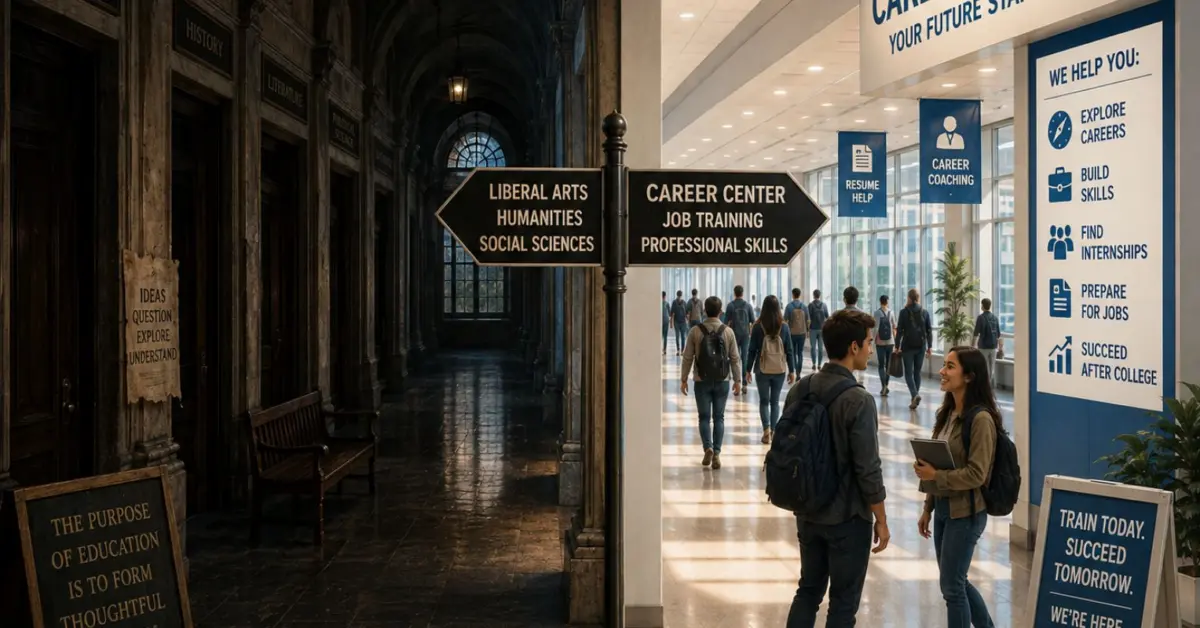
To understand how higher education reached this existential crossroads, we must examine the historical divergence between the two core purposes of the American college: its signaling function and its civic function.
The Dual Mandate of the University
Historically, a college education has served a dual role. The signaling function acts as an economic credential, verifying to prospective employers that a student possesses baseline competence, specialized knowledge, and the grit required to complete complex tasks. Conversely, the civic function transmits a society’s cultural and intellectual inheritance. It cultivates independent thought, ethical reasoning, and the capacity to engage constructively in democratic self-governance.
For generations, intellectual giants from John Dewey and W.E.B. Du Bois to Robert Maynard Hutchins championed this civic function. They argued that a democratic society cannot endure without institutions dedicated to shaping the whole person.
The Pragmatic Shift
Yet, as the cost of attendance skyrocketed over the past four decades, public perception shifted. The civic function was increasingly dismissed as hopelessly impractical. Students considering "imprudent" majors in sociology, history, music, literature, or philosophy are routinely met with the skeptical query: "What are you going to do with that?"
While John Adams hoped that future generations would naturally gravitate toward the liberal arts, contemporary economic reality has forced the exact opposite. Humanities and liberal-arts majors have experienced a steep, uninterrupted decline for well over a decade. Terrified parents and debt-burdened students now view higher education almost exclusively through the lens of return on investment (ROI).
This raises an uncomfortable and urgent question: Should the transmission of our collective cultural inheritance be tightly tethered to the capricious demands of the labor market? And more ominously, what happens when the labor market itself suddenly requires far fewer human workers?
Supporting Context & Metrics: The Perfect Storm Facing Higher Education
The fear that the labor market may soon need fewer workers is no longer the stuff of science fiction. It is an imminent economic reality driven by technological acceleration and demographic decline.
The Artificial Intelligence Disruption
In a recent essay, technology pioneer Bill Gates warned that artificial intelligence is poised to transform the global labor market faster than any previous technological revolution in human history. Within a decade, advanced automation threatens to disrupt white-collar and professional sectors once thought immune—including law, medicine, customer service, software engineering, and advanced manufacturing. In interviews with major publications, industry insiders have conceded that technology leaders are privately far more alarmed about AI’s employment displacement effects than they dare admit in public statements.
Enrollment Cliffs and Institutional Closures
This technological shockwave is colliding with a brutal demographic and financial reality. In late August 2026, former Democratic presidential candidate and entrepreneur Andrew Yang highlighted the stark vulnerability of smaller academic institutions, writing on social media:
"Heard about a small college in the Midwest that has lost 50% of its enrollment in the last 10 years. Hundreds of colleges are going to close in the next decade, and it’s going to be devastating for many communities."
Yang’s warning is underscored by hard data. Colleges today face a historic convergence of systemic threats:
- The Enrollment Cliff: A shrinking pool of college-age individuals due to declining birth rates following the 2008 financial crisis.
- The Debt Crisis: Crushing levels of student loan debt that make high-cost, low-yield degrees financially untenable.
- Academic and Mental Health Deficits: Declining baseline academic preparation among incoming students paired with an unprecedented youth mental health crisis.
- Eroding Public Trust: Plummeting confidence in higher education driven by hyper-polarized political climates that frequently target universities as ideological battlegrounds.
When these pressures are compounded, the long-term prognosis is grim. If advanced AI and automation steadily shrink the economy’s human labor requirements, the university risks transforming from an engine of social mobility into an exclusive playground for the wealthy—where the humanities are treated as elitist luxuries.
Official Statements and Policy Shifts
Faced with these intractable financial pressures, institutional leaders and policymakers have largely abandoned resistance, leaning aggressively into absolute workforce alignment.
Federal Policy: The "Do No Harm" Standard
The federal government has accelerated this shift. Under regulatory frameworks like the Trump administration’s proposed "Do No Harm" earnings standard, undergraduate programs must mathematically demonstrate that their graduates out-earn the typical high school graduate. Programs that fail this metric face immediate termination of their eligibility for federal student loan subsidies.
Defending this approach, U.S. Department of Education officials, including Under Secretary Nicholas Kent, have articulated a blunt utilitarian logic: taxpayers should not be forced to subsidize academic programs that fail to leave graduates financially better off.
The Institutional Retreat
This philosophy was on full display at a recent higher-education panel composed of university presidents, researchers, and financial solvency experts. The consensus among these leaders was stark: patchwork reforms are no longer sufficient. Major structural surgery is imperative.
Panelists emphasized that modern colleges must "demonstrate their value in real time" through aggressive workforce alignment and vocational partnerships. They spoke candidly of a "vanishing line between higher education and the workplace," prioritizing fast-track flexibility and micro-certificates over the "too slow" pace of traditional multi-year degree programs. Institutional survival now requires the systematic elimination of "underperforming" (low-enrolled) humanities programs and an open-door policy inviting corporate employers to dictate curriculum content.
While these administrators deserve empathy rather than condemnation—they are desperately trying to keep their institutions afloat amid a hurricane of economic headwinds—their concessions carry profound, irreversible consequences. If these pronouncements become unalterable policy, the civic soul of the university will be quietly extinguished.
Future Outlook: Reclaiming the Civic Purpose of Education
Market incentives and federal efficiency metrics alone cannot sustain a healthy democracy. A society ultimately gets the university it is willing to fund and fight for.
If we tether higher education entirely to the shrinking, utilitarian demands of the corporate labor market, we risk actively severing generations of students from the intellectual, humanistic, and spiritual foundations conveyed by the liberal arts. This outcome bodes ill for democratic self-governance. A complex, interconnected society navigating existential challenges—such as accelerating technological displacement, ecological strains, eroding social trust, and staggering public debt—requires citizens trained in critical thought, historical memory, and moral imagination.
Over a century ago, pragmatist philosopher John Dewey recognized the transformative power of genuine education, writing that it:
"…is continually shaping the individual’s powers, saturating his consciousness, forming his habits, training his ideas, and arousing his feelings and emotions."
Protecting that formative work—before the final humanities department locks its doors and sells off its library—is the most urgent cultural task facing contemporary society.
Market forces cannot rescue the liberal arts; only a deliberate, courageous public commitment can. Academic reformers and policy advocates have increasingly called for a renewed national investment in the public financing of higher education. Such a model would insulate colleges from the tyranny of short-term employability metrics, enabling institutions to sustain the humanities and civic education as public goods.
Admittedly, proposing massive public investment in the liberal arts sounds quixotic in the current political climate. Yet, expecting a democratic society entirely stripped of civic education, historical depth, and critical philosophy to successfully navigate the severe economic and social shocks ahead is far more delusional.