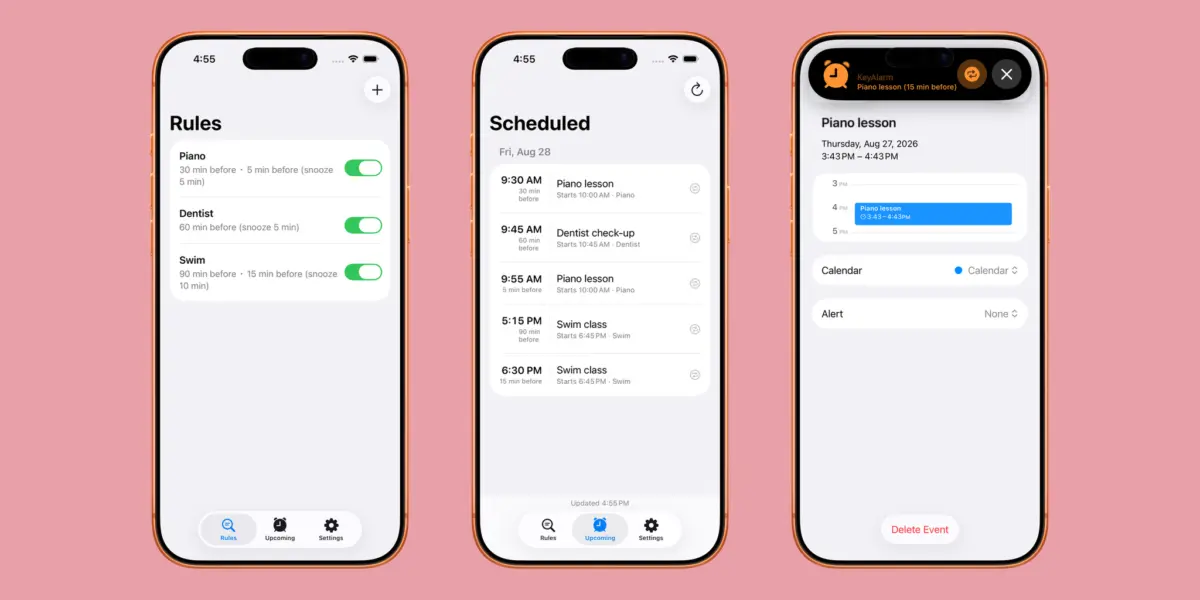
Executive Overview
In an era defined by hyper-connectivity, digital noise, and an endless stream of notifications, missing a critical appointment has paradoxically become easier than ever. Standard calendar applications rely heavily on push notifications and passive banner alerts. If your iPhone is silenced by "Do Not Disturb" or "Focus" modes, buried at the bottom of a bag, or simply overlooked while you are deep in concentration, those pivotal life events—from vital medical appointments to high-stakes client meetings—slip by unnoticed.
Enter KeyAlarm, a brilliant new entry in the independent software development scene, featured as part of 9to5Mac’s ongoing Indie App Spotlight series. Designed specifically for users running iOS 26 and later, KeyAlarm bridges the historical chasm between passive calendar entries and active, hard-to-ignore alarm sounds. By intelligently parsing keywords and syncing directly with your Apple ecosystem, KeyAlarm ensures that high-priority events demand your attention with the unmistakable urgency of an alarm clock.
This deep-dive investigation explores the architecture, functionality, real-world utility, and underlying technology of KeyAlarm. We will examine how this minimalist $0.99 utility leverages Apple’s latest developer frameworks to solve a universal human frustration, reshaping how modern professionals, busy parents, and meticulous planners interact with time.
Detailed Chronology: The Evolution of iOS Time Management and the Birth of KeyAlarm
To understand the genius behind KeyAlarm, one must look at the historical trajectory of notification handling within Apple’s mobile operating system.
The Limitations of Traditional Calendars
Since the inception of the iPhone, the native Apple Calendar app (alongside third-party alternatives like Google Calendar and Outlook) has relied on the standard notification center. While sufficient for casual reminders—such as grabbing groceries or calling a friend—these alerts share a fatal flaw: they are easily dismissed, muted, or ignored.
As Apple introduced more robust filtering tools, such as customizable Focus modes, the probability of missing a time-sensitive alert skyrocketed. Users routinely configure their phones to silence notifications during work hours or sleep cycles. Unfortunately, a sudden shift in schedule can easily bypass these filters if an app cannot differentiate between a low-priority social invitation and a critical early-morning commitment.
The Development of KeyAlarm
Recognizing this persistent gap in productivity tooling, independent developers set out to engineer a streamlined solution that would automate the transition from notification to alarm. The result is KeyAlarm, a purpose-built utility designed to monitor user calendars in real time, filtering designated keywords and converting matched events into fully functional, high-priority system alarms.
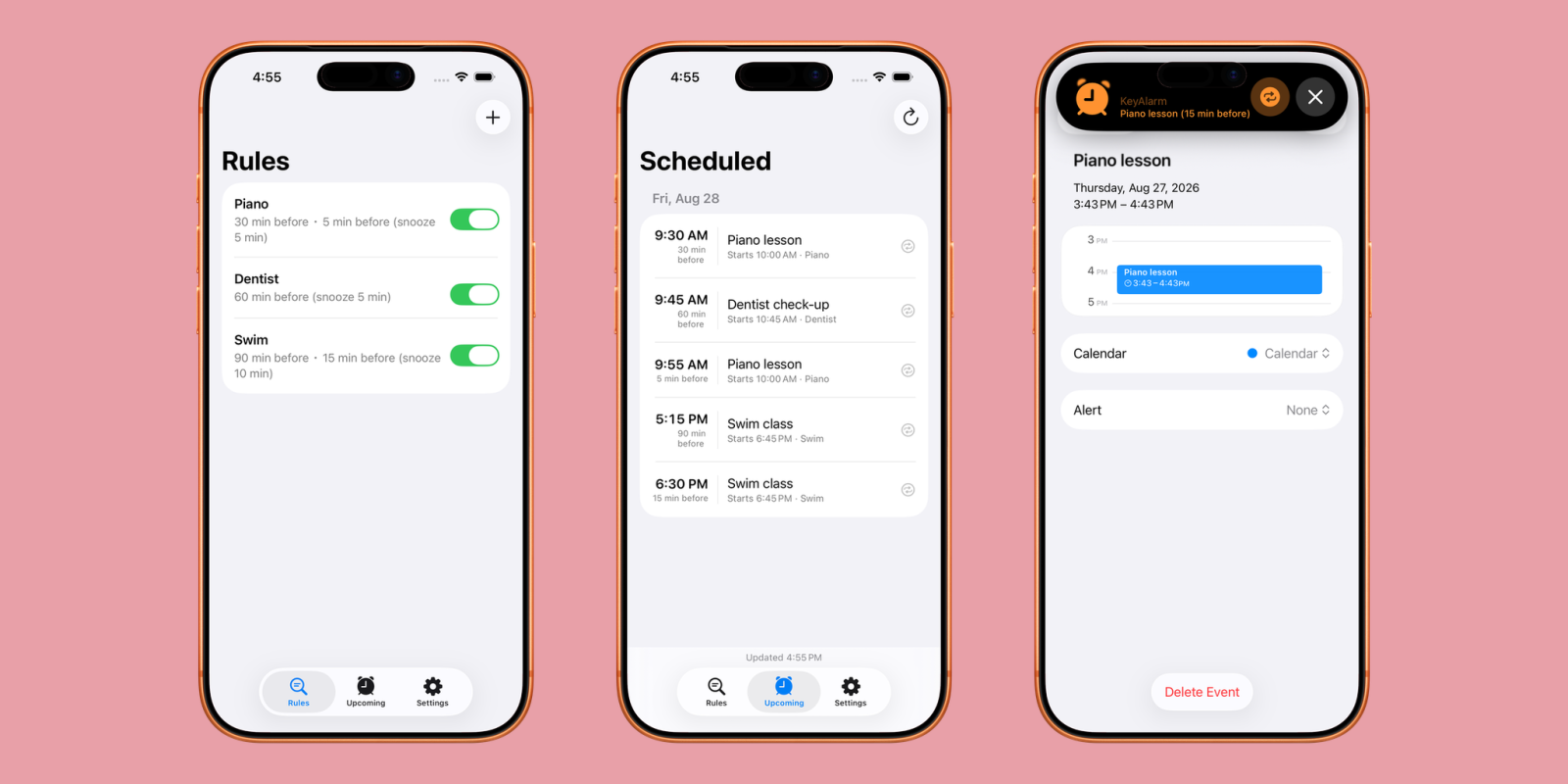
Leveraging Apple’s newly introduced AlarmKit framework in iOS 26, the developer behind KeyAlarm was able to construct a seamless bridge between the Calendar database and the native Clock/Alarm architecture. Rather than requiring users to manually configure redundant alarms for recurring professional or personal engagements, KeyAlarm automates the entire pipeline. The app enters the market as a frictionless utility, offering a 30-day fully functional trial period followed by an accessible $0.99 lifetime unlock on the App Store.
Supporting Context & Metrics: Why Automation Trumps Manual Scheduling
In the realm of personal productivity, friction is the ultimate enemy of efficiency. When analyzing user behavior regarding time management, data consistently shows that manual steps lead to high rates of user abandonment.
The Cost of Missed Commitments
Missing a meeting, an interview, or a medical appointment incurs tangible costs:
- Professional Fallout: Missed client check-ins can damage corporate relationships and erode professional credibility.
- Financial Penalties: Late cancellations or missed medical/dental appointments frequently result in direct financial fees.
- Cognitive Load: Constantly double-checking calendar entries and manually cross-referencing them with the iOS Clock app drains mental energy—a phenomenon known in behavioral psychology as decision fatigue.
How KeyAlarm Eliminates Friction
KeyAlarm targets these pain points through three core pillars of automation:
- Keyword-Based Triggering: Users establish global or localized triggers. For instance, inputting the keyword
"Dentist"ensures that every future calendar entry containing that string automatically spawns a dedicated alarm. - Customizable Lead Times: Commute times vary. KeyAlarm allows users to configure precisely how far in advance an alarm should sound—whether that is a 60-minute heads-up for a cross-town drive or a 15-minute warning for a Zoom call.
- Multi-Alarm Stacking: Complex schedules require layered warnings. KeyAlarm supports multiple alarms for a single event. A user can set a preliminary alarm one hour prior for preparation, followed by a secondary alarm 15 minutes prior for immediate departure.
Furthermore, the app respects the organizational structure of modern digital lives. Users can isolate triggers by specific calendars (e.g., separating "Family," "Personal," and "Work" calendars), ensuring that keyword rules apply only where intended.
Official Statements and Technical Architecture
The technical underpinnings of KeyAlarm represent a masterclass in modern iOS development, heavily reliant on Apple’s ongoing expansion of system-level APIs.
Leveraging the Power of AlarmKit in iOS 26
Historically, third-party applications faced significant sandboxing hurdles when attempting to interface directly with iOS system alarms. Developers were often forced to rely on local notifications carrying critical sound profiles, which still remained vulnerable to strict Focus mode overrides and user error.

With the release of iOS 26, Apple introduced AlarmKit, a transformative framework designed to grant authorized applications deeper, more reliable access to the device’s core alarm subsystem. KeyAlarm represents one of the first indie utilities to fully capitalize on this capability.
According to technical briefs surrounding the app’s release:
"Keyword triggering and automated alarm generation are made possible entirely through the newly minted AlarmKit framework in iOS 26. This allows KeyAlarm to operate efficiently in the background, reading encrypted calendar event parameters and securely posting system-level alarms without draining device battery life or violating user privacy constraints."
Developer Insights and the Indie App Ecosystem
The indie app community continues to serve as an incubator for creative problem-solving on Apple platforms. While major tech conglomerates often focus on broad, sweeping platform features, independent developers excel at crafting hyper-focused solutions for specific user friction points.
In discussions surrounding the launch of KeyAlarm via the 9to5Mac Indie App Spotlight, industry analysts have praised the app’s pricing model and architectural simplicity. Eschewing invasive subscription models, the developer opted for a transparent 30-day trial mode culminating in a nominal $0.99 one-time purchase. This consumer-friendly approach reflects a growing trend among boutique developers seeking to build sustainable, trust-based relationships with their user base.
Future Outlook: The Next Generation of Context-Aware Productivity
As we look toward the horizon of mobile operating systems and personal computing, tools like KeyAlarm offer a glimpse into the future of contextual automation.
The Convergence of Calendar, Alarms, and AI
The natural evolution for applications like KeyAlarm lies in predictive intelligence and machine learning integration. Future iterations of calendar-to-alarm utilities could theoretically analyze traffic patterns via Apple Maps or Google Maps in real time, dynamically adjusting alarm lead times based on live congestion data, weather conditions, and transit delays.

Imagine a scenario where KeyAlarm does not merely fire an alarm 45 minutes before an event, but actively calculates that a sudden highway accident requires you to leave 15 minutes earlier, automatically shifting the alarm forward without manual user intervention.
Platform Expansion and Ecosystem Integration
As Apple continues to harmonize its software suite across iPhone, iPad, Apple Watch, and Mac (via Catalyst and unified frameworks), users increasingly expect seamless cross-device synchronization. While KeyAlarm currently focuses heavily on the core iPhone experience running iOS 26, the underlying AlarmKit architecture paves the way for deeper Apple Watch integration. Having a critical calendar alarm vibrate directly on your wrist via a tactical haptic pattern—synced automatically from a calendar keyword—represents the ultimate evolution of interruption management.
Final Thoughts
In a digital landscape overflowing with bloated software suites and aggressive subscription fees, KeyAlarm stands out as a refreshing exercise in disciplined, utilitarian design. It solves one specific problem—preventing you from missing crucial calendar events—with absolute precision, leveraging cutting-edge iOS 26 frameworks without compromising user privacy or battery life.
For anyone who has ever missed an important meeting because a push notification vanished into the ether of a silenced phone, KeyAlarm is an essential, frictionless addition to the iOS home screen. Available now on the App Store with a 30-day trial and a modest $0.99 lifetime unlock, it is a shining example of the ingenuity driving the modern indie app ecosystem.