
Executive Overview
For years, the conventional wisdom surrounding Instagram growth has been absolute and unforgiving: Dance, point, talk, or get left behind. The meteoric rise of Reels convinced millions of creators, solopreneurs, and enterprise brands that video was the singular gateway to algorithmic salvation. Yet, beneath the hyper-saturated surface of lip-syncs, talking heads, and viral trends, a quiet counter-revolution is taking place.
Content creators are discovering that the relentless pressure to perform on camera leads to creative burnout, erratic posting schedules, and shallow engagement. Enter the Instagram carousel—a format historically relegated to photo dumps and text-heavy infographics, now re-engineered into a high-converting, authority-building powerhouse.
According to marketing strategist and agency founder Katelyn Rhoades, who built a six-figure revenue stream and a following exceeding 217,000 predominantly through educational carousels, video is entirely optional. By leveraging the psychological mechanics of user dwell time, swiping behavior, and strategic storytelling, brands can achieve sustainable growth, high-ticket lead generation, and loyal digital communities without ever hitting the record button. This investigative report breaks down the blueprint for mastering Instagram carousels, offering an authoritative, step-by-step methodology for modern digital marketers.
Detailed Chronology: The Anatomy of a High-Performing Carousel
Building a carousel that converts casual scrollers into paying clients requires a disciplined, chronological framework. Successful creators do not stumble into viral reach; they engineer it through a meticulous four-step process that prioritizes narrative structure, psychological hooks, and friction-free calls to action.

Step 1: Plan the Story Before Designing Anything
The most pervasive trap in social media design is opening a canvas tool like Canva or Adobe Express and attempting to force a coherent message out of decorative graphics. Rhoades emphasizes that the design must always serve the narrative, never the other way around.
The planning phase begins not with a broad target demographic, but with a singular person: the dream client. Creators must isolate one specific pain point, one burning question, and one definitive transformation. When content addresses an individual’s precise struggle with pinpoint accuracy, a mass audience feels individually seen.
The narrative arc follows a classic storytelling progression:
- The Hook (Slide 1): Delivers an undeniable disruption to the user’s feed.
- The Value (Slides 2–7): Delivers actionable, insightful steps that build immediate trust and authority. Crucially, this value must be useful yet incomplete—giving the reader a tangible win while leaving them hungry for the deeper implementation strategy only the creator can provide.
- The Resolution (Final Slide): Guides the reader toward a definitive next step.
While Instagram allows up to 20 slides per carousel, data consistently favors brevity and impact. The optimal length sits between 8 and 10 slides. Every single slide must earn the reader’s swipe; if a graphic does not aggressively advance the story or reinforce the core premise, it must be excised. For writers who struggle with structural flow, artificial intelligence tools like ChatGPT can serve as storyboard assistants. By feeding bullet-pointed core concepts into an AI prompt, creators can rapidly generate high-conversion narrative frameworks.
Step 2: Crafting the Text Hook
If the narrative is the engine of a carousel, the text hook on the first slide is the ignition. Without a scroll-stopping hook, even the most profound insights will remain entirely unseen.
Psychological research into content consumption reveals a fascinating consumer bias: negative hooks consistently outperform positive ones. Phrases centered around common mistakes, hidden myths, or self-sabotaging behaviors trigger immediate curiosity gaps. A generic hook like “How to Grow on Instagram Today” invites a frictionless scroll-past. Conversely, a friction-heavy hook such as “You are quietly killing your Instagram reach if you don’t fix this one mistake” forces the brain to pause and ask, “Am I making that mistake?”
Readability and design contrast are equally vital. High-contrast typography—such as clean black-and-white text or attention-grabbing yellow text that disrupts the platform’s default visual patterns—ensures eye fatigue doesn’t override interest. Furthermore, the first slide must never resolve its own premise. If the hook answers the question it poses, the user has no incentive to swipe.
Step 3: Architecting the Call to Action (CTA)
A staggering number of creators execute flawless hooks and engaging value sequences, only to leave their final slide entirely blank or passive. The final slide represents the monetization window of the content ecosystem. Different CTAs serve fundamentally different business objectives:
- General Comments for Algorithmic Distribution: Prompting users to answer a simple question or drop a specific emoji signals active engagement to Instagram’s distribution systems. Increased comment volume broadens overall organic reach.
- Shares for Viral Velocity: In the current algorithmic landscape, shares have eclipsed saves as the gold standard of engagement. Directing users to “Share this with someone who needs to hear it” leverages peer-to-peer distribution networks.
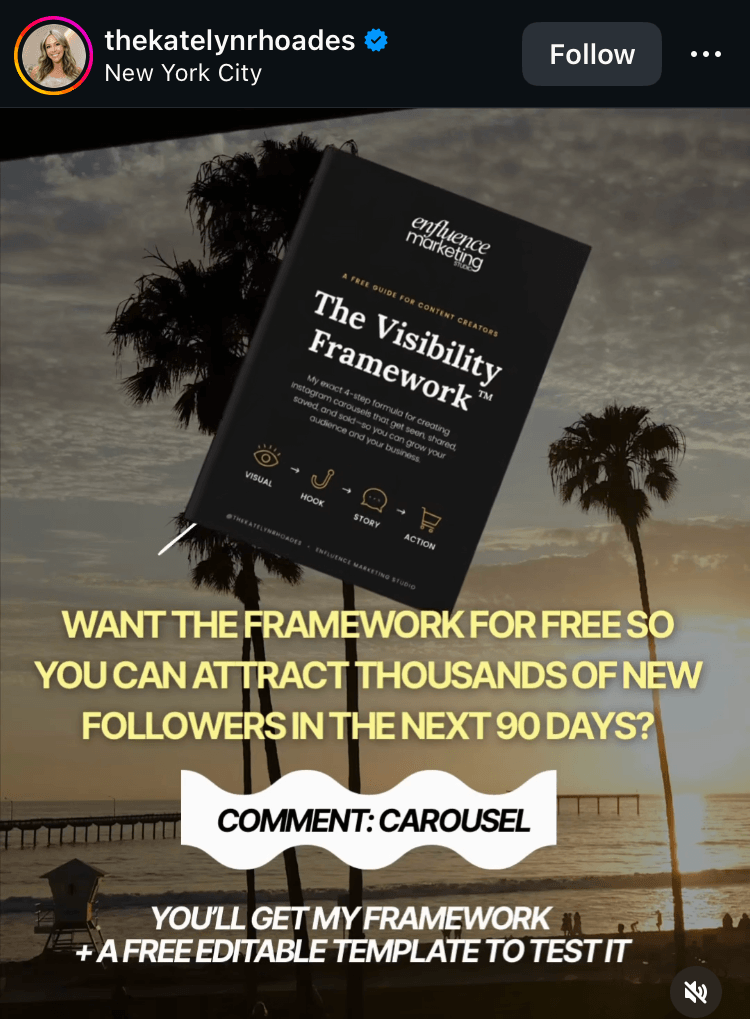
- Sales CTAs and Automated Direct Messaging: This is where carousels transform from vanity metrics into revenue-generating assets. By instructing users to comment with a specific keyword (e.g., “STARTER”), creators can deploy DM automation tools like ManyChat or Stan Store. The software instantly delivers the requested resource, lead magnet, or sales page directly to the user’s inbox. For smaller creators without automation tools, manual DM delivery yields identical algorithmic benefits with a personal touch.
Step 4: Design, Imagery, and Animation
The final phase brings the structural plan to life through visual aesthetics. Instagram provides two core carousel dimensions: square and vertical rectangle. The rectangle format commands significantly more vertical real estate in the mobile feed, naturally suppressing competing content and forcing attention downward.
When selecting imagery, authenticity consistently outperforms sterile, high-budget corporate polish. Camera-roll assets—including casual mirror selfies, candid snapshots at restaurants, behind-the-scenes glimpses, and raw daily-life documentation—perform exponentially better than stock photography. The primary rule: anchor the first slide with a human face to establish instant neurological connection.
For creators avoiding personal imagery, template platforms like Canva and Adobe Express offer structural jumping-off points, though custom imagery remains superior. To streamline production, modern creators maintain a categorized digital asset library, utilizing native search capabilities on devices to pull up relevant contextual backgrounds in seconds.
Supporting Context & Metrics: The Algorithmic Advantage of Carousels
To fully understand why carousels have become the weapon of choice for non-video creators, one must analyze how Instagram’s recommendation engine evaluates user behavior.

Unlike Reels, which encourage passive consumption—where users watch a loop and flick their thumbs upward to the next piece of media—carousels demand active, cognitively engaged participation. The algorithm tracks a complex matrix of micro-interactions:
- Dwell Time: The total duration a user lingers on a specific slide.
- Swipe Depth: How many slides a user traverses before abandoning the post.
- Back-Tracking: Whether a user swipes backward to re-read earlier slides, indicating high information density and value.
- Actionable Clicks: Saves, shares, and comment inputs.
Because carousels naturally require time to digest, they register exceptionally high dwell times. Instagram’s algorithm rewards this sustained attention by pushing the content deeper into explore pages and hashtag feeds.
Beyond algorithmic favorability, carousels solve a profound industry-wide problem: creator burnout. By shifting the primary medium from video production to copywriting and graphic layout, introverted creators, writers, and visual thinkers can maintain unwavering publishing consistency. This operational efficiency allows brands to compound their authority without the daily friction of lighting setups, wardrobe changes, and on-camera anxiety.
Future Outlook: The Next Wave of Non-Video Content Strategy
As social media platforms mature, audience fatigue regarding hyper-curated video content is reaching an inflection point. Users increasingly crave substance, speed of information, and actionable takeaways over cinematic fluff.
The future of organic growth on Instagram belongs to hybrid content strategists who master both narrative depth and automated conversion funnels. With native text-overlay features rolling out directly inside photo-sharing interfaces, the barrier to entry for creating high-performing carousels is lower than ever.
As artificial intelligence tools continue to refine ideation, hook generation, and motion graphics—such as Gemini’s ability to animate static frames or Photoshop’s generative canvas extensions—the speed at which a single creator can deploy a multi-slide educational asset will accelerate dramatically. For businesses and personal brands willing to abandon the camera and embrace the quiet, calculated power of the carousel, the path to sustainable digital authority is wide open.