Executive Overview
The venture capital landscape has undergone a seismic structural realignment. For over a decade, the defining aspiration for technology startups and their early financial backers was reaching "unicorn" status—a $1 billion valuation that historically marked an elite tier of market disruption. Today, that milestone looks quaint. Driven by explosive advancements in vertical AI, historic capital influxes, and a fundamental shift in where and when companies choose to list or remain private, the baseline target for mega-funds has shifted dramatically. In 2026, $25 billion is the new $1 billion.
This paradigm shift is not merely a psychological adjustment among venture partners; it is a mathematical imperative dictated by the ballooning size of modern venture funds. When a top-tier firm closes a multi-billion-dollar pool—such as Menlo Ventures securing a record-breaking $3 billion fund—its underlying return math breaks down entirely if it continues to chase billion-dollar outcomes. To return capital to institutional Limited Partners (LPs) at scale, modern venture capital requires massive, right-tail outcomes.
Consequently, venture capital firms are no longer hunting for unicorns; they are hunting for decacorns and $25B+ giants. Recent watershed moments underscore this reality: SpaceX’s record-shattering $60 billion acquisition of AI coding pioneer Cursor in August 2026, followed closely by Cognition’s monumental Series E valuing the company at $48 billion just weeks later. These events signal that the ceiling has become the floor. For startup founders, understanding this new math is essential to survival—dictating everything from how a Series A pitch deck is structured to whether a company should be raising venture capital at all.
Detailed Chronology: The Summer of Hyper-Scale AI
The velocity at which modern startups are achieving astronomical valuations has compressed timelines to a degree previously thought impossible. The summer of 2026 will be remembered in financial history as the inflection point where AI native applications broke historical valuation molds.
August 14, 2026: The SpaceX-Cursor Mega-Acquisition
On August 14, 2026, aerospace giant SpaceX closed its acquisition of Anysphere, the developer behind the breakout AI coding assistant Cursor. Structured as an all-stock transaction valued at an unprecedented $60 billion, the deal involved the issuance of approximately 391 million Class A shares, as confirmed by regulatory 8-K filings.
The trajectory of Cursor defies traditional corporate finance models. Valued at a modest $2.5 billion at the start of 2025, the company crossed $29.3 billion during its Series D round in November of that same year. By the time of its acquisition, Cursor was generating roughly $4 billion in annualized revenue, having scaled from inception to a $60 billion exit in just four years. While critics note that the transaction required a newly minted public currency (SpaceX stock) to achieve liquidity, the sheer magnitude of the exit cements it as the largest venture-backed startup acquisition in history.
September 8, 2026: Cognition’s Meteoric Series E
Hardly had the ink dried on the Cursor headlines when another tectonic shift occurred in the AI coding space. On September 8, 2026, Cognition announced a Series E funding round exceeding $2 billion, pushing its post-money valuation to an astonishing $48 billion.
The round was spearheaded by an elite syndicate including Andreessen Horowitz (a16z), Accel, Founders Fund, General Catalyst, and Avenir. The speed of Cognition’s appreciation is dizzying: as recently as May 2026, the company raised capital at a $26 billion valuation on an annualized run rate of $492 million. By September, that run rate was rapidly approaching $900 million. In a matter of just over three months, Cognition’s valuation nearly doubled, perfectly illustrating the relentless velocity of the current tech cycle.
Supporting Context & Metrics: The Anatomy of the Decacorn Boom
To comprehend why $25 billion has become the benchmark for modern venture investments, one must examine the broader macro data compiled by research firms like PitchBook and analytical frameworks shared by venture leaders.
The Proliferation of Decacorns
Ten years ago, a $10 billion private valuation was a monumental anomaly. Today, it has evolved into a predictable cohort. According to PitchBook’s mid-year data, there are now over 60 active US decacorns, a staggering leap from 53 the previous year and just 26 in 2021. In the first half of 2026 alone, 19 new companies crossed the $10 billion threshold, eclipsing the total number of new decacorns minted across all of 2025.
Furthermore, mega-deals of $100 million or more accounted for an astounding 87.5% of the $412.7 billion invested in US startups during the first half of 2026. Capital that historically arrived at the Initial Public Offering (IPO) stage is now being deployed aggressively at the Series D, E, and F stages. Consequently, the massive returns that public market investors used to capture must now be engineered while companies remain entirely private.
The Arithmetic of a $3B Fund
To understand the investor’s perspective, consider the basic unvarnished math of a large modern venture fund. When a firm announces a $3 billion vehicle—mirroring capital injections seen across top-tier Silicon Valley shops—it typically targets a standard 3x net return to satisfy institutional LPs. This means generating roughly $9 billion to $10 billion in gross liquidity.
In an ideal theoretical model, an early investor might hold 15% to 20% of a company at exit. However, real-world dilution paints a different picture. Carta’s 2026 data shows that the median founding team’s equity is diluted from 56% at seed to roughly 36% after Series A, dropping further to 16.1% by Series C. Venture investors ride this exact same dilution slide unless they consistently execute pro-rata rights in every subsequent round. Given the massive capital requirements of AI startups, most early-stage funds cannot afford full pro-rata participation.
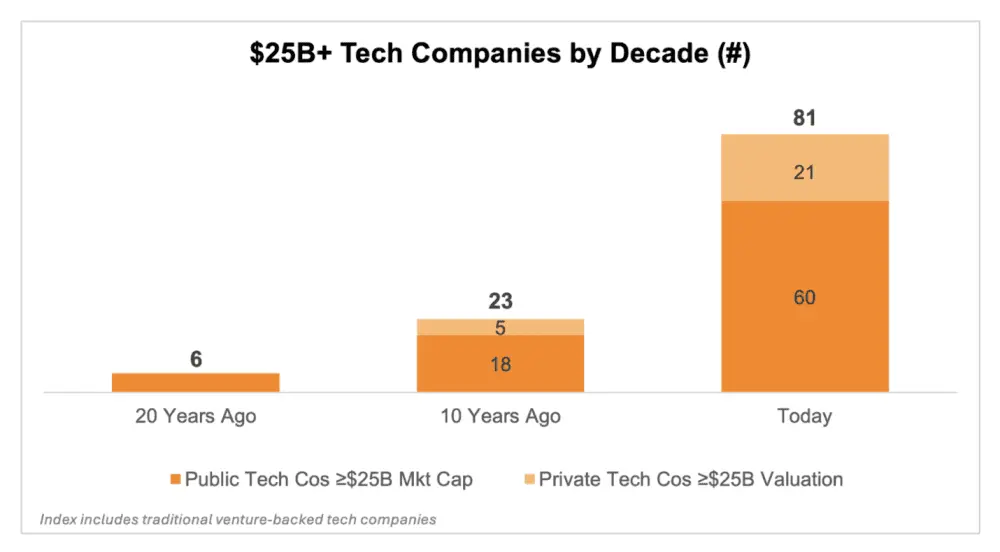
At a realistic 8% to 10% ownership stake at exit, a $3 billion fund requires four separate $25 billion companies to successfully return the fund. Out of the roughly 81 decacorns and private giants operating globally, a single fund needs to capture four of them over a ten-year lifecycle.

For growth-stage funds operating under different constraints, the math pivots around entry price rather than baseline ownership. Writing a $100 million check into a $5 billion round typically secures a 2% stake. Whether an investor owns 2% or 6%, the multiple on entry remains identical: a jump from $5 billion to $25 billion yields a 5x return. To secure a healthy fund return from these lofty entry points, portfolio companies must cross the $25 billion threshold and continue climbing.
Official Statements and Industry Insights
The structural transformation of venture capital has prompted leading investors to openly articulate the new realities of the market.
Alex Kurland, transitioning to a growth partner at Menlo Ventures, published a definitive framework outlining how modern venture capital operates in 2026. Kurland’s data highlights the unprecedented migration of value creation into the private markets. Twenty years ago, achieving a $25 billion valuation necessitated an immediate public listing; today, dozens of private companies command that valuation behind closed doors.
Similarly, the decision by traditional early-stage stalwarts like Benchmark to participate heavily in mega-growth rounds—exemplified by their involvement in Cognition’s $48 billion valuation—speaks volumes. Everett Randle of Benchmark noted regarding the Cognition investment:
"Cognition is the first investment in our first dedicated growth fund. When we discussed the fund’s strategy, we agreed that we wanted to focus solely on companies that were still only 1% of the way through their journey despite being at growth-stage scale, and had a shot at transforming software development globally."
The leadership team at Cognition echoed this sentiment in their official statement following their massive Series E raise:
"The world needs far more software than it can build. Cognition exists to change that. We’ve just raised over $2B at a $48B valuation… Since our round in May, run-rate revenue has grown from $492M to almost $900M."
Future Outlook: Tailoring Strategy to Fund Scale
As the venture ecosystem adjusts to the $25 billion mandate, the implications for founders and emerging fund managers are profound.
What This Means for Startup Founders
Pitching a venture capitalist today requires an acute awareness of what happens behind closed doors during partner meetings. The core question an investor evaluates is no longer simply, "Will this business work?" Instead, it is, "If this business works, how large is its ultimate ceiling?"
In this environment, a credible, mathematically sound path to a $25 billion valuation easily eclipses a highly probable path to a $500 million acquisition. Founders must demonstrate massive market expansion potential, extreme capital efficiency, and hyper-growth velocity—traits exemplified by AI native pioneers like Cursor and Lovable, the latter of which scaled to $100 million in ARR with a team of just 45 people in under a year.
However, founders must also recognize that a venture-backed hyper-growth model is not universally applicable. For many B2B software companies, a $300 million or $500 million exit is a life-changing outcome for the founding team and a stellar return for a micro-VC, yet completely invisible to a multi-billion-dollar fund. Forcing a company with a natural ceiling of $500 million into the hyper-growth venture machinery often introduces destructive pressures that ultimately destroy value.
The Rise of the Alternative Path
Fortunately, the market has never offered better alternatives for non-unicorn trajectories. Thanks to modern AI tooling—such as lean operations running multi-million dollar revenue streams with fractional headcounts—founders can choose to bootstrap, raise capital from micro-VC funds aligned with smaller exits, or bypass institutional venture capital altogether.
For solo General Partners operating smaller funds (such as $60 million vehicles), the math offers an entirely different strategic advantage. While dilution remains a factor, securing a 3% stake in a $2 billion outcome yields $60 million—effectively returning the entire fund on a single bet that a mega-fund would write off as a rounding error. Concentration and early conviction allow smaller funds to thrive outside the hyper-competitive decacorn arena.
Conclusion: A Permanent Structural Shift
The evolution from unicorns to decacorns and ultimately to $25B+ private giants represents a permanent maturation of the technology sector. As private markets absorb the compounding curve that once belonged exclusively to public shareholders, the benchmarks for success have forever changed. Whether navigating the lofty heights of a $48 billion Series E or aligning fund size with realistic business ceilings, market participants across the board must respect the immutable arithmetic of 2026. The $25 billion mandate is here to stay.