Executive Overview
Two decades after dominating the cultural zeitgeist as the peer-to-peer file-sharing software of choice for millions of internet users, LimeWire has completed one of the most improbable transformations in digital history. Shedding its turbulent legacy of MP3 downloads and copyright legal battles, the brand has been resurrected as a sophisticated, Web3-integrated artificial intelligence content-publishing ecosystem known as LimeWire AI Studio.
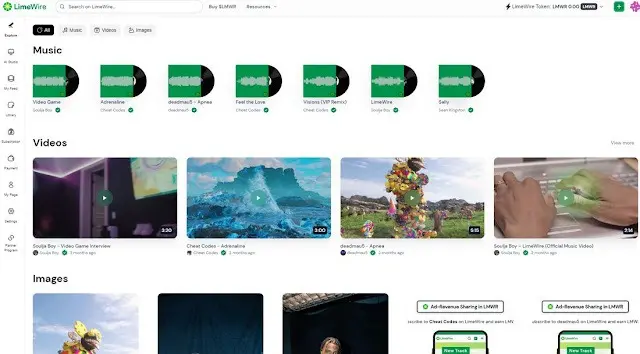
Today’s LimeWire operates at the intersection of generative artificial intelligence and decentralized blockchain technology. It provides creators—ranging from independent hobbyists to household-name musical artists such as Deadmau5, Soulja Boy, and Sean Kingston—with an all-in-one platform to generate, publish, monetize, and trade digital media. By marrying advanced machine learning frameworks like Stable Diffusion and DALL-E with automated NFT minting on networks like Polygon and Algorand, LimeWire has carved out a distinct niche. It is no longer just a tool for artistic output; it is a self-sustaining economy where digital creations become ownable, tradeable financial assets.
This comprehensive investigative report examines LimeWire’s technological architecture, its innovative revenue models driven by its native LMWR token, its subscription tiers, and its broader implications for the future of creator economies.
Detailed Chronology
The 2000s: The Napster Successor and Legal Twilight
To understand the magnitude of LimeWire’s current incarnation, one must look at its origins. Founded in 2000 by Mark Gorton, LimeWire was a dominant Java-based peer-to-peer file-sharing client. During the golden age of digital piracy, it was installed on millions of computers worldwide. Users traded music, movies, software, and documents with absolute impunity.
However, this decentralized exchange of copyrighted material placed LimeWire on a collision course with the Recording Industry Association of America (RIAA). Following years of contentious litigation, a federal judge ordered LimeWire to disable its search, downloading, and file-sharing functions in 2010. The platform went dark, cementing its status as a nostalgic relic of early 2000s internet culture.
The 2022–Present Resurrection: Pivoting to Web3 and AI
In 2022, Austrian entrepreneurs Julian and Paul Zehetmayr acquired the intellectual property rights to LimeWire with a vision entirely disconnected from its file-sharing past. Recognizing the explosive growth of generative artificial intelligence and blockchain technology, the new leadership team sought to repurpose the trusted brand name for the modern creator economy.
- Early 2022: The founders announced plans to relaunch LimeWire as a digital collectibles marketplace for art and music, initially focusing on the music NFT space.
- Late 2022 to 2023: As generative AI tools like Midjourney, Stable Diffusion, and OpenAI’s DALL-E captured public imagination, LimeWire rapidly pivoted. It integrated advanced image generation models into its platform, giving birth to LimeWire Studio.
- Mid-2023: The platform launched its native utility and governance token, LMWR, listed on major cryptocurrency exchanges including Kraken, Bybit, and Uniswap.
- 2024 and Beyond: LimeWire expanded its technical suite, supporting advanced image models like Stable Diffusion XL (SDXL) while laying the groundwork for upcoming video and audio generation frameworks.
Supporting Context & Metrics: Architecture and Monetization
LimeWire’s current business model is engineered around decentralization, creator empowerment, and automated revenue distribution. The platform relies on several foundational pillars:
1. Advanced AI Image Generation Frameworks
LimeWire Studio is not locked into a single proprietary model. Instead, it aggregates industry-leading open-source and proprietary text-to-image engines. Users can leverage:
- Stable Diffusion (Versions 2.1 and XL): Known for photorealism and high-detail outputs.
- DALL-E 2: Renowned for its conceptual depth and ability to interpret complex, multi-layered prompts.
Users can apply various design styles—such as cinematic, anime, pixel art, digital art, and analog film—with a single click. Furthermore, integrated samplers allow creators to fine-tune image resolution, aspect ratios, and prompt guidance scales, bridging the gap between novice accessibility and professional-grade customization.
2. Automated NFT Minting via Polygon and Algorand
Unlike traditional art platforms where minting NFTs requires technical smart-contract deployment and cryptocurrency transaction (gas) fees upfront, LimeWire automates this pipeline. Once a user generates and publishes an image, the platform automatically mints the creation as a Non-Fungible Token on either the Polygon or Algorand blockchain.
This infrastructure provides two distinct publishing options:
- Public Release: Content is discoverable by the global LimeWire community. Anyone can view, collect, and trade the resulting NFTs on secondary markets.
- Subscriber-Only Access: Content is locked behind a paywall, available exclusively to premium followers who subscribe to the creator’s page.
3. The Tokenomics of LMWR and Revenue Sharing
LimeWire operates an aggressive revenue-sharing model designed to incentivize active participation. Creators retain up to 70% of all ad revenue generated when other users view their published images, music, and videos on the platform.
This financial distribution is handled via LMWR tokens. Earned revenue is disbursed monthly in LMWR, which can be liquidated on external cryptocurrency exchanges or reinvested directly into the platform to purchase additional prompt credits. Additionally, creators earn a 2.5% royalty every time their digital collectibles are traded within the community marketplace.
4. Tiered Pricing Plans and Credit Systems
LimeWire utilizes a credit-based consumption model alongside several subscription tiers to accommodate casual hobbyists and professional digital artists alike:
- Free Tier:
- Cost: $0/month
- Credits: 10 free credits (yielding up to 20 AI images per day)
- Revenue Share: 50% ad revenue split
- Basic Plan:
- Cost: $9.99/month
- Credits: 1,000 credits/month (up to 2,000 image generations)
- Perks: Early access to new AI models, 50% ad revenue share, Pro profile badge, faster generation speeds, and an ad-free experience.
- Plus Plan:
- Cost: $29/month
- Credits: 3,750 credits/month (up to 7,500 image generations)
- Perks: Early access to new AI models, 60% ad revenue share, Pro profile badge, and full creation history tracking.
- Pro Plan:
- Cost: $49/month
- Credits: 5,000 credits/month (up to 10,000 image generations)
- Perks: Early access to new AI models, 70% ad revenue share, Pro profile badge, and priority generation queues.
- Advanced / Elite Plan:
- Cost: $99/month
- Credits: 11,250 credits/month (up to 22,500 image generations)
- Perks: Maximum credit allocation, 70% ad revenue share, VIP support, and full enterprise-level tooling access.
Official Statements and Industry Reception
The strategic pivot of a legendary tech brand has attracted significant attention from both the tech and entertainment sectors. Industry leaders and celebrity early adopters have shared their perspectives on the platform’s utility.
Julian Zehetmayr, co-founder of LimeWire, emphasized the democratization of digital art during a recent product rollout:
"We aren’t just building an AI art generator; we are building an economy. For too long, creators have built audiences on social media platforms that monetize their attention without sharing the upside. By integrating generative AI with blockchain ownership and ad-revenue sharing, LimeWire ensures that the people doing the actual creative work capture the vast majority of the financial value."
Prominent musicians who have leveraged LimeWire Studio—such as Soulja Boy and Sean Kingston—have praised the platform’s ability to forge intimate connections with fanbases through tokenized media drops. By releasing unreleased tracks and visual art as digital collectibles, these artists have found new revenue streams outside traditional streaming platforms, which are frequently criticized for low royalty payouts.
Tech analysts note that while the generative AI market is fiercely competitive—contending with giants like Midjourney, Adobe Firefly, and OpenAI—LimeWire’s structural focus on Web3 monetization and social community building provides a unique value proposition that pure-play image generators lack.
Future Outlook
As LimeWire looks toward the horizon, its roadmap is defined by aggressive expansion beyond still imagery. The platform’s developers have confirmed active development on proprietary AI models, moving away from sole reliance on third-party open-source engines like Stable Diffusion. This proprietary shift is expected to yield higher stylistic consistency and faster generation times.
Furthermore, the imminent rollout of AI music and video generation tools will transform LimeWire Studio into a truly multimedia-capable publishing suite. In a digital landscape where short-form video and generative audio are becoming dominant modes of communication, these upcoming tools will allow musicians, filmmakers, and digital artists to produce complex, multi-modal content entirely within the LimeWire ecosystem.
Conclusion
LimeWire’s evolution from a controversial file-sharing utility into a premier Web3 AI studio is a masterclass in strategic brand reinvention. By solving two of the modern creator economy’s biggest pain points—monetizing digital art and establishing verifiable ownership—LimeWire has positioned itself as an indispensable platform for the next generation of digital creators. Whether through free experimental prompts or high-tier professional publishing, LimeWire successfully bridges the gap between imagination and economic empowerment.