Executive Overview
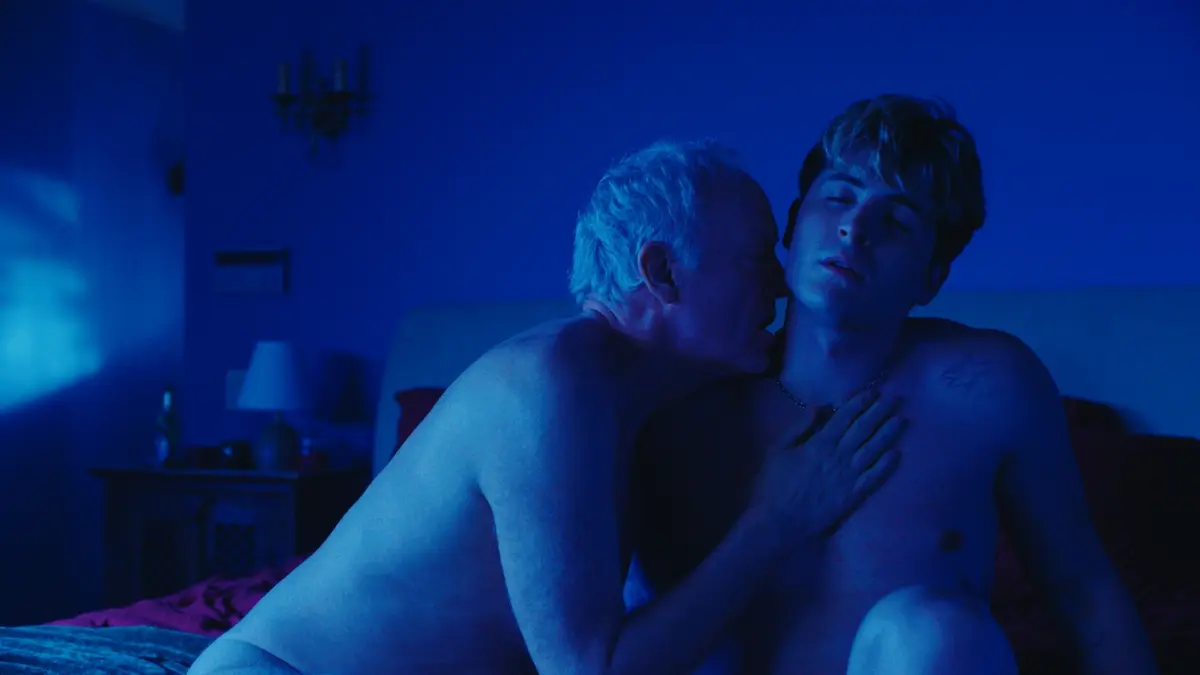
In the contemporary landscape of independent cinema, few young filmmakers possess the audacity to stake their sophomore features on narrative tension derived entirely from psychological peril rather than physical violence or graphic spectacle. Enter Blue Film, the bold, fiercely polarizing second feature from 26-year-old director Elliot Tuttle. Shot on a remarkably modest budget of just $50,000, the film unfolds almost entirely within the claustrophobic confines of a rented Los Angeles living room. It maps out a harrowing, nocturnal encounter between Aaron, a confident young sex worker and internet camboy, and an anonymous client who turns out to be Hank Grant—Aaron’s disgraced, convicted former English teacher.
Described by critics as a perverse, queer inversion of Richard Linklater’s Before Sunrise, Blue Film refuses to offer comforting moral resolutions or didactic safety nets. Instead, it positions its audience as reluctant voyeurs to an intricate power struggle defined by trauma, transactional intimacy, and systemic failure. Driven by riveting, fearless lead performances from Kieron Moore and Tony-winning veteran Reed Birney, Tuttle’s film eschews overt cinematic nudity in favor of a far more combustible element: transgressive ideas. As the film secures its theatrical release in the United Kingdom, it forces an uncomfortable dialogue regarding accountability, the mechanics of grooming, and the porous boundaries of consent in the digital age.
Detailed Chronology: From Personal Journaling to Cinematic Provocation
The genesis of Blue Film dates back approximately three years, when Tuttle found himself residing in Los Angeles, sifting through memories and journaling about the complex, often confusing power dynamics of adolescent crushes on authority figures.
"I was watching a lot of Catherine Breillat films and thinking retroactively about my adolescent sexuality," Tuttle explains over a video call from his home in New York. "Your brain isn’t developed enough to morally qualify your attraction. But as an adult, I think: what did I actually want to happen? It then became a film about loneliness."
Tuttle’s creative process also drew from real-world observations of acquaintances who engaged in trysts with former educators after reaching adulthood, lending an unsettling verisimilitude to the narrative premise.
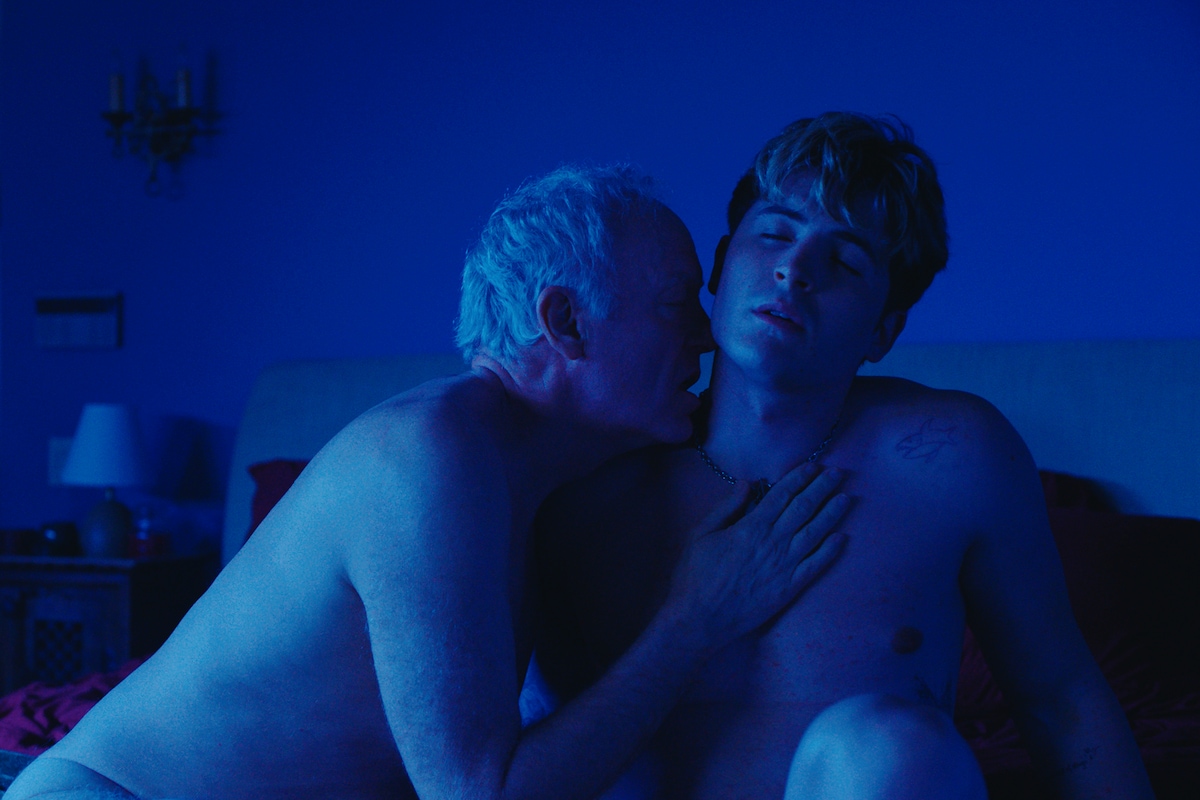
The plot centers on Aaron (played by Kieron Moore), a muscular, sex-positive twentysomething who typically makes a living via financial domination (findom) and webcam fetishes. Believing he has secured a lucrative booking, Aaron agrees to spend the night with an anonymous client willing to pay $50,000 upfront. Upon arrival, however, the masked client is revealed to be Hank Grant (Reed Birney), a man previously imprisoned for attempting to solicit another underage pupil.
What follows is an escalating chess match disguised as a casual late-night conversation over pizza and beer. Aaron initially relies on his bravado, defending his line of work as a pragmatic exploitation of his physical assets. Hank, meanwhile, attempts to rationalize his behavior by recounting his own childhood abuse—a psychological defense mechanism that attempts to map a twisted lineage of trauma. As the night deepens, the power dynamics continuously shift. In a particularly disquieting sequence, Aaron—despite his visceral disgust—remains in the space and permits Hank to shave his head, an act laden with symbolic attempts at de-ageing and psychological subjugation.
Supporting Context & Metrics: Research, Budgeting, and Aesthetics
Constructing a cinematic dialogue between a sex worker and a convicted sex offender without inadvertently stepping into apologism required meticulous research and an acute awareness of narrative responsibility.
The Burden of Representation and Research
Tuttle openly acknowledges the tightrope walk inherent to the script. "I knew while writing the film that there’s a danger of sympathising with a villainous figure," he notes. "I’m a gay man, but I’m also not a sex worker. And I’m not a paedophile."
To ground the characters in psychological realism without resorting to caricature, Tuttle immersed himself in documentaries concerning sex offender rehabilitation. Chief among them was Pervert Park (2014), a documentary chronicling a community of registered sex offenders living in Florida. The film provided Tuttle with a sobering recurring motif: the vast majority of convicted sex offenders reported histories of childhood abuse, pointing toward a cyclical, deeply warped understanding of intimacy, affection, and boundary recognition.
"The common thread is that many convicted sex offenders were abused as children," Tuttle observes. "That’s fairly consistent across everything I watched. Many of them have a warped understanding of sex and love, and how to express it. Again, none of this is a justification for the act of paedophilia. I hope we can all go, ‘Yes, it’s wrong. Now let’s watch the movie.’ It was worth interrogating how a person might become this way, or if they were born like that. No one’s really funding research on it."
Micro-Budget Ingenuity and Formal Choices
Operating on a restricted $50,000 production budget, Blue Film successfully avoids the trap of feeling like a static stage play. Tuttle achieves this dynamic visual rhythm primarily through the strategic integration of mini DV camcorder footage shot from Hank’s perspective. Describing this stylistic choice, Tuttle characterizes the aesthetic as existing "in the Venn diagram of a snuff film and family home video."
Crucially, the film breaks from contemporary trends of hyper-explicit shock value by maintaining a complete absence of physical nudity. Tuttle recognized that displaying explicit acts would detract from the psychological weight of the narrative. "I liked the idea of making a film where the ideas were the dangerous part," he remarks. "Everything else felt like a hat on a hat."
Official Statements & Critical Reception
The friction between the film’s thematic ambitions and its reception has generated significant discourse across festival circuits. Because the narrative tackles topics generally quarantined from mainstream cinematic exploration, audience reactions have been sharply divided.
"I wanted to make a film that, by design, had a very unique relationship with each audience member," Tuttle states. "The audience member can meet the film where they’re willing to meet it. I’m happy if the controversial parts of the film get people to see the film. I want people to say whatever they want about it."
Critics have praised the raw intensity of the lead performances. Reed Birney balances his character’s monstrous history with an aching, pathetic desperation, painting a portrait of a man entirely consumed by his own isolation. Conversely, Kieron Moore peels back Aaron’s external armor—his tattooed physique and financial confidence—to expose a profound vulnerability when confronted with the ghosts of his past.
The film poses a series of unflinching questions to the viewer:
- If a convicted individual has served their legally mandated prison sentence, to what extent does society reserve the right to perpetually punish them?
- If a sex worker is an autonomous, consenting adult, which transactions fall outside the boundaries of ethical engagement?
- When two individuals are locked in a room, who holds the genuine physical power—a hulking young gym enthusiast, or an aging, unemployable outcast?
Future Outlook
As Blue Film prepares for its official theatrical rollout in the United Kingdom on September 11, its trajectory signals a broader shift in independent filmmaking toward narratives that actively provoke intellectual discomfort over easy catharsis.
Elliot Tuttle’s sophomore feature will likely be studied not only for its micro-budget efficiency but for its refusal to pander to modern moral consensus. By daring its audience to sit in silence, question their own ethical thresholds, and confront the darkest corners of human loneliness, Blue Film establishes Tuttle as one of the most fearless—and polarizing—young auteurs working today. Whether the industry is prepared for the conversations the film demands remains to be seen, but Blue Film ensures that turning away is no longer an option.