Executive Overview
To the untrained eye, a Software-as-a-Service (SaaS) application can appear deceptively simple—often judged merely by the gloss of its user interface. A dashboard comprising ten sleek screens might look like a straightforward, low-cost development project on a wireframe. However, beneath that polished veneer lies a complex web of backend engineering: multi-tenant data architecture, granular role-based access control (RBAC), Stripe subscription engines, asynchronous webhooks, third-party API integrations, robust background job processors, and continuous production monitoring. These components represent entirely distinct engineering challenges that dictate the true cost of building software.
For founders, product leaders, and engineering executives navigating the tech ecosystem in 2026, estimating SaaS development costs by counting pages or UI components is a perilous trap. The real question is no longer simply "How much does SaaS development cost?" but rather "What specific engineering architecture does this product require to operate reliably for real-world users?"
This report investigates the granular cost drivers of SaaS development, moving past superficial metrics to examine database design, authentication complexity, billing systems, integration pipelines, AI workflows, and the hidden investments required for true production readiness.
Detailed Chronology and Project Lifecycle Stages
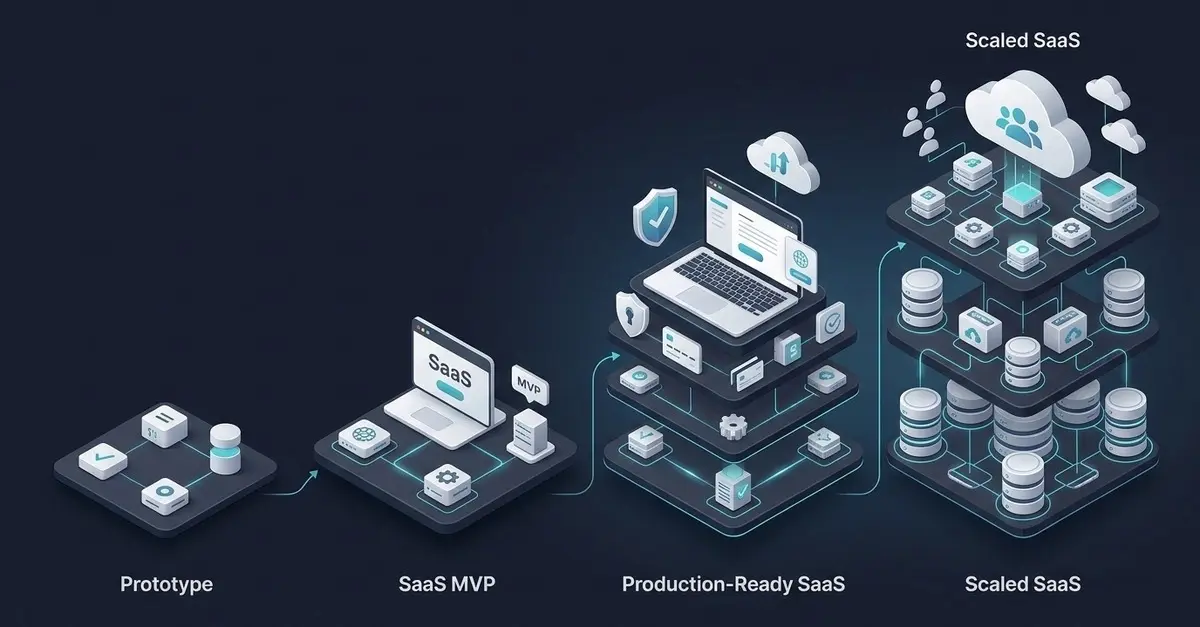
Understanding how a SaaS product evolves from a conceptual validation into a complex, multi-tiered enterprise platform requires looking at the typical financial and temporal milestones. Rather than fixed market prices, development costs fluctuate based on architecture, compliance needs, and workflow depth.
Initial Concept ➔ Database & Architecture ➔ Lean MVP ➔ Production Hardening ➔ Scaling & Iteration1. The Prototyping and Validation Phase ($500 – $2,500 | 1–3 Weeks)
At the earliest stage, the objective is risk reduction and validation. Founders build low-fidelity prototypes or clickable mockups to test core value propositions with potential users without writing heavy backend code. The focus is purely on market demand, UI validation, and user feedback loops.
2. The Lean SaaS MVP ($3,000 – $8,000 | 4–8 Weeks)
Once validation is achieved, a lean Minimum Viable Product is constructed. This stage introduces core functionality—such as a simplified database, basic user authentication, and perhaps a rudimentary payment gateway—allowing early adopters to experience the primary workflow.
3. Production-Ready SaaS ($7,000 – $20,000 | 6–12 Weeks)
This is where the engineering paradigm shifts. Transitioning from a demo to a stable commercial product requires comprehensive architecture, secure secrets management, automated testing, reliable webhook handling for billing, and production monitoring. This tier represents the baseline for any business intending to charge money and scale reliably.
4. Complex SaaS Architecture ($20,000 – $50,000+ | 3–6+ Months)
Enterprise-grade platforms, multi-sided marketplaces, complex AI automation pipelines, and cross-platform applications fall into this category. These projects demand distributed backend architectures, advanced caching layers, stringent compliance (such as SOC2 or HIPAA readiness), and extensive integration support.
Supporting Context & Metrics: Unpacking the Engineering Drivers
To understand where capital is allocated during a build, one must examine the fundamental architectural choices that dictate development hours and maintenance overhead.
1. Database Architecture: Tenant Isolation Over UI Screens
A common pitfall is sizing a database based on the number of frontend views. In reality, modern B2B SaaS applications rely heavily on multi-tenant structures. Consider a standard relational hierarchy:
Organization ➔ Members ➔ Users ➔ Projects ➔ TransactionsEvery database query must securely isolate data according to the requesting tenant. For instance, a standard PostgreSQL query executed in a secure backend environment requires strict organization-level filtering:
SELECT *
FROM projects
WHERE organization_id = $1
ORDER BY created_at DESC;
That organization_id column is not merely an attribute; it is the cornerstone of a tenant-isolation strategy. If implemented incorrectly, vulnerabilities can expose cross-customer data, leading to severe security breaches. As data structures grow more complex, database architecture becomes a primary cost driver.
2. Authentication and the True Cost of Permissions
Basic consumer applications require simple login flows:
User ➔ DashboardIn contrast, production B2B SaaS environments mirror intricate corporate hierarchies:
User ➔ Organization ➔ Team ➔ Role ➔ Permission ➔ ResourceAuthentication goes far beyond verifying a user session. Engineers must implement and maintain authorization logic across every API endpoint and operation. Consider this permission validation snippet:
function canEditProject(user, project)
  if (user.organizationId !== project.organizationId)
    return false;

  return user.permissions.includes("project:edit");
While the code block itself is concise, the true engineering cost lies in ensuring these authorization rules are uniformly and flawlessly applied across hundreds of endpoints without introducing security gaps.
3. Stripe Integration and Billing Complexity
Billing is frequently underestimated by technical and non-technical stakeholders alike. A statement such as "We just need Stripe subscriptions" often masks an intricate state-machine workflow:
Checkout ➔ Stripe ➔ Webhook ➔ Subscription State ➔ Database ➔ User AccessWhile creating a subscription via the Stripe SDK is relatively straightforward:
const subscription = await stripe.subscriptions.create(
  customer: customerId,
  items: [ price: priceId ],
);
This is only the surface. Production billing systems must gracefully handle failed credit card charges, prorations, usage-based billing tiers, trial periods, upgrades, downgrades, and tax calculations. Crucially, engineering best practices dictate that the browser’s checkout response must never be treated as the ultimate source of truth for subscription states.
Instead, robust webhook listeners must process asynchronous events from payment processors:
app.post("/webhooks/stripe", express.raw( type: "application/json" ), async (req, res) =>
  const event = stripe.webhooks.constructEvent(
    req.body,
    req.headers["stripe-signature"],
    process.env.STRIPE_WEBHOOK_SECRET
  );

  if (event.type === "customer.subscription.updated")
    const subscription = event.data.object;
    await updateSubscription(subscription);


  res.json( received: true );
);
The engineering overhead stems from ensuring this state-sync mechanism remains resilient when events arrive late, duplicate themselves, or arrive out of sequence.
4. Integrations as Multipliers of Failure Points
Integrating third-party services—such as Google Calendar, Slack, or Salesforce—introduces external dependencies outside the control of the core application.
Your API ➔ OAuth ➔ External API ➔ Rate Limits ➔ Retries ➔ Error Handling ➔ Data SyncWhen an external API throws an error, the system must respond intelligently. Developing robust retry policies with exponential backoff, rate-limit management, idempotency keys, and asynchronous background processing transforms a simple API wrapper into a heavy enterprise integration pipeline.
5. AI Workflows vs. Simple API Wrappers
The integration of Artificial Intelligence into SaaS products has accelerated feature delivery in some domains, but an AI feature is rarely limited to a single API call:
User Request ➔ API ➔ Background Job ➔ AI Model ➔ Validation ➔ Database ➔ NotificationProduction-ready AI implementations require prompt versioning, cost tracking, token-limit management, output validation (to catch hallucinations), fallback models, and queue-based processing to prevent UI lockouts during long-running inference tasks.
6. Production Readiness: The Transition from Demo to Enterprise
Demos can run on optimism and local environments; production environments demand engineering rigor. Production readiness encompasses:
- Automated testing suites and CI/CD deployment pipelines
- Secure secrets management and environment isolation
- Zero-downtime database migrations and rollback strategies
- Comprehensive error tracking, APM monitoring, and rate limiting
Failing to invest in these systems early leads to catastrophic failures during database migrations, traffic spikes, or unexpected webhook floods.
Official Statements and Industry Insights
According to industry analysts and software architects, the primary miscalculation in SaaS budgeting stems from confusing feature volume with architectural complexity.
As Haseeb, lead engineer and SaaS builder at Seebify, notes:
"The biggest SaaS cost mistake isn’t choosing the wrong technology stack; it’s building too much before learning enough. You can spend months building advanced analytics, multi-tenant dashboards, AI automation, and dozens of integrations—only to discover that customers only wanted one simple workflow."
Industry consensus emphasizes that a lean MVP should successfully reduce scope, but it should never deliberately compromise engineering quality or security protocols.
Future Outlook: The SaaS Lifecycle in 2026 and Beyond
As the software landscape matures through 2026, building a SaaS product must be approached as managing an ongoing lifecycle rather than completing a static, one-off project.
Initial Build ➔ Real Users ➔ Feedback ➔ Iteration ➔ Scaling ➔ Architectural RefinementInfrastructure vs. Development Budgets
Founders must separate initial development expenditures from ongoing infrastructure costs. Early-stage SaaS products frequently leverage cost-effective serverless architectures, managed databases, and modern hosting platforms, keeping monthly cloud overhead to modest amounts while development capital is directed toward core feature validation and architecture. As user adoption scales, infrastructure costs naturally expand in alignment with database input/output, storage volume, AI token consumption, and network bandwidth.
Strategic Recommendations for Founders
- Reduce Scope, Not Reliability: Focus on the core five features that prove market value, but build them on a rock-solid, production-ready foundation with proper authentication and data isolation.
- Prioritize the Feedback Loop: Launch early, measure real-world user behavior, and reinvest capital exclusively into features that customers actively use and validate.
- Budget for the Lifecycle: Recognize that software evolution continues post-launch. Maintain an ongoing engineering budget for continuous iteration, performance scaling, and architectural refactoring.
By shifting the focus from superficial UI screens to resilient backend workflows, data architecture, and production readiness, product teams can successfully navigate the financial and technical realities of building high-performing SaaS products in 2026.