Executive Overview
Home appliance and consumer electronics giant LG Electronics USA has announced a decisive policy shift targeting smart TV applications that convert everyday household televisions into unvetted, always-on residential proxy nodes. Under the newly implemented measures, the corporation is actively working to purge its webOS app store of any software featuring embedded residential proxy Software Development Kits (SDKs). Developers failing to comply with these updated platform guidelines face immediate suspension of their applications.
This sweeping regulatory action follows alarming security revelations published by threat intelligence firm Spur. Their investigation uncovered that more than 42 percent of applications available on the LG webOS store—and over a quarter of apps on Samsung’s Tizen platform—harbored hidden code capable of siphoning a user’s home internet bandwidth to route third-party web traffic.
While monetization firms and proxy network operators defend the practice as consensual and compliant with industry standards, cybersecurity researchers argue that integrating these systems into consumer appliances introduces unacceptably high risks. By transforming standard televisions into passive exit nodes for global data harvesting, these applications blur the lines between legitimate monetization and unauthorized resource utilization, leaving millions of consumers vulnerable to network abuse without their explicit, informed understanding.
Detailed Chronology of the Smart TV Proxy Investigation
The unfolding crisis surrounding residential proxy SDKs in consumer electronics began gaining widespread industry traction following targeted telemetry analysis and application code audits.
July 2: The Spur Disclosure
On July 2, cybersecurity firm Spur published a groundbreaking report examining the deep infiltration of residential proxy software development kits into smart TV ecosystems. The research cataloged thousands of seemingly harmless consumer applications—ranging from classic puzzle games like Pac-Man and file utilities to basic screensavers—that secretly bundled proxy SDKs. These SDKs allowed external commercial platforms to rent out the idle bandwidth of residential users, routing global internet traffic directly through home routers.
The report revealed an astonishingly high prevalence rate: 42 percent of evaluated LG webOS applications and more than 25 percent of Samsung Tizen applications contained these proxy components. The findings immediately drew concern from privacy advocates and security researchers who pointed out that home televisions are rarely viewed by the general public as traditional computing devices capable of handling complex network-routing operations.
Mid-July: Industry Scrutiny and Media Inquiries
Following the publication of the Spur report, security journalism outlets, including KrebsOnSecurity, reached out to major television manufacturers for comment regarding their app store governance and vetting procedures. While Samsung’s platform also faced heavy criticism for high proxy SDK prevalence, LG was the first major manufacturer to take immediate, public corrective action to address the architectural vulnerability.
Late July: LG’s Policy Enforcement and Platform Cleanup
Responding directly to inquiries regarding the Spur findings, LG Senior Vice President John Taylor confirmed that the corporation was actively coordinating with app developers to strip residential proxy capabilities from the webOS platform. LG initiated a comprehensive code-review sweep of its app catalog, warning developers that failure to excise these SDKs would result in swift application suspension.
Concurrently, major proxy providers named in the Spur report—most notably Bright Data, which accounted for the vast majority of identified proxy SDKs across both LG and Samsung ecosystems—issued formal defenses of their operational models, emphasizing strict user consent workflows and independent third-party audits.
Supporting Context & Metrics: How Residential Proxies Infiltrated the Living Room
To understand how a home television transforms into a global proxy node, it is necessary to examine the underlying economic incentives driving modern app development on smart platforms.
The App Monetization Dilemma
Developing applications for smart television platforms is often a labor of love with limited direct revenue potential. Unlike mobile operating systems with mature, ubiquitous micropayment infrastructures, smart TV ecosystems frequently struggle to monetize casual user engagement effectively through traditional ad banners or paid downloads.
To bridge this monetization gap, app developers increasingly turn to monetization intermediaries and residential proxy networks. These proxy providers offer lucrative financial compensation to developers who agree to bundle specialized SDKs into their applications.
The Mechanics of the Consumer Trade-Off
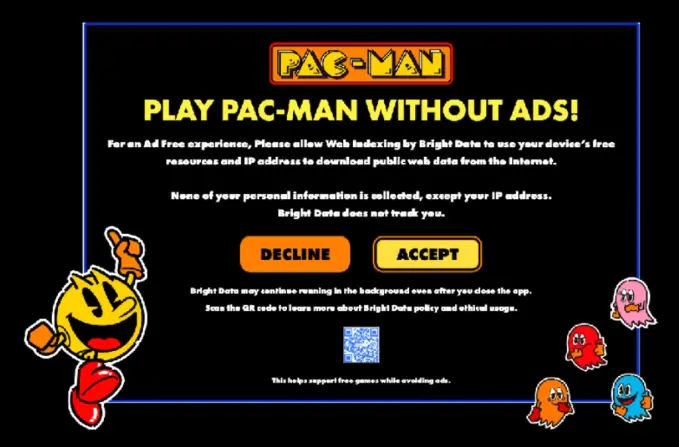
When a user downloads a free game, screensaver, or utility app on their smart TV, the application may present an initial opt-in screen. For example, analysis by Spur highlighted specific implementations—such as a Pac-Man app associated with Bright Data—that offered users a choice between watching traditional video advertisements or agreeing to allow their television to function as a residential proxy node.
Once opted in, the application runs a background process that establishes a persistent connection to the proxy provider’s command-and-control infrastructure. The user’s home internet connection is then cataloged as a "residential IP address," which commands a high market value because it mimics genuine consumer traffic rather than known corporate data centers. Businesses, market researchers, and web-scraping outfits rent these residential IPs to perform large-scale data collection, geo-testing, and ad verification without getting blocked by anti-bot systems.
Scope and Scale: The Numbers Behind the Threat
The metrics uncovered during the Spur investigation underscore the massive scale of this phenomenon within consumer smart ecosystems:
- LG webOS Vulnerability Rate: Over 42% of tested apps contained residential proxy components capable of turning the TV into an indefinite proxy node.
- Samsung Tizen Vulnerability Rate: More than 25% of evaluated apps incorporated similar proxy SDKs.
- Dominant Provider: Bright Data accounted for the vast majority of identified proxy SDKs across both major TV operating systems, representing a dominant market share in the smart appliance proxy monetization sector.
Official Statements and Industry Perspectives
The clash between consumer privacy advocates, smart appliance manufacturers, and proxy platform providers highlights deep philosophical divisions over transparency, consent, and platform accountability.

LG Electronics USA
In an official statement provided to security researchers, LG Senior Vice President John Taylor firmly distanced the hardware manufacturer from the practice, drawing a clear boundary regarding the intended use of smart televisions.
"A residential proxy network is not an intended use for LG smart TVs, and LG Electronics is working with developers to remove the residential proxy option from their apps on the webOS platform," Taylor stated. "If this option is not removed, these apps will be suspended."
Taylor emphasized that the company’s internal review of developer-submitted packages is already well underway and outlined future steps to harden the platform:
"As part of our ongoing efforts to enhance platform quality and the user experience, LG will continue to strengthen our evaluation process for developer-submitted apps, including those that incorporate residential proxy SDKs."
Bright Data
Defending its operational integrity, proxy provider Bright Data issued a detailed response highlighting its commitment to transparency, consent, and rigorous third-party oversight.
"Every peer opts in through a dedicated screen and receives value in return; every customer is vetted, and our practices have now undergone a second independent audit by PwC," Bright Data noted in its statement. "We remain committed to an open, transparent internet where legitimate businesses, researchers, and institutions can responsibly access data that lives in the public domain."
Bright Data and competing proxy networks maintain that they enforce strict Know-Your-Customer (KYC) procedures to ensure their paying customers utilize the proxy infrastructure solely for lawful activities, such as ad verification and price aggregation. Furthermore, these companies emphasize that technical safeguards are built into their SDKs to prevent proxy traffic from interacting with or scanning other connected devices residing on the local home network.
Security Researchers and Advocacy
Despite assurances from proxy operators regarding consent and safety, cybersecurity professionals remain deeply skeptical. Trevor Sutter of Spur criticized the fundamental viability of relying on casual end-user consent models within shared household environments.
"A one-time consent prompt buried in a TV app is not a substitute for meaningful transparency, ongoing control, and platform oversight," Sutter wrote. "The risk is amplified when consent comes from individuals within the household who use the device but shouldn’t give consent, such as minors."
Researchers argue that televisions are communal devices operated by children, guests, and elderly family members who lack the technical literacy to understand the legal and security implications of agreeing to terms that repurpose household infrastructure into commercial exit nodes.
Future Outlook and Broader Implications for Consumer IoT
While LG’s swift enforcement action represents a major victory for consumer privacy and platform integrity, the broader ecosystem of connected home appliances remains fraught with governance challenges.
The Expanding Attack Surface of Smart Appliances
As televisions, refrigerators, thermostats, and lighting systems become increasingly digitized and app-driven, they evolve into dual-use devices. Consumers view them as household utilities, while software developers and monetization networks view them as persistent entry points into residential IP blocks. Without stringent, automated code analysis tools integrated directly into vendor app stores, malicious or overly aggressive monetization SDKs will continue to find pathways into consumer hardware.
Emerging Regulatory and Compliance Pressures
Hardware manufacturers are facing mounting scrutiny not only for software compliance within app stores but also for broader system bundling practices. For instance, recent controversies surrounding LG—such as the automated deployment of third-party security software promotions via Windows Update drivers on high-end LCD monitors, as highlighted by tech channels like Gamers Nexus—demonstrate that consumers are increasingly growing fatigued by unsolicited software installations masquerading as value-added features.
Recommendations for Consumers and Manufacturers
To protect against the unauthorized use of residential bandwidth, industry analysts recommend several key structural improvements:
- Enhanced App Store Vetting: TV manufacturers must implement automated static and dynamic code analysis during the app submission phase to instantly flag and reject SDKs associated with proxy routing, packet sniffing, and external data relay.
- Granular Network Monitoring: Advanced home routers and firewall appliances should incorporate telemetry tools that alert users when connected IoT devices establish persistent outbound connections to known commercial proxy networks.
- Transparent Opt-In Standards: Regulatory bodies may soon need to establish strict legal definitions for consent on shared household hardware, ensuring that background data-sharing features cannot be casually enabled by minors or unverified users during routine application setup.
LG’s decision to purge proxy SDKs from its webOS ecosystem sets an important precedent for the consumer electronics industry. However, as the boundaries between home appliances and commercial data networks continue to blur, maintaining a secure, transparent digital living room will require continuous vigilance from manufacturers, regulators, and consumers alike.