Executive Overview
Nearly a quarter-century after its original release in the fall of 2000, BioWare’s Baldur’s Gate II: Shadows of Amn occupies a curious space in video game history. It is revered, studied, and cited as a foundational text of modern role-playing games, yet it is frequently overshadowed in contemporary discourse by its modern, multi-award-winning successor, Larian Studios’ Baldur’s Gate 3.
While Baldur’s Gate 3 continues to command massive concurrent player counts on Steam, dominate social media feeds, and capture the collective imagination of modern gamers years after its debut, a dedicated core of computer role-playing game (CRPG) purists insists that the crown belongs elsewhere. To these veterans, the definitive peak of the franchise—and arguably the entire genre—remains the 2000 classic.
This is not merely a matter of retro-tinted nostalgia. Baldur’s Gate 2 established the structural DNA for decades of prestige narrative gaming, directly inspiring giants like BioWare’s own Star Wars: Knights of the Old Republic, Mass Effect, and Dragon Age: Origins. Its handling of reactive companions, complex moral alignment systems, bespoke class-specific Strongholds, and deeply personal high-stakes villainy created a masterclass in interactive storytelling. This article explores why the blueprint laid down by BioWare in Shadows of Amn remains unbeaten, how it shaped the evolution of the RPG genre, and why modern players are increasingly returning to the Sword Coast of 2000 to find an experience that even modern technological marvels struggle to replicate.
Detailed Chronology: From the Dungeons of Athkatla to the Gates of Hell
To understand the genius of Baldur’s Gate 2, one must trace the harrowing journey it forces the player to undertake from its very first moments.
Act I: The Crucible of Athkatla
The game picks up directly following the events of the original Baldur’s Gate, though it functions smoothly as a standalone narrative. The protagonist is a "Bhaalspawn"—one of numerous mortal offspring fathered by Bhaal, the dead god of murder. Across the Sword Coast, these divine-blooded individuals are hunted for the latent godhood humming in their veins.
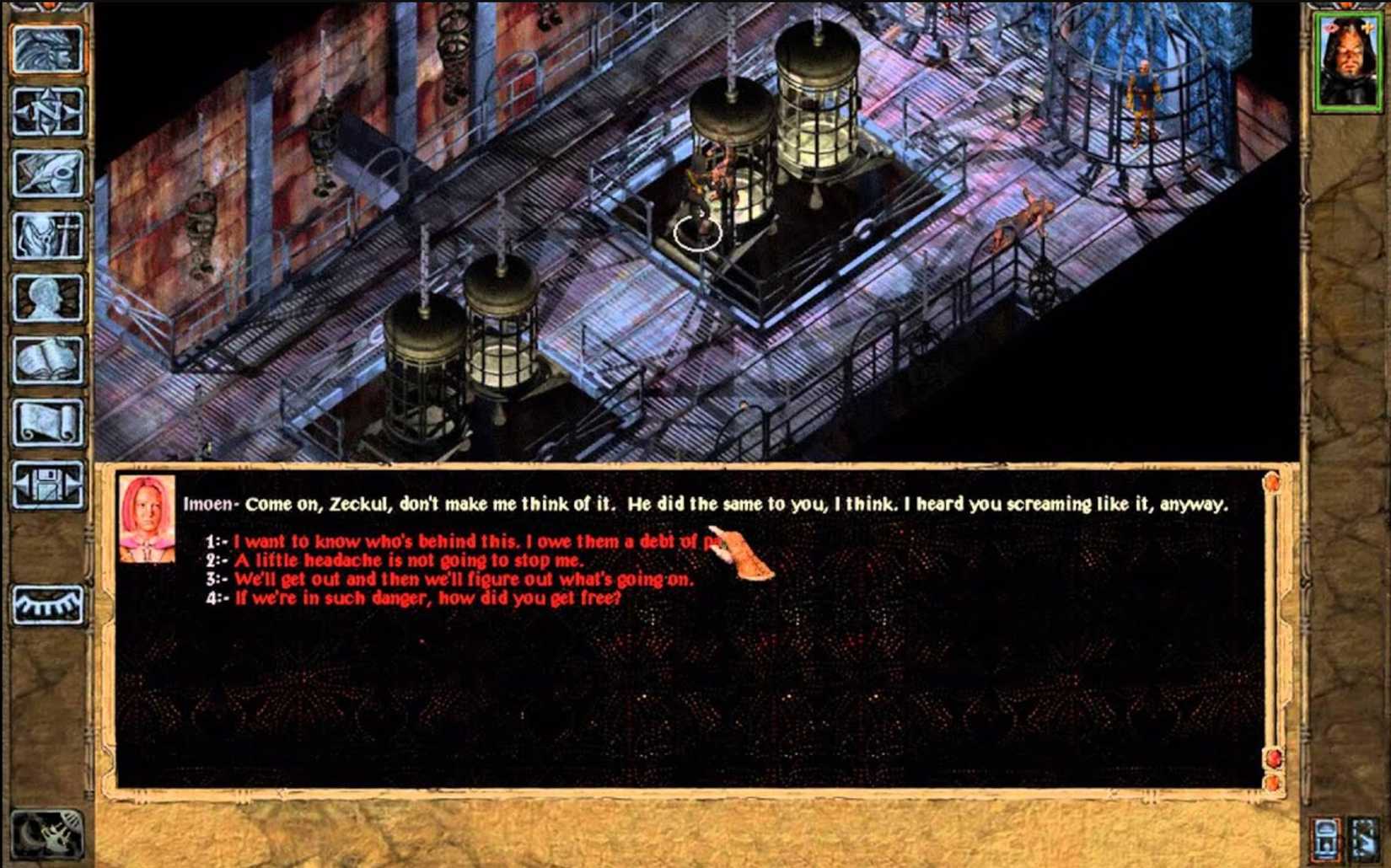
Shadows of Amn opens with zero exposition-heavy hand-holding. You wake up chained to a wall in a locked, subterranean cell beneath the sprawling city of Athkatla. Your trusted companions are imprisoned in nearby cages, subjected to sadistic experiments by a mysterious elven mage. This captor is Jon Irenicus, a skin-crawling, brilliant, and utterly broken villain whose cold cruelty is established within minutes. Before you even manage to claw your way out of his dungeon, you discover a grove of dryads he has drained dry simply to test his arcane theories—tree spirits reduced to withered, silent husks for no utilitarian purpose.
Act II & III: The Open Sandbox and Class Quests
Upon escaping Irenicus’s underground laboratory, the game opens into the vast, multi-tiered districts of Athkatla—the Docks, the Slums, the Government District, and the Waukeen’s Promenade. Long before "open world" became a ubiquitous marketing buzzword, BioWare designed a city that rewarded immediate, unfiltered exploration.
Crucially, Baldur’s Gate 2 tied the player’s profession directly into the narrative framework of the world through its legendary Stronghold system. Depending on your character class, you gained access to an entirely unique, exclusive questline that shaped your interaction with Athkatla:
- Fighters inherit and manage a sprawling noble estate (De’Arnise Keep), settling disputes and defending it from rival factions.
- Thieves take over a shadow guild in the Docks district, managing criminal enterprises and turf wars.
- Clerics are tasked with restoring a neglected temple, handling matters of faith and orthodoxy.
- Mages acquire a planar sphere, unlocking arcane research and otherworldly excursions.
These were not simple, modular side quests; they were entirely separate slices of narrative gated strictly behind the mechanical identity of the player character, lending the campaign staggering replayability.
Act IV through Finale: Underdark, Divine Ascension, and the Slayer
The narrative eventually expands far beyond the urban sprawl of Athkatla. Players are dragged into the subterranean terrors of the Underdark, forced to navigate the treacherous politics of the drow city of Ust Natha, and eventually pushed across planar boundaries to confront Irenicus directly in Hell.

Throughout this 70-to-100-hour journey, the player wrestles with their monstrous heritage. The Bhaalspawn protagonist possesses a terrifying transformation—the Slayer form—which threatens to burst out of their skin during moments of extreme stress or narrative turning points. The climax asks a fundamental philosophical question: When offered the divine spark of a dead god, will you seize the throne of murder and embrace your monstrous nature, or will you claw back your humanity and reject the legacy of Bhaal?
Supporting Context & Metrics: The Undying Legacy
The enduring footprint of Baldur’s Gate 2 can be measured not just in critical acclaim, but in how long players remain engaged with its mechanics and community spaces, as well as its historic commercial impact.
| Metric / Milestone | Detail | Significance |
|---|---|---|
| Release Year | October 2000 (Developed by BioWare, Published by Interplay/Black Isle) | Released during the golden era of Infinity Engine CRPGs. |
| Main Campaign Length | ~70 Hours (Standard Playthrough); 100+ Hours (Completionist) | A massive, densely packed narrative requiring genuine strategic commitment. |
| Replayability Index | Players reporting multi-decade devotion; single campaigns lasting up to 12 real-world years due to alternate class paths. | Highlights the depth of class-specific content and character building. |
| Metacritic / Critical Reception | Universal acclaim upon release; frequently cited in "Top 10 RPGs of All Time" lists by outlets like IGN, PC Gamer, and Eurogamer. | Cemented BioWare’s reputation as the premier narrative RPG studio of the 2000s. |
The Companion Dynamic
Long before Baldur’s Gate 3 won praise for reactive party members who judge your actions, romance you, or betray you, Baldur’s Gate 2 pioneered the modern companion arc. The party members you recruit are not silent cardboard cutouts; they are deeply flawed individuals wrestling with profound personal trauma:
- Jaheira, a series regular, is mourning the violent death of her husband before the game even properly begins, forcing the player to navigate her grief alongside the main quest.
- Aerie, an elven cleric/mage, spent her youth as a caged circus performer with her wings surgically clipped; her arc centers on overcoming physical and psychological trauma.
- Anomen, a hot-headed squire, is so desperate to prove his worth to the Order of the Radiant Heart that his reckless ambition leads directly to tragedy.
- Viconia DeVir, a drow priestess, faces constant hostility not just from the surface world, but from the very dark goddess she tries to serve after committing the unforgivable crime of showing mercy.
These companions interacted with one another dynamically—arguing, falling in love, or coming to blows based on alignment clashes—setting a standard for character writing that few studios have matched since.
Official Statements & Industry Impact
The influence of Baldur’s Gate 2 on the broader video game industry is a matter of historical record. Former BioWare leads and industry developers have frequently cited the game as the foundational template for entire generations of cinematic, choice-driven role-playing games.
"Baldur’s Gate 2 was the crucible where we learned how to marry complex tactical mechanics with deep, cinematic character writing. Everything we built afterward—from KOTOR to Mass Effect—was an attempt to capture the lightning we first bottled in Athkatla."
— Anonymous BioWare Developer retrospective analysis
When BioWare transitioned into science fiction and space opera with Star Wars: Knights of the Old Republic (2003) and Mass Effect (2007), they directly adapted the structural pillars of Shadows of Amn:
- The Alignment System: KOTOR utilized a binary light/dark morality matrix heavily influenced by Dungeons & Dragons alignment mechanics.
- Loyalty and Stronghold Missions: The crew missions in Mass Effect 2 and the fortress defense systems in Dragon Age: Origins were spiritual successors to the class-specific strongholds and companion-driven side plots of Baldur’s Gate 2.
- The Late-Game Twist: The psychological manipulation and identity subversion executed by Jon Irenicus laid the groundwork for legendary narrative plot twists in subsequent BioWare titles.
Even Larian Studios, the masterminds behind Baldur’s Gate 3, acknowledged the heavy shadow cast by the Infinity Engine classics. Swen Vincke and his team at Larian approached the third installment not as a clean break, but as an inheritor to a legendary literary and mechanical lineage—incorporating reactive companions, moral ambiguity, and internal monstrous transformations that mirror the original Bhaalspawn struggle.
Future Outlook: Why Modern Players Are Returning to the Infinity Engine
As the video game industry increasingly pivots toward live-service monetization, cinematic spectacle over systemic depth, and streamlined mechanics, a counter-movement is quietly gaining momentum. Modern CRPG players—frequently raised on Baldur’s Gate 3, Divinity: Original Sin 2, and Pillars of Eternity—are looking backward to understand the roots of the genre.
Platforms like Steam, GOG, and mobile storefronts (via Beamdog’s Enhanced Edition) have kept Baldur’s Gate 2 accessible to contemporary audiences. While its Advanced Dungeons & Dragons (AD&D) 2nd Edition rule set can present a steep learning curve for players accustomed to modern 5th Edition streamlining, the payoff is an intellectual and narrative richness that few modern titles attempt.

The Ultimate Challenge
For the modern gamer who has completed Baldur’s Gate 3 three, four, or five times and is eagerly scouring community forums for new replay modifiers, the ultimate recommendation is clear: Step away from the Coast of Faerûn as rendered by Larian, and step back into the cell beneath Athkatla.
Confront Jon Irenicus. Listen to the haunting, atmospheric MIDI soundtrack composed by Michael Hoenig. Guide a party of deeply broken, unforgettable companions through a sprawling world that respects your intelligence, punishes your foolishness, and rewards your tactical cunning.
Baldur’s Gate 2 remains unbeaten not because modern technology cannot replicate its graphics—it easily surpasses them—but because the absolute mastery of pacing, character writing, and player agency achieved by BioWare in 2000 remains a towering monument to what interactive storytelling can achieve. There is nothing to lose—except, perhaps, your soul.