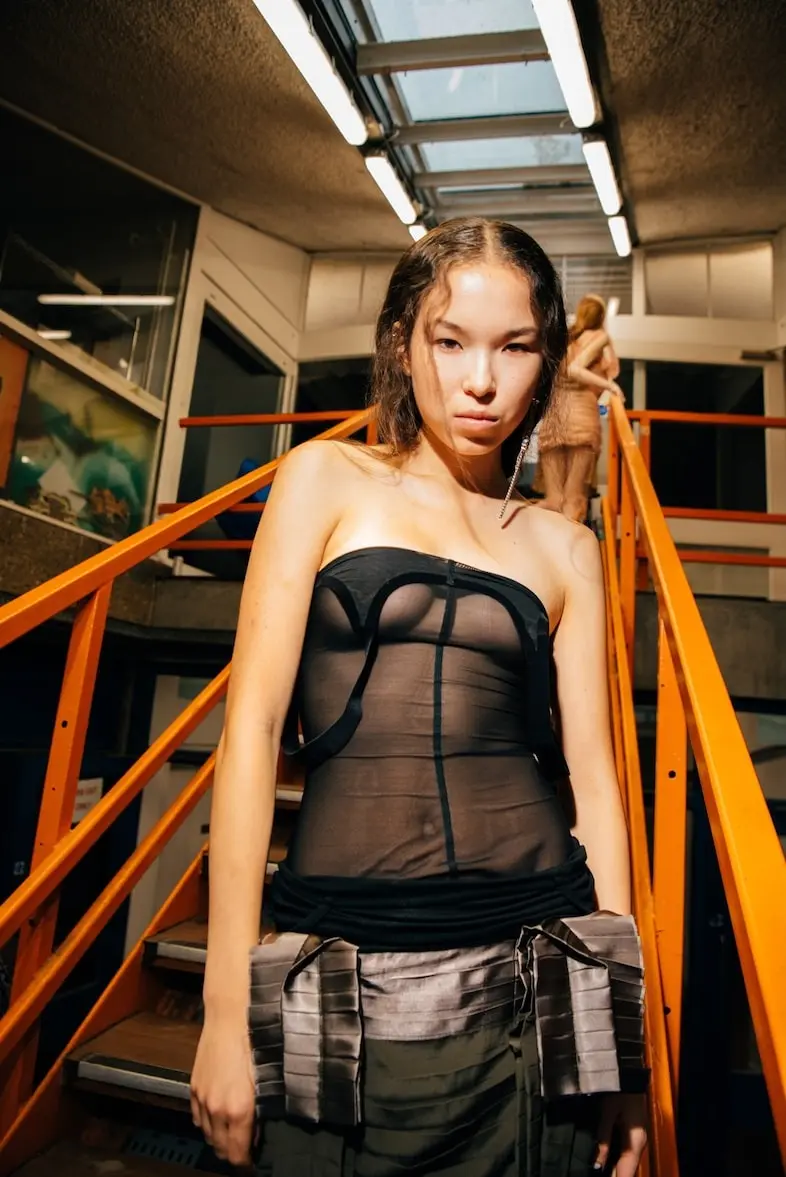
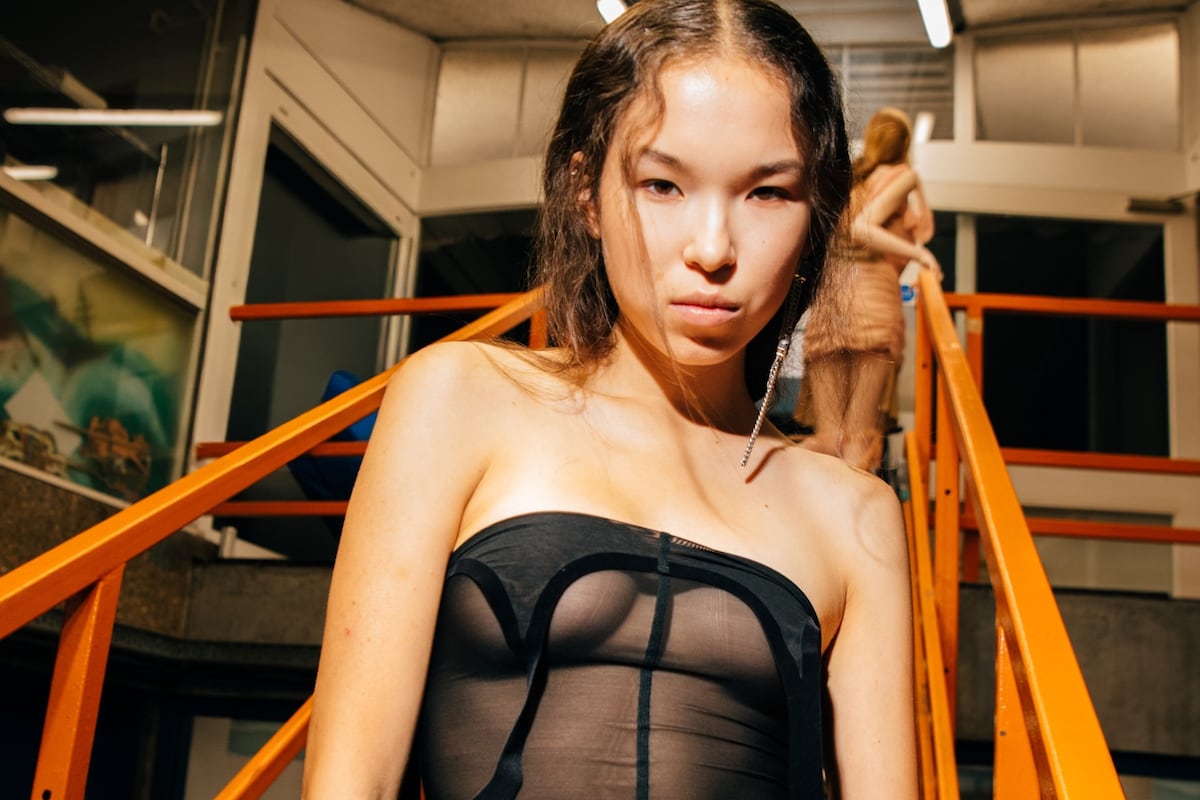
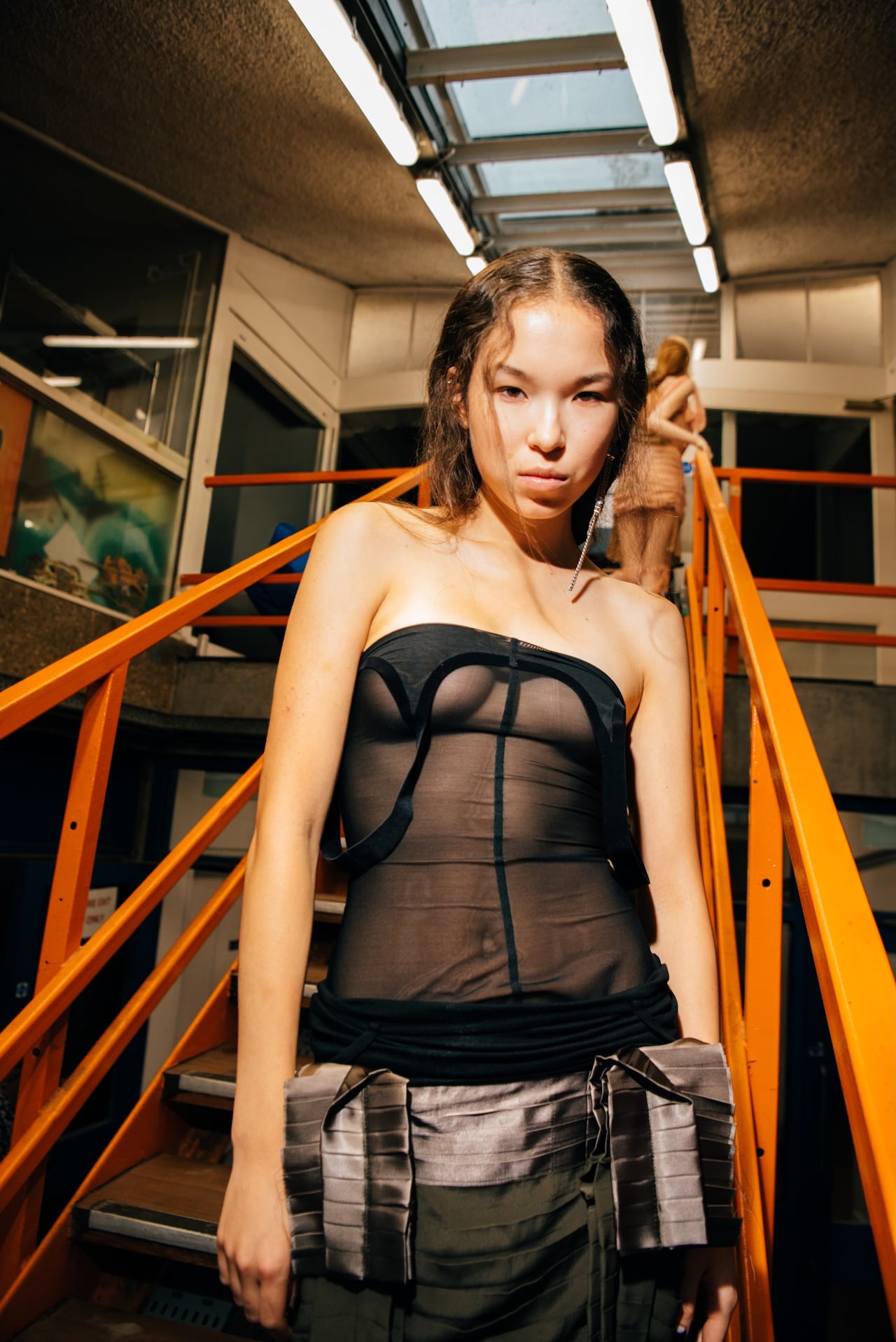
London Fashion Week witnessed a triumphant homecoming as cult-favourite label KNWLS—led by the visionary design duo Charlotte Knowles and Alexandre Arsenault—reclaimed its position on the British capital’s official schedule. Following a strategic detour to Milan last September to debut their widely celebrated collaboration with athletic powerhouse Nike, the brand’s return to home soil felt less like a standard runway presentation and more like a cultural coronation. For their Spring/Summer 2027 (SS27) collection, KNWLS drew inspiration from Bettina Rheims’s seminal 1991 photographic series Chambre Close, translating its haunting explorations of intimacy, exposure, and vulnerability into a masterclass of modern womenswear.
Yet, to label the collection merely as a study in disarray would be to miss its most profound technical and conceptual stroke. Beneath an outward appearance of garments coming apart at the seams—featuring sliding vest straps, asymmetrical garter clips, and strategically sliced fabrics—lay a rigorous, invisible framework. Through an ingenious sleight of hand utilizing phantom tulle, boned hems, and concealed structural wire, Knowles and Arsenault constructed an illusion of vulnerability that was, in reality, an exercise in absolute control.
This deep dive examines the SS27 presentation from every angle: the star-studded front row that underscored the brand’s enduring cultural capital, the intricate craftsmanship subverting traditional expectations of female exposure, and the broader philosophical statement on empowerment through engineered reconstruction.
Detailed Chronology: The Anatomy of a Homecoming
Setting the Scene in Southeast London
Anticipation had been steadily building for months leading up to the Sunday afternoon showcase in southeast London. The venue itself—industrial, raw, and bathed in stark, dramatic lighting—provided an intentional contrast to the romantic and subversive softness of the collection. Long before the first model stepped onto the concrete catwalk, the atmosphere was charged with the unmistakable electricity of a major fashion event.
Adding an immersive sensory layer to the experience, cult fragrance brand Escentric Molecules was drafted in to curate the olfactory landscape. The space was subtly infused with their signature Escentric 01 molecule, a scent famously engineered to adapt dynamically to the unique body chemistry of each individual wearer. It was a fitting metaphor for a collection designed to challenge and reflect the multifaceted identities of those wearing it.
The Front Row and Cultural Capital
The capital’s creative elite turned out in force to welcome Knowles and Arsenault back to London, cementing the label’s status as a cornerstone of contemporary British style. The front row read like a definitive census of modern cool, featuring international models, trailblazing musicians, and multidisciplinary artists:
Alva Claire, whose commanding presence in the fashion industry aligns seamlessly with KNWLS’s bold silhouettes.
Deto Black, the boundary-pushing rapper whose eclectic personal style mirrors the brand’s edgy aesthetic.
Crystal Murray, the Parisian-born songstress known for her ethereal yet gritty artistic output.
Amy Hunt, the elite athlete bringing a dynamic, performance-driven energy to the fashion sphere.
Lava La Rue and Rhian Teasdale, the formidable indie-pop power couple turning heads with their distinct creative visions.
The Runway Unfolds
As the house lights dimmed, the show began with a striking visual statement. The opening look featured a model clad in a cream-hued girdle paired with a white skirt held aloft by traditional garter clips. In a gesture immediately signalling the collection’s disruptive intent, the skirt was unhitched on one side, casually exposing the white briefs beneath.
As the procession continued, the theme of calculated exposure deepened. Vest straps drifted suggestively off shoulders, camisoles and cotton T-shirts were slashed with daring peekaboo openings, and an exposed lace bra peeked out from underneath a sharply tailored purple cardigan. To the untrained eye, the KNWLS heroine appeared to be coming undone—slipping out of her clothes in a moment of public vulnerability.
Yet, as models navigated the runway with unyielding posture and fierce gazes, it became abundantly clear that this was no accidental disarray. It was a meticulously choreographed performance of power.
Supporting Context & Metrics: The Illusion of Vulnerability
Engineering the "Phantom" Silhouette
A closer inspection of the SS27 collection backstage and during detailed post-show viewings revealed the sheer technical brilliance underpinning the garments. What initially read as rips, tears, and falling fabrics were actually complex trompe-l’œil constructions engineered by Knowles and Arsenault.
Phantom Tulle Panelling: The dramatic slashes and gaps in camisoles and tops were stabilized by nearly invisible panels of sheer, skin-toned mesh. These panels gave the optical illusion of torn fabric while securely holding the garment’s integrity together.
Structural Boning: Skirts that appeared to be gravitationally slipping toward the ankles or floating upward were anchored by rigid, hidden boned hems.
Invisible Wire Framing: Fallen shoulder straps and sliding necklines that hovered precariously below the clavicles were locked into place using micro-thin metal wires sewn directly into the garment infrastructure.
The Inspiration: Bettina Rheims’s Chambre Close
To fully grasp the narrative arc of SS27, one must examine its muse. Bettina Rheims’s 1991 monograph Chambre Close remains a watershed moment in photographic history. Commissioned in collaboration with novelist Serge Bramly, the series captured ordinary women in hotel rooms in states of profound emotional and physical exposure—sometimes weeping, often half-dressed, always raw. Rheims’s work questioned the boundary between voyeurism and empowerment, asking what happens when women are stripped of their public armor.
Knowles and Arsenault transposed these photographic questions into the medium of luxury garment construction. By mimicking the undone states found in Chambre Close while simultaneously reinforcing them with rigid internal architectures, KNWLS inverted the premise of Rheims’s subjects. The women in KNWLS SS27 are not victims of circumstance or involuntary exposure; they are architects of their own unveiling.
Official Statements & Design Philosophy
The creative direction of KNWLS has always been deeply rooted in a fierce, uncompromising vision of modern femininity. The official show notes distributed to guests offered profound insight into the mechanics of the collection:
"With its Spring/Summer 2027 collection, the KNWLS heroine comes undone. Exposure becomes an essential feature of KNWLS’s language of empowerment."
The notes went on to elaborate on the paradox of the collection’s physical construction:
"Held together by silent architectures of phantom tulle and invisible wire, undoneness is an illusion. Rather than a mark of dishevelment or decline, it’s a reflection of an exacting self-possession and control, of a cunning knack for twisting and perverting expected presentations of empowered femininity. Of the power to be found in moments of slippage, unravelling, and reconstruction."
In their post-show remarks, Charlotte Knowles and Alexandre Arsenault expanded on the emotional resonance of returning to London and handing the narrative control directly back to the wearer.
"We wanted to explore the duality of how women are perceived when they appear vulnerable versus the absolute tactical control they actually possess," Knowles explained. "The clothes might look like they are falling apart, but every single thread is precisely where it needs to be to project strength."
Future Outlook: What SS27 Signals for the Brand
The triumphant execution of the SS27 collection marks a critical juncture for KNWLS. By successfully bridging their commercial triumphs—such as their high-profile Nike partnership—with their avant-garde couture sensibilities, the label has demonstrated remarkable versatility.
1. Re-establishing London’s Avant-Garde Supremacy
While Milan offered a lucrative and exciting global stage, KNWLS’s return to London Fashion Week serves as a vital anchor for the British capital’s creative economy. As international buyers and critics search for brands that can balance raw emotional storytelling with uncompromising garment engineering, KNWLS has positioned itself as an essential pillar of London’s design identity.
2. The Evolution of Contemporary Feminine Power
The technical innovations seen in SS27—particularly the use of invisible structural supports to fake garments coming undone—open up exciting new avenues for the brand’s future collections. We can expect to see Knowles and Arsenault continue to push the boundaries of textiles, exploring how transparency, illusion, and inner framing can redefine the silhouettes of the late 2020s.
3. Commercial Viability of Subversive Design
Critics have frequently praised KNWLS for making subversive fashion wearable, and SS27 is no exception. While the runway featured high-drama styling, the underlying separates—the engineered camisoles, the structured knitwear, and the deconstructed tailoring—are poised to dominate high-end retail spaces. Consumers hungry for garments that tell a complex story of strength and vulnerability will undoubtedly drive strong demand when the collection hits stores.
Ultimately, KNWLS SS27 will be remembered as the season the brand proved that true control does not require rigid armor. Sometimes, the most powerful statement a woman can make is appearing entirely undone, while secretly holding every single thread in the palm of her hand.