Executive Overview
For the past several years, the artificial intelligence landscape has been dominated by a single, expensive narrative: if your business wants to leverage frontier-class intelligence, you must subscribe to closed commercial platforms and accept whatever pricing structures they dictate. Major AI providers have aggressively subsidized consumer and professional tiers, absorbing the vast differences between subscription fees and actual infrastructure costs to build user habits and market dominance.
However, industry experts warn that this grace period is rapidly coming to an end. As venture capital-backed subsidies taper off and infrastructure demands skyrocket, organizations relying entirely on closed commercial models face severe budgetary vulnerability.
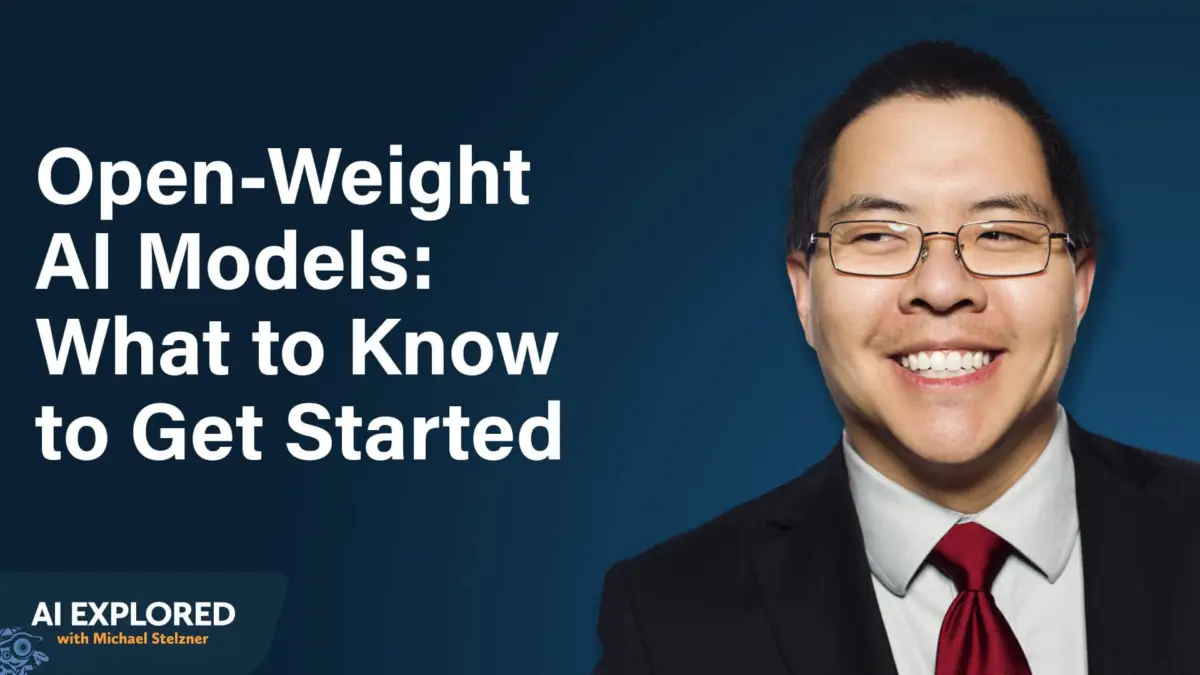
Enter the era of open-weight AI models. Co-created by Christopher Penn—co-founder of the AI consultancy Trust Insights—and Michael Stelzner, a paradigm shift is underway. By decoupling the "engine" of AI from proprietary cloud infrastructure, businesses can now download, host, and run powerful artificial intelligence models locally or via cost-effective third-party providers.
Open-weight models offer a trifecta of business advantages: slashed operating expenditures, airtight data privacy, and a capability gap against closed models that has shrunk to a mere three to six months. This investigative report explores how open-weight models work, what hardware and software are required to implement them, and how savvy organizations are leveraging them to slash monthly software bills and secure proprietary data.
Detailed Chronology: The Evolution Toward Local Intelligence
To understand how the market arrived at the current precipice of AI costs, one must examine the strategic playbook deployed by major tech platforms over the last two decades.
The Subsidy Trap
In the early days of social media, platforms like Facebook offered massive reach for free, systematically building user dependency before introducing monetization and adjusting pricing structures. The current artificial intelligence landscape is mirroring this exact playbook.
Major AI providers heavily subsidize consumer plans to drive user habit formation. According to Christopher Penn, a standard professional tier like the Claude Max plan—priced at $200 per month—delivers roughly $8,000 worth of actual computational usage, translating to an astonishing 97.5% discount for the end-user. Providers absorb this financial delta to capture market share and lock enterprises into proprietary workflows.
The Narrowing Capability Gap
Historically, open-source or open-weight models lagged years behind proprietary frontier models, making them largely impractical for complex business operations. That narrative has fundamentally shifted.
The latest generation of open-weight models—such as Zhipu AI’s GLM 5.2 and Alibaba’s Qwen series—now benchmark closely against top-tier proprietary models like Claude Opus. Rather than lagging years behind, open-weight architectures sit merely one generation—or roughly three to six months—behind the current frontier. This convergence of capability, combined with the impending expiration of commercial subsidies, has triggered a mass migration of forward-thinking enterprises toward self-hosted and open-weight ecosystems.
Supporting Context & Metrics: Economics, Privacy, and Hardware
Adopting open-weight models requires a foundational understanding of how they operate, how they are structured, and what infrastructural requirements are necessary for deployment.
The Car Engine Analogy
Christopher Penn utilizes a clear analogy to distinguish between closed and open AI: an AI model is akin to a car’s engine, while the application built around it (such as a chat interface, coding tool, or automated agent) represents the rest of the car.
- Closed-weight models (e.g., Claude Opus, GPT-5.5, Google Gemini) are engines that can never be downloaded or run independently; they must be accessed exclusively through the provider’s closed infrastructure.
- Open-weight models are engines that any individual or enterprise can download and run on their own hardware for free, allowing for complete operational independence.
The Four Core Pillars of Open-Weight Models
- Cost Efficiency: Open-weight models are drastically cheaper to operate. While hosted third-party versions of models like GLM 5.2 are available at a fraction of the cost of proprietary counterparts, running them locally incurs only the cost of electricity.
- Guaranteed Privacy: Regulatory compliance demands data security. Processing sensitive corporate or health information through public cloud tools introduces severe liability. Open-weight models guarantee that proprietary data never leaves an organization’s physical infrastructure.
- Sustained Capability: With performance benchmarks tracking just months behind proprietary leaders, enterprises no longer have to compromise intelligence for independence.
- Environmental Sustainability: Running small open-weight models locally on laptops or modest edge hardware consumes minimal electricity and zero fresh water for data center cooling, offering a vastly reduced corporate carbon footprint.
Dense vs. Mixture of Experts (MoE) Architectures
When selecting an open-weight model, administrators must choose between two primary architectural designs based on their computational constraints and workflow needs:
- Dense Models: Keep all parameters active simultaneously. While they retain comprehensive knowledge across all domains, they process queries more slowly. Naming conventions typically feature a single parameter count (e.g., Qwen 3.6 31B).
- Mixture of Experts (MoE) Models: Feature two parameter numbers—total parameters and active parameters (e.g., Qwen 3.6 35B-3AB). Internal routing systems direct queries to specialized subsets of experts, rendering them slightly less accurate in hyper-niche scenarios but significantly faster. MoE models are ideal for high-volume, repetitive tasks like sentiment scoring and document summarization.
Recommended Model Families
- Qwen (Alibaba): Widely regarded as the premier model family for tool handling and agentic workflows. Qwen excels at autonomous tasks like web searching, spreadsheet manipulation, and multi-step task chaining. (Note: Using Qwen via Alibaba’s web portal routes data through China; downloading the open-weight version locally ensures absolute data privacy).
- Gemma 4 (Google): The open-weight equivalent to Gemini Flash, ideal for general-purpose data processing and straightforward business tasks.
- DeepSeek V4 Pro/Flash & MiniMax M3: Highly capable models that deliver exceptional performance but generally require robust enterprise hardware or cloud hosting partners.
- Zhipu AI GLM 5.2: A high-performing alternative that benchmarks near Claude Opus at a fraction of commercial API costs.
Official Statements & Technical Implementation
Transitioning to open-weight models requires understanding the necessary hardware and software stack. As Chris Penn outlines, the implementation framework mirrors traditional web hosting: content (the model), a server (to serve it), and a client (to interact with it).
Hardware Requirements
All AI inference relies heavily on Graphics Processing Units (GPUs) and sufficient video memory (RAM). Businesses have several hardware paths:

- Unified Memory Machines (Apple Silicon): MacBooks and Mac Studios with M-series chips feature shared memory architectures, allowing the GPU to access all system RAM. Using tools like the open-source exo project, organizations can network multiple office Macs together to function as a single localized AI supercomputer.
- Dedicated PC Graphics Cards: Windows or Linux PCs equipped with robust GPUs capable of running high-end graphical applications possess adequate VRAM for local AI inference.
- Dedicated AI Appliances: Purpose-built edge devices—such as the NVIDIA DGX Spark, Asus GX10, or AMD ROCm-based systems—provide dedicated local processing power, consuming a fraction of the energy required by standard commercial servers.
The Software Stack
- Servers: For macOS, applications like oMLX or LM Studio load models into memory locally. For Windows and Linux environments, llama.cpp or Anything LLM serve the same function. Automated scripts can even cycle models in and out of memory based on active workloads.
- Clients: Free, open-source clients like OpenCode (optimized for software development and coding tasks) and OpenWork (tailored for business operations, spreadsheets, and general productivity) allow users to interact with local engines via a simple dropdown menu.
For organizations preferring cloud-hosted inference without heavy hardware investments, zero-data-retention API providers like DeepInfra, Cerebras, and Groq offer high-speed token processing at a fraction of closed-model pricing.
Future Outlook: Building Autonomous Agents and Eliminating SaaS Sprawl
The true power of open-weight models extends beyond simple chat interfaces; it lies in the automation of complex business workflows and the systematic reduction of software-as-a-service (SaaS) expenditures.
The Hybrid Planning-and-Execution Workflow
To maximize efficiency, experts recommend a hybrid operational model: utilize a powerful closed-weight proprietary model to plan complex automated agents, and hand off the execution phase to a local open-weight model.
By applying structured frameworks—such as Trust Insights’ 5Ps (Purpose, People, Process, Platform, Performance)—marketers and business leaders can prompt a frontier model to generate comprehensive implementation blueprints. Once the plan is established, it is executed locally by an open-weight engine at virtually zero marginal cost.
Eliminating Subscription Bloat
Forward-thinking enterprises are systematically auditing their software stacks, using tools like Claude Code to plan custom replacements for paid WordPress plugins, internal dashboards, and workflow utilities. By leveraging open-weight models to build, document, and maintain these custom solutions, businesses are permanently shrinking their monthly software overhead while maintaining internal tech support via localized AI agents.
Conclusion
The era of unquestioning reliance on expensive, closed commercial AI models is drawing to a close. As infrastructure subsidies vanish and corporate data privacy regulations tighten, open-weight AI models present a viable, cost-effective, and secure alternative. By investing strategically in local hardware, open-source software stacks, and hybrid operational workflows, businesses can future-proof their operations, protect their sensitive data, and save thousands of dollars in the process.