Executive Overview
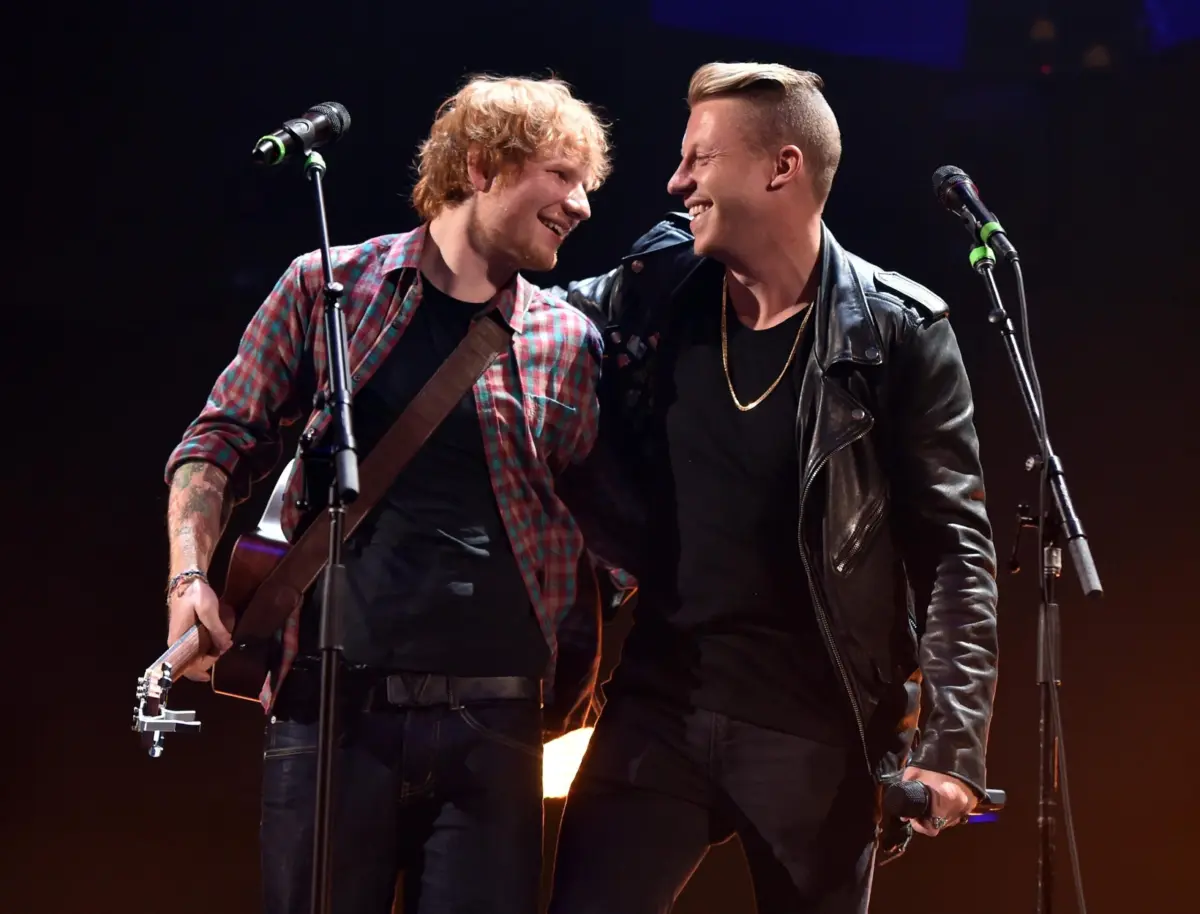
What began as a routine pop music tour has rapidly mutated into a high-stakes cultural firestorm, exposing deep ideological fissures within Western entertainment, corporate real estate, and modern geopolitical discourse. Benjamin Hammond Haggerty—better known by his stage name, Macklemore—found himself at the epicenter of an international controversy that ultimately imploded Ed Sheeran’s blockbuster, 59-date global "Loop Tour."
The escalating crisis, which has seen venue owners, major pop stars, backing bands, and opening acts violently collide, serves as a vivid micro-chasm of contemporary Western polarization. At its core, the saga encapsulates the volatile intersection of celebrity activism, the boundaries of corporate speech, the specter of historical antisemitism, and the rapidly shifting landscape of American generational attitudes toward the Middle East. What started as a dispute over a rapper’s on-stage political polemic has escalated into a comprehensive institutional reckoning, demonstrating how fragile modern cultural infrastructure has become when forced to navigate the third rail of international politics.
Detailed Chronology of a Collapse
To understand how a major international concert tour completely unraveled, one must trace the timeline of events that transformed musical stages into ideological battlegrounds.
The friction began when Macklemore, a staple of millennial-era hip-hop whose career experienced a massive resurgence through social media activism, aligned himself vocally and musically with the Palestinian independence movement. His advocacy culminated in the release of "Hind’s Hall," a protest track named in honor of the student-led occupations at Columbia University. While the song struck a chord with progressive activists, it immediately alienated vast swaths of concertgoers and industry insiders who viewed his involvement through a more critical lens, pointing to historical controversies—most notably a 2014 incident where the rapper wore a costume widely condemned as containing antisemitic tropes, for which he later issued a lengthy apology.
The tension reached a boiling point in mid-September during Ed Sheeran’s sprawling international tour, on which Macklemore was serving as a prominent opening act.
The Turning Point: Pink’s Public Rebuke
The dam broke on a Friday when pop superstar Pink published a scathing, detailed critique of Macklemore’s on-stage rhetoric. Pink targeted the rapper’s use of inflammatory wartime imagery and aggressive geopolitical polemics during his live sets, arguing that his commentary had crossed the line from political expression into fear-mongering that deeply frightened Jewish concertgoers, including herself. The public rebuke by a fellow tour-adjacent mega-star stripped away the protective insulation typically afforded to high-profile musicians engaged in political messaging.
The Corporate and Venue Backlash
Simultaneously, the corporate machinery behind large-scale live entertainment began to shudder. Robert Kraft—the billionaire sports magnate, owner of the New England Patriots, and operator of Gillette Stadium just outside Boston—reportedly notified tour organizers that Macklemore would be barred from performing at his venue for an upcoming late-September show. Kraft, who is prominent in Jewish philanthropic and cultural circles, explicitly cited Macklemore’s recent pro-Palestinian advocacy combined with his historical controversies as grounds for the denial, pointing to a "history of antisemitic rhetoric."
Faced with mounting pressure, tour organizers revealed that multiple venues across the international circuit had issued ultimatums: either Macklemore was removed from the bill, or the shows would be entirely canceled. Bowing to logistical and financial realities, tour management officially dropped Macklemore from the remainder of the Loop Tour.
The Domino Effect: Backing Bands and Openers Walk Out
Yet, in the hyper-connected political climate of 2026, the expulsion of a controversial artist could not happen quietly. The decision to boot Macklemore triggered an immediate, cascading mutiny from within the tour’s own ranks. By Tuesday, the remaining opening acts announced they were walking away from the tour in direct protest of the decision. In an extraordinary display of solidarity, Ed Sheeran’s own backing band pulled out of the remaining dates, leaving the blockbuster tour in absolute disarray and forcing industry analysts to question the future viability of mixing overtly divisive political messaging with commercial live music enterprises.
Supporting Context & Metrics: Generational Shifts on Israel
The public implosion of the Loop Tour is far more than a localized dispute between a rapper and a stadium owner; it is a symptom of a profound, quantifiable demographic shift in how Americans view the Israeli-Palestinian conflict.
For decades, bipartisan and cross-generational support for the state of Israel was a foundational pillar of American foreign policy and cultural consensus. However, over the past ten to fifteen years, that consensus has fractured along stark generational lines.
The Millennial Vanguard and Gen Z Radicalization
While much of the media focus has centered on Generation Z college students occupying campus quads—a phenomenon that prompted Israeli Prime Minister Benjamin Netanyahu to publicly concede that his nation "has work to do to win over Gen Z"—the generational rebellion actually began years earlier with American millennials.
Demographic polling data underscores this evolution. Pew Research Center data from the 2014 Gaza war revealed that Americans under 30 were already noticeably more likely to blame Israel than Hamas for the outbreak of hostilities—a stark departure from older cohorts. Throughout the mid-2010s, millennial activists successfully wove Palestinian advocacy into broader progressive frameworks, linking international anti-colonialism with domestic social justice initiatives like Black Lives Matter. Organizations that spearheaded the massive campus demonstrations of 2024 were frequently built upon infrastructural foundations laid a decade prior.
The 35–54 Demographic Tipping Point
Crucially, the attitudinal shift is no longer confined to the progressive fringe or the youngest voters. Recent data from Gallup and other major polling institutions indicates that sympathy for Israel has experienced a steady, downward trend across nearly all age brackets.
However, the most statistically significant drop over the past two years has occurred among Americans aged 35 to 54—the exact generational demographic that forms the core fanbase of artists like Macklemore and Ed Sheeran. This middle-aged cohort, having matured during a different geopolitical era, is driving a broader narrative shift in U.S. public opinion, rendering cultural spaces that were once reliably neutral into battlegrounds of intense ideological debate.
Official Statements and Industry Reactions
The fallout from the tour cancellation prompted a flurry of formal responses from the primary stakeholders, each attempting to frame the controversy through their own lens of principle and operational necessity.
- Ed Sheeran and Tour Management: In subsequent statements, tour organizers emphasized the impossible logistical position they were placed in. They confirmed that numerous international venues threatened sweeping cancellations if Macklemore remained on the bill, leaving management with what they described as a binary choice between salvaging the tour for thousands of waiting fans or facing total operational paralysis.
- Robert Kraft and Venue Ownership: Representatives for Kraft reaffirmed the stance taken regarding Gillette Stadium, emphasizing that venue owners bear a corporate and moral responsibility to ensure the safety and psychological well-being of all patrons. They underscored that Macklemore’s public commentary crossed boundaries by invoking inflammatory wartime rhetoric alongside past behavioral controversies.
- Macklemore and Supporters: While the rapper has largely allowed his artistic output and prior statements to stand as his defense, his supporters and the artists who walked off the tour in protest framed their actions as a defense of free expression, artistic integrity, and the fundamental right to protest foreign policy without facing corporate blacklisting.
Future Outlook: The New Normal for Live Entertainment
As the dust settles on the wreckage of the Loop Tour, entertainment executives, booking agents, and artists are left grappling with a transformed landscape. The incident signals the permanent death of the "apolitical pop concert."
For decades, major touring acts operated under the implicit assumption that music could transcend political divisions, serving as a unifying cultural balm. Today, that illusion has been thoroughly shattered. Venues are increasingly acting as ideological gatekeepers, exercising their property rights to preemptively cancel acts deemed too controversial, while artists and backing musicians are displaying an unprecedented willingness to sacrifice lucrative contracts on the altar of political solidarity.
As generational demographics continue to shift and public opinion regarding international conflicts remains intensely polarized, the Macklemore-Sheeran tour collapse will likely be studied not as an isolated anomaly, but as the moment live entertainment officially entered a perilous new era of ideological accountability.