Executive Overview
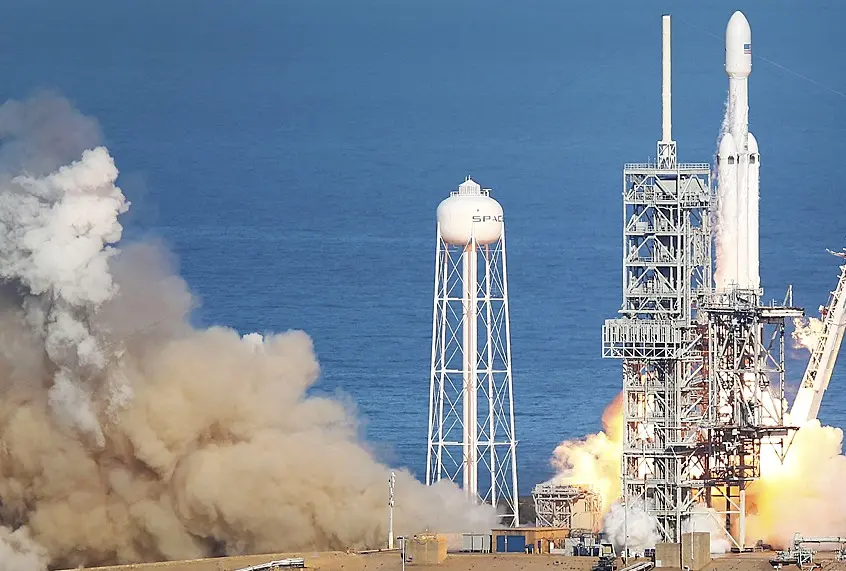
On February 6, 2018, the aerospace industry crossed a historic threshold. At 3:45 PM EST, SpaceX successfully executed the maiden flight of its Falcon Heavy rocket from historic Launch Complex 39A at the Kennedy Space Center in Florida. More than just a demonstration of unprecedented heavy-lift engineering—which culminated in the breathtaking, simultaneous synchronized landing of two reusable side boosters—the launch carried an eccentric, highly publicized payload: a cherry-red Tesla Roadster driven by a mannequin affectionately dubbed "Starman."
Broadcast globally across multiple digital and social media platforms, the live-streamed footage provided millions of viewers with crystal-clear, uninterrupted views of Earth from deep space. As the vehicle ascended past the stratosphere, the undeniable, spheroidal curvature of our home planet came into sharp relief against the infinite black vacuum of the cosmos.
Almost immediately, a secondary cultural phenomenon erupted online. The vivid imagery prompted an immediate wave of commentary across social media platforms, directed squarely at a resilient, if scientifically marginalized, subculture: flat-Earth truthers. Observers, influencers, and science advocates alike flooded feeds with memes and rhetorical challenges, asking a singular question: Will the definitive, high-definition proof of a round Earth finally put the flat-Earth conspiracy to rest?
This article examines the landmark engineering achievements of the Falcon Heavy launch, analyzes the mechanics of modern spaceflight documentation, explores the core tenets of flat-Earth belief systems, and investigates why psychological resilience in the face of empirical evidence ensures that visual proof alone is rarely enough to bridge the gap between science and conspiracy.
Detailed Chronology: A Day That Redefined Commercial Aerospace
To understand the cultural and scientific impact of the February 6 launch, one must look closely at the sequence of events that unfolded at the Kennedy Space Center and in the skies above the Atlantic Ocean.
T-Minus Hours: Anticipation and Uncertainty
The atmosphere at Cape Canaveral in the days leading up to the launch was thick with nervous anticipation. SpaceX CEO Elon Musk had repeatedly cautioned the public and media that the Falcon Heavy’s inaugural flight carried an unusually high risk of failure. Unlike standard commercial payloads worth hundreds of millions of dollars—which insurers would demand fly on proven configurations—the inaugural flight of a rocket comprising three modified Falcon 9 cores strapped together was an experimental gamble. Musk famously estimated a 50% chance that the rocket would either clear the pad successfully or tear itself apart mid-flight, potentially destroying historic Launch Complex 39A, the very site from which Apollo Saturn V rockets and Space Shuttles had departed for the Moon and low Earth orbit.
Lift-Off at 3:45 PM EST
When the countdown hit zero, 27 Merlin engines roared to life, generating a staggering 5 million pounds of thrust at lift-off. The sheer acoustic energy shook the surrounding Florida wetlands and rattled the windows of press enclosures miles away. Slowly, majestically, the massive white vehicle cleared the tower. For the first few minutes of flight, millions watched with bated breath as the vehicle passed through Max-Q (maximum aerodynamic pressure), the most physically punishing phase of ascent.
The Dual Booster Landing
Roughly two and a half minutes into the flight, the two side boosters successfully separated from the central core, flipped in mid-air using cold-gas thrusters, and began their powered descent back toward Cape Canaveral Air Force Station. Minutes later, both boosters touched down simultaneously on Landing Zones 1 and 2 in a synchronized ballet of precision engineering. The twin sonic booms rolled across the coastline, signaling not just a successful launch, but a monumental leap forward in rocket reusability.
Deep Space Insertion and "Starman"
While the central core ultimately missed its target drone ship in the Atlantic Ocean due to an engine ignition failure during its final landing burn, the upper stage coasted successfully into Earth orbit. Following a prolonged dwell period, a final burn sent the upper stage—and its unusual cargo, the Tesla Roadster carrying Starman—on a hyperbolic trajectory toward a solar orbit that would eventually cross the orbit of Mars.
As the cameras mounted on the car’s frame began broadcasting live views of the vehicle floating against the stunning backdrop of planet Earth, the internet reacted in real time. The horizon bowed gracefully, oceans gleamed blue beneath swirling cloud patterns, and the thin, fragile blue line of the atmosphere separated life from the void. For the mainstream world, it was an awe-inspiring confirmation of humanity’s place in the solar system. For internet commentators, it was an irresistible moment to mock modern conspiracy theories.
Supporting Context & Metrics: The Anatomy of Falcon Heavy and the Flat-Earth Phenomenon
Engineering Specifications of the Falcon Heavy
To grasp why the February 6 launch was a technological watershed, one must look at the raw metrics of the Falcon Heavy system:
- Total Height: 70 meters (229.6 feet)
- Total Mass at Lift-Off: 1,420,788 kilograms (3,125,735 pounds)
- Payload Capacity to Low Earth Orbit (LEO): 63,800 kilograms (140,660 pounds)
- Payload Capacity to Mars: 16,800 kilograms (37,000 pounds)
- Total Engine Count: 27 Merlin 1D engines operating concurrently on the first stage.
This heavy-lift capacity essentially doubled the capability of any operational rocket flying at the time, opening up deep-space exploration pathways previously restricted to government-funded agencies like NASA.
The Persistence of the Flat-Earth Belief System
In stark contrast to the precision of orbital mechanics stands the flat-Earth movement. Adherents of this worldview maintain that the Earth is not an oblate spheroid, but rather a disk-like plane centered around the Arctic, bounded by an impenetrable wall of Antarctic ice.
Core assertions of the movement include:
- Denial of Gravity: Many flat-Earthers argue that gravity does not exist, attributing downward acceleration instead to the disk of the Earth accelerating upward through space driven by "universal acceleration," or alternatively, density and buoyancy principles.
- The "CGI" Conspiracy: All photographic and video evidence originating from space agencies (NASA, SpaceX, ESA) or private satellite operators is systematically dismissed as computer-generated imagery (CGI) or studio fabrications designed to maintain a multi-billion-dollar global deception.
- The Ice Wall Hypothesis: The Antarctic continent is re-imagined not as a southern polar landmass, but as a ring of towering ice cliffs that prevent oceans from spilling off the edge of the planetary disk.
From a sociological and psychological standpoint, researchers studying conspiracy theories note that flat-Earth beliefs offer adherents a profound sense of specialized belonging, moral superiority, and empowerment. By believing that institutional science is fundamentally corrupt, adherents position themselves as enlightened "truth-seekers" who have penetrated a global deception.
Official Statements and Social Media Reactions
The juxtaposition between advanced aerospace engineering and internet meme culture played out vividly across digital platforms during and immediately after the launch.
Elon Musk and SpaceX Mission Control
Following the successful deployment of the Tesla Roadster, Elon Musk took to Twitter and addressed reporters at post-launch press conferences with a mixture of humor and philosophical reflection.
"Life cannot just be about solving one miserable problem after another," Musk remarked during the post-launch briefing. "There need to be things that inspire you, that make you glad you are waking up in the morning and be proud to be human. That is why we did this."
Musk also highlighted the bizarre nature of the payload, noting the surrealism of watching a commercial automobile cruise through the cosmos playing David Bowie’s "Space Oddity" on a continuous loop.
The Internet Reacts: Memes vs. Reality
Social media users immediately recognized the public relations goldmine the launch provided regarding science denialism. Comedians, influencers, and everyday users flooded Twitter and Instagram with witty ripostes:
- Sebastian Bell (@sepsis13): "Suck it Flat Earthers. #Starman"
- Skyler (@thatguysky13): "Look you can see the curvature of the Earth, I bet the flat Earthers are pissssed."
- Dave Days: "Flat earth officially debunked… with style @SpaceX #FlatEarth"
Sarcasm became the weapon of choice for many digital commentators who posted images of the curved horizon with captions playfully asserting, "Look at that flat earth," highlighting the cognitive dissonance required to maintain flat-Earth beliefs in the face of panoramic visual evidence.
Future Outlook: The Intersection of Public Science Communication and Conspiracy
While the live footage from the Falcon Heavy launch provided breathtaking confirmation of planetary geography for the vast majority of the global population, sociologists of science and psychology experts predicted accurately that it would do little to convert dedicated flat-Earth truthers.
Why Visual Proof Fails Against Conspiratorial Ideology
In the psychology of belief systems, confirmation bias and motivated reasoning create a powerful psychological armor. When presented with evidence that directly contradicts a core worldview—such as high-definition video of Earth’s curvature—conspiracy theorists do not update their model of reality. Instead, they incorporate the new evidence into their existing narrative framework.
In the case of the SpaceX broadcast, flat-Earth forums and communities quickly generated counter-explanations:
- They claimed the camera lenses used on the Falcon Heavy upper stage utilized wide-angle or "fisheye" lenses specifically engineered to artificially introduce curvature into a flat plane.
- They questioned the timing and continuity of the live stream, suggesting edits or composite rendering during signal handover periods.
- They argued that commercial entities like SpaceX are corporate contractors functioning as extensions of government space agencies, meaning their footage is subject to the same institutional "falsification."
The Broader Legacy of the Falcon Heavy Flight
Ultimately, while the February 6, 2018 launch failed to eradicate fringe conspiracies, its true legacy lies elsewhere. It permanently shifted the economics of space exploration, proving that heavy-lift vertical landing and rocket reusability were viable engineering paradigms. It democratized the visual narrative of space, allowing millions of everyday citizens to experience the sublime perspective of our planet hanging suspended in the dark expanse of space.
As commercial spaceflight continues to expand in the decades following this milestone—paving the way for private orbital tourism, lunar return missions, and crewed voyages to Mars—the gulf between empirical scientific reality and ideological skepticism will likely persist. Yet, for science communicators and space enthusiasts alike, the image of Starman cruising against the breathtaking, undeniable curve of the Earth remains an enduring monument to human ingenuity and the triumph of verified empirical truth.