Executive Overview
For nearly two decades, the software industry has operated under a rigid, unwritten law: the 14-day free trial. Born in the era of legacy SaaS giants like Salesforce and HubSpot, this two-week window became the default testing ground for everything from enterprise resource planning platforms to consumer photo editors. Founders and product-led growth (PLG) teams adopted it universally, rarely questioning whether a fortnight was truly the optimal timeframe for a customer to understand, internalize, and commit to a product’s value.
Now, the foundational data layer of the mobile subscription economy has blown that orthodoxy wide open.
RevenueCat, which powers the subscription and revenue infrastructure for over 60% of mobile subscription applications globally, has published one of the most comprehensive datasets on free trial behavior ever assembled. Analyzing the performance of more than 17,000 mobile applications over a full operational year—from August 2025 through July 2026—the study tracks trial lengths, conversion curves, and long-term retention cohorts at an unprecedented scale.
While a significant portion of RevenueCat’s ecosystem skews toward B2C titans (fitness apps, streaming services, photo editors, and language learning tools), its underlying mechanics hold profound implications for B2B software, developer tools, and especially the booming sector of artificial intelligence applications. The findings demonstrate a stark reality: the traditional 14-day trial is often a suboptimal compromise, leaving massive amounts of revenue and customer lifetime value (LTV) on the table—particularly for annual commitments.
As software companies grapple with rising user acquisition costs, infrastructure burn—especially the heavy compute bills of generative AI inference—and shifting global buying behaviors, this dataset provides an urgent roadmap. It’s time to stop blindly copying legacy benchmarks and start aligning trial architecture with the actual time-to-value of the product.
Detailed Chronology: The Evolution of Software Trials and the Shift in Data Scale
To understand why this new dataset represents a watershed moment for product strategy, one must trace the evolutionary path of software distribution models over the last twenty years.
The Era of Legacy SaaS (Late 2000s – Early 2010s)
When cloud-based software first disrupted on-premise deployments, companies had to convince buyers to trust web-delivered infrastructure. The 14-day trial emerged as a psychological sweet spot. It was long enough to give a prospective buyer a taste of the tool, but short enough to create a sense of urgency. Because these early tools were largely desktop-bound, workflow-oriented B2B systems, sales teams utilized the 14-day mark as a hard boundary to trigger aggressive outreach calls, pushing for an annual or multi-year contract before momentum died.
The Mobile App Boom and the Race for Volume (2015 – 2023)
As the App Store and Google Play matured, consumer subscription apps adopted aggressive growth hacking techniques. Many top-tier apps chased volume by shrinking trials to four days or less, or abandoning them altogether in favor of immediate monetization supported by heavy performance marketing. Cash could be realized faster, and feedback loops from paid acquisition channels tightened. During this period, trial lengths were dictated less by user psychology and more by cash-flow velocity and the desire to mimic category leaders.
The Comprehensive Dataset Era (2025 – 2026)
Enter the current epoch defined by RevenueCat’s massive ecosystem visibility. By tracking billions of subscription events across diverse verticals—spanning consumer utilities, workflow productivity tools, and modern AI wrappers—analysts now possess the granular cohort tracking required to move past anecdotal assumptions. The data compiled between August 2025 and July 2026 captures an industry at a crossroads, balancing the skyrocketing costs of customer acquisition against the need for durable, high-retention cohorts.
What the chronology reveals is simple: while early software eras optimized for initial transaction speed, today’s saturated market demands an optimization for long-term retention. And the data proves that longer evaluation windows—when properly structured—produce vastly superior cohorts.
Supporting Context & Metrics: Deep Dive into the Data
The RevenueCat dataset shatters several long-held myths about trial length, slicing the metrics by commitment type (annual vs. monthly), geographic region, and product category.
1. The Annual Plan Revelation: Why 30 Days Wins
For annual subscriptions, the data is unequivocal: longer trials yield substantially better conversion and retention rates.
- Conversion Climbs with Time: On annual plans, user conversion rose step-for-step with trial length. Trials lasting 4 days or less converted just 24% of users. That figure climbed to 33% for 5-to-9-day trials, reached 43% for 10-to-16-day trials, and peaked at a remarkable 44.6% for trials stretching between 17 and 32 days.
- The Retention Multiplier: First-year renewals moved even more dramatically, surging from 18.3% on short trials to 47.5% on the longest trials.
- The Compounded Impact: When combining conversion and renewal metrics—measuring the sheer share of initial trial users who paid and subsequently renewed a full year later—the results are staggering. The shortest trials achieved a meager 3.5% long-term retention rate, whereas the longest trials hit 18.5%. This means companies running 30-day trials secured more than 5 times the number of retained customers from the exact same volume of initial trial starts.
The B2B Translation: Committing to an annual software contract requires organizational alignment, budget approval, and workflow integration. Forcing a buyer into an annual commitment after only a few days creates friction and remorse. Giving buyers up to a month to evaluate builds genuine confidence, filtering out low-intent users while forging deeply loyal customers out of those who cross the finish line.
2. Monthly Plan Dynamics and the Sweet Spot
While annual plans heavily favor extended timelines, monthly subscriptions present a more nuanced picture.
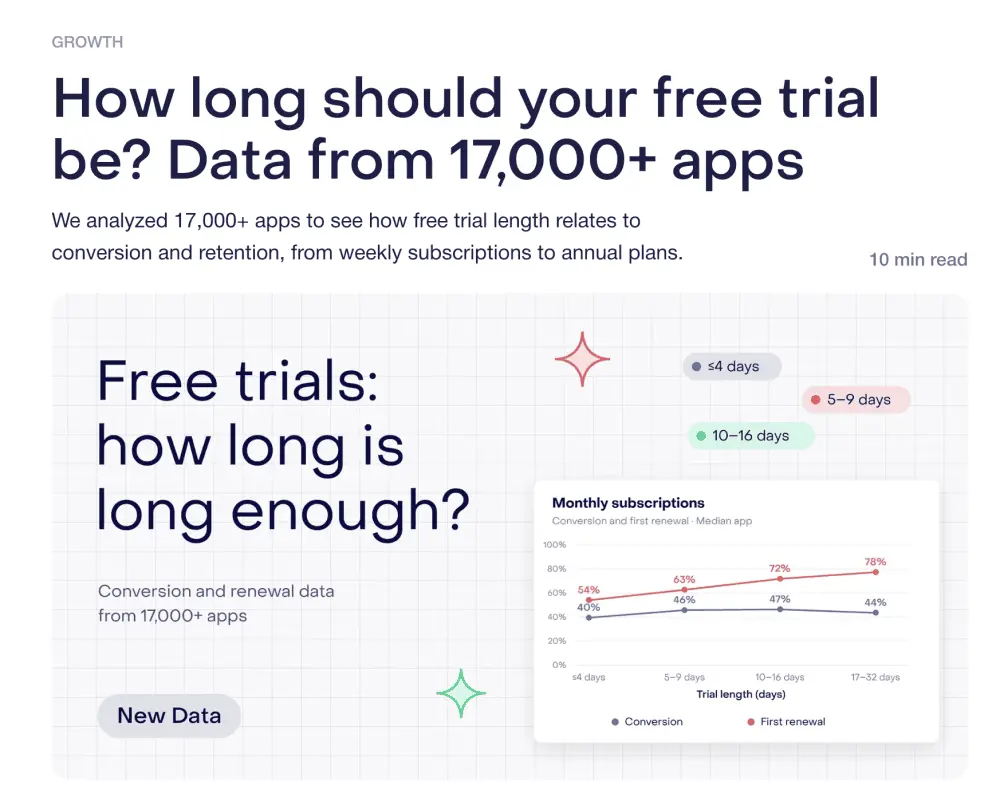
- The Sweet Spot: Monthly conversion rates peaked at 46.6% on 10-to-16-day trials. Pushing beyond 16 days saw conversion rates flatten or slightly decline.
- The Retention Trade-off: While conversion peaked at the two-week mark, renewal rates continued to climb slightly before leveling off. Overall, roughly 30.6% of users in the 10-to-16-day bracket paid and maintained their subscription through the first renewal cycle.
For self-serve, product-led monthly B2B products, the traditional 14-day trial actually lands within an empirically sound zone. Founders must decide whether their primary funnel leak is conversion (requiring a tighter window) or churn (requiring deeper engagement and potentially a slightly longer evaluation period).
3. The Danger of Eliminating Trials Entirely
Some founders attempt to bypass the conversion drop-off by eliminating free trials altogether, forcing upfront payment. The data highlights a distinct bifurcation based on billing frequency:
- Monthly No-Trial Reality: Monthly buyers with no trial renewed at a modest 49.5%, compared to 77.5% for users emerging from 17-to-32-day trials.
- Annual No-Trial Anomaly: Conversely, annual buyers who paid upfront with no trial renewed at 26.6%—outperforming short trials (18.3% for ≤4 days; 25.3% for 5–9 days) and only beaten by trials lasting 10+ days (reaching up to 47.5%).
This points to a clear psychological profile: the no-trial annual buyer is typically an enterprise, sales-assisted, or highly driven referral customer who already knows precisely what they want. Meanwhile, a customer pushed into an annual plan immediately following an abbreviated 3-day trial forms one of the weakest cohorts in the entire dataset.
4. The Artificial Intelligence Dilemma: The Cost of Inference
For the burgeoning sector of B2B artificial intelligence applications, the RevenueCat study delivers a critical warning.
Unlike traditional software—where an idle user sitting in a trial account costs the business virtually nothing—every single interaction with an AI tool burns compute resources through Large Language Model (LLM) inference tokens.
- Diminishing Returns for AI: For AI apps on monthly plans, conversion rates dropped significantly from 38.5% down to 31.8% once trial lengths pushed past 16 days.
- The Cost of Extended Trials: Pushing monthly AI trials into the 17-to-32-day bracket produced fewer paying customers and zero net gain in retention (holding flat at 64.1% compared to 64.2% for 10-to-16-day windows). Two extra weeks of free inference simply burned capital on users who ultimately churned.
- Underperforming Benchmarks: AI apps consistently converted and renewed at lower rates than non-AI apps across nearly every monthly trial length, meaning the margin for structural trial error is razor-thin.
Strategic Takeaway for AI Startups: Time-based trials for AI applications should rarely exceed two weeks. If buyers require extended evaluation periods for annual commitments, companies should pivot from time-based limitations to usage-capped models (such as credit limits, prompt caps, or seat restrictions). This gives enterprise buyers the calendar room they need while safeguarding the startup from crippling inference overhead.
5. Geographic and Category Variations
Subscription behavior is far from monolithic across global markets:
- North America and Western Europe demonstrated consistent performance gains with longer annual trials, rewarding extended evaluation periods all the way up to 32 days.
- Emerging Markets (including Latin America, India, Southeast Asia, and the Middle East & Africa) favored shorter evaluation windows, often peaking sharply at 5 to 9 days, with conversion rates dropping significantly on extended trials.
- Utilities and Productivity Apps—the closest mobile analogs to B2B software—saw first-year renewal rates skyrocket to 77.9% after the longest trials, compared to 55% for the shortest trials. While a short trial can prove a utility tool works, a longer trial allows the software to weave itself into a recurring weekly workflow, driving multi-seat expansion and long-term retention.
Official Perspectives & Industry Insights
Industry veterans and venture capitalists have been quick to dissect the operational lessons embedded within the RevenueCat dataset.
Prominent startup investors and operators note that the modern software landscape has suffered from "path dependency"—the tendency for founders to copy pricing pages, packaging models, and trial lengths from legacy incumbents without running localized experiments.
"In B2B, most of us run 14-day trials simply because Salesforce and HubSpot did it fifteen years ago, and then we push the annual plan hard on day fourteen," industry analysts observe. "If you want a secure 12-month commitment, the empirical data strongly suggests giving buyers closer to thirty days to make up their minds. Forcing an enterprise or team buyer to digest an annual contract inside two weeks is an artifact of old sales motions, not modern buyer psychology."
Furthermore, product growth leaders emphasize the dataset’s critical nuance regarding active engagement. RevenueCat rightly points out a core correlational caveat: users who remain active on day 25 of a trial are inherently more intent-driven than those who abandon ship on day two. Part of the outperformance of longer trials is driven by self-selection—the right users stick around. However, the sheer magnitude of the retention lift proves that calendar breathing room fundamentally changes the economics of high-commitment purchases.
Future Outlook: Redesigning the Modern Software Funnel
As the software industry matures past the hyper-growth exuberance of the early 2020s into an era defined by capital efficiency, unit economics, and sustainable growth, trial architecture is undergoing a quiet revolution.
Moving forward, winning B2B and AI software companies are expected to abandon blunt, one-size-fits-all trial lengths in favor of dynamic, context-aware onboarding funnels:
- Segmented Trial Lengths by Billing Tier: Companies will increasingly decouple monthly and annual trial lengths. While monthly self-serve products may retain a streamlined 7-to-14-day window to maintain cash velocity, annual contracts will expand toward 30-day evaluation periods to accommodate internal procurement and stakeholder review cycles.
- Usage-Based Guardrails for AI: AI-native platforms will reject open-ended time trials in favor of hybrid models—combining a short calendar window with strict token or compute consumption limits. This protects gross margins from runaway inference costs while accommodating genuine buyer evaluation.
- Regionally Adapted Pricing Logic: Globalized SaaS companies will tailor trial durations to geographic purchasing behaviors, deploying shorter evaluation cycles in price-sensitive emerging markets while maintaining extended, relationship-building trials across North America and Western Europe.
- Continuous Experimentation Culture: Most importantly, leadership teams will audit their historical defaults. The era of blindly copying legacy SaaS benchmarks is over.
The data is clear: 17,000 applications have spoken. The traditional trial playbook is broken, and the companies that re-engineer their funnels around real customer time-to-value will capture the lion’s share of market loyalty in the years ahead.