Executive Overview
As B2B and artificial intelligence companies finalize their event budgets for the upcoming year, a familiar and expensive cycle is repeating itself. Driven by slick marketing decks, heavily promoted press releases, and AI-generated "best conference" roundups, organizations are rapidly committing capital to crowded exhibition floors. By the third quarter, however, many marketing leaders will face a stark reality: half their booths produced no meaningful pipeline, and their return on investment (ROI) looks dismal.
The conference ecosystem is plagued by self-reported attendance figures that go completely unaudited. When events claim massive leaps in crowd sizes, the actual experience on the show floor often tells a different story—one of empty aisles and low-intent foot traffic.
To help revenue leaders, founders, and CMOs protect their capital, this analysis cuts through the promotional noise. By examining verified sponsor outcomes, evaluating the financial health of event organizers, and establishing strict qualification criteria, this guide provides a tactical roadmap for where—and where not—to invest your 2027 event budget.
Detailed Chronology & Event Landscape for 2027
Navigating the 2027 conference calendar requires strict adherence to timelines and a clear understanding of when and where key buyers congregate. Below is the chronological breakdown of major B2B, AI, and vertical events shaping the market.
Q1 2027: Early-Year Kickoffs and Focused Summits
- January 21, 2027: GTM Alliance: AI for GTM Festival (San Francisco). A concentrated, single-day event co-located with RevOps and Sales Enablement summits. Best suited for teams targeting RevOps practitioners rather than enterprise-level budget holders.
- February 24–25, 2027: AI for Marketers Summit (Las Vegas). A highly niche, marketing-specific AI conference. Worth considering only if your Ideal Customer Profile (ICP) sits strictly within marketing departments.
- March 7–10, 2027: HumanX (Las Vegas). Returning to Las Vegas after a stint in San Francisco, HumanX faces scrutiny regarding its 2026 attendance claims and an aggressive push for 700+ sponsors in 2027. Vendors should consider opting out of expensive booths and instead utilize structured meeting programs like SolutionBridge or VentureConnect.
- March 22–24, 2027: Shoptalk Spring (Las Vegas). Retail and e-commerce’s marquee event. Distinguished by its buyer-centric matchmaking program—where qualified retail decision-makers receive all-access passes and travel reimbursements in exchange for guaranteed meetings—it offers exceptional buyer density for retail-focused tech stacks.
- March 23–25, 2027: Adobe Summit (Las Vegas). A major platform event critical for ISVs and ecosystem partners tightly integrated with Adobe’s enterprise architecture.
Q2 2027: The Core GTM and Enterprise Conference Window
- April 5–7, 2027: POSSIBLE (Miami Beach). Rapidly expanding marketing festival drawing major brand leaders, agencies, and ad tech innovators. For B2B and AI firms, the invitation-only CMO Lab represents the primary high-value engagement zone.
- April 13–15, 2027: Google Cloud Next (Las Vegas). A massive gathering of cloud architects, CIOs, CTOs, and developers. Because revenue leaders comprise a small fraction of the attendees, sponsorship is only viable for companies leveraging the Google Cloud Marketplace, co-selling with Google’s field teams, or participating in the April 12 Partner Summit.
- May 2–4, 2027: Forrester B2B Summit (Phoenix). Targeting enterprise marketing organizations. However, parent-company revenue declines and shrinking event P&Ls warrant caution. Prospective sponsors should request concrete 2026 reference metrics before signing agreements.
- May 11–12, 2027: SaaStr AI Annual (SF Bay Area). Evolving into a premier agents and go-to-market (GTM) event, bringing together founders, CROs, CMOs, and VCs. Programming centers squarely on deploying AI within revenue organizations.
- May/Spring 2027 (Exact Dates TBD): Gartner CSO & Sales Leader Conference (Las Vegas). The definitive analyst-backed gathering for Chief Sales Officers and sales operations leaders, offering high-intent access to pure revenue-leadership buyers.
- June 7–9, 2027: Gartner Marketing Symposium/Xpo (Denver). Positioned at the Gaylord Rockies, this is a premium, analyst-driven destination for enterprise marketing leaders, currently outperforming competing CMO events in market health.
- June 16, 2027: Go-to-Market Festival (London). A localized European counterpart to GTM Alliance’s U.S. programming, targeting operational and enablement leaders.
Q3 & Q4 2027: Late-Year Industry Flagships
- October 18–21, 2027 (Tentative): Money20/20 USA (Las Vegas). The definitive global stage for fintech, banking, and payment technologies. Featuring extensive matchmaking platforms and thousands of verified industry executives, it remains a must-attend for companies selling into financial services.
Supporting Context & Metrics: How to Evaluate Any Conference
To avoid falling victim to vanity metrics, B2B marketers must adopt an investigative mindset. Before allocating capital to any event in 2027, leadership teams should evaluate every opportunity against five core criteria:
- Who controls the budget in that room?
A single Chief Revenue Officer or VP of Sales holding an active software budget is worth fifty individual practitioners. Prioritize rooms with high density over sheer volume. A focused gathering of 2,000 revenue executives vastly outperforms a 30,000-person engineering convention if your product targets the C-suite. - What were the verified lead counts from prior sponsors?
Never rely on vague ranges or percentages listed in sponsorship prospectuses. Demand exact, audited lead counts broken down by sponsor tier from the previous year, and independently reach out to past sponsors to verify their pipeline reality. - What is the sponsor density and competitive clutter?
When an AI conference lists upwards of 700 sponsors, brand dilution becomes inevitable. At such high densities, only the most expensive, top-tier packages secure meaningful visibility. - Is it a platform ecosystem event?
Conferences like Dreamforce, Google Cloud Next, and HubSpot’s UNBOUND deliver incredible returns only if your business model relies on selling directly into that platform’s established installed base or partner network. - What does the organizer’s financial health indicate?
Publicly traded conference organizers and market research firms report their event P&Ls quarterly. A shrinking event revenue stream typically signals a diminishing room size, regardless of what the marketing copy promises.
Official Insights & Case Studies: Inside Tier-1 Events
Examining audited performance data from established GTM events reveals what is truly achievable when event programming aligns with buyer intent.

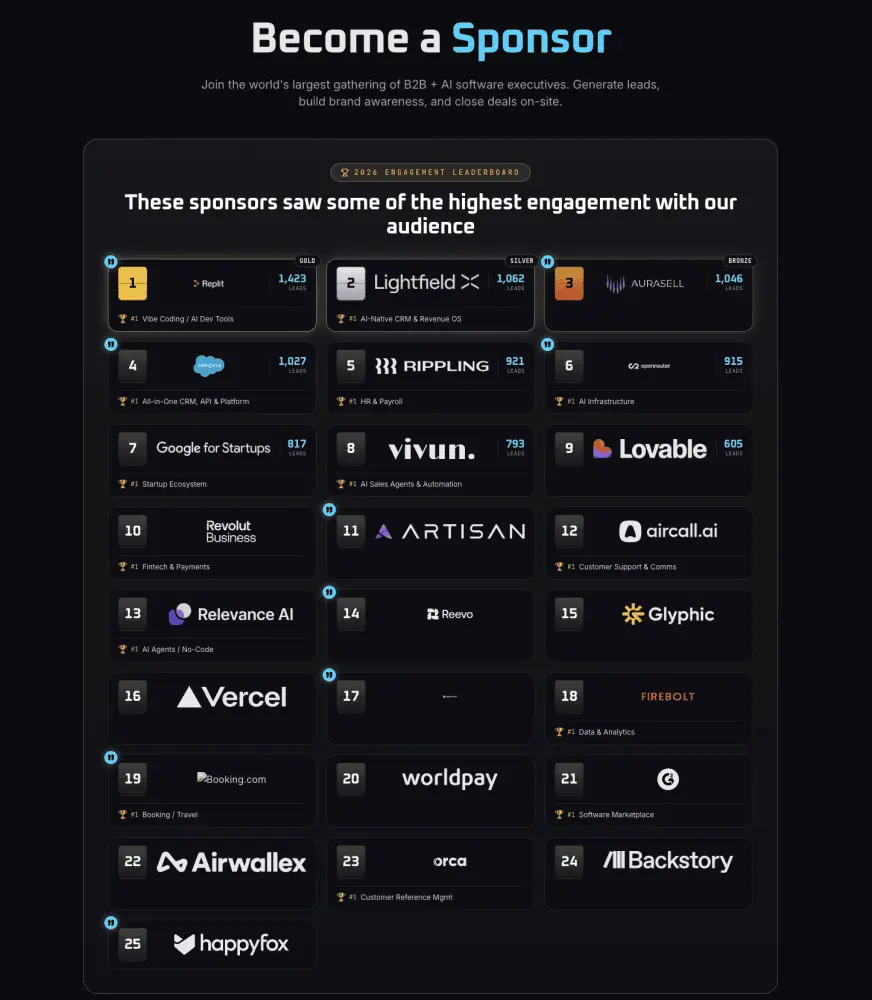
At the SaaStr AI Annual, historical lead tracking demonstrates that successful sponsors are not restricted solely to GTM tooling. While revenue-focused platforms like Lightfield, Aurasell, Salesforce, and Vivun captured substantial pipeline, infrastructure and developer tools such as Replit, Lovable, and OpenRouter—alongside operational platforms like Rippling—each secured upwards of 600 qualified leads from the same room.
Execution on the show floor and stage plays a pivotal role. For instance, Aurasell leveraged high-impact booth placement to drive high-velocity interactions, noting instances where enterprise clients committed to software transitions days after initial introductions. Similarly, live-demo stage presence—such as Artisan’s deployment of an AI BDR on stage—yielded over 600 qualified leads, significant closed-won ARR on-site, and millions in influenced pipeline during prior deployments.
These outcomes emphasize a critical rule: apply rigorous verification. Ask event organizers for direct sponsor references, and call those references to validate whether the projected ROI materialized.
Future Outlook: Strategic Allocation for 2027 Budgets
As the B2B software and artificial intelligence markets mature, the era of blanket event sponsorships is officially over. CFOs and CMOs are demanding rigorous attribution, measurable pipeline velocity, and undeniable proof of buyer intent.
To maximize a 2027 event budget, organizations must pivot toward targeted precision:
- Concentrate on Decision-Makers: Direct investments toward events where C-suite revenue buyers, CSOs, and CMOs hold undisputed majority presence.
- Audit Before You Commit: Dismiss self-reported headline attendance numbers in favor of peer reviews, floor feedback, and verified sponsor references.
- Blend Horizontal GTM with Vertical Scale: Balance core AI and revenue-leadership events with high-density vertical gatherings (such as Shoptalk for retail or Money20/20 for fintech) where your specific Ideal Customer Profile concentrates in volume.
By treating event sponsorship with the same rigorous financial scrutiny applied to paid acquisition and outbound pipelines, B2B and AI companies can eliminate wasted spend, dominate the right show floors, and drive sustainable revenue growth throughout 2027 and beyond.