Executive Overview
Nintendo and developer Intelligent Systems have long steered clear of direct, hard-hitting political commentary. While Monolith Soft’s sprawling Xenoblade Chronicles series leans heavily into philosophical and existential themes, and earlier entries in the Fire Emblem franchise largely adhered to straightforward fantasy tropes—cautioning players against entering literal or metaphorical alliances with dragons or warning of the dangers of handing supreme power to a maniacal king—the series has generally avoided mirroring real-world geopolitical crises.
All of that changes with Fire Emblem: Fortune’s Weave. Released on September 17, 2026, for the Nintendo Switch 2, the game plunges headfirst into uncomfortable, urgent themes. Far from a standard high-fantasy romp, Fortune’s Weave serves as an uncompromising, razor-sharp critique of nationalism, historical revisionism, and the generational dangers of ignoring—or weaponizing—the atrocities of the past. Through the sprawling, tragic history of the empire of Dagda, the narrative holds up a mirror to contemporary socio-political anxieties, drawing chilling parallels to modern imperialism, right-wing radicalization, and the cyclical nature of historical violence.
Detailed Chronology: The Anatomy of an Empire
To understand the core conflict of Fire Emblem: Fortune’s Weave, one must trace the bloody lineage of Dagda, an empire whose origins mirror the most destructive conquest narratives in human history.
Centuries of Subjugation and Divine Mandate
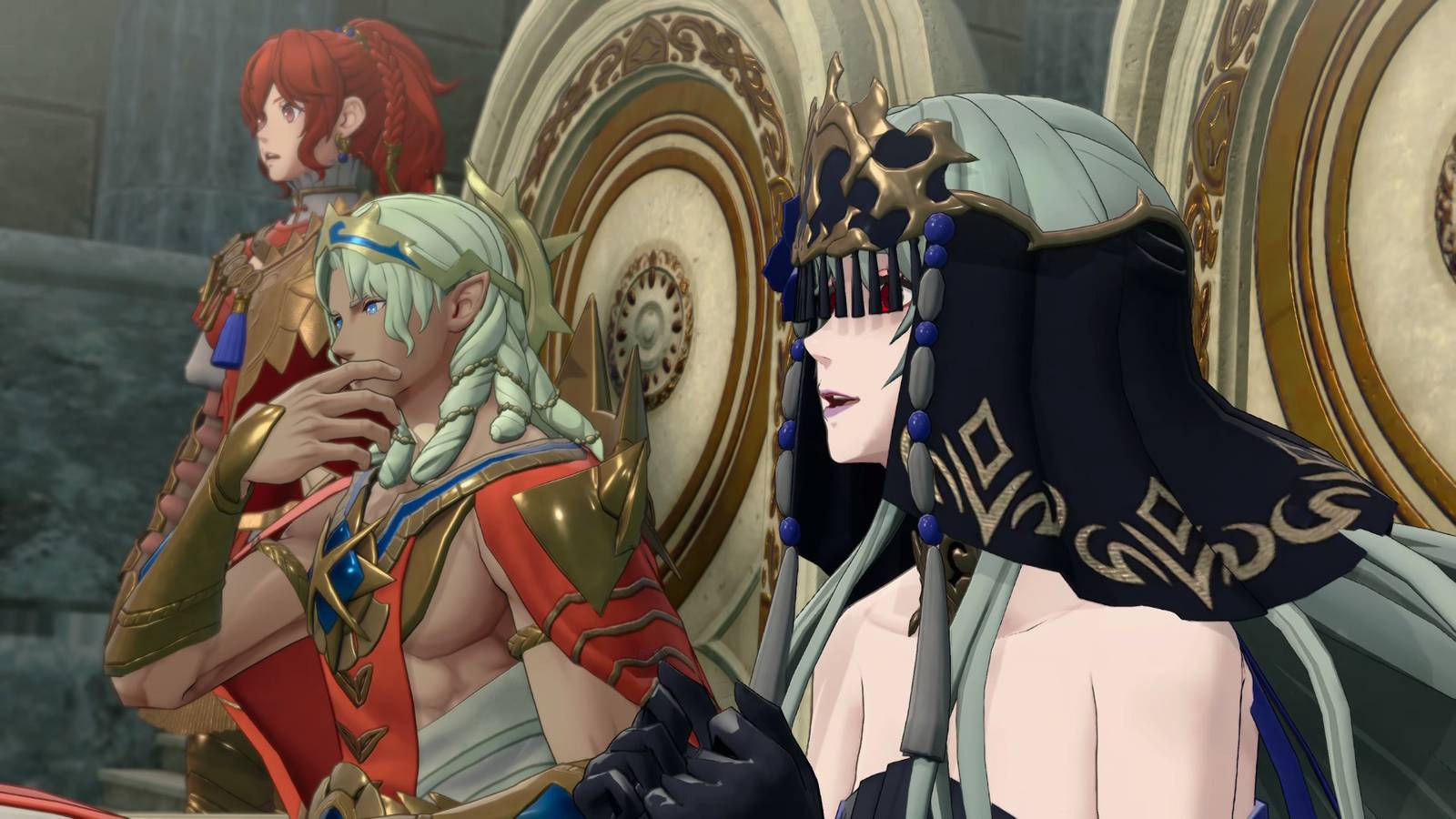
For centuries, Dagda’s borders expanded through brutal warfare. This relentless conquest was underpinned by a fervent, state-sponsored theology: the belief in the divine right of the conqueror. Because the nation’s ruler, Dagda himself, is framed as the offspring of the progenitor god Sothis, the common populace was easily indoctrinated. In Part 2 of the game, Dagda openly justifies his latest military campaign to his remaining court by asserting that Sothis herself tasked him with bringing the entire continent under his absolute control.
This narrative invokes historical concepts like the Chinese Mandate of Heaven—the belief that dynasties ruled through divine favor—while leaning heavily into the 19th-century American doctrine of Manifest Destiny. Under this mindset, expansion was not merely a political choice, but a divine imperative. Any resistance was viewed not as a defense of sovereignty, but as an affront to cosmic order, punishable by total destruction.
The Eradication of the People of the White Egg
As the narrative unfolds, players uncover the empire’s darkest secrets. Dagda viewed the People of the White Egg as obstacles or expendable resources. Despite posing no military threat, the empire executed approximately 100,000 of them, hunted down their surviving lineages, and quarantined the remainder in a barren wasteland at the edge of the continent.

The historical parallels are unmistakable, echoing the displacement and destruction of Indigenous populations by federal and state governments, as well as similar systemic erasures seen globally—from the treatment of the Ainu by imperial Japan to modern geopolitical conflicts. Yet, within Dagda, these atrocities are thoroughly whitewashed. To the average citizen, the empire’s history is packaged as heroic entertainment, celebrated through pageantry and sanitized arena spectacles known as the Heroic Games. The victims are reduced to fairy-tale villains, and anyone wearing white remains under constant threat of state surveillance and arrest.
The Tragedy of Damascar and Solel’s Compromise
Following the genocide of the People of the White Egg, Dagda targeted the descendants in Damascar. When Yu Phas—daughter of Balor and wife of Dagda’s son, Solel—intervened to rescue as many children as possible, Dagda had her brutally murdered.
Because immortal or divine beings exist on a timescale detached from human mortality, Dagda’s actions initially sparked little internal resistance among his family. However, the murder of Yu Phas drove Solel to take up an axe against his own father, plunging Dagda into a 500-year slumber.

Upon assuming power as the new Divine Sovereign, Solel faced a choice: confront the foundational lies of his empire or preserve the status quo. Predictably, he chose the latter. He allowed the vilification of his deceased wife, permitted the operation of the shadow cult known as the Order of Mithras, and validated brutal military crackdowns—such as Arago’s massacre in Cydonia—because maintaining imperial stability required ignoring the suffering of the marginalized.
Supporting Context & Metrics: The Parallels to Modern Geopolitics
The narrative framework of Fortune’s Weave resonates far beyond the confines of fantasy storytelling, offering a poignant examination of real-world political shifts in the mid-2020s.
The Echoes of Modern Populism and Nationalism
When analyzed through a contemporary lens, Dagda’s resurrection and the mechanisms of his return bear an uncanny resemblance to the political trajectory of figures like Donald Trump in the United States. The narrative dissects how a leader whose historical legacy is defined by institutional failure and violence can manage to reassume power by weaponizing nostalgia, distorting historical truths, and manufacturing fear of outsiders ("the other").

+-----------------------------------------------------------------+
|              THE CYCLE OF IMPERIAL REVISIONISM                  |
+-----------------------------------------------------------------+
| 1. CONQUEST & ATROCITY: Systematic elimination of minorities    |
|    (e.g., People of the White Egg, Damascar).                   |
+-----------------------------------------------------------------+
| 2. HISTORICAL WHITEWASHING: State-sponsored mythology & arena   |
|    entertainment replace grim realities.                        |
+-----------------------------------------------------------------+
| 3. COMPLICITY OF ELITES: Successors maintain the status quo to   |
|    protect personal comfort and systemic power.                 |
+-----------------------------------------------------------------+
| 4. THE RETURN OF THE TYRANT: Reviving the past leads directly   |
|    to the repetition of historical atrocities.                  |
+-----------------------------------------------------------------+
This phenomenon is not isolated to the U.S. political landscape. International observers have noted parallel trends globally:
- Japan: Ongoing societal and political debates surrounding right-wing nationalism and historical revisionism regarding imperial-era actions.
- Germany: The rising electoral influence and mainstreaming of far-right political factions, such as the Alternative for Germany (AfD), which frequently capitalize on anti-immigrant sentiment and revisionist historical narratives.
In every instance highlighted by Fortune’s Weave, the core tragedy is collective amnesia—the persistent shock that history is repeating itself, compounded by the willful ignorance of a populace that refused to confront uncomfortable truths.
Official Statements & Critical Reception
The sudden pivot toward gritty, socio-political commentary has caught both longtime fans and critics by surprise, sparking intense discussions within gaming communities.

- Intelligent Systems’ Narrative Shift: While Nintendo has traditionally maintained a neutral stance on political allegory in its first-party titles, industry analysts note that Fortune’s Weave represents a maturing of the Fire Emblem writing room. The shift from localized medieval squabbles to systemic critiques of empire-building signals a new willingness to engage with mature, real-world themes.
- Fan Community Discourse: Social media platforms and fan forums have been flooded with deep-dive lore analyses since the game’s September release. Particular attention has been paid to fan theories surrounding the mysterious character Eshmel and their suspected identity as a reincarnated Solel—a narrative thread that suggests even those who enabled past atrocities may be granted a path toward karmic redemption.
Future Outlook
As players continue to dissect the branching paths and narrative nuances of Fire Emblem: Fortune’s Weave, the game has established a new high watermark for storytelling within Nintendo’s strategy-RPG stable. By anchoring its fantasy conflicts in the ugly, undeniable realities of historical imperialism, Intelligent Systems has delivered more than just a stellar tactical experience for the Switch 2. They have crafted a timeless warning about the dangers of whitewashed history, proving that the most terrifying monsters are often the ones we choose to forget we created.