Executive Overview
John Steinbeck’s 1952 literary masterpiece East of Eden has long occupied a towering space in American letters. Regarded by the author himself as his magnum opus, the novel is an expansive, sprawling examination of human nature, free will, inherited trauma, and the eternal friction between good and evil. Yet, despite its cultural gravity, the text has seen surprisingly few adaptations. Aside from Elia Kazan’s iconic 1955 cinematic version—which famously helped cement James Dean as a generational icon—and a 1981 television miniseries starring Jane Seymour, the Salinas Valley epic has largely remained untouched on screen.
That drought officially ends as Netflix debuts its new seven-episode, prestige miniseries adaptation of East of Eden. Helmed by showrunner and writer Zoe Kazan (granddaughter of the director of the 1955 film) alongside directors Garth Davis and Laure de Clermont-Tonnerre, this modern retelling injects contemporary psychological nuance into an age-old framework. Spanning nearly five decades and tracing the volatile trajectory of the Trask family from post-Civil War Connecticut to the sun-bleached fields of California during the First World War, the miniseries acts as the streaming equivalent of a compulsive page-turner.
Bolstered by an extraordinary ensemble cast—headlined by Florence Pugh, Christopher Abbott, and Mike Faist—the streaming event tackles the theological and philosophical underpinnings of the biblical Cain and Abel mythos with stark visual elegance and razor-sharp dramatic focus. As the series unfurls its narrative canvas, it interrogates a central, haunting question: Are monsters born into this world, or are they meticulously manufactured by the cruelty of others?
Detailed Chronology: A Generation-Spanning Saga
The Roots of Cruelty: Post-Civil War Connecticut (1874)
The seven-part miniseries opens with Episode 1, appropriately titled "Brothers," transporting viewers back to 1874 Connecticut. Here, the audience is introduced to young Adam (played in his youth by Costa D’Angelo) and his brother Charles (Tom Sweet). Their upbringing is defined by the rigid, militaristic tyranny of their father, Cyrus Trask (portrayed with terrifying malice by Tracy Letts). Cyrus remains psychologically trapped in the battles of the Civil War, forcing his young sons to execute grueling military drills on their farm while engaging in blatant, psychologically damaging favoritism.
In a chilling display of parental manipulation, Cyrus tells Adam, "Adam, don’t you see? I love you better," while Charles stands barely within earshot. Yet, Cyrus’s peculiar brand of affection translates into a toxic paradox: he elects to send a hesitant Adam off to military service while compelling Charles—the son genuinely eager to enlist—to remain home and manage the estate. This foundational wedge of paternal rejection plants the seeds of lifelong fraternal rivalry and emotional isolation.
The Arrival of the Apex Predator: Cathy Ames
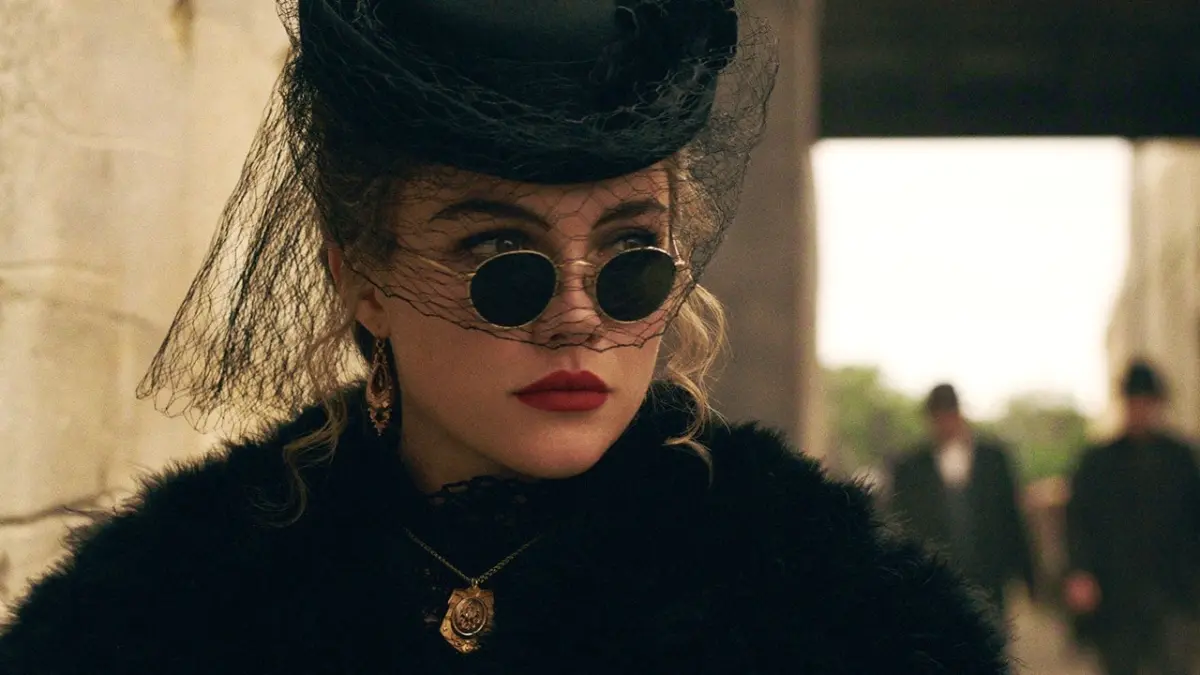
Into this fragile, emotionally starved ecosystem enters Cathy Ames, brought to terrifying, magnetic life by Florence Pugh. When Cathy crosses paths with the Trask brothers years later, she is literally at death’s door, having survived a savage and mysterious beating by unknown assailants. Pugh’s Cathy immediately establishes herself as the narrative center of gravity, opening the series with a chilling, philosophical voiceover: "I believe there are monsters born in this world to human parents."
Cathy’s calculated entry into the lives of Adam (now played by Christopher Abbott) and Charles (now played by Mike Faist) ruptures the already fractured brotherhood. Despite Adam and Cathy being destined to marry and bear children, Cathy operates as an agent of chaos. She is cruel, calculating, and seemingly devoid of empathy, orchestrating psychological destruction with surgical precision. Yet, as the narrative progresses, Zoe Kazan’s script complicates Cathy’s absolute villainy, forcing the audience to ask whether she was spawned as an innate monster or forged into one by a world that abused and exploited her earliest vulnerabilities.
Migration West and the Salinas Valley
As the generational narrative advances, the surviving members of the Trask family migrate out West, eventually planting roots in California’s fertile Salinas Valley right as the shadows of World War I loom over the horizon. The domestic landscape of the household shifts fundamentally with the introduction of Lee (portrayed with quiet, devastating dignity by Hoon Lee), the family’s Chinese-American manservant. Despite being born in America, Lee navigates a society riddled with racial prejudice, treated as a subordinate by the white community around him. His deep, complex bonds with Adam and, later, Adam’s twin sons, offer moments of profound philosophical inquiry and heartbreaking empathy.
In the latter half of the miniseries, the generational trauma passes down to a new set of brothers: Caleb and Aron, played by Joseph Zada and Joe Anders, respectively. Functioning as 20th-century counterparts to their father Adam and uncle Charles, these twin boys inherit the same ancient fraternal friction, proving that the sins of the father—and the weight of biblical destiny—are perpetually recycled through time. The series finally reaches its emotional and thematic zenith in its finale, appropriately titled "Timshel."
Supporting Context & Metrics: The Philosophy of "Timshel"
While East of Eden occasionally leans slightly heavy-handed in its dialogue—characters frequently voice their inner turmoils with lines like "I want to be good" right before making catastrophic decisions—its thematic explorations frequently soar into moments of sublime philosophical debate.
The emotional and intellectual core of the series crystallizes in the interactions between Lee and the compassionate neighbor Samuel Hamilton (played with warm gravitas by Ciarán Hinds). Together, these characters unpack the Hebrew word timshel, which John Steinbeck famously translated in the novel as "thou mayest."
| Narrative Element | Literary Origin / Context | Miniseries Representation |
|---|---|---|
| The Core Mythos | Book of Genesis (Cain and Abel) | Explored through the generational rivalries of Adam/Charles and Caleb/Aron. |
| Central Philosophical Concept | Hebrew translation of Timshel ("Thou Mayest") | Examined deeply through philosophical dialogues between Lee and Samuel Hamilton. |
| Pivotal Character Arc | Cathy Ames (The Psychological Enigma) | Interpreted through Florence Pugh’s commanding performance, questioning nature vs. nurture. |
| Temporal Scope | 1952 Novel by John Steinbeck | Spans 46 years (1874 Connecticut to WWI-era Salinas Valley across 7 episodes). |
This linguistic and theological concept shatters the notion of absolute predestination. Rather than declaring that humanity is structurally bound to inherit sin or enact evil, timshel grants individuals the ultimate agency of free will. It dictates that you may choose righteousness, or you may choose wickedness—the burden of choice rests entirely on the individual soul. This thematic anchor elevates the streaming series from a mere period melodrama into a profound meditation on moral responsibility.
Official Statements and Production Insights
The journey of bringing East of Eden to the modern television landscape has been a labor of love rooted in artistic legacy and meticulous craftsmanship. Showrunner and adapter Zoe Kazan approached the seminal text with a clear mandate: to honor her grandfather Elia Kazan’s cinematic connection to the material while dismantling the story through a distinctly contemporary, empathetic lens.
"When you look at a character like Cathy Ames, it is very easy to write her off simply as a cartoonish villain or a manifestation of pure evil," production insiders note regarding the development of the series. "Zoe Kazan and directors Garth Davis and Laure de Clermont-Tonnerre wanted to strip away the binary morality of the 1950s. They asked: What happens when a survivor of unimaginable trauma weaponizes that trauma against a society that failed her? Florence Pugh embodies that terrifying duality flawlessly."
Florence Pugh herself has spoken extensively about the emotional toll and exhilaration of inhabiting such a polarizing literary figure. "Cathy tells us right at the start that monsters are born among us," Pugh shared during early promotional cycles. "Playing her required stepping entirely outside of conventional moral judgments. You cannot play a villain by apologizing for them; you have to understand the logic of their isolation, even if that logic is chilling."
Christopher Abbott, reflecting on his role as the perpetually tormented Adam Trask, emphasized the heavy psychological burden placed upon the cast. "Adam is a man desperately seeking light in a world built on the foundations of a loveless household and biblical condemnation," Abbott explained. "Working opposite Florence and Mike [Faist] felt less like filming a traditional period piece and more like navigating a high-stakes psychological battlefield."
Future Outlook & Critical Verdict
Netflix’s seven-episode miniseries iteration of East of Eden arrives as a major artistic triumph for the streaming platform, proving that prestige literary adaptations can successfully marry sweeping historical scope with intimate psychological depth. By stretching the narrative across a measured, novelistic runtime, the production avoids the compression traps that frequently plague film adaptations of multi-generational epics.
From a production standpoint, the series benefits immensely from exquisite cinematography that contrasts the claustrophobic, puritanical shadows of 19th-century Connecticut with the golden, wide-open expanses of the Salinas Valley. Performances across the board are universally strong, with Florence Pugh delivering a career-defining turn as Cathy, Christopher Abbott and Mike Faist grounding the fraternal tragedy in palpable heartache, and Hoon Lee standing out as the emotional heartbeat of the entire saga.
Ultimately, East of Eden succeeds because it refuses to offer easy answers to the complex questions it raises. It treats its audience with intellectual respect, forcing viewers to wrestle alongside its characters with the agonizing weight of free will. Beautifully shot, relentlessly gripping, and intellectually stimulating, this miniseries is not only appointment television—it stands as one of the finest streaming achievements of the year.