By the Gaming Desk
Published October 1, 2026
Executive Overview
The boundary between virtual fiction and real-world geography has officially blurred in downtown Miami. In what is rapidly shaping up to be one of the most audacious and expensive marketing campaigns in entertainment history, Rockstar Games has transformed the city’s iconic Kaseya Center into a real-world monument for Grand Theft Auto VI. Featuring massive, glowing signage welcoming onlookers to "Vice City" alongside the Roman numerals "VI," the stunt marks the opening salvo of a nearly $1 million local advertising blitz designed to highlight the staggering fidelity of the upcoming open-world sequel.
Set against the backdrop of a fictionalized Florida known as Leonida, GTA 6 has long promised an uncanny mirror-image of the Sunshine State’s distinct neon-soaked architecture, coastal culture, and chaotic energy. By embedding its fictional landmarks directly into the Miami skyline, Rockstar is not merely advertising a product; it is staking a claim on the physical territory that inspired it.
Yet, this high-stakes crossover of life and art did not happen without intense political friction. Months of secretive negotiations between Rockstar executives and Miami-Dade County officials reveal a deeply divided local government weighing the massive economic and cultural windfalls of the gaming colossus against concerns over local representation, moral panic, and public image. As Grand Theft Auto VI barrels toward its November 19, 2026 release date for PlayStation 5 and Xbox Series X/S, the Miami takeover stands as a watershed moment for how blockbuster video games interact with the physical municipalities they immortalize.
Detailed Chronology: From Backroom Talks to Biscayne Bay Neon
The realization of the Vice City signage atop the Kaseya Center is the culmination of a months-long diplomatic and logistical chess match between a multi-billion-dollar publisher and municipal bureaucrats.
The Whispers of Leonida (Late Summer 2026)
Long before the scaffolding went up on Biscayne Bay, rumors circulated through municipal planning offices that Rockstar Games was angling for an unprecedented physical footprint in South Florida. Initial proposals leaked to local media outlets revealed an astonishingly ambitious scope. Rockstar wasn’t just looking for standard billboard space; executive proposals reportedly floated the radical idea of partially rebranding the Miami International Airport, orchestrating massive, coordinated drone light shows across the coastline, and executing temporary takeovers of public beaches to mirror the game’s coastal environments.
The Municipal Firewall and Committee Debate
Because these activations required public property usage, airspace permissions, and municipal coordination, they were subjected to strict legislative review. The campaign hit a major roadblock when it reached the local commission floor.
Opposition was spearheaded by figures such as Miami Beach Commissioner David Suarez, who took a hardline stance against the developer. During heated commission debates, Suarez screened footage from the extended GTA 6 trailers, arguing that the franchise’s satirical, hyper-violent, and hedonistic depiction of Florida culture was fundamentally at odds with the values and dignity of the local community. To Suarez and a conservative bloc of commissioners, allowing a video game known for crime syndicates and societal satire to stamp its branding across public infrastructure felt akin to endorsing a caricature of their home.
Conversely, the campaign found vocal champions among younger commissioners and gaming advocates. Commissioner Monica Matteo-Salinas emerged as a prominent defender of the project, delivering a passionate counter-argument that ultimately helped tilt the scales: "This is a win for gamers and gaming nerds such as myself." Matteo-Salinas emphasized the undeniable cultural relevance of the franchise and the immense global tourism spotlight the game would inevitably cast upon South Florida.
The 4-3 Compromise and the $1 Million Installation
Following intense debate, the Miami-Dade County commission narrowly voted 4-3 to approve a modified, more discreet version of the marketing campaign. While the grander plans—such as airport takeovers and large-scale drone deployments—were ultimately scaled back or discarded to appease concerned stakeholders, the agreement cleared the path for targeted commercial placements.
By late September 2026, local residents and tourists began capturing footage of construction crews scaling the Kaseya Center—home to the NBA’s Miami Heat—to install the monumental signage. By October 1, the installation was complete, illuminating the Biscayne Bay waterfront with the glowing declaration: "Welcome to Vice City VI." Industry insiders familiar with the project have estimated the cost of securing the venue rights, engineering, and execution of the signage alone to be close to $1 million.

Supporting Context & Metrics: The Anatomy of a Blockbuster Launch
To understand the magnitude of a $1 million single-location marketing stunt, one must examine the unprecedented cultural and economic gravity surrounding Grand Theft Auto VI.
Mirroring the Real World
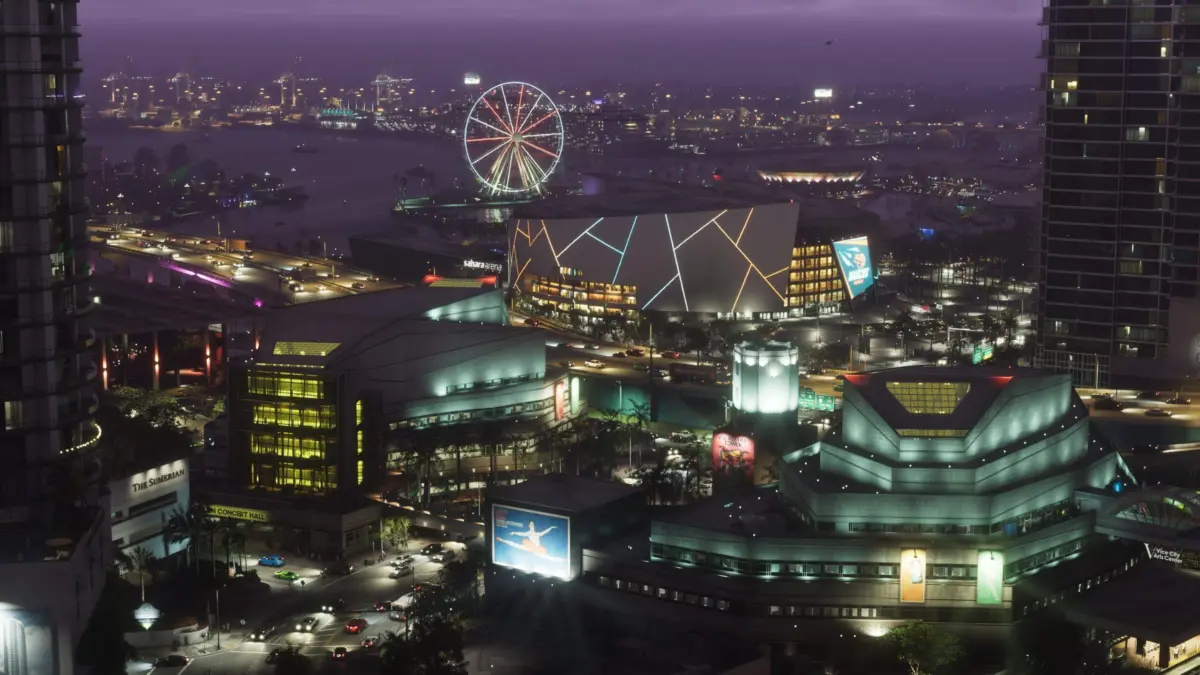
The Kaseya Center takeover is more than just a flashy billboard; it is a direct nod to the intricate world-building craft of Rockstar North. In the digital ecosystem of GTA 6, the arena is rendered as the "Sahara Arena," positioned geographically in the exact same urban pocket of the game’s fictional Miami equivalent, flanked by a remarkably similar waterfront Ferris wheel.
This design philosophy was further corroborated when Game Informer published a fresh batch of GTA 6 screenshots, showcasing jaw-dropping fidelity in lighting, crowd density, and environmental storytelling. Side-by-side comparisons by industry analysts revealed that players will be able to navigate virtual spaces that mirror real-world coordinates down to the architectural nuances of individual entertainment complexes.
The Stakes for Rockstar Games and Take-Two Interactive
As the successor to Grand Theft Auto V—widely regarded as one of the most financially lucrative entertainment products of all time, having generated over $8 billion in revenue—GTA 6 carries immense expectations.
- Platform Availability: Set for release on November 19, 2026, the game is initially launching exclusively on current-generation hardware (PlayStation 5 and Xbox Series X/S), a decision that promises to push the technical boundaries of Sony and Microsoft’s consoles to their absolute limits.
- The Marketing Ecosystem: Beyond the Miami physical takeover, Rockstar’s marketing rollout has been notoriously calculated. Espewing traditional, continuous media blitzes, the studio relies on sparse, highly anticipated info-drops—such as the recent Director Rob Nelson interview, exclusive media previews, and the gradual unmasking of the game’s voice acting and motion-capture cast.
- Economic Impact on Tourism: Economists note that while past iterations of the franchise popularized fictionalized cities, the explicit naming of real-world locales like Leonida (Florida) creates a symbiotic tourism loop. Millions of digital tourists will virtualize Miami, which historically translates into tangible, real-world tourism spikes as fans seek out the real-world inspirations behind their favorite virtual locales.
Official Statements and Public Division
The intersection of municipal governance and billion-dollar entertainment marketing has exposed a fascinating culture clash within South Florida’s leadership.
+-------------------------------------------------------------------------+
|                      THE DOWNTOWN MIAMI DIVIDE                          |
+-------------------------------------------------------------------------+
| OPPOSITION (e.g., Commissioner David Suarez)                            |
| • Argued the franchise does not reflect local values.                   |
| • Voiced concern over satirical depictions of crime and hedonism.       |
| • Successfully lobbied against the most disruptive proposals (airport). |
+-------------------------------------------------------------------------+
| ADVOCACY (e.g., Commissioner Monica Matteo-Salinas)                     |
| • Championed the campaign as a cultural milestone.                      |
| • Embraced the economic and global spotlight for the city.              |
| • Successfully argued for the approval of targeted marketing.           |
+-------------------------------------------------------------------------+
The friction highlights a broader societal evolution: video games are no longer niche counter-cultural media consumed behind closed doors; they are monumental cultural institutions capable of reshaping the physical skylines of major metropolitan areas. While opponents like Commissioner Suarez worried about the cultural export of Florida’s wild reputation, proponents like Matteo-Salinas recognized that Miami’s identity has long been inextricably linked with cinematic and interactive storytelling.
Rockstar Games has maintained its characteristic corporate silence regarding the political wrangling, allowing the physical installation to speak for itself. However, public relations analysts point out that even the controversy surrounding the commission votes served as free publicity, keeping GTA 6 atop global news cycles for weeks leading up to its late-year launch window.
Future Outlook: The Road to November 19, 2026
With the Kaseya Center now fully illuminated under the banner of Vice City, the countdown to November 19 has entered its final, most intense phase.
As autumn progresses, industry watchers expect Rockstar to ramp up its promotional campaign, though whether other cities or additional Miami landmarks will receive the "Vice City" treatment remains a closely guarded secret. The successful negotiation of the Miami-Dade County commission sets a compelling precedent for future interactive media marketing. If a video game developer can successfully lobby a major American city to alter its skyline—even temporarily—to reflect a fictional setting, the line between augmented reality, virtual worlds, and physical municipal spaces will continue to dissolve.
For the residents of Miami, the glowing "VI" atop Biscayne Bay serves as a daily reminder that their city is about to become the center of the global gaming universe. Whether viewed as an inspiring triumph of digital art or a controversial corporate encroachment, one thing is certain: Vice City has arrived in the real world, and the simulation is about to begin.