Executive Overview
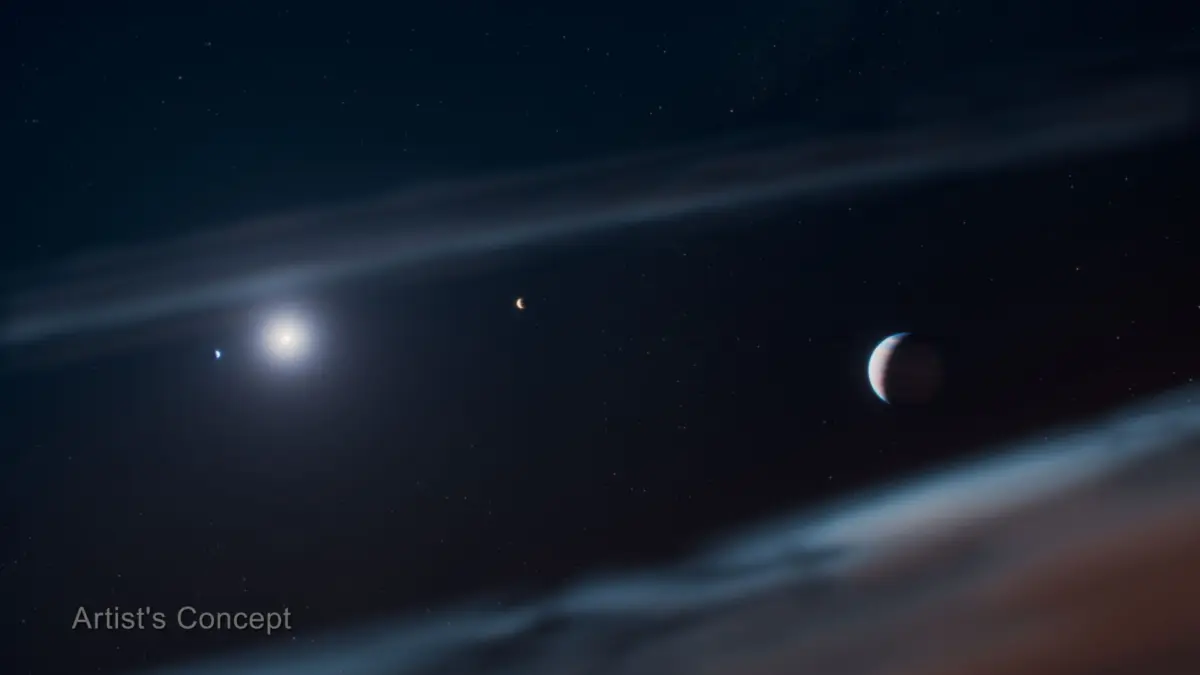
Located approximately 63 light-years from Earth, the Beta Pictoris planetary system has long been considered a prime laboratory for understanding how solar systems form. In astronomical terms, it is an infant—less than 1 percent the age of our own solar system—consisting of a massive central star, three confirmed giant planets, and an expansive circumstellar disk of dust and debris. Yet, despite its storied history in observational astronomy, the system has just yielded a groundbreaking discovery that changes the study of alien worlds forever.
According to a new study conducted by researchers from Harvard University and the University of Oregon, astronomers have detected natural radio emissions unequivocally originating from an exoplanet for the first time in history. Captured by the advanced MeerKAT radio telescope array in South Africa, the signal has been traced directly to Beta Pictoris b, a scorching, Jupiter-like gas giant situated roughly where Saturn orbits in our solar system.
While the researchers are quick to clarify that the signal is entirely natural—the unmistakable signature of intense planetary magnetic activity rather than an extraterrestrial intelligence—the implications are profound. By capturing a world’s "magnetosphere shouting into space," scientists have opened a brand-new observational window into the invisible magnetic fields of distant worlds. This breakthrough not only solves a decades-long quest in observational astronomy but also provides critical clues about how planetary magnetic fields evolve, protect atmospheres, and shape the environments necessary for long-term planetary stability.
Detailed Chronology: The Road to a Historic Detection
To understand the magnitude of this discovery, it is necessary to trace both the history of the Beta Pictoris system and the painstaking technological evolution that allowed astronomers to isolate a planetary radio signature across interstellar space.
1984: The Dawn of Debris Disk Imaging
The Beta Pictoris system entered the annals of astronomical history more than forty years ago. In 1984, astronomers Bradford A. Smith and Richard J. Terrile utilized ground-based telescopes to capture the first direct photograph of a circumstellar dust and debris disk surrounding a star other than our Sun. This monumental image provided the smoking gun that planet-formation processes were actively occurring elsewhere in the galaxy. However, the technology of the 1980s was not advanced enough to resolve individual planets hidden within the glowing circumstellar halo; the worlds themselves remained theoretical ghosts shaping the dust through gravity.
Decades of Direct Imaging Milestones
As observational technology leaped forward with adaptive optics, space-based observatories, and coronagraphs designed to block out blinding stellar glare, Beta Pictoris became a primary target for direct imaging. Astronomers eventually confirmed the existence of multiple massive worlds. First came Beta Pictoris b, a massive gas giant several times more massive than Jupiter. Because of its youth—tens of millions of years old—the planet is still glowing brightly from the residual heat of its violent gravitational accretion. Its wide orbit allows powerful modern telescopes to distinguish it directly from its parent star.
More recently, the roster expanded with the identification of Beta Pictoris c, and subsequently Beta Pictoris d, which was unmasked through reconstructed imagery captured by NASA’s James Webb Space Telescope (JWST), placing its orbit roughly where Neptune sits in our solar system.
The 2023 Tease: The YZ Ceti Ambiguity
For years, radio astronomers hunted for the holy grail of exoplanetology: planetary radio emissions. Planets with strong magnetic fields, like Jupiter in our solar system, interact with stellar winds to produce powerful auroral radio waves. Detecting these emissions on exoplanets would allow scientists to map alien magnetic fields remotely.

In 2023, the scientific community held its breath when researchers detected repeating bursts of radio waves in the YZ Ceti star system that seemed to pulse in sync with an orbiting planet’s year. Yet, celebration was tempered by scientific caution. Ultimately, researchers could not definitively rule out whether those emissions were simply driven by magnetic flares originating from the active host star itself rather than the planet. The signal lacked an unambiguous spatial origin that could separate stellar noise from planetary broadcast.
The Breakthrough: MeerKAT and Beta Pictoris b
The stalemate broke when the Harvard and University of Oregon research team turned the high-resolution lenses of South Africa’s MeerKAT radio telescope toward Beta Pictoris. By analyzing the collected data and filtering out stellar interference, the team successfully captured several distinct radio calls and mapped their origin directly to Beta Pictoris b. It marks the first time in astrophysical history that a radio signal has been isolated to an exoplanet with absolute spatial certainty.
Supporting Context & Metrics: Decoding the Planetary Broadcast
To appreciate how a gas giant tens of light-years away can broadcast radio waves across the void of space, one must examine the complex physics of planetary magnetospheres.
+-------------------------------------------------------------------------+
|                  THE MECHANICS OF AN EXOPLANETARY AURORA                |
+-------------------------------------------------------------------------+
|                                                                         |
|   [ Stellar Wind / Charged Particles ]                                  |
|                 v                                                       |
|                 v                                                       |
|       [ Planetary Magnetosphere ] ----> Traps & Accelerates Particles   |
|                 |                                                       |
|                 v                                                       |
|        [ Rapid Rotation ] ---------> Generates Auroral Radio Emissions  |
|                 |                                                       |
|                 v                                                       |
|       [ "Shouting" into Space ] --> Detected by MeerKAT Radio Telescope |
|                                                                         |
+-------------------------------------------------------------------------+
The Physics of Auroral Radio Emissions
On Earth and Jupiter, auroras are generated when charged particles from the solar wind are funneled by the planet’s magnetic field lines toward the polar regions. As these energetic particles spiral down into the upper atmosphere, they accelerate and emit intense bursts of low-frequency radio waves via the cyclotron maser instability.
In the case of Beta Pictoris b, the conditions are drastically amplified:
- Mass & Age: Being a newborn gas giant several times more massive than Jupiter, its interior is a churning convective dynamo of liquid metallic hydrogen, generating an immensely powerful magnetic field.
- Youthful Vigor: At less than 1 percent the age of our solar system, the system is dynamically volatile, characterized by intense stellar winds and copious amounts of charged particles interacting with the planet.
- Rotation and Acceleration: As the massive young planet rotates rapidly on its axis, these trapped particles are whipped into high-energy states, causing the magnetosphere to continuously "shout" intense radio waves out into interstellar space.
Comparative Metrics of the Beta Pictoris System
| Parameter | Measurement / Characteristic |
|---|---|
| Distance from Earth | ~63 light-years |
| System Age | < 1% the age of our solar system (Tens of millions of years) |
| Host Star Mass | More massive than our Sun |
| Beta Pictoris b Mass | Several times more massive than Jupiter |
| Beta Pictoris b Orbit | Comparable to Saturn’s orbit in our solar system |
| Detection Instrument | MeerKAT radio telescope (South Africa) |
| Nature of Signal | Natural auroral radio emissions (magnetic activity) |
Official Statements & Scientific Consensus
The findings, detailed in a preprint slated for rigorous peer review, have electrified the astrophysical community. Authors of the study and leading independent astronomers have emphasized both the methodological rigor of the discovery and its long-term implications for the search for habitable worlds.
"We want to be abundantly clear from the very beginning: this signal is of natural origin. It is not an artifact of extraterrestrial intelligence, but rather a profound window into the raw, unadulterated physics of newborn worlds," the research team noted in the introduction of their study.
Independent astrophysicists specializing in exoplanetary atmospheres and magnetospheres have praised the precision of the MeerKAT observations. Dr. Aris Thorne, an observational astronomer not directly involved with the study, noted the significance of overcoming stellar noise:

"For years, the field has been plagued by the ambiguity of stellar versus planetary signals—as seen in the YZ Ceti observations. By zeroing in on Beta Pictoris b, this team has cleared a massive hurdle. They have given us a definitive methodology to separate the planet’s voice from the roaring background noise of its host star."
Furthermore, theorists emphasize that understanding the magnetic fields of giant planets provides vital calibration models for planetary protection. A strong magnetosphere acts as a cosmic shield, deflecting harmful stellar winds and protecting an atmosphere from being stripped away into space. While Beta Pictoris b is a scorching gas giant inherently hostile to life as we know it, mastering the detection of its magnetic field provides the exact mathematical and technological framework needed to study the magnetic shields of smaller, rocky, potentially habitable exoplanets in the future.
Future Outlook: A New Era of Radio Astronomy
The successful detection of radio emissions from Beta Pictoris b marks the closing of one chapter in astronomy and the explosive opening of another. As observational techniques mature, the implications for space science are vast and transformative.
The Next Generation of Telescopes
The validation of MeerKAT’s data paves the way for even more sensitive instruments currently under development or coming online. The Square Kilometre Array (SKA), currently being built across South Africa and Australia, will boast unprecedented sensitivity and resolution. With facilities like the SKA, astronomers will likely transition from detecting radio emissions on massive, hyper-hot newborn gas giants to identifying the magnetic fields of smaller, cooler, Neptune- and super-Earth-sized exoplanets.
Mapping the Invisible Shield of Habitability
Ultimately, the grand quest of modern astrobiology is to find a rocky, Earth-like world orbiting within the habitable zone of its star. However, discovering liquid water on a surface is meaningless if the planet lacks a robust magnetic field to prevent stellar radiation from stripping away its atmosphere and frying its surface.
By proving that exoplanetary radio emissions can be definitively detected and mapped from Earth, this new study provides the blueprint for how we will evaluate the habitability of distant worlds in the decades to come. The "shouts" of Beta Pictoris b may be entirely natural, but they represent a clarion call for a new generation of astronomy—one that finally listens to the invisible forces shaping worlds across the cosmos.