Executive Overview
The digital curation landscape underwent a seismic shift following Mozilla’s decision to sunset its long-standing read-it-later service, Pocket. For over a decade, Pocket served as the default repository for internet users looking to save articles, essays, and web pages for future consumption. Its closure left a massive vacuum, prompting a wave of developers to rush into the market with alternative solutions. However, while most newcomers have focused on replicating Pocket’s text-centric model, a new iOS and macOS application named Laytr is attempting to redefine the category entirely.
Developed by Mostafa Talaat under his Ontario-based indie studio, Waitery Inc., Laytr transcends the traditional "read-it-later" paradigm. Instead of limiting users to text-based articles, the application acts as a comprehensive, multi-format digital archive capable of capturing recipes, screenshots, videos, PDFs, bookmarks, and active browser tabs. Crucially, Laytr distinguishes itself through a strict, uncompromising commitment to user privacy: it operates on a serverless, local-first architecture that bypasses the need for account creation, syncing data exclusively through Apple’s secure iCloud infrastructure.
By rejecting the data-harvesting business models of modern software-as-a-service (SaaS) platforms and refusing to integrate trendy, resource-heavy AI features, Laytr positions itself as a quiet, highly secure sanctuary for digital minimalists and power users alike.
Detailed Chronology
The Fall of Pocket and the Curation Crisis
To understand the emergence of Laytr, one must trace the decline of its predecessor. Mozilla acquired Pocket (originally launched as Read It Later) in 2017, integrating it deeply into the Firefox browser ecosystem. Over the years, however, the service struggled to balance user expectations with monetization pressure, leading to sponsored content integrations and a perceived stagnation in core feature development.
The definitive turning point came in May 2025, when Mozilla officially announced its plans to phase out the service. By the time Pocket shut down completely in August 2026, millions of users were left stranded, searching for a platform that could preserve their accumulated archives without subjecting them to invasive tracking or bloated subscription tiers.
The Conception and Launch of Laytr
Observing the widespread frustration of displaced Pocket users throughout late 2025 and early 2026, Mostafa Talaat began designing an alternative that addressed the core vulnerabilities of centralized curation services. Talaat recognized that the primary risk of third-party cloud services is their impermanence: when a company changes its business model or shuts down, users risk losing years of curated intellectual capital.
[May 2025] Mozilla announces Pocket shutdown
       │
[August 2026] Pocket service officially terminates
       │
[Late 2026] Mostafa Talaat (Waitery Inc.) launches Laytr
       │
[December 2026] Laytr introduces introductory lifetime pricing & Pocket import tools
Talaat’s response was Waitery Inc.’s launch of Laytr in late 2026. Built specifically for the Apple ecosystem, the app was engineered from day one to facilitate seamless transitions. It launched with a native, one-click Pocket export import tool, ensuring that users migrating from the defunct Mozilla service could instantly restore their libraries without losing their tags, metadata, or reading progress.

Supporting Context & Metrics
The Architecture of "Local-First" Privacy
In an era dominated by surveillance capitalism and centralized cloud databases, Laytr’s technical architecture represents a radical departure from industry norms. Traditional read-it-later apps require users to create an account, storing their reading habits, interests, and saved links on proprietary servers. This data is highly valuable, often analyzed to build consumer profiles or train machine learning algorithms.
Laytr operates on a local-first, zero-knowledge framework:
- No Account Required: Users download the app and begin saving content immediately. No email address, password, or third-party OAuth logins are requested.
- Device-Level Archiving: When a user saves a webpage, PDF, or screenshot, the asset is parsed and stored directly on the device’s local storage.
- iCloud Syncing: Cross-device synchronization across iPhone, iPad, and Mac is handled entirely via Apple’s native iCloud API. This means the data is encrypted end-to-end and managed under the user’s personal Apple security umbrella, completely invisible to Waitery Inc. or any third-party observers.
Feature Set: Moving Beyond Simple Text Curation
Unlike traditional RSS-based readers, Laytr’s interface is designed to handle the modern, fragmented nature of web media.
┌──────────────────────────────────────────────────────────┐
│                      LAYTR ARCHIVE                       │
├───────────────┬──────────────┬─────────────┬─────────────┤
│   Articles    │  Multimedia  │  Documents  │  Metadata   │
│  (Web/Blogs)  │ (Video/Pics) │ (PDFs/Tabs) │ (Tags/Date) │
└───────────────┴──────────────┴─────────────┴─────────────┘
The application automatically categorizes incoming content into distinct file types, sorting them into dedicated streams:
- The "Cases" System: Instead of standard folders, Laytr utilizes "cases"—dynamic, customizable collections that allow users to group disparate media types (e.g., a PDF manual, a YouTube video tutorial, and a web article) under a single project or topic.
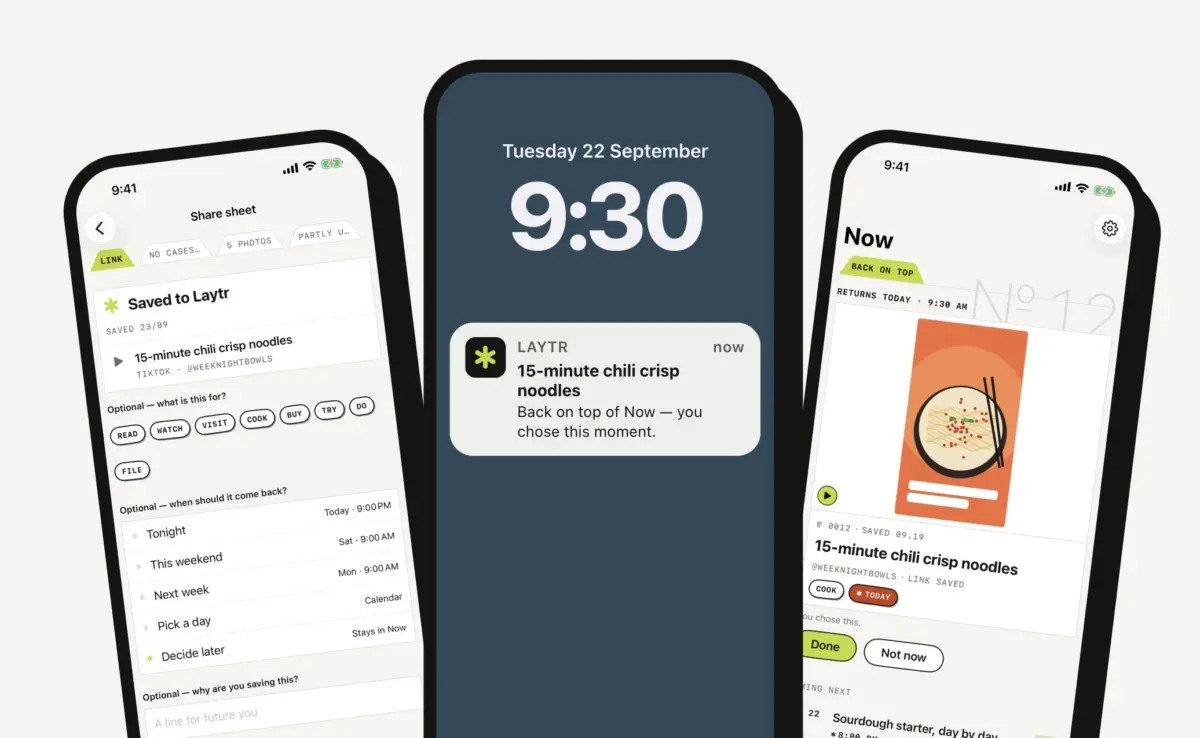
- Time-Based Reminders: Recognizing that saved items often sit unread indefinitely, Laytr incorporates a native scheduling engine. Users can assign a specific date to any saved item, triggering a local notification. This turns the app into an event planner or a structured learning syllabus, prompting users to revisit local event listings, travel itineraries, or academic papers exactly when they are needed.
- Data Portability via ZIP Export: To combat platform lock-in, Laytr offers a comprehensive export feature. At any point, users can download their entire archive as a structured ZIP file. Every saved item, note, tag, and date is preserved in universal, human-readable Markdown and HTML formats, ensuring that the data remains accessible even if the user decides to abandon the app.
The Cost of Privacy: Rejecting AI Bloat
A notable design choice in Laytr is its complete rejection of artificial intelligence integrations. While contemporary productivity apps are increasingly marketing AI-driven summarization, automated tagging, and algorithmic feed personalization, Laytr intentionally avoids these features.
Talaat’s philosophy dictates that automated processing compromises both user privacy (as content must often be sent to external LLM APIs) and the cognitive value of curation. By forcing users to interact directly with their saved content, Laytr preserves the active, intentional nature of reading and research.
Pricing and Subscription Economics
To maintain its independent, serverless operational model without relying on venture capital or ad-tech revenue, Waitery Inc. has implemented a transparent, multi-tiered pricing structure:

| Tier | Price | Limitations / Benefits |
|---|---|---|
| Free Tier | $0.00 | Full features; limited to 30 total saved items. |
| Premium Monthly | $1.99 / month | Unlimited saves; iCloud sync; advanced organizing. |
| Premium Yearly | $14.99 / year | Value option; equivalent to ~$1.25 / month. |
| Lifetime Purchase | $39.99 (one-time)* | Permanent access; no recurring fees. |
*Note: The lifetime plan is launched with a promotional rate of $24.99 running through the end of December 2026.
A key point of differentiation in Laytr’s monetization strategy is its non-punitive subscription lapse policy. If a user cancels their premium subscription, they do not lose access to their existing database. The archive remains completely readable, searchable, and exportable; the app simply restricts the user from adding new items until they either resubscribe or delete enough files to drop below the free tier’s 30-item limit.
Official Statements
In discussions regarding the launch of Laytr and the design philosophies governing Waitery Inc., Mostafa Talaat emphasized that the app was born out of a desire to protect the digital footprints of internet users.
"What you save says a lot about you, and I didn’t want to be holding it. Everything stays on your device and in your own iCloud," Talaat stated, outlining his ethical stance on user data custody. "When you save something, Laytr asks when you want it back and reminds you on that day. It also imports your old Pocket export, so nobody has to start over."
This focus on sovereign data storage directly addresses a growing anxiety among consumer software users: the fear of platform instability. By utilizing iCloud rather than proprietary databases, Talaat ensures that even if Waitery Inc. were to cease operations in the future, the app would continue to function locally on users’ devices, protecting their curated archives from sudden deletion.
Future Outlook
As Laytr establishes its footing in the post-Pocket era, its trajectory will serve as an important case study for the viability of indie, local-first software. In the immediate future, Waitery Inc. plans to focus heavily on localization, systematically introducing support for multiple languages to cater to a global audience of displaced curation enthusiasts.
The broader implications of Laytr’s launch point to a growing counter-cultural movement in software development. As mainstream productivity tools become increasingly bloated with algorithmic recommendations, invasive tracking, and forced AI integrations, highly focused utilities like Laytr offer an appealing alternative. By prioritizing speed, absolute privacy, and total data portability, Laytr is not merely surviving the collapse of legacy read-it-later tools—it is setting a new, highly ethical standard for how we collect, store, and interact with the web.