Executive Overview
Stephen King adaptations occupy a distinct, towering tier within cinematic history. From the uplifting, institutional redemption of The Shawshank Redemption and The Green Mile to foundational horror touchstones like Stanley Kubrick’s The Shining, Brian De Palma’s Carrie, and Rob Reiner’s Misery, King’s literary universe has routinely translated into legendary visual art. Yet, these adaptations are equally infamous for taking staggering, unapologetic liberties with their source material—none more divisive, nor more utterly devastating, than Frank Darabont’s 2007 cinematic interpretation of the 1980 novella The Mist.
Operating on a modest budget, Darabont crafted a film that begins as a conventional, atmospheric creature feature before devolving into a psychologically suffocating masterclass in misanthropic dread. While the film’s visual effects have visibly aged over nearly two decades, its narrative ambition, powerhouse lead performances, and—above all—its merciless final moments ensure its status as a landmark of modern horror. This retrospective explores how Darabont modernized a classic cosmic horror tale, traded rubbery CGI for terrifying human psychology, and ultimately constructed an ending so bleak that even Stephen King himself wished he had written it first.
Detailed Chronology: From Supermarket Refuge to Final Act
The Arrival of the White Death
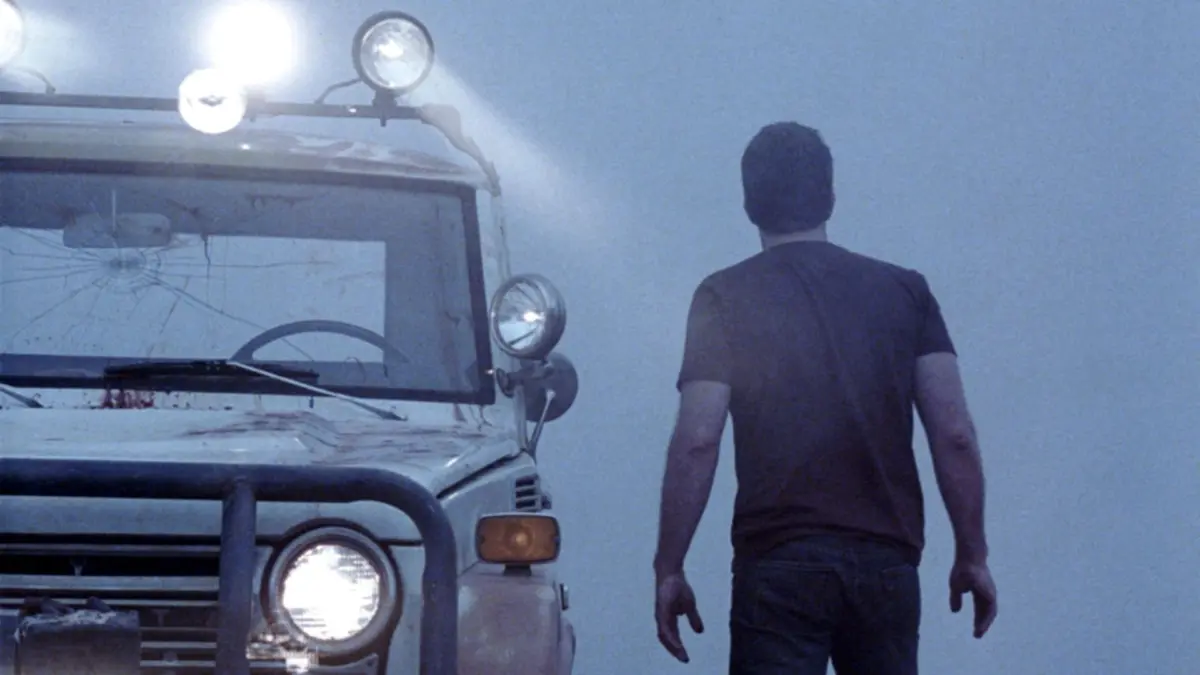
The narrative engine of The Mist ignites in the wake of a ferocious nocturnal storm that batters the lakefront home of commercial artist David Drayton (Thomas Jane) in Maine. Seeking provisions and assessing property damage, David, his young son Billy (Nathan Gamble), and their abrasive neighbor Brent Norton (Andre Braugher) drive into town. The local supermarket is already crammed with anxious townspeople stocking up on essentials when an unnatural, dense white fog rolls over the landscape, swallowing the town whole.
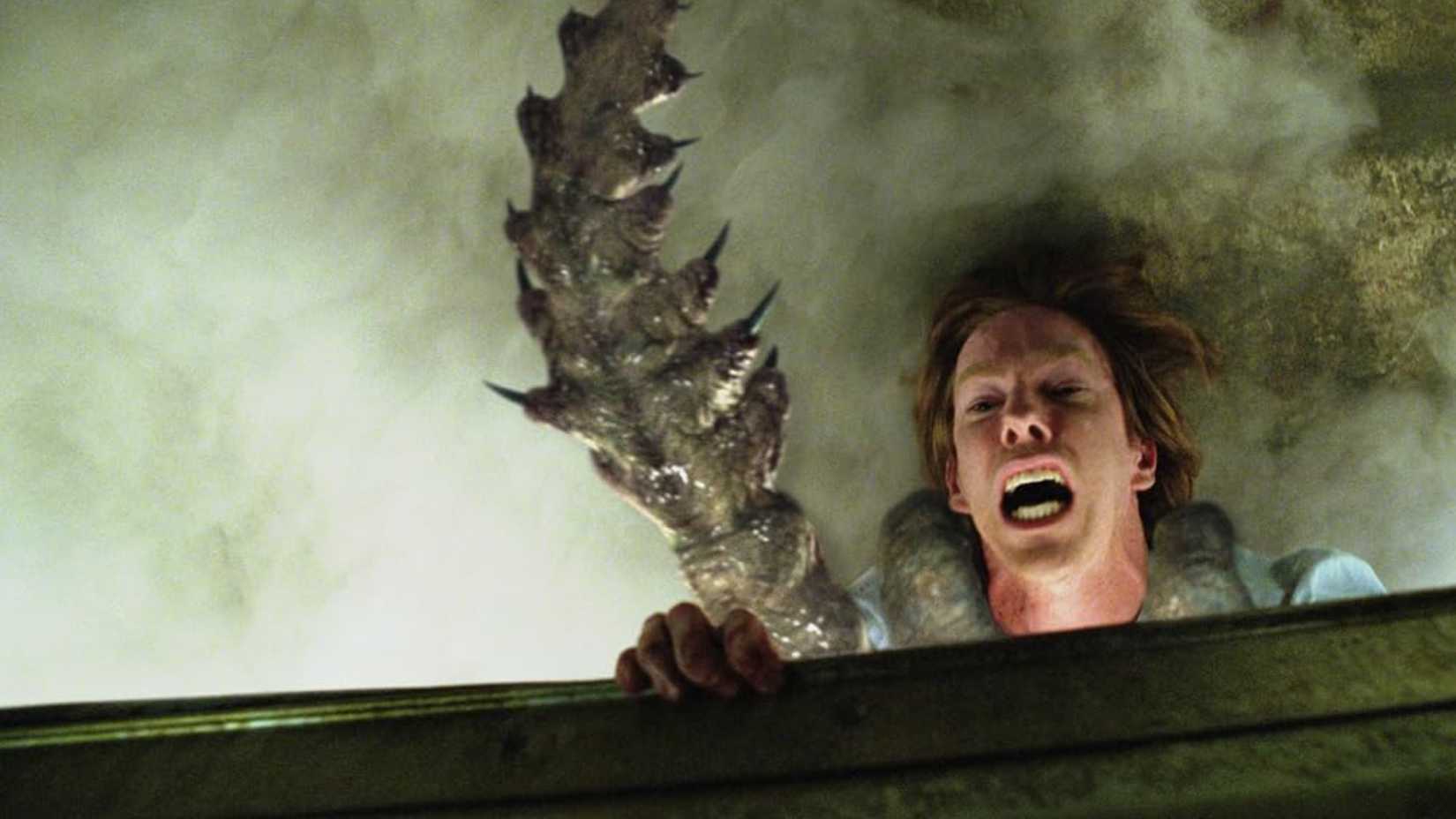
Almost immediately, the storefront’s glass windows become a fragile barrier between civilization and a suite of unknowable cosmic horrors. The true nature of the threat is established with unflinching brutality early in the runtime, when a group of men investigates the loading dock. Massive, otherworldly tentacles rupture through the mist and the garage door.
Stock clerk Norm (Chris Owen) is snatched by an appendage equipped with razor-sharp blades that slice through human tissue effortlessly. Despite the frantic efforts of David, Ollie Weeks (Toby Jones), and others to pull him back, Norm is dragged screaming into the impenetrable white smog, sacrificed to an unseen entity. This sequence establishes the supermarket not as a sanctuary, but as a cage.

The Collapse of the Social Contract
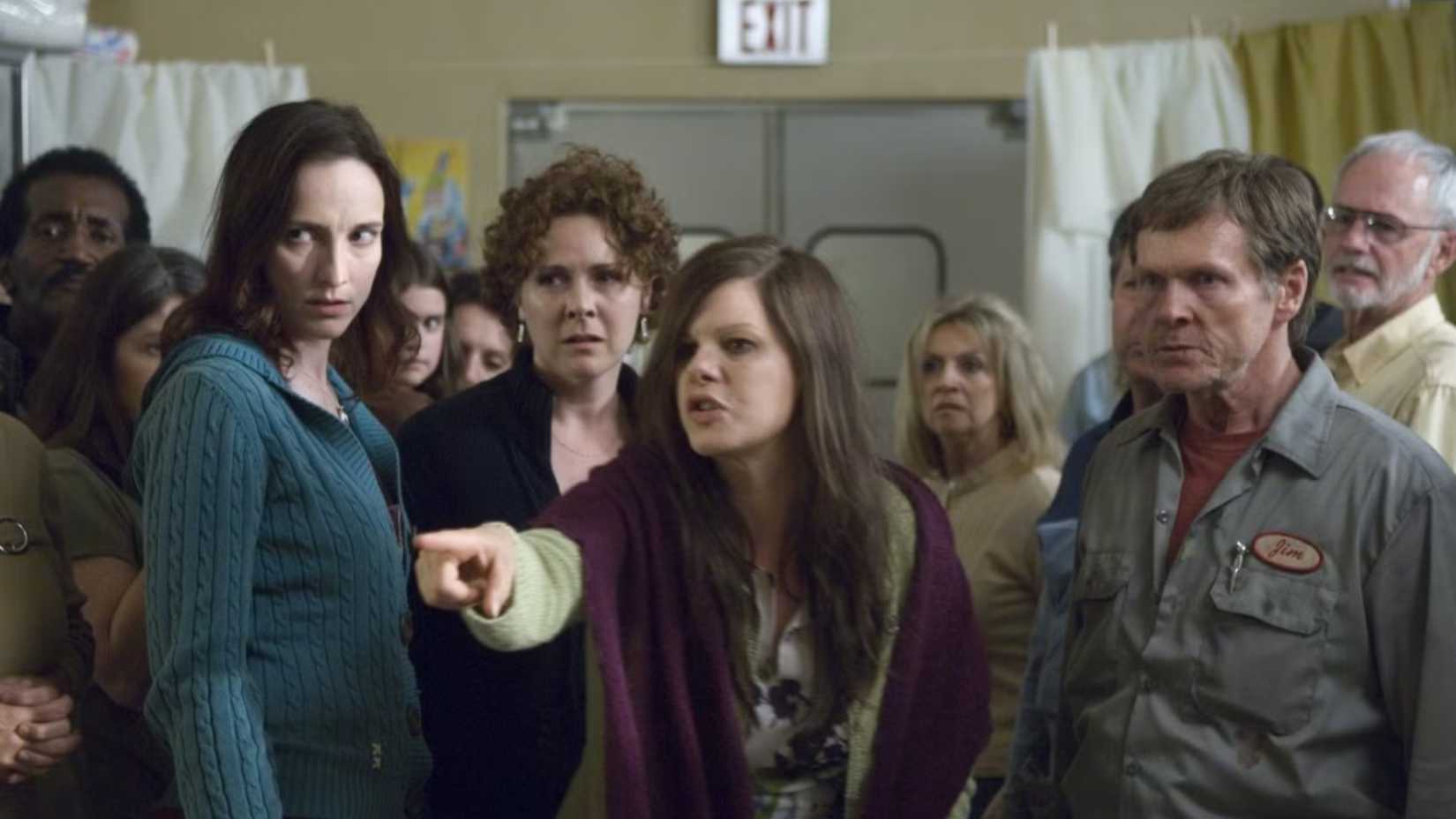
As the days bleed together, the psychological pressures inside the market outpace the threat of the monsters lurking outside. Darabont meticulously charts the rapid decay of societal norms under the weight of existential terror. Enter Mrs. Carmody (Marcia Gay Harden), a religious zealot whose fervent warnings morph from eccentric rantings into a full-blown apocalyptic cult.
As the survivors bicker over whether the fog is a government experiment or an environmental hazard, Carmody weaponizes their shared despair. She frames the monsters as instruments of divine wrath and demands blood sacrifices to appease an angry God. The central thesis of the film—encapsulated by its unforgettable marketing tagline, “Fear changes everything”—takes terrifying shape. The monsters in the fog are horrifying, but they pale in comparison to the cruelty ordinary people inflict upon one another when stripped of hope.
The Desperate Flight and the Unforgivable Choice
Driven out of the supermarket by Carmody’s fanatical followers and internal bloodshed, David, Billy, and a small band of survivors—including Amanda Dunfry (Laurie Holden), Dan Miller (Jeffrey DeMunn), and Irene Reppler (Frances Sternhagen)—escape in a car. They drive aimlessly through a hellscape of overturned military hardware and gargantuan, building-sized beasts until their vehicle runs completely out of gas.
Trapped in the middle of a desolate landscape with no escape and no answers, David makes an agonizing decision. Faced with the certainty of being devoured alive by the horrors closing in around them, and possessing only a revolver with four remaining bullets, he executes his fellow survivors, saving his young son Billy for last. The horror of the act is compounded by the fact that David spent the entire film fighting tooth and nail to protect the boy, only to become his executioner.
In the film’s final, shattering sequence, David stumbles out of the car, howling in grief, demanding that the monsters take him. But the mist does not yield beasts. Instead, it parts to reveal a massive United States military convoy rolling past, complete with tanks, flamethrowers, and trucks packed with survivors—including the mother from the beginning of the movie who had ventured out alone into the fog. Assistance was just seconds away.

Supporting Context & Metrics: Production Realities and Visual Effects
Budgetary Constraints and Aesthetic Limitations
The Mist was produced on an estimated budget ranging between $13 million and $18 million—a remarkably lean sum for a creature-feature boasting large-scale monsters and environmental effects. Director Frank Darabont operated under a severely compressed shooting schedule and strict financial limitations, forcing his production team to make strategic compromises on visual effects (VFX).
The film’s digital assets—particularly the Lovecraftian creatures, flying insects, and the infamous supermarket loading dock tentacles—frequently exhibit the flat lighting, rubbery textures, and lack of shadow integration common to mid-2000s CGI. Critics and audiences have long pointed out these technical shortcomings. However, rather than undermining the picture, this raw aesthetic inadvertently leans into a gritty B-movie sensibility. The obscured framing, heavy reliance on shadows, and panic-driven camera movements mask the budget constraints, shifting the audience’s focus away from digital shortcomings and onto the authentic panic of the human cast.
Critical Reception and Box Office Performance
Upon its theatrical release by Dimension Films in November 2007, The Mist performed respectably at the box office, grossing approximately $57.2 million worldwide against its modest budget. Critical reception was largely positive, praising the film’s unflinching tone, thematic depth, and performances—particularly Marcia Gay Harden’s chilling turn as Mrs. Carmody, which earned her a Saturn Award nomination for Best Supporting Actress.
Over the ensuing decades, the film has undergone a major critical reassessment. While initially viewed by some as a bleak, standard-issue horror outing, modern retrospectives celebrate it as one of the most intellectually daring and emotionally devastating genre films of the 21st century.
Official Statements & Creative Insights
The evolution of The Mist from Stephen King’s ambiguous literary conclusion to Darabont’s execution-style finale remains one of the most famous creative departures in horror history.
In various interviews, Frank Darabont has detailed his long-standing obsession with altering the ending. While King’s 1980 novella concludes on an ambiguous, hopeful note—with David and his surviving companions driving south into an endless fog, their fate unknown—Darabont felt cinema demanded a definitive emotional punctuation mark.
"I had been thinking about that ending for years before we even got the financing," Darabont noted during retrospective discussions on the film’s production. "I knew it was going to shock people, but I felt it was the only honest place to take a story about total, unadulterated despair."
Stephen King’s reaction to the cinematic finale stands in stark contrast to his notorious disdain for Stanley Kubrick’s changes to The Shining. Rather than condemning the alteration, King gave Darabont’s conclusion his absolute blessing. In a frequently cited remark, King confessed that he wished he had thought of the twist himself, praising its ruthless emotional logic and thematic resonance.
Future Outlook: The Legacy of a Modern Horror Classic
Nearly two decades after its theatrical debut, the cultural footprint of Frank Darabont’s The Mist continues to expand. In an era saturated with sanitized blockbusters and predictable narrative arcs, the film stands as a bold reminder of what horror cinema can achieve when it refuses to compromise its emotional integrity.
While discussions surrounding potential reboots or television adaptations—such as the short-lived Spike TV series in 2017—have come and gone, none have managed to capture the lightning-in-a-bottle tension of Darabont’s 2007 feature. The definitive nature of David Drayton’s tragedy ensures that the film remains a timeless cautionary tale about human panic, societal collapse, and the cruelest ironies of fate.
As long as audiences seek out cinema that challenges comfort zones and explores the darkest corners of human behavior, The Mist will continue to occupy its rightful place as one of the most fearless and devastating achievements in horror history.