Executive Overview
Deep beneath the Canadian Shield, two kilometers underground inside the Creighton mine at SNOLAB, detector technologist Matt Depatie maneuvers an inflatable raft across a cavern filled with 7,000 tons of ultrapure, glowing blue water. This subterranean chamber—normally one of the darkest and most rigorously sanitized environments on Earth—provides a rare window into an experiment built to capture some of the most elusive particles in physics: neutrinos.
The SNO+ (Sudbury Neutrino Observatory Plus) collaboration has achieved a major milestone by detecting its first batch of geoneutrinos, rare subatomic messengers originating from deep within the Earth’s interior. This breakthrough marks the first time geoneutrinos have been successfully captured in the Western Hemisphere.
For decades, geophysicists and particle astrophysicists have relied on seismic waves and surface-level mineral samples to infer the composition of Earth’s inaccessible interior. However, capturing geoneutrinos provides a direct, chemical accounting of the radioactive elements powering our planet’s interior heat engine. SNO+’s landmark detection—alongside upcoming observations from massive detectors like China’s JUNO experiment—is igniting a scientific debate over whether Earth’s mantle is chemically uniform or home to vast, hidden variations. If confirmed, these findings could rewrite textbooks on plate tectonics, planetary formation, and the thermodynamic engine that has kept Earth habitable for billions of years.
Detailed Chronology: From Solar Neutrinos to Subterranean Geoneutrino Detection
The pursuit of geoneutrinos is the culmination of decades of particle physics instrumentation designed to isolate signals from the universe while shielding detectors from cosmic noise.
1. The Historical Quest for Neutrinos (1990s–2006)
The origins of SNOLAB trace back to the original SNO experiment, which ran from 1999 to 2006. SNO famously solved the "solar neutrino problem" by proving that electron neutrinos emitted by the sun change flavors as they travel to Earth. Built inside an active nickel and copper mine, SNO demonstrated that heavy water ($textD_2textO$) buried deep underground could act as a stable trap for rare particle interactions, shielded from cosmic radiation by thousands of meters of solid rock.
2. The First Glances at Earth’s Interior (2005–2009)
While physicists initially focused on extraterrestrial sources like the sun and supernovae, a select group of geochemists and particle physicists realized that the radioactive decay of uranium, thorium, and potassium inside Earth should produce a distinct class of low-energy electron antineutrinos, known as geoneutrinos.
- 2005: The KamLAND (Kamioka Liquid Scintillator Antineutrino Detector) experiment in Japan reported the world’s first experimental detection of geoneutrinos, proving that subatomic particles could be used to probe terrestrial chemistry.
- 2009: The Borexino detector, located at the Gran Sasso National Laboratory in Italy, confirmed and expanded upon these findings, capturing several dozen additional geoneutrino events.
3. SNO+ Joins the Global Network (November 2025)
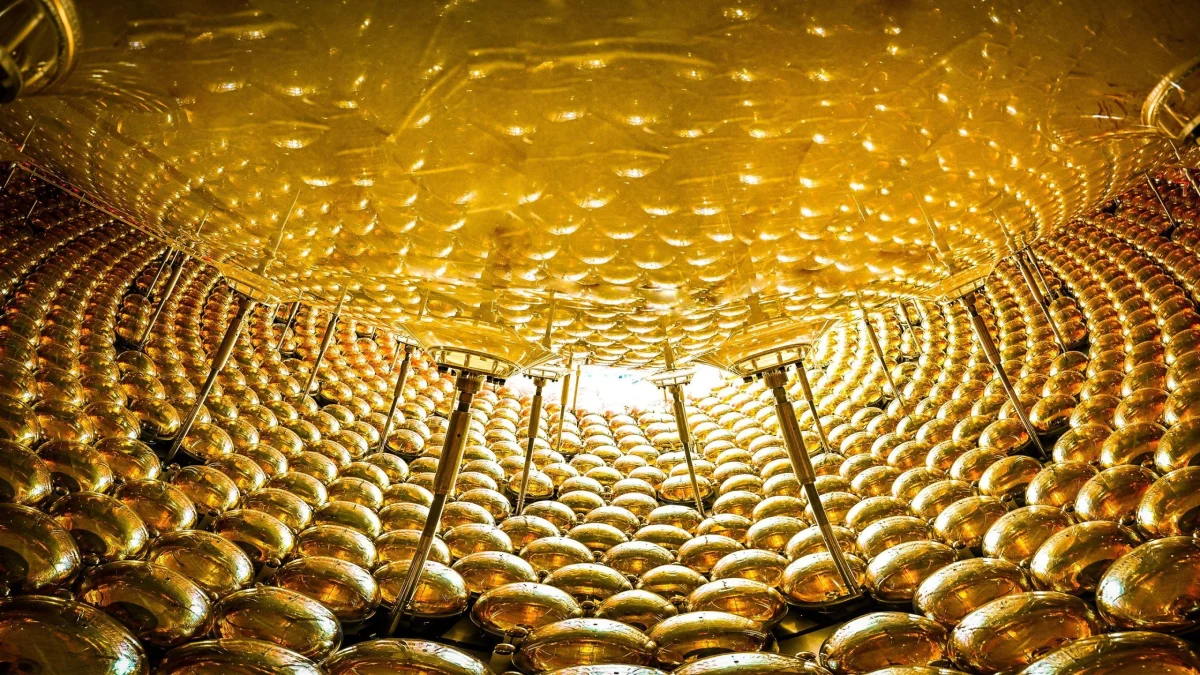
In late 2025, the SNO+ collaboration officially reported its first detection of geoneutrinos, successfully capturing roughly 50 events. Because SNO+ repurposed the original infrastructure of the SNO experiment—including its acrylic vessel and 10,000 photomultiplier tubes, but filled with 780 tons of a specialized linear alkylbenzene-based liquid scintillator—it provided a brand-new, independent vantage point in the Western Hemisphere.

4. The Expanding Horizon (2026 and Beyond)
The geoneutrino landscape is entering its most data-rich era. The Jiangmen Underground Neutrino Observatory (JUNO) in China, featuring a massive 20,000-ton liquid scintillator detector buried beneath a mountain near Guangzhou, began operations in August 2025 and is projected to report its initial geoneutrino measurements. JUNO is expected to eclipse the historical catch of all prior experiments combined within its first year of operation.
Supporting Context & Metrics: The Physics and Geology of Geoneutrinos
Understanding the significance of these detections requires examining the extreme physics of neutrinos and the thermal dynamics of the Earth.
The Elusive Nature of Neutrinos
Neutrinos are the most abundant massive particles in the universe. Yet, they possess almost negligible mass—roughly a million times lighter than an electron—and carry no electromagnetic charge. Because they interact with matter solely via the weak nuclear force and gravity, trillions of solar and cosmic neutrinos stream through the human body every second without leaving a trace.
Geoneutrinos are specifically electron antineutrinos generated by the radioactive decay chains of long-lived isotopes:
- Uranium-238 ($textU^238$)
- Thorium-232 ($textTh^232$)
- Potassium-40 ($textK^40$)
These radioactive elements, along with primordial heat trapped during planetary accretion, supply the thermal energy that drives mantle convection. This convective motion powers plate tectonics, fuels volcanic activity, and sustains Earth’s protective magnetic field. Without the continuous heat generated by radioactive decay, Earth would have cooled into a geologically dead world billions of years ago, mirroring the fate of Mars.
The Contamination Challenge
Detecting geoneutrinos is an exercise in extreme isolation and background suppression. To protect the SNO+ detector from cosmic rays—high-energy particles from space that would otherwise overwhelm the data—the experiment is buried 2 kilometers beneath the surface under massive quantities of rock.
Furthermore, access protocols are rigorous. Technicians and researchers must strip out of street clothes, shower, and don specialized electric blue jumpsuits and hairnets before entering the cavern. As Ryan Bayes, a particle astrophysicist at Queen’s University, noted: "The showers aren’t for you, they’re for the science." Even microscopic traces of radioactive radon dust carried on clothing can trigger false signals in the sensitive scintillator fluid.

Once background radiation is eliminated, physicists must carefully subtract other sources of antineutrinos, including:
- Nuclear Reactors: Man-made antineutrinos produced by nearby power plants.
- The Crust: Geoneutrinos generated within the topmost, radioactive-rich layers of Earth’s continental crust, particularly within hundreds of kilometers of the detector.
Once these components are subtracted, the remaining signal isolates the geoneutrinos originating from the deep mantle.
Official Statements and Expert Perspectives
The global scientific community is sharply divided over what current data implies about Earth’s internal structure.
Mapping a Non-Uniform Mantle
Traditionally, geochemists assumed that mantle convection thoroughly mixes radioactive elements, resulting in a relatively homogenous distribution throughout the planet’s interior. However, comparisons between data from Borexino, KamLAND, and now SNO+ challenge this assumption.
"It could be that that’s the first hint that the mantle is not uniform," says Mark Chen, a particle astrophysicist at Queen’s University and director of the SNO+ collaboration.
The geoneutrino flux measured by Borexino in Europe appears significantly higher than the flux measured by KamLAND in Japan. SNO+’s preliminary results from Canada suggest an intermediate value.
These spatial discrepancies may correlate with large low-shear-velocity provinces (LLSVPs)—two continent-sized blobs of ultra-dense, anomalously hot material resting deep in the lower mantle on opposite sides of Earth’s core (one beneath Africa, the other beneath the Pacific Ocean).

"There may be deep Earth structures in the mantle that are not understood," Chen explains. "It could be that [they] concentrate some kinds of elements."
The Debate Over Global Discrepancies
William McDonough, a geochemist at the Chinese Academy of Sciences who has pioneered geoneutrino research for decades, emphasizes the statistical uncertainties that still plague the field.
"If we take it at face value, we could say maybe the western hemisphere has a lot more radioactive material in it than the eastern hemisphere," McDonough notes. However, he remains cautious: "Are the Italians right? Are the Japanese right? Are both right? Or is something wrong?"
Virginia Strati, a researcher at the University of Ferrara who helped model the complex local radioactivity of the Sudbury impact basin surrounding SNOLAB, points out the difficulties in parsing regional crustal contributions from mantle signals: "There are lots of unknowns in this geological area… The difference in the geoneutrino flux expected from various distributions of radioactive elements is very small, and is hidden in these uncertainties."
Future Outlook: The Road to an Ocean-Bottom Detector
As the field looks past the initial SNO+ findings and anticipates comprehensive data from China’s JUNO detector, researchers are already mapping out the next generation of geoneutrino science.
Overcoming Continental Interference
The single greatest obstacle in geoneutrino detection is interference from continental crust, which contains high concentrations of uranium and thorium. Because continental crust varies wildly in thickness and composition, it introduces massive margins of error when trying to image the mantle below.
To solve this, William McDonough has championed a radical proposal for decades: building a neutrino detector at the bottom of the ocean.

An oceanic detector would offer distinct advantages:
- Thin Oceanic Crust: Oceanic crust is much thinner, more uniform, and contains far fewer radioactive elements than continental crust.
- Mantle Isolation: By placing a detector miles offshore in deep water, background noise from continental rocks drops precipitously, pushing researchers squarely into "mantle-only territory."
While an ocean-floor neutrino detector is estimated to cost hundreds of millions of dollars and has faced hesitation from traditional Western funding agencies, momentum may shift. China has increasingly shown a willingness to fund large-scale, ambitious geoscience and particle physics infrastructure, raising the possibility that an oceanic detector could move from theoretical design to reality in the coming decades.
Conclusion
Until an ocean-bottom detector is built, the quest to unravel Earth’s thermal history will continue deep underground. As researchers at SNOLAB, KamLAND, Borexino, and JUNO refine their particle-sorting algorithms and expand their statistical datasets, humanity inches closer to producing the world’s first true chemical map of Earth’s deep interior—turning invisible ghost particles into a beacon illuminating the engine that sustains our world.