SEATTLE — In a move set to fundamentally transform how cloud architectures are audited, optimized, and maintained, Amazon Web Services (AWS) has announced the public preview of the AWS Well-Architected Agent.
This cutting-edge, artificial intelligence-powered service represents a quantum leap forward from traditional, manual cloud management tools. Rather than forcing engineers to sift through generic checklists, static dashboards, or labor-intensive periodic audits, the Well-Architected Agent acts as an autonomous virtual cloud architect. It continuously evaluates an organization’s AWS environment, aligns its findings with explicit business objectives, and delivers context-aware optimization strategies accompanied by ready-to-implement remediation packages.
Delivered as part of AWS Support, the new agent bridges the historical gap between high-level architectural guidelines—codified in the AWS Well-Architected Framework—and the operational reality of complex, multi-account, and multi-region cloud estates. As enterprises grapple with mounting cloud expenditures, escalating security threats, and the complexities of distributed system performance, the introduction of an AI agent capable of synthesizing utilization metrics, resource configurations, and application topologies arrives at a critical juncture.
Executive Overview
The modern enterprise cloud footprint is vast, dynamic, and frequently difficult to govern manually. Organizations regularly struggle to maintain parity between rapid application delivery and foundational best practices across cost optimization, security, reliability, performance efficiency, and operational excellence.
The AWS Well-Architected Agent addresses these systemic challenges by automating the deep analytical work typically reserved for seasoned cloud architects. Operating across more than 65 AWS services, the agent evaluates infrastructure configurations against established best practices while factoring in the unique priorities of the business.
Key Capabilities at a Glance
- Context-Aware Analytics: Automatically correlates utilization metrics, application topologies, and resource configurations without relying on static spreadsheets or generic questionnaires.
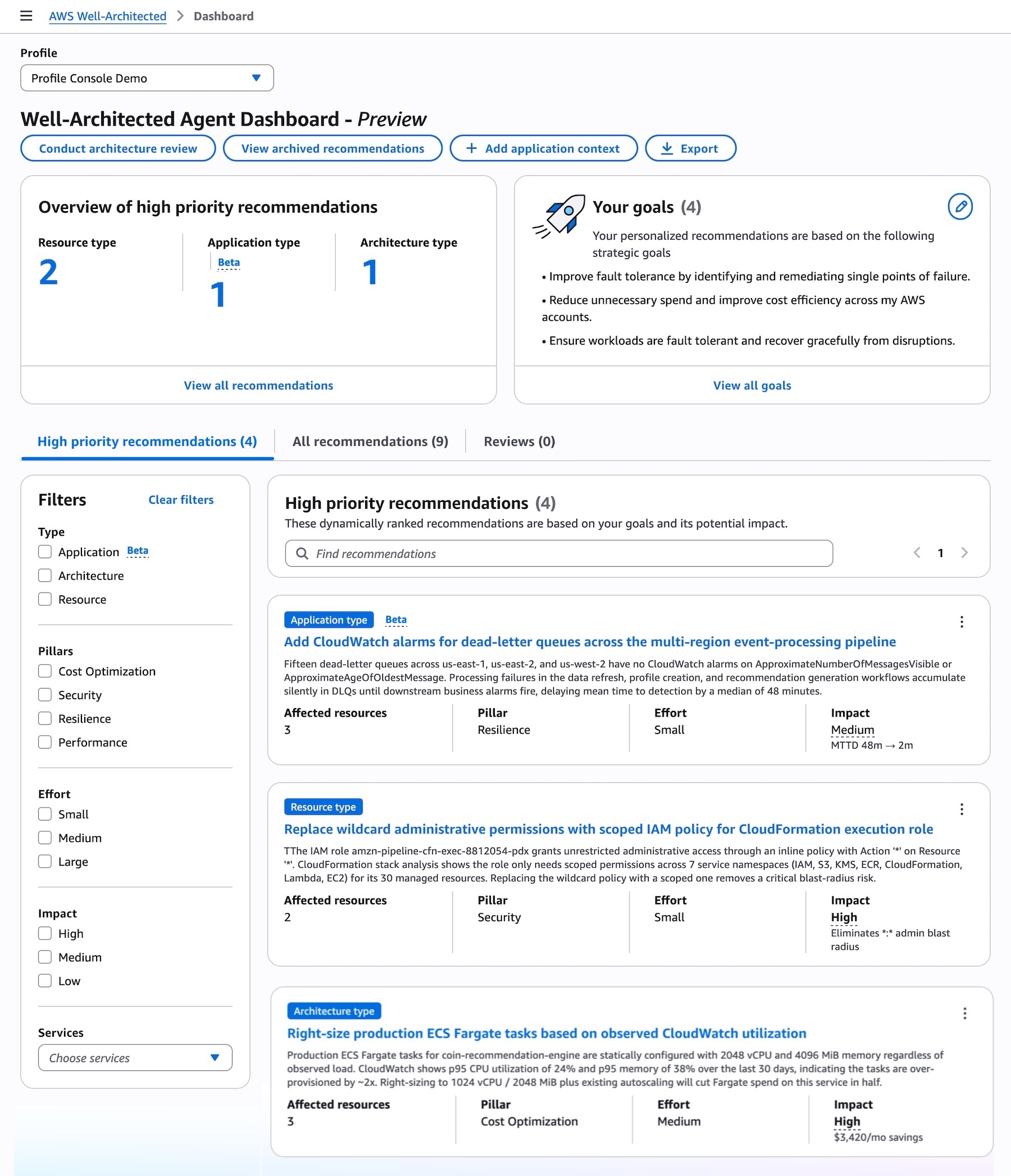
- Business-Aligned Prioritization: Ranks recommendations based on declared organizational goals—whether an enterprise prioritizes hyper-aggressive cost reduction, uncompromising security posture, or maximal resiliency.
- Pre-Deployment & Runtime Reviews: Analyzes live environments as well as pre-deployment workloads via Infrastructure as Code (IaC) templates.
- Actionable Remediation Packages: Eliminates guesswork by providing copy-and-paste code modifications, updated IaC templates (Terraform, CloudFormation, AWS CDK), AWS CLI commands, and step-by-step console instructions.
- Cross-Pillar Trade-Off Visibility: Transparently surfaces the systemic impacts of changes—such as highlighting the performance or cost implications of implementing a heightened security posture.
Detailed Chronology & Mechanics: How the Well-Architected Agent Works
The architecture of the AWS Well-Architected Agent is engineered for seamless integration into existing cloud operations. Getting started with the preview requires a structured sequence of profile creation, permission provisioning, and context configuration.

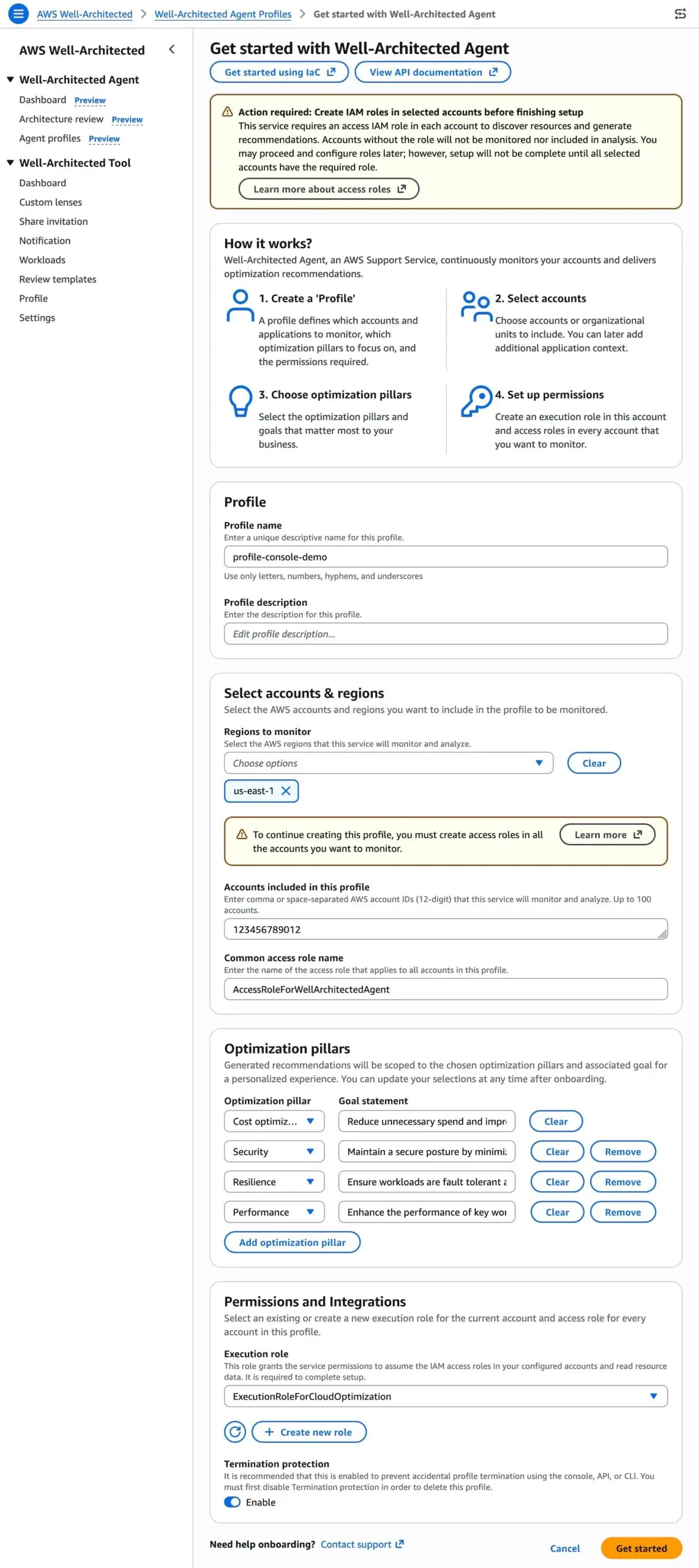
1. Creating an Agent Profile
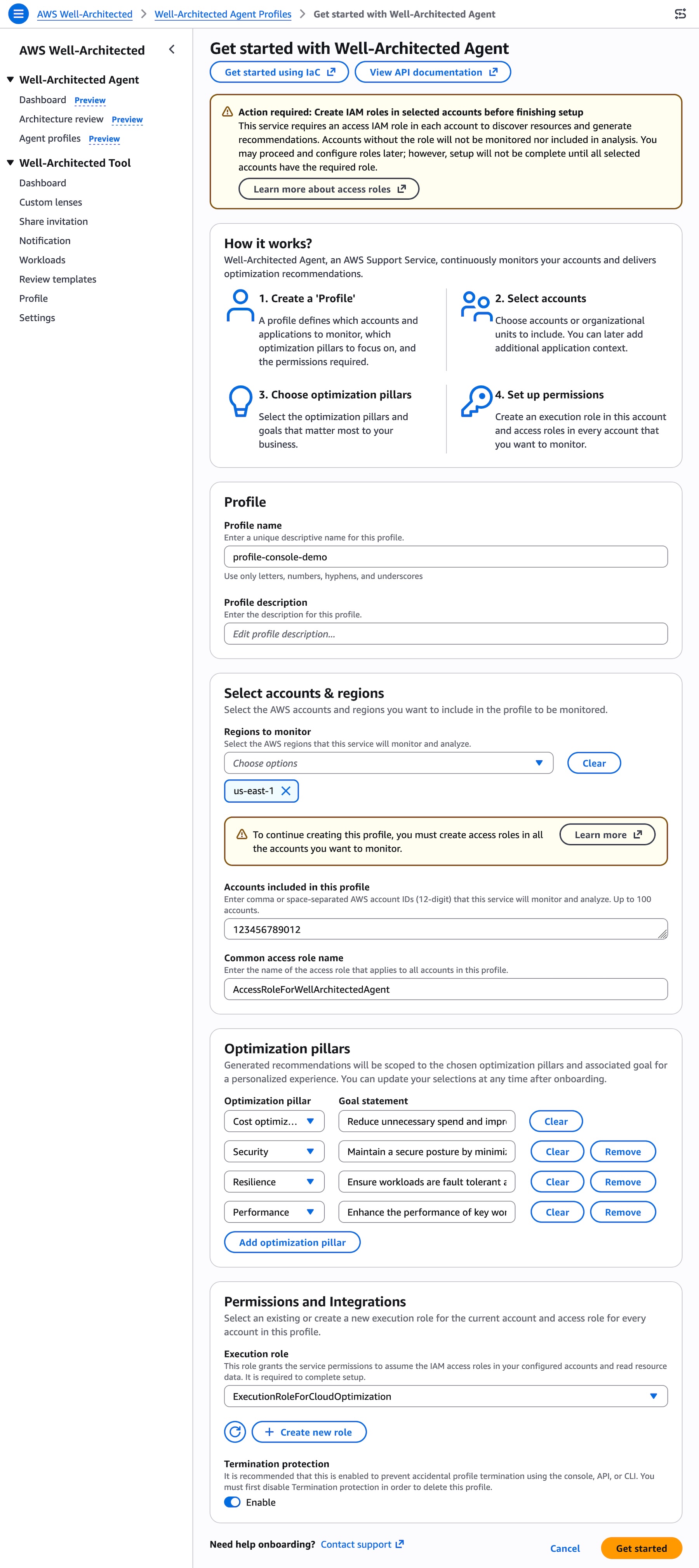
Administrators begin within the AWS Well-Architected console by launching the profile creation wizard. This interface defines the blast radius and operational scope of the agent. Users specify:
- Target AWS accounts and regions to monitor.
- Optimization pillars that align with current corporate objectives.
- Tailored goals for specific pillars (e.g., maximizing throughput for performance-critical databases versus minimizing idle compute spend).
To ensure secure, least-privilege operations, customers provision customer-managed AWS Identity and Access Management (IAM) roles. These roles grant the agent read-only access to necessary resource configurations, utilization metrics, and application topologies. Once initialized, the agent processes the environment, generating initial resource and application recommendations within 24 hours.
2. Shifting Left: Pre-Deployment Architecture Reviews
A standout feature of the Well-Architected Agent is its ability to audit infrastructure before it touches production. By leveraging Infrastructure as Code (IaC) analysis, engineering teams can catch architectural anti-patterns during the development phase.
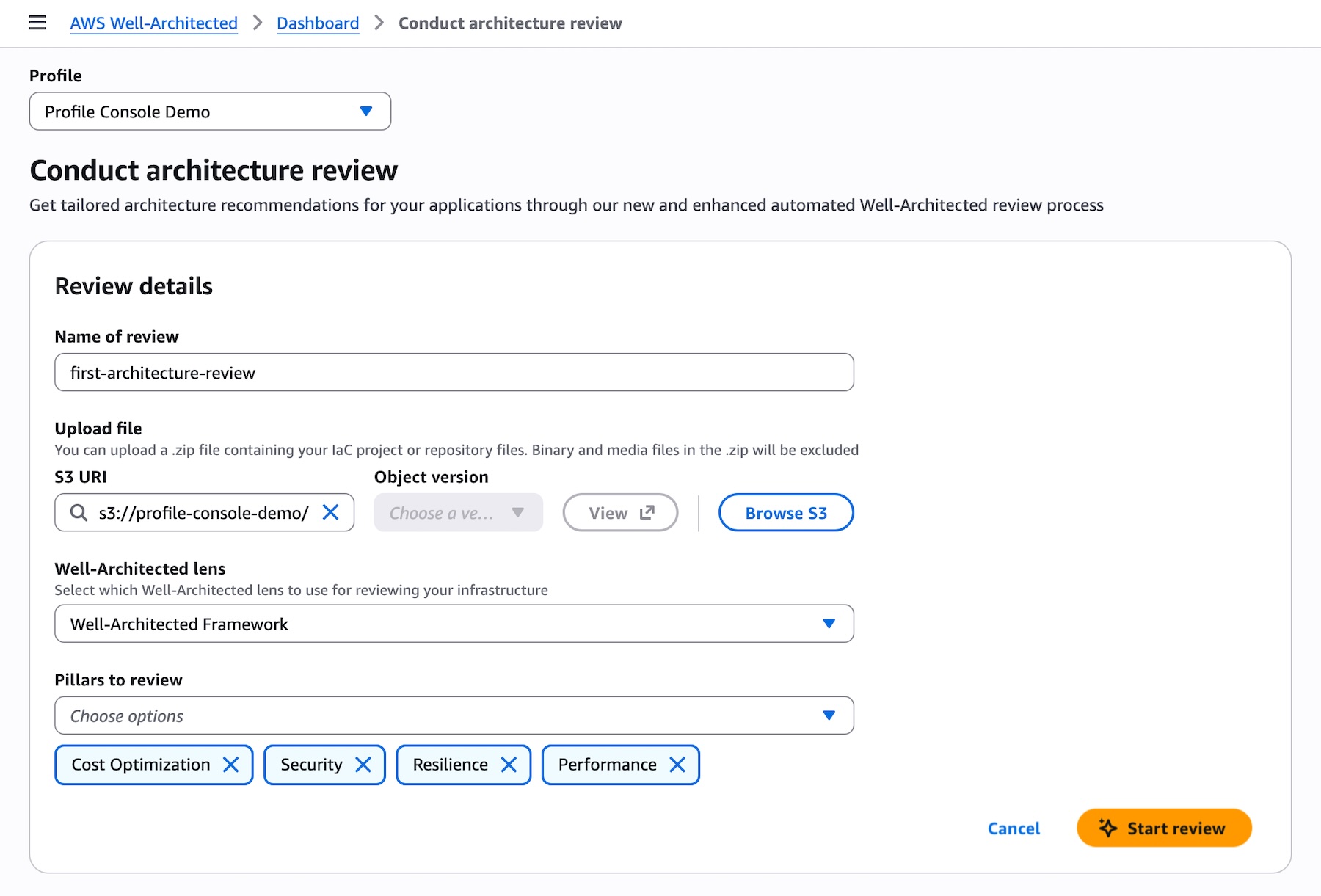
To conduct a pre-deployment review, users upload a .zip file containing an IaC project—supporting Terraform, AWS CloudFormation, or the AWS Cloud Development Kit (CDK)—directly into the dashboard. After selecting the appropriate Well-Architected lens, the agent parses the code repositories, checks them against enterprise guidelines, and returns prioritized findings before code ever reaches a deployment pipeline.
3. Adding Application Context for Hyper-Relevance
Generic recommendations often fail because automated tools lack domain knowledge about specific workloads. The Well-Architected Agent solves this by allowing teams to attach rich operational context.
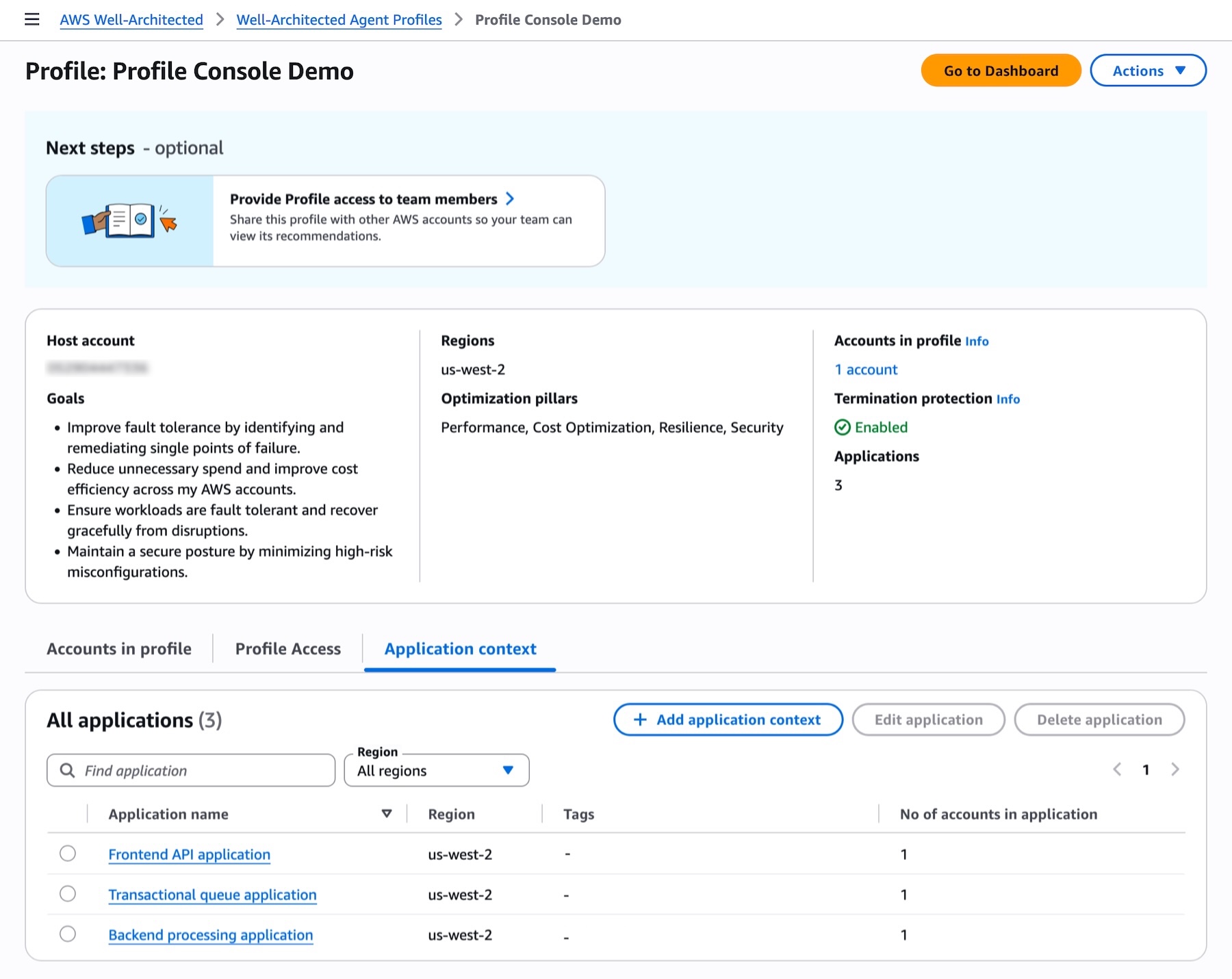
Through the "Add application context" dashboard utility, engineers can link applications to specific AWS accounts, regions, services, and resource tags. This metadata enables the agent to filter out noise, focus exclusively on mission-critical applications, and deliver hyper-targeted insights tailored to the workload’s specific business function.
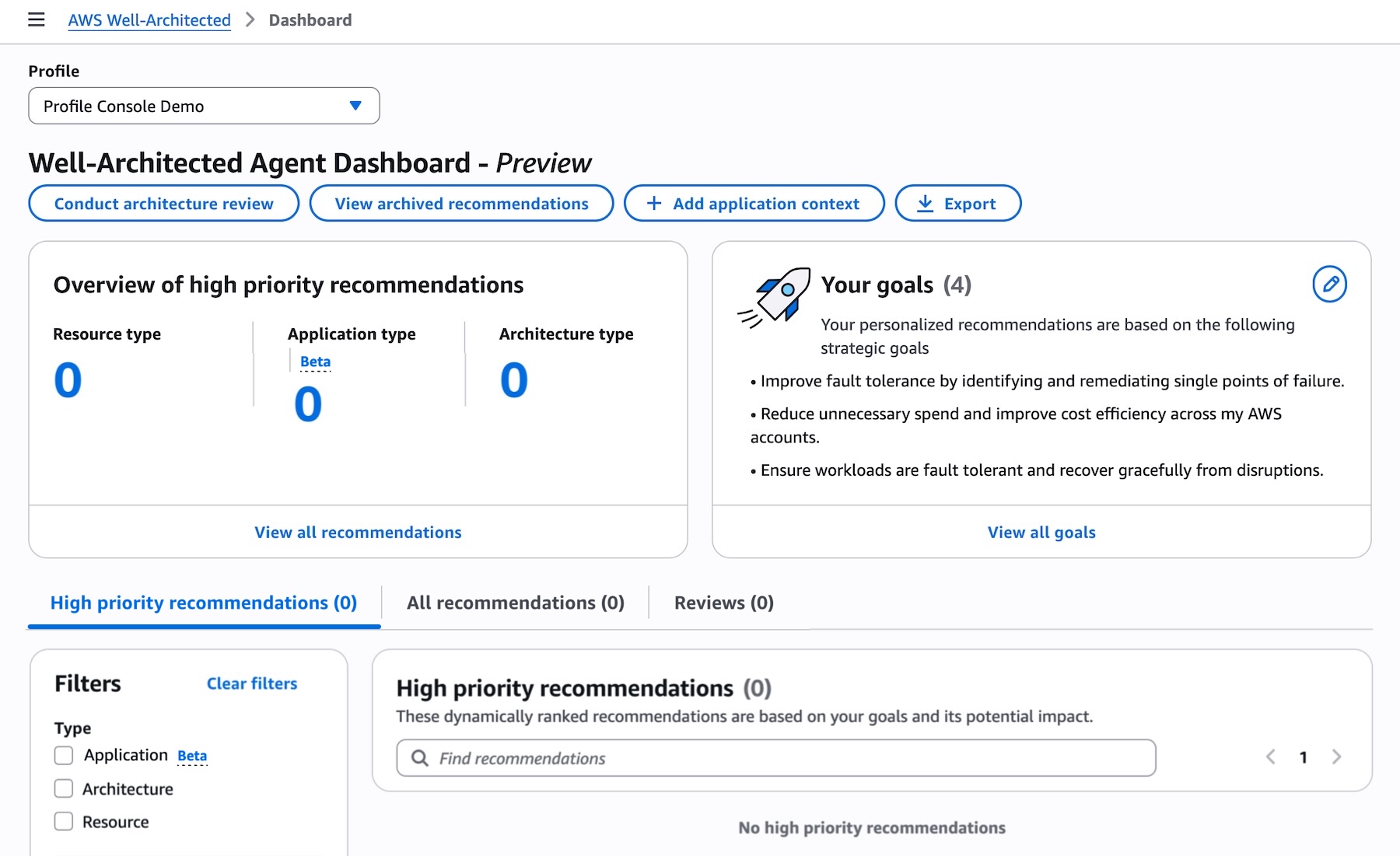
4. Reviewing Prioritized Recommendations and Executing Remediation
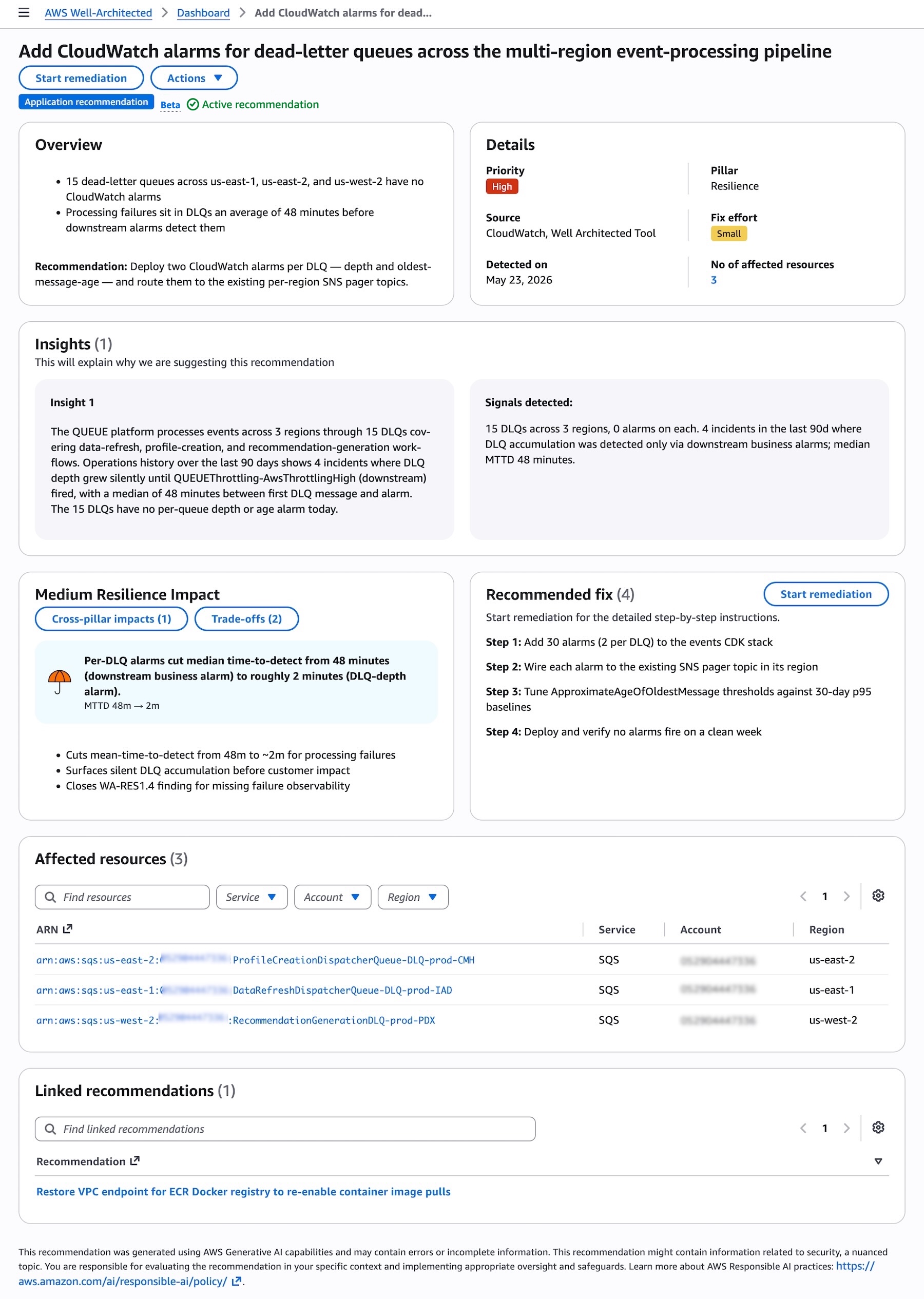
Once the analysis is complete, the agent presents a unified, ranked list of recommendations. Selecting an individual finding opens a deep-dive panel that details:
- The root cause of the finding and the rationale behind the agent’s suggestion.
- Potential cross-pillar impacts and architectural trade-offs.
- Affected AWS resources.
Remediation is streamlined through the Start remediation workflow. Depending on the preferred resolution type, users can choose between guided AWS Management Console steps, AWS CLI commands, or updated IaC templates. For example, selecting an updated IaC template generates the exact code patch required—such as a modified CDK function block—which engineers can copy directly into their local codebase.
Furthermore, teams can configure API access to pull recommendations directly into native development and operations workflows. By utilizing the AWS Model Context Protocol (MCP) Server and associated plugins, developers can query the Well-Architected Agent, run documentation searches, and receive architectural guidance directly within their preferred AI coding assistants.
Supporting Context & Metrics: The Evolution of Cloud Governance
The launch of the Well-Architected Agent marks a maturation phase in cloud computing. Over the past decade, AWS has expanded its service catalog to encompass hundreds of specialized tools, databases, serverless frameworks, and container orchestration platforms. While this abundance unlocks unprecedented engineering velocity, it has simultaneously introduced staggering complexity.
Industry studies consistently highlight that a significant percentage of enterprise cloud spend is wasted on idle or over-provisioned resources. Concurrently, misconfigurations remain a leading vector for security vulnerabilities.
Bridging the Knowledge Gap
Historically, optimizing an environment meant scheduling periodic Well-Architected reviews—interviews where cloud architects and project managers sat down with the AWS Well-Architected Tool to manually answer questionnaires about security, reliability, and cost. While effective, this model suffered from two primary bottlenecks:
- Infrequency: Reviews were point-in-time snapshots, becoming obsolete the moment a new microservice was deployed or an infrastructure change was pushed.
- Subjectivity & Scale: Translating high-level pillars (e.g., "design for resilience") into concrete configuration parameters across thousands of AWS resources required elite domain expertise that many lean engineering teams lacked.
By turning the Well-Architected framework into an autonomous agent that continuously interrogates metrics and resource maps, AWS is effectively democratizing elite cloud architecture expertise. Junior developers and seasoned principal engineers alike gain access to an advisor that thinks holistically across security boundaries, performance bottlenecks, cost ledgers, and reliability metrics.
Official Statements and Strategic Implications
Industry analysts view the Well-Architected Agent as a strategic salvo in the broader enterprise transition toward autonomous, AI-driven operations (AIOps). By integrating intelligence directly into foundational governance frameworks, AWS is shifting the value proposition of enterprise cloud support.
The service is delivered as an extension of AWS Support, making it immediately accessible to customers enrolled in eligible AWS Support tiers. By tying advanced AI-driven remediation directly to enterprise support plans, AWS is signaling that proactive, automated optimization is no longer a luxury add-on, but a core component of enterprise cloud hygiene.
Regional Availability and Onboarding
At launch, the preview for the AWS Well-Architected Agent is hosted in three primary AWS Regions:
- US East (N. Virginia)
- US East (Ohio)
- US West (Oregon)
However, enterprises are not restricted to monitoring these specific geographies; workloads from any commercial AWS Region can be onboarded into the agent profiles for comprehensive global oversight.
Future Outlook: What’s Next for Autonomous Cloud Architecture?
As the public preview gathers momentum and real-world telemetry from early adopters, the roadmap for the AWS Well-Architected Agent points toward even deeper automation.
Future iterations are widely expected to expand native CI/CD pipeline integrations, enabling automated pull requests that resolve architectural violations before code reaches staging environments. Moreover, as the agent’s underlying models absorb more cross-industry telemetry, the fidelity of its cross-pillar trade-off analysis will sharpen, allowing organizations to fine-tune their infrastructure dynamically against shifting economic and security landscapes.
For organizations looking to eliminate architectural debt, control burgeoning cloud costs, and harden security postures without scaling their headcount, the AWS Well-Architected Agent offers an enticing glimpse into the future of cloud computing: an environment where infrastructure heals, optimizes, and adapts itself.
The public preview of the AWS Well-Architected Agent is available today within the AWS Well-Architected Console. Customers are encouraged to test workloads and submit feedback through their established AWS Support channels.