Executive Overview
For decades, the standard playbook for scaling a B2B software company has followed a predictable arc: build a world-class product in Silicon Valley or a major domestic hub, achieve product-market fit, capture the United States market, scale domestic sales and marketing operations, and only then—often years later—look outward across oceans.
However, a profound structural shift is rewriting this narrative. Modern cloud-native architectures, digital-first buying behaviors, and borderless product-led growth (PLG) loops mean that software products are no longer born local; they are born global by default. Long before a company formally decides to open an overseas office, digital demand quietly crosses borders, laying down roots in Berlin, São Paulo, Bengaluru, and Dublin.
Data from industry benchmarks reveals a striking reality: many of the world’s most successful software-as-a-service (SaaS) and infrastructure companies generate nearly half of their total revenue internationally while still operating with heavily US-centric footprints. When companies like Replit—which recently announced its first international office in London nearly a decade after its founding, despite boasting over 50 million users and tracking toward $1 billion in run-rate revenue—finally make the leap, it highlights a broader industry phenomenon. Silicon Valley and North American tech leaders are consistently waiting just a bit too long to invest in their overseas markets.
This investigative report examines the data behind international software revenues, the high costs of delayed localization, and a provocative framework for when—and how—growing tech companies should commit capital to foreign soil.
Detailed Chronology & Industry Evolution: The Anatomy of International Expansion
To understand how modern tech companies approach international expansion, one must examine the timeline of typical B2B scale-ups. The journey from a garage-built prototype to a multinational enterprise is fraught with operational milestones, yet geographic expansion is frequently treated as a secondary phase rather than a parallel track.
The Replit Case Study: A Decade in the Making
Consider the trajectory of Replit. Founded in 2016, the collaborative browser-based programming platform scaled at an astonishing pace, amassing more than 50 million users worldwide. Backed by substantial venture capital—including a massive $400 million funding round at a $9 billion valuation, explicitly earmarked in part for expansion across Europe, Asia, and the Middle East—the company became a global developer home.
Yet, it wasn’t until late 2026 that CEO Amjad Masad announced the opening of Replit’s first international office in London.
Ten years of operation, 50 million users, a billion dollars in run-rate revenue, and only then does the first official outpost outside the United States open its doors. Replit’s trajectory is not an outlier; it is the textbook definition of the traditional expansion pattern. Founders and executive teams build massive international user bases organically, watching foreign traffic climb month over month, while keeping physical and operational infrastructure tightly locked within domestic borders.
The Organic Influx: Growth Before Infrastructure
Why does this pattern persist? For self-serve and PLG products, the barriers to global distribution have effectively vanished. A developer in Tokyo, a designer in Buenos Aires, or a data engineer in Munich can sign up for a cloud database, a design suite, or an automation tool with a credit card and an internet connection.
Consequently, companies routinely find that 20%, 30%, or even 40% of their total inbound demand originates outside their home country before they have hired a single international employee, established a local legal entity, or localized their software strings.
While this organic adoption is a powerful testament to product-market fit, it also represents a dangerous form of corporate myopia. When companies wait for domestic growth to plateau before looking abroad, they leave massive amounts of unconverted demand on the table. They rely on foreign users to navigate English-only documentation, grapple with cross-border currency friction, and accept high-latency performance—all while ignoring the local competitors who are actively waiting to swoop in with native alternatives.
Supporting Context & Metrics: The Hard Numbers on B2B Globalization
To quantify this global revenue lag, industry analysts frequently pull data from top-tier public and private B2B software leaders. The metrics reveal a stark divide between the sheer volume of international users and the actual revenue capture facilitated by localized operations.
Public Market Insights: Where the Money Goes
A snapshot of prominent B2B technology companies illustrates the substantial weight of international revenue in modern enterprise tech:
- Figma: 53% of total revenue is international (while an astounding 85% of total users reside outside the United States).
- Cloudflare: 49% of revenue is international.
- HubSpot: 49% of revenue is international.
- MongoDB: 46% of revenue is international.
- Twilio: 36% of revenue is international.
- Snowflake: 26% of revenue is international.
- Okta: 20% of revenue is international.
Across a dozen leading public B2B companies, two-thirds generate 40% or more of their revenue outside the United States. However, the path to these numbers varies wildly depending on the go-to-market (GTM) motion.
PLG vs. Enterprise Sales: Self-Serve vs. Boots on the Ground
The distinction between self-serve products and enterprise sales-led products dictates how quickly international revenue scales:
- Self-Serve and Product-Led Growth: For products like Figma, growth happens from the bottom up. Users invite teammates across borders, creating viral loops that span continents effortlessly. However, underinvestment in these regions means leaving high-intent, self-serve demand unconverted or under-monetized. For years, Figma’s metrics showed a massive pool of global users before the company aggressively stood up regional hubs, local data hosting, and specialized localized governance.
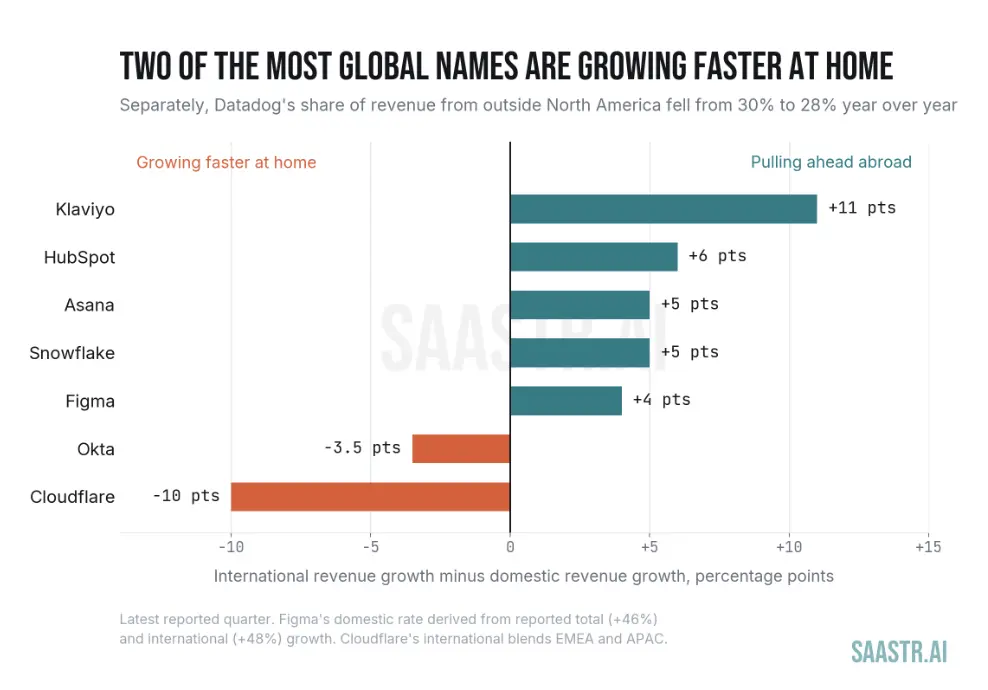
- Enterprise Sales-Led Motions: For companies like Snowflake and Okta, international revenue operates on a different mechanistic rule. Because enterprise software deals require complex procurement cycles, security reviews, and localized account executives, revenue only appears in a country after you have staffed it.
Consequently, a company like Snowflake sitting at 26% international revenue—or Okta sitting at 20%—is not suffering from a lack of foreign demand. Rather, those figures are a direct, lagging indicator of headcount decisions made two to three years prior. Once these enterprises begin hiring boots on the ground, non-US revenue growth routinely outpaces domestic growth, proving that the demand was waiting all along.
Klaviyo’s Regional Hub Playbook
The direct impact of strategic regional investments can be seen in companies like Klaviyo. Facing relatively flat international metrics, Klaviyo added targeted regional hubs in Dublin and Singapore.
The results were swift and dramatic. Within a single year, Klaviyo’s international share of revenue shifted from 39.5% to 42%. In that same period, international revenue surged by 33%, outpacing domestic US revenue growth of 22%. Crucially, this transformation was achieved not through a massive, uncontrolled global rollout, but through targeted, surgical investments in just two regional nodes. It proved that a minor structural adjustment could successfully unfreeze metrics that had flatlined for years.
Official Statements and Industry Perspectives
The realization that enterprise leaders have systematically underinvested in international markets has sparked candid reflections among prominent technology executives.
When discussing the delayed expansion timelines of major cloud and identity companies, industry leaders have increasingly pointed to strategic blind spots. Addressing Okta’s international revenue footprint, CEO Todd McKinnon offered a remarkably blunt assessment of the company’s historical approach to global markets on social media:
"We should have gone much harder much earlier. One of the many mistakes I’ve made. Like many things it’s just focus and priority!"
— Todd McKinnon, CEO of Okta
McKinnon’s admission strikes at the heart of why companies delay international expansion: opportunity cost and executive bandwidth. When a domestic market is booming, expanding abroad feels like an unnecessary distraction. It introduces regulatory complexity, foreign exchange volatility, and management overhead. It is far easier for a CEO to focus on dominating North America than to untangle the nuances of GDPR, local tax compliance, and multi-region sales compensation structures.
However, as the data demonstrates, treating international expansion as a "Phase 2" project often means forfeiting market share to nimbler competitors who are willing to localize earlier. The consensus among top-tier operators is shifting: waiting until domestic growth fully stalls is no longer a viable strategy for category leaders.
The 5% Rule: A New Framework for International Investment
To help founders and executive teams escape the trap of perpetual delay, industry veterans have proposed a streamlined, metrics-driven heuristic known as the SaaS Global Expansion Rule.
Rethinking the Threshold
Traditional tech wisdom often dictates that a company should not invest in an international market until that region accounts for 15% to 20% of total revenue, or until the foreign market is "material enough to justify the cost."
This logic is fundamentally flawed. According to the 5% Rule, once a single foreign country or unified economic zone reaches 5% of total revenue with zero local investment, the company should immediately lean in.
Why 5% is the Magic Number
Achieving 5% of revenue from a foreign market purely by accident—without local sales reps, local marketing campaigns, localized pricing, or native language support—proves that you have cleared the three hardest hurdles in business:
- Discovery: People in that country were able to find your product organically despite your lack of localized SEO or regional PR.
- Utility: The core product solves a painful enough problem that foreign users are willing to overlook language barriers, latency, and cultural gaps.
- Monetization: They figured out how to pay you through a domestic buying process, currency conversion, or cross-border payment method that you never designed for them.
In short, you have cleared the hardest parts of market entry by accident. What remains is the cheap part: intentional optimization.
What "Leaning In" Actually Means
Leaning in at the 5% threshold does not mean recklessly burning capital on expensive downtown office leases, complex foreign subsidiaries, and bloated sales teams of twenty people. Instead, it requires a lightweight, phased investment playbook:
- Regional Data Hosting & Compliance: Ensure your infrastructure complies with local data residency laws (such as GDPR in Europe or local data localization mandates in India) to remove enterprise friction.
- Localized Payment Processing: Support local currencies, regional credit card acquirers, and common local payment methods (such as Pix in Brazil or SEPA transfers in Europe).
- Targeted Content & Support: Provide localized documentation, asynchronous customer support coverage in local time zones, and translated UI strings for high-intent workflows.
- Surgical Headcount: Hire a small number of strategic field marketing, customer success, or account executive resources on the ground—often starting with remote contractors or Employer of Record (EOR) services—to nurture existing demand rather than trying to manufacture new demand from scratch.
Deploying this lightweight playbook costs a tiny fraction of what founders typically assume. More importantly, it is the operational difference between a company like MongoDB watching its international revenue percentage flatline for three consecutive years and a company like Klaviyo rapidly accelerating its global mix.
Future Outlook: The Borderless Enterprise of Tomorrow
As the global technology landscape matures over the remainder of the decade, the traditional friction of crossing borders will continue to diminish. Artificial intelligence translation tools, borderless fintech rails, and globally distributed talent networks are making it easier than ever for early-stage startups to operate across multiple continents from day one.
For the next generation of B2B scale-ups, the question will no longer be if or when to expand internationally, but how deeply to embed localization into the foundational DNA of the company.
Companies that continue to treat international demand as a passive byproduct of domestic success—waiting until they hit $1 billion in revenue before opening their first overseas office—will increasingly find themselves vulnerable to agile, localized challengers. Conversely, those that heed the data, respect the 5% rule, and invest early in their global communities will capture the lion’s share of the worldwide market.
The demand is already out there, waiting across the ocean. The only remaining question is whether leadership teams have the foresight to meet it halfway.