Executive Overview
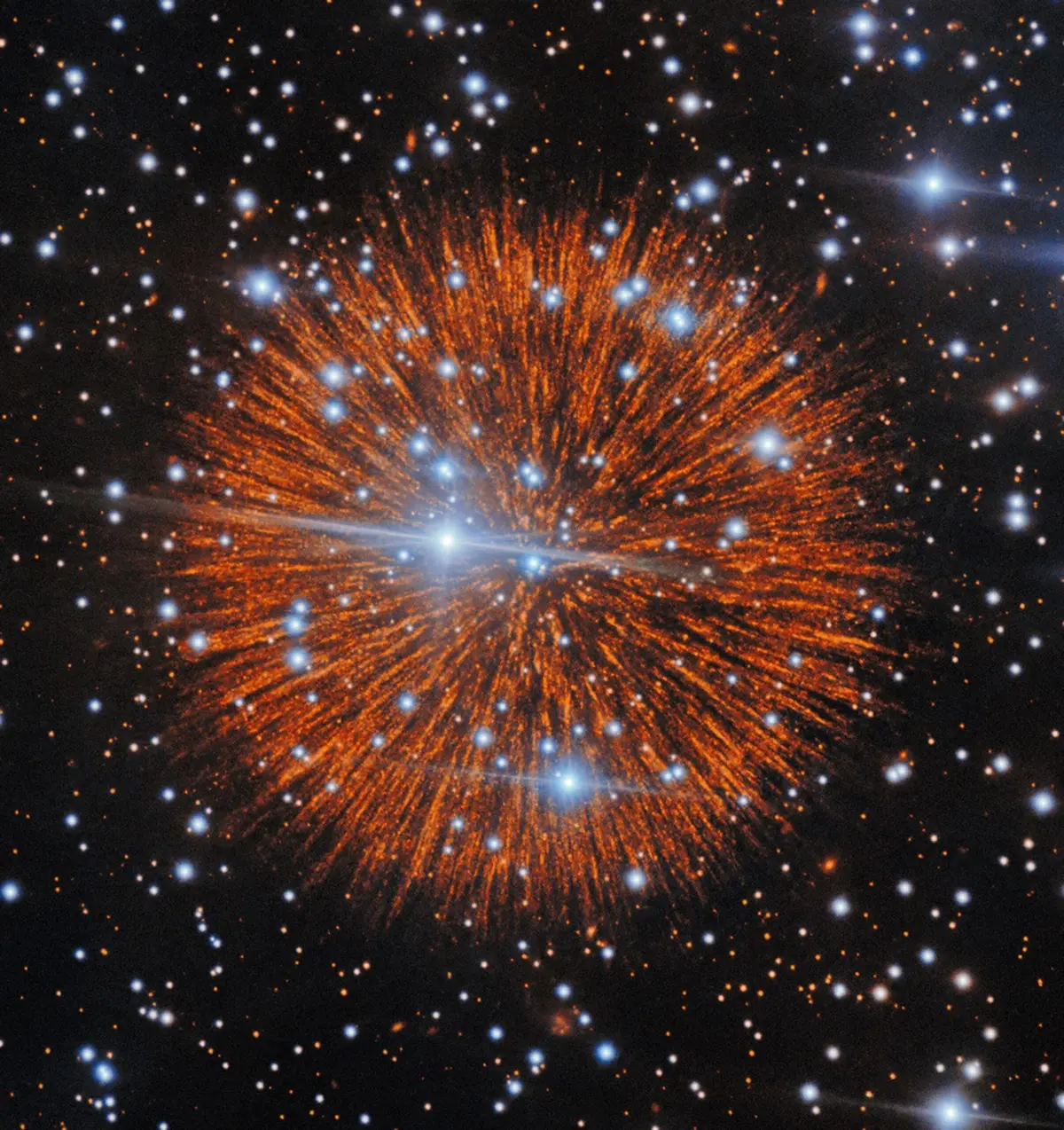
In a milestone achievement for observational astronomy, an international team of researchers has captured the most detailed, high-resolution image to date of the Pa 30 nebula. This expanding cosmic apparition is the preserved ghost of a historic supernova—a cataclysmic stellar explosion famously recorded by medieval astronomers and chroniclers on Earth. Utilizing the formidable light-gathering power of the Gemini North telescope in Hawaii, astronomers have peered deep into the heart of the remnant, uncovering structural intricacies that have eluded detection until now.
Far from being a uniform, continuous discharge of stellar guts, the nebula’s signature filamentary strands—which collectively mimic the frozen explosion of a dandelion or a celestial firework—are composed of distinct, bead-like formations. Published recently in The Astrophysical Journal, the new data reveal that these filaments are segmented into pearl-like knots of gas of remarkably uniform size and distribution.
These formations, appropriately dubbed "cosmic pearls," challenge long-held assumptions regarding the chaotic physics of stellar death. Each individual knot measures an astonishing four light-days across—vast enough to swallow the entire planetary region of our solar system roughly ten times over with room to spare. The discovery of such striking geometric regularity in the aftermath of a violent explosion offers astrophysicists a pristine laboratory to re-evaluate the mechanisms governing how dying stars shed their outer layers. As researchers race to model these bizarre structures, Pa 30 is rapidly transitioning from a historical astronomical curiosity into a cornerstone case study for modern stellar evolution and nucleosynthesis.
Detailed Chronology: From Medieval Skies to Modern Observatories
The Historical Context: The Guest Star of 1181 CE
To fully appreciate the significance of the Gemini North observations, one must look back over eight centuries. In the late summer of 1181 CE, stargazers across East Asia—particularly in China and Japan—witnessed a sudden, dramatic disruption in the night sky. A brilliant "guest star" flared into existence, shining brightly in the constellations Cassiopeia and Cepheus. For approximately six months, this stellar interloper remained visible to the naked eye, rivaling Saturn in brightness before slowly fading into the cosmic background.
For centuries, this transient event remained a footnote in historical texts, one of only a handful of historical supernovae recorded before the invention of the telescope. Modern astronomers recognized that identifying the modern remnant of the 1181 supernova would provide a rare opportunity: a chance to study a stellar explosion with a precisely known age.
The Hunt for Pa 30
Connecting the historical records to a modern celestial object proved to be a decades-long detective story. In recent years, astronomers zeroed in on Pa 30—a faint, expanding nebula surrounding a rare, rapidly rotating white dwarf star (often referred to as a "zombie star" resulting from a rare type of thermonuclear merger known as a Type Iax supernova).
While previous imaging campaigns successfully mapped the broad strokes of the nebula, capturing its spherical, dandelion-like morphology, they lacked the spatial resolution required to resolve fine-scale phenomena. The faintness of the nebula, combined with the interstellar dust cluttering the galactic plane, presented a formidable barrier.
The Breakthrough at Gemini North
The turning point arrived when researchers trained the Gemini Multi-Object Spectrograph on the Gemini North telescope—part of the International Gemini Observatory, operated by NOIRLab and funded by the U.S. National Science Foundation (NSF). By leveraging advanced adaptive optics and long-exposure imaging techniques, the research team bypassed atmospheric distortion to deliver a view of Pa 30 boasting roughly ten times the structural detail of any previous observation. It was through this unprecedented clarity that the continuous filaments of the nebula resolved into distinct, bead-like pearls, fundamentally rewriting our understanding of the remnant’s morphology.
Supporting Context & Metrics: Anatomy of a Cosmic Cataclysm
The Physics of a Type Iax Supernova
To understand why the discovery of Pa 30’s "cosmic pearls" has sent ripples through the astrophysical community, one must examine the nature of the explosion that created them. Pa 30 is widely believed to be the remnant of a Type Iax supernova—a sub-class of thermonuclear explosions involving white dwarfs. Unlike standard Type Ia supernovae, which completely obliterate the progenitor white dwarf, Type Iax events are milder. They often leave behind a surviving remnant star, surrounded by a rapidly expanding shroud of ejected material.
The explosion hurls stellar matter outward at velocities reaching thousands of kilometers per second. In the case of Pa 30, this high-speed ejecta is shaping the intricate web of filaments observed by modern telescopes.
Scale and Uniformity: The "Cosmic Pearls"
The sheer scale of the newly discovered structures defies intuitive comprehension. According to the data published in The Astrophysical Journal:

- Knot Diameter: Each individual "pearl" measures approximately four light-days across. To put this in perspective, one light-day is roughly 25.9 billion kilometers (16.1 billion miles).
- Volumetric Comparison: The planetary region of our solar system—extending out past the orbit of Neptune—could fit comfortably inside a single knot approximately ten times, with ample space left over.
- Structural Regularity: Unlike the chaotic, asymmetrical clumps of gas typically associated with standard supernova remnants, the knots in Pa 30 display a high degree of uniformity in both size and spacing along their respective filaments.
This unexpected geometrical order has forced theorists to reconsider how matter condenses and organizes itself in the wake of extreme hydrodynamic shocks.
Official Statements and Expert Insights
The implications of the Gemini North observations have electrified the astronomical community, prompting enthusiastic responses from the researchers spearheading the investigation.
Ilaria Caiazzo, a co-author of the study from the Institute of Science and Technology Austria (ISTA), highlighted both the staggering scale of the structures and the analytical challenge they present. In a press release accompanying the study, Caiazzo noted:
"The planetary region of our solar system could fit in each knot about 10 times with room to spare. The knots are quite strikingly uniform. We are excited to try to model them."
Adding to this perspective, researchers emphasize that the regularity of the pearls points toward an underlying physical mechanism that engineers a controlled fragmentation of the ejected stellar material. Rather than tearing apart in a purely random, turbulent fashion, the shockwaves and magnetic fields interacting within the expanding debris field appear to be channeling matter into stable, repeating pockets.
Other members of the research collective have pointed out that studying Pa 30 allows astrophysicists to bridge the gap between theoretical hydrodynamics and observable space weather. Because the age of the remnant is constrained by the 1181 CE historical record, scientists have an accurate clock ticking in the background. They know precisely how long it has taken for these pearl-like knots to travel outward from the central zombie star, providing a hard temporal constraint for future computer simulations.
Future Outlook: The Next Frontier in Stellar Remnant Research
As the ink dries on the initial publication in The Astrophysical Journal, the work on Pa 30 is far from finished. The discovery of the cosmic pearls has opened up several new avenues of research that will occupy astrophysicists for years to come.
1. Advanced Computational Modeling
The primary objective for theorists is to construct robust hydrodynamic and magnetohydrodynamic models that can replicate the formation of pearl-like knots with such extreme uniformity. Researchers will test various scenarios, including interactions between the fast-moving ejecta and preexisting circumstellar material shed by the progenitor star prior to its demise, as well as the influence of magnetic fields generated by the central white dwarf.
2. Multi-Wavelength Campaigns
While optical telescopes like Gemini North have provided breathtaking structural clarity, a complete picture of Pa 30 requires multi-wavelength observations. Astronomers are already planning follow-up campaigns utilizing space-based observatories:
- X-ray Telescopes: To probe the ultra-hot gas trapped behind the expanding shock front and study the high-energy environment surrounding the central star.
- Infrared Instruments: To search for cooler dust grains that may be sequestered within or around the cosmic pearls, shedding light on how heavy elements synthesized in the supernova are recycled into the interstellar medium.
- Radio Observatories: To map magnetic field lines and trace the synchrotron radiation emitted by relativistic particles accelerated by the remnant.
3. Broadening the Search for Historical Remnants
The success of the Pa 30 investigation serves as a powerful proof-of-concept for pairing historical archives with cutting-edge optical technology. Astronomers are now casting a critical eye toward other historical records of guest stars—such as those from 185 CE, 393 CE, and 1006 CE—wondering what hidden structural marvels might be uncovered if older, fainter remnants are revisited with next-generation resolution.
Ultimately, Pa 30 stands as a testament to the enduring dialogue between our species’ ancient past and our technological future. What began as a mysterious glowing dot in the medieval night sky has now evolved into a microscopic window—magnified to cosmic proportions—into the violent, beautiful physics of stellar rebirth.