In an extraordinary convergence of international law enforcement and the murky underworld of cyber extortion, federal agents have arrested a prominent Canadian cybersecurity executive in connection with the notorious ShinyHunters hacking syndicate. The suspect, identified in federal court records as Edward Dubrovsky—a 54-year-old security professional, author, and executive associated with the Canadian firms Cypfer and CyberSteward—was taken into custody in Pennsylvania.
The arrest represents a seismic shift in the ongoing federal investigation into ShinyHunters, a cybercrime collective that recently executed a devastating breach against the Federal Bureau of Investigation (FBI) itself, exfiltrating sensitive personal, medical, and operational data concerning thousands of federal agents.
According to multiple sources close to the investigation, Dubrovsky was apprehended while visiting the United States to attend the Cyber Risk Summit at the Loews Philadelphia Hotel. His firm specialized in an acutely sensitive niche of the digital economy: navigating ransomware negotiations and facilitating settlements between victimized corporations and extortionist syndicates.
However, federal prosecutors allege that Dubrovsky’s involvement crossed the legal line from advisory defense into active criminal conspiracy and extortion. Court documents filed in the Eastern District of Texas—the newly established epicenter of the multi-jurisdictional ShinyHunters probe—charge the defendant with conspiracy to threaten the confidentiality of information with intent to extort money, alongside charges of interference with commerce by threats.
This unfolding scandal highlights the precarious, often legally ambiguous role played by private incident response firms operating on the front lines of the global ransomware epidemic. As the FBI scrambles to reclaim lost data and dismantle the infrastructure of one of the world’s most aggressive extortion rings, the arrest of a veteran security advisor signals that federal investigators are expanding their aperture beyond traditional hackers to scrutinize the ecosystem of negotiators who manage corporate ransom payouts.
Detailed Chronology: From Philadelphia Conference to Federal Custody
The sequence of events leading to Dubrovsky’s arrest highlights the rapid, cross-border coordination between U.S. federal authorities, international law enforcement agencies, and private-sector intelligence assets.
October 5 – October 7, 2026: The Cyber Risk Summit
Edward Dubrovsky traveled to Philadelphia, Pennsylvania, to participate in the annual Cyber Risk Summit, held at the Loews Philadelphia Hotel. Conference materials and public listings identified Dubrovsky as a key figure associated with CyberSteward, a Canadian cybersecurity firm that sponsored the event. Months prior, Dubrovsky had utilized LinkedIn to publicize his attendance, noting his intent to advance industry discussions surrounding global, technology-agnostic ransomware advisory and settlement services.
Unbeknownst to conference attendees, federal authorities had been tracking Dubrovsky’s movements as part of a sweeping, centralized investigation into the ShinyHunters collective—an inquiry that had recently been consolidated under the direct supervision of an FBI field office in Texas.
October 8, 2026: Arrest and Initial Detention
Federal Bureau of Investigation agents executed the arrest of Edward Dubrovsky (noted in select court filings under the slightly misspelled surname Dobrovsky) in Pennsylvania. Following his apprehension, Dubrovsky was processed and initially held at a federal detention facility in Philadelphia.

Initial docket entries on CourtListener revealed that the core criminal complaints were swiftly placed under seal. However, unsealed summaries exposed the gravity of the charges: conspiracy to threaten the confidentiality of proprietary and personal data to exact illicit payments, and interference with commerce via coercion and threats.
October 9, 2026: Jurisdictional Transfer to Texas
Recognizing the broader geographic and systemic implications of the case, federal magistrates executed a notice transferring the legal proceedings to the U.S. District Court for the Eastern District of Texas. Legal analysts note that this district has become the centralized hub for the Justice Department’s comprehensive prosecution strategy against the ShinyHunters infrastructure. At the time of his initial court appearances, Dubrovsky remained unrepresented by counsel, awaiting the formal appointment of a public defender or private legal representation.
October 10, 2026: Corporate Distancing and Public Fallout
As news of the arrest rippled across international media outlets, corporate entities moved quickly to distance themselves from the detained executive. Cypfer, a major cyber insurance conference sponsor and security firm, issued a public clarification regarding Dubrovsky’s corporate history. While public LinkedIn profiles previously characterized Dubrovsky as a co-founder of Cypfer, corporate spokespersons firmly disputed this, stating that he merely served as a managing director prior to his resignation in November 2025.
Supporting Context & Metrics: The Anatomy of the ShinyHunters Threat
To fully comprehend the significance of Dubrovsky’s arrest, one must examine the operational velocity and sheer audacity of the ShinyHunters organization. Over the past several years, the group has evolved from a standard data-theft outfit into a multi-million-dollar extortion enterprise that poses a direct threat to national security infrastructure.
Modus Operandi and Financial Impact
ShinyHunters primarily exploits vulnerabilities in Software-as-a-Service (SaaS) environments, leveraging sophisticated phishing campaigns and stolen corporate credentials to siphon proprietary databases from high-value enterprise targets. Once inside, the group threatens public leaks or corporate exposure unless exorbitant ransom demands are satisfied.
According to official metrics released by the FBI, ShinyHunters has successfully extorted more than $70 million from corporate and institutional victims globally throughout the year alone. The group’s reach extends across diverse sectors, including aviation, technology, insurance, and federal defense contracting.
The Breach of the FBI Recruitment Portal
The urgency of the federal response was catalyzed when ShinyHunters managed to penetrate the FBI’s own digital perimeter, relieving the bureau of sensitive recruitment records. The stolen data trove included comprehensive personnel files detailing agents’ specific units, operational specializations, and highly sensitive medical and psychiatric evaluations.
This breach struck at the heart of federal law enforcement credibility, prompting an aggressive, retaliatory dragnet coordinated across multiple international borders.
Global Interventions: The Dutch Connection
Dubrovsky’s arrest does not exist in a vacuum; it is part of a domino effect triggered by international police cooperation. Weeks prior to the Philadelphia arrest, Dutch law enforcement authorities apprehended Pepijn van der Stap, a reformed hacker tied to the ShinyHunters infrastructure.

The seizure of electronic devices and communication servers during Van der Stap’s arrest provided the FBI with a goldmine of digital forensics. Sources indicate that investigators have spent weeks poring over these seized devices, mapping out the financial pipelines, communication channels, and intermediaries who facilitated negotiations between victims and hackers. Federal sources suggest that additional charges against principals at other ransomware negotiation firms may be forthcoming.
The Teenage Mastermind Known as "Rey"
Compounding the embarrassment for U.S. intelligence, immediately following Van der Stap’s arrest, a high-ranking ShinyHunters operative known by the handle "Rey" assumed operational control of the syndicate. Rey began aggressively taunting FBI leadership on social media platforms regarding the stolen recruitment portal data.
Journalistic investigations by Reuters and security reporting from KrebsOnSecurity soon unmasked "Rey" as a teenager named Saif Al-din Khader. Khader was subsequently detained and began cooperating with federal investigators. His apprehension occurred just as the cybercrime syndicate was attempting a high-profile extortion plot against a digital aviation and navigation unit recently divested by aerospace giant Boeing in late 2025.
Official Statements and Institutional Reactions
The federal government’s posture regarding the operation has been characterized by tightly controlled information flows, punctuated by high-level public pronouncements.
- FBI Director Kash Patel: Following the apprehension of the Canadian executive, FBI Director Kash Patel took to social media platform X (formerly Twitter) to issue a formal statement acknowledging the arrest. While Patel’s statement confirmed the capture of a foreign national linked to the ShinyHunters conspiracy, it notably omitted specific naming conventions prior to the formal unsealing of core court documents.
- The Federal Bureau of Investigation: When formally approached for comment by investigative journalists, FBI spokespersons declined to elaborate on ongoing operational details, citing the active, multi-district nature of the prosecution led out of the Eastern District of Texas.
- Private Industry Silence: Representatives for CyberSteward, the firm with which Dubrovsky was most recently affiliated, have largely remained silent. Industry peers watching the case unfold have expressed profound unease, noting that the criminalization of ransomware negotiation tactics could fundamentally chill the incident response industry, leaving victimized enterprises without safe channels for crisis management.
Future Outlook: Implications for the Cybersecurity Industry
The arrest of Edward Dubrovsky marks a dangerous and unprecedented turning point in how governments handle the ecosystem of cyber extortion. For over a decade, the multi-billion-dollar incident response industry has operated in a legal gray zone, utilizing professional negotiators to mediate communication, verify attacker claims, and—when legally permissible—facilitate ransom payments to protect corporate assets from catastrophic data leaks.
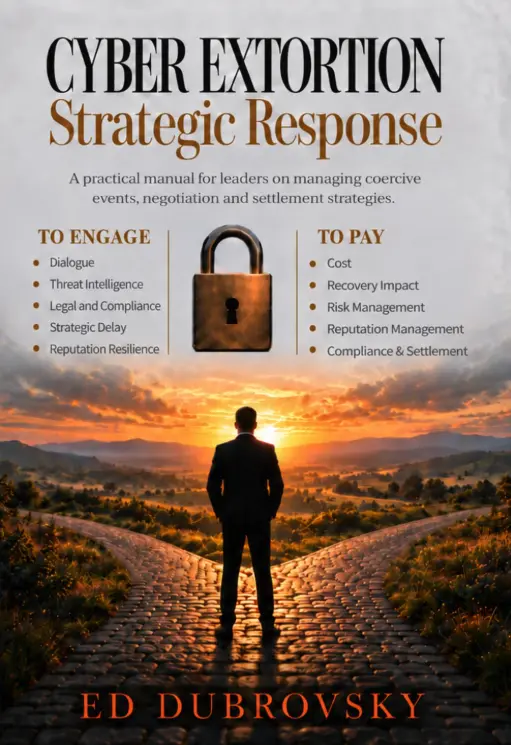
Dubrovsky himself literally wrote the manual on these practices, having authored the 252-page textbook Cyber Extortion Strategic Response. Within its pages, Dubrovsky emphasized a critical distinction: “Communicating with a criminal is not the same as negotiating a payment, and negotiating is not a commitment to pay. Engagement can serve other objectives, including testing claims, gathering information, creating time, and preserving options while the organization evaluates its next move.”
Now, federal prosecutors in Texas appear determined to test the legal boundaries of that distinction. By targeting an executive whose professional life was dedicated to ransomware advisory services, the Department of Justice is sending an unmistakable message: the wall separating corporate incident responders from the criminal enterprises they negotiate with is cracking.
As this fast-moving legal saga continues to evolve, the ripple effects will be felt across boardrooms worldwide. Incident response firms are currently auditing their operational protocols, legal counsels are re-evaluating compliance standards for extortion negotiations, and international cyber gangs are watching to see how far the long arm of U.S. federal law enforcement can reach.
Further updates, court filings, and institutional responses will be appended to this report as developments warrant.