Executive Overview
The integration of Generative AI into mature B2B software portfolios remains one of the most contentious topics in modern enterprise architecture. Technology leaders face a barrage of contradictory advice: Go headless because chat is the ultimate user interface; chat is a fundamentally flawed UX, so build native features instead. Never bolt AI onto legacy codebases; rebuild everything from scratch. Every member of the product team must become a hands-on AI builder.
To cut through this theoretical noise, Atlassian—a software titan managing a portfolio of more than 20 distinct applications, six of which were built natively in the generative AI era—undertook a massive, empirical test of these competing strategies at scale. With over 5 million users regularly interacting with Atlassian’s AI capabilities, the company’s approach offers a masterclass in pragmatism.
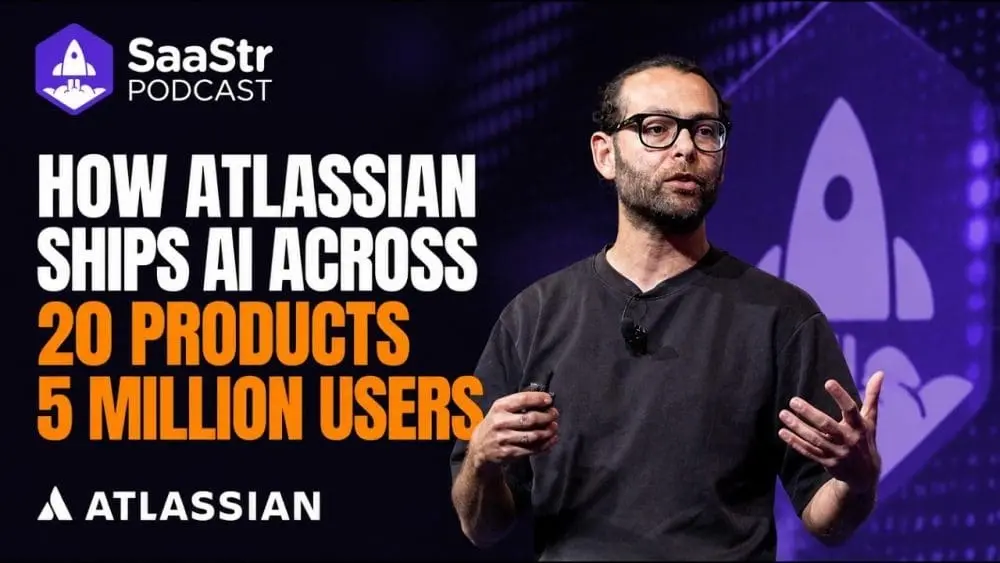
In a revealing presentation at the SaaStr AI session, Sherif Mansour, Head of AI and Product Management Craft at Atlassian (overseeing a massive organization of 450 product managers), detailed how the company navigated three critical architectural and organizational decisions. Mansour’s insights challenge conventional Silicon Valley wisdom, proving that successful AI transformation is less about chasing fleeting UI fads and more about rigorously pairing emerging capabilities with established product primitives.
Detailed Chronology: Three Pivotal Decisions
Decision 1: Embracing Chat as the Modern Command Line
Two years ago, introducing "Rovo chat" into foundational products like Jira, Confluence, and adjacent applications sparked intense internal debate.
- The Case Against Chat: Internal detractors argued that chat is merely a transitional medium rather than an end state. For many complex, structured workflows, conversational interfaces offer a frustrating user experience—try efficiently filling out a multi-field administrative form entirely through natural language chat.
- The Case For Chat: Proponents maintained that because enterprise product teams could not reliably predict the precise ways customers would attempt to harness AI, deploying an open-ended conversational box was the fastest way to observe real-world behavior.
Ultimately, the decision was driven by practical infrastructure realities: Atlassian had to build a robust chat backend anyway to power localized AI features across its application portfolio. Once that foundational infrastructure existed, deploying the chat interface to more than 20 apps served as an exhaustive learning mechanism.
To explain chat’s enduring utility, Mansour draws a historical parallel to the MS-DOS command line. The command line originally served as the universal, catch-all interface for early operating systems, handling everything from word processing to spreadsheets and simple games. Over time, as standard use cases crystallized, developers built dedicated graphical user interfaces (GUIs). Yet, the command line never truly vanished; it continues to handle the long tail of edge-case tasks.
Similarly, conversational chat plays the DOS role for modern AI. It accommodates an unlimited universe of unstructured use cases while illuminating which specific workflows generate enough demand to warrant a dedicated, native UI.
From Whiteboard Prompts to Multi-Layered Features
This methodology was clearly demonstrated using Confluence whiteboards. By analyzing what users typed into conversational prompts, Atlassian identified distinct usage patterns. A single whiteboard prompt effortlessly transformed into a standalone feature, an automated workflow step, and a reusable agent tool.
Crucially, every capability engineered for human interaction was simultaneously exposed as a tool for autonomous software agents. For instance, a "group-into-themes" function or a "whiteboard-to-backlog" conversion became callable skills for Rovo agents. By integrating with the Model Context Protocol (MCP) and Atlassian’s command-line interface (CLI), these tools could be invoked externally by developer environments like Claude Code and Cursor, ensuring Atlassian’s features deliver value regardless of whether the user is inside an Atlassian application interface.
Decision 2: The Pragmatic "Bolt-On" Strategy for Jira Workflows
Conventional wisdom dictates that software engineering teams should never awkwardly bolt AI onto an existing product architecture, demanding instead that legacy systems be completely reimagined and rebuilt from scratch. Atlassian deliberately chose to violate this golden rule.
To understand why, one must first recognize the structural reality of Jira. While new product managers often assume Jira is exclusively a tool for software developers, the vast majority of its user base consists of non-technical teams. Jira functions as a universal workflow engine for virtually any operational process. For example, submitting a consumer complaint about a rideshare service or disputing a billing error with a telecommunications giant both flow seamlessly through Jira-managed backends.
Recognizing this, Atlassian’s engineering teams took the existing Jira automation designer 2.5 years ago and inserted a single, discrete box: Execute a Rovo agent at this operational step. This literal bolt-on was shipped rapidly to test the market waters.
Rather than hitting immediate technical debt walls, enterprise customers pushed the feature far beyond expectations. Users began chaining agents together, introducing complex branching logic and conditional checks. In one observed enterprise pattern, an incoming support ticket triggers an agent review, which subsequently calls Canva via an API to generate marketing visual assets, followed by a social media agent that reads those assets and publishes updates automatically. Customers successfully automated the human-run workflows they had spent years refining inside Jira.
Mansour illustrates this approach with a domestic analogy: when a family purchases a home, they often choose to live with the existing kitchen for a period before launching a major renovation. Inhabiting the space reveals precisely which structural problems actually require fixing. Teams can iterate on individual components over time before eventually gutting the room. For established enterprise platforms with active user bases, the existing workflow is the core asset to be evolved. Starting entirely from scratch is a strategy reserved for net-new products—a path Atlassian pursued concurrently with its six dedicated AI-native applications.
Decision 3: The Rise and Stall of Pure "AI Builder" Teams
As generative AI accelerated, tech commentators suggested that coding assistants would soon collapse the traditional triad of product management, design, and engineering into a single, unified role: the "AI builder"—an individual whose primary job is shipping code directly alongside AI tools.
To test this hypothesis, Atlassian assembled approximately 10 software project teams staffed with hand-picked AI builders across both legacy and new codebases.
The initial weeks yielded explosive velocity. Teams moved at a blinding pace. However, after several weeks to a few months, momentum ground to a severe halt. Mansour colorfully describes the organizational breakdown: everyone was rowing furiously, but no one was steering.
Without dedicated leadership making hard product calls regarding architectural direction and customer prioritization, teams spun in circles. Product managers and designers organically drifted back to their traditional responsibilities because supplying deep customer context and making high-stakes decisions proved to be the ultimate unblocking mechanism.
This bottleneck is easily explained by team ratios. Atlassian typically maintains a ratio of roughly one product manager and designer for every 10 engineers on product teams (and 1-to-20 on platform teams). As AI tooling empowers engineers to write and ship code at unprecedented volumes, that effective ratio stretches to 1-to-30 or 1-to-40. Engineers rapidly complete assigned tasks and return demanding immediate clarity: What is next? Are we building the right thing? A product manager bogged down trying to "vibe code" cannot be in two places at once to provide strategic direction.
Consequently, while Atlassian continues to embrace AI-augmented roles, the notion that every product manager or designer should abandon traditional craft duties to become a full-time coder is empirically flawed in mid-sized to enterprise organizations.
Supporting Context & Metrics: The Human Element and Talent Pipeline
The Four Primitives of Agentic Work
Approximately six months into their agent development cycle, Atlassian’s product leadership established a guiding organizational principle: Any operational problem that can be solved for a human worker can—and should—be solved for an autonomous software agent.
An analysis of human work reveals four immutable primitives:
- Tools
- Context
- Goals and Accountability
- Visibility into Teammate Activities
Autonomous agents require the exact same foundational primitives. As organizations increasingly deploy agent sworkforces alongside human employees, cross-functional planning between humans and algorithms emerges as a primary operational hurdle. Atlassian systematically evaluated its product portfolio against this principle, forcing design teams to justify any instance where an agent performed a function that a human worker could not or would not execute within the application framework. 90% of the time, the mandate stood: agents must follow the interaction patterns already established for human teams.
Flipping the Hiring Pipeline: Junior vs. Senior Talent
Corporate boardrooms frequently debate engineering talent strategy in the AI era. A common executive refrain urges organizations to halt hiring junior developers—who allegedly produce code "slop" requiring years of mentorship to yield ROI—and instead hire a smaller cohort of senior engineers augmented by AI.
Atlassian’s internal data and strategic actions defied this conventional wisdom. Historically, the company’s hiring pipeline skewed toward a modest number of junior developers supported by a heavy concentration of mid-level and senior talent. Today, that pipeline has inverted, skewing heavily toward both ends of the seniority spectrum with a leaner middle.
The strategic rationale centers on the friction of unlearning. Atlassian employs thousands of Research & Development professionals who must unlearn operational habits deeply ingrained over 10, 20, or 30 years of enterprise software development. Unlearning established patterns is cognitively harder than learning novel paradigms.
New university graduates, conversely, carry no legacy baggage. Mansour notes that modern youth bypass traditional syntax learning entirely through visual coding environments, treating generative AI and natural language generation as native literacy.
Internal Atlassian research strongly validates this observation:
- Junior engineers are up to 38% more likely to adopt AI tooling.
- They are nearly twice as likely to actively experiment across diverse codebases.
- While junior developers initially produce more code quality anomalies ("slop") and do not always report subjective productivity gains, senior engineers excel at rigorous code review, filtering out inferior AI output, and steering the architecture.
To bridge this gap, Atlassian institutionalized AI Builder Week. Every few months, the entire R&D organization pauses routine operational work for a synchronized four-day sprint. Junior engineers lead sessions demonstrating novel AI tools and rapid prototyping techniques, while senior engineers mentor the organization on quality control, defensive coding against slop, and building differentiated AI features rather than generic wrappers.
Future Outlook: Key Lessons and Strategic Takeaways
Sherif Mansour’s candid autopsy of Atlassian’s generative AI transition provides a definitive roadmap for software founders and enterprise leaders navigating the technological paradigm shift:
- Chat is the Modern Command Line: Do not dismiss conversational chat interfaces prematurely. Treat chat as an expansive testing ground that reveals which user workflows generate enough organic demand to warrant dedicated graphical user interfaces.
- Evolve Legacies Rather Than Chasing Zero: If your product possesses active daily users and established workflows, leverage those assets. Evolve existing architectures incrementally just like renovating a lived-in kitchen, rather than pursuing costly, utopian rewrites from scratch.
- Preserve Strategic Steering: Empowering engineers with AI coding tools dramatically accelerates output, but it intensifies the need for dedicated product management and design oversight. Do not let your steering committee vanish into the codebase.
- Embrace Generational Adaptability: Balance your talent pipeline by welcoming junior developers who possess no legacy technical debt, pairing their fearless experimentation with senior engineering oversight to maintain uncompromising enterprise software quality.