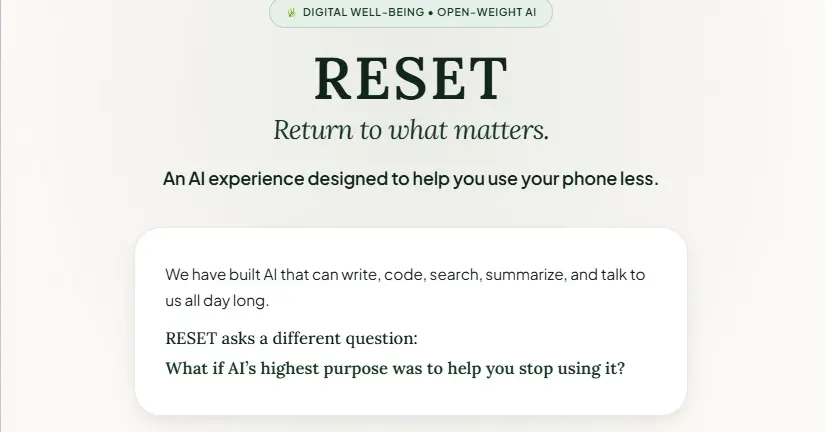
In an era dominated by relentless digital stimulation, infinite scroll feeds, and engineered attention traps, a counter-cultural technological movement is beginning to take shape. Enter Re:Set, an innovative, open-source, and open-weight artificial intelligence experience engineered with a radical premise: to help people reclaim their attention from screen addiction and return to tactile, offline life—starting with reading.
Built by developer Aayushi Shinde as a submission for the Hacktoberfest Open-Source AI Challenge Week 1: Touch Grass, Re:Set subverts the traditional architecture of modern software. While contemporary generative AI tools are designed to maximize daily active users (DAUs), lengthen session times, and capture as much cognitive bandwidth as possible, Re:Set is built on an inverted design philosophy:
"The better Re:Set works, the less time the user spends inside Re:Set."
Rather than trapping individuals inside gamified productivity dashboards, endless chatbot conversation loops, or manipulative streak trackers, Re:Set acts as a temporal and technological bridge. It leverages Google’s powerful open-weight Gemma 2 model family (specifically the 9B and 2B parameter iterations) to guide users out of digital rabbit holes and back into the physical world. Fully open-source under the Apache-2.0 license and deployed live via Render, Re:Set represents a refreshing inquiry into how artificial intelligence can be harnessed not to conquer human attention, but to restore it.
Detailed Chronology: The Genesis and Architecture of Re:Set
1. The Ideation Phase: Confronting Digital Fatigue
The modern digital landscape is characterized by a paradox: while technology has drastically improved our capacity for productivity and communication, it has simultaneously eroded our ability to focus on deep, unfragmented tasks. Millions of individuals find themselves trapped in passive notification loops during their free time, scrolling through algorithmic feeds even when they consciously yearn to return to tactile offline hobbies—such as reading physical books, walking outdoors, or engaging in face-to-face community interaction.
Conventional applications that attempt to solve screen addiction frequently exacerbate the underlying problem. They demand more screen time by requiring daily check-ins, punishing broken habit streaks with punitive notifications, and treating human attention merely as an engagement metric to be monetized.
Recognizing this systemic flaw, Shinde conceptualized Re:Set during Week 1 of the Hacktoberfest Open-Source AI Challenge. The core question driving the project was deceptively simple: If we can build artificial intelligence that writes computer code and generates hyper-realistic images, why can’t we build an AI whose sole purpose is to help people stop using AI and put down their phones?
2. Architectural Framework and the Gemma 2 Integration
To achieve this mission without sacrificing privacy or relying on centralized, closed-source black-box models, Re:Set was engineered using an open-weight architecture centered around Google’s Gemma 2 models.
The application establishes a modular provider interface that allows seamless switching between cloud-hosted Gemma implementations and local execution via Ollama (running locally on port 11434). This modularity ensures that the application remains lightweight, extensible, and respectful of user privacy.
The underlying system design emphasizes minimalism. By keeping the user interface clean and devoid of addictive visual loops, Re:Set acts as an intelligent intermediary. It analyzes the user’s reading goals, digests snippets of physical text or reading preferences, and curates personalized, frictionless off-screen reading paths.
3. Deployment and Accessibility
Following rigorous local testing and iterative refinement, Re:Set was successfully deployed to production and is now publicly accessible via Render:
Licensing: 100% Open-Source under the Apache-2.0 License.
Supporting Context & Metrics: The Crisis of Modern Attention
To understand the cultural and technical significance of Re:Set, one must examine the broader socioeconomic backdrop against which it was built. Modern software engineering has spent the past two decades optimizing for Engagement Economics—a metric-driven ecosystem where human attention is treated as the primary extraction resource.
The Psychology of Digital Retention
The Dopamine Loop: Infinite scroll mechanics and variable reward schedules (similar to slot machines) keep users tethered to their mobile devices long past the point of diminishing utility.
The Paradox of Wellness Apps: Most digital wellbeing tools rely on the same addictive UX patterns they seek to cure. They feature daily push notifications ("You missed your streak!"), red notification badges, and complex gamification loops that subconsciously reinforce phone dependency.
The Cognitive Cost: Constant task-switching and micro-interruptions degrade human working memory, deep reading comprehension, and sustained focus.
How Re:Set Counters Engagement Economics
Re:Set rejects these paradigms by establishing a non-addictive user journey. The application’s core metrics of success are deliberately inverted:
Session Duration Minimization: Success is measured by how quickly the user closes the app and engages with physical media.
Zero-Notification Policy: The platform sends no artificial engagement pings, respects user autonomy, and avoids guilt-tripping mechanics like streak counters.
Tactile Transition: By utilizing Gemma 2 to generate tailored reading summaries, thoughtful discussion prompts, or bite-sized chapter breakdowns, Re:Set lowers the activation energy required to transition from a glowing glass screen to a physical, paper-bound book.
Official Statements and Philosophy
In documentation accompanying the Hacktoberfest submission, creator Aayushi Shinde outlined the fundamental ethos guiding the open-source community around Re:Set:
"We built AI that can write code and generate images; we wanted to build an AI whose sole purpose is to help people stop using AI and put down their phones.
Re:Set is not another AI chatbot, productivity dashboard, habit tracker, streak app, or wellness assistant. It is a bridge between artificial intelligence and real-world life. The better Re:Set works, the less time the user spends inside Re:Set."
This sentiment echoes a growing sentiment within open-source communities: that the next frontier of artificial intelligence should focus on human empowerment and cognitive liberation rather than endless digital capture. By making the source code publicly available under the Apache-2.0 license, the project invites global developers to audit, fork, and expand upon the codebase, ensuring that privacy, transparency, and digital well-being remain at the forefront of the development lifecycle.
Future Outlook: The Next Chapter for Open-Source Digital Wellbeing
As Re:Set continues to gain traction within the open-source development community following its Hacktoberfest introduction, the roadmap ahead points toward deeper integration with local-first AI models and expanded offline modalities.
1. Expanding Local-First AI Capabilities
With the increasing accessibility of compact, high-performing open-weight models (such as Gemma 2 2B and 9B), future iterations of Re:Set aim to run entirely on-device. This will eliminate cloud dependency, drastically reduce latency, and guarantee absolute data privacy for users seeking to audit their digital habits without transmitting personal data to third-party servers.
2. Beyond Reading: Expanding into Tactile Domains
While Re:Set’s initial release focuses heavily on returning users to the lost art of physical reading, the underlying modular architecture can easily be adapted to other offline domains:
Creative Arts and Crafting: Guiding users through analog hobbies like painting, woodworking, or knitting without requiring continuous video tutorials on mobile devices.
Physical Kinesthetics: Designing structured outdoor exploration, hiking itineraries, and calisthenics routines that keep smartphones tucked safely away in pockets.
In-Person Social Gathering: Facilitating offline community board game nights, book clubs, and collaborative local workshops.
3. The Open-Source Community Call to Action
Because Re:Set is fully open-source under the Apache-2.0 license, its long-term viability relies on community contributions. Developers, UX designers, and digital wellness advocates are encouraged to review the repository, test the live deployment, and submit pull requests to refine the Gemma provider interface and expand the application’s offline capabilities.
In a technological ecosystem hyper-fixated on keeping users glued to screens, Re:Set stands as a bold, practical reminder that the ultimate triumph of artificial intelligence may not be keeping us online, but successfully reminding us how to touch grass.