Executive Overview
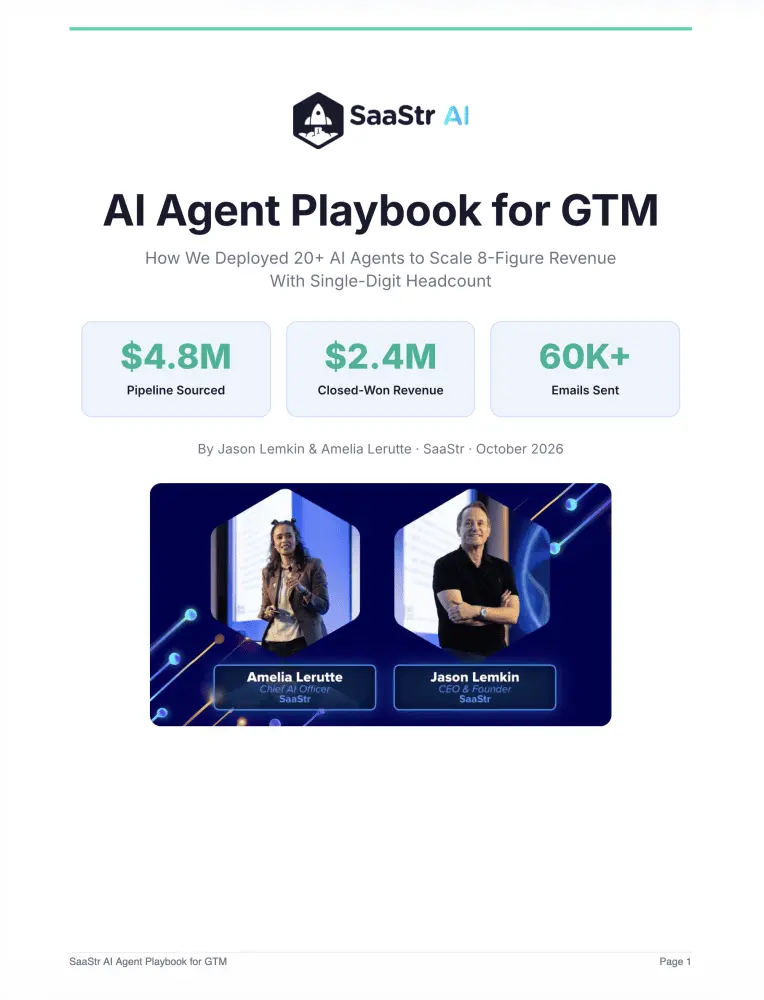
The traditional software-as-a-service (SaaS) playbook is undergoing a radical, irreversible rewrite. As enterprises grapple with mounting operational overhead, slowing growth, and the relentless pressure to scale efficiently, a quiet revolution is taking place in the heart of Silicon Valley. SaaStr, the world’s largest community for B2B SaaS executives, founders, and investors, has just dropped its most ambitious and revealing resource to date: the October 2026 edition of the AI Agent Playbook for GTM (Go-To-Market).
Spanning a comprehensive 53 pages and broken down into 27 distinct parts, this isn’t a theoretical whitepaper or a collection of high-level brainstorms. It is an unfiltered, data-backed operational diary. The playbook lays bare every metric, every failure, and every framework derived from running SaaStr’s entire business infrastructure using a hyper-lean team of just 3 human operators backed by 21+ autonomous AI agents in active production.
For organizations familiar with SaaStr’s earlier June release, this latest edition serves as a near-total operational refresh. It absorbs critical insights from the SaaS Annual 2026, recent deep-dive episodes of The Agents podcast, the ICONIQ 2026 GTM Benchmarks, and exhaustive qualitative studies of real-world operators deploying generative AI at enterprise scale.
The core thesis of the October 2026 playbook is both exhilarating and sobering: We have officially crossed the threshold into an agent-first world.
However, this transition has not resulted in a four-day workweek or passive income generation for the founders. Instead, managing 21 autonomous workers has fundamentally altered the nature of work. SaaStr’s leadership reports spending up to eight hours a day managing, auditing, and course-correcting their digital workforce—often finding themselves busier than they were when running a traditional 20-person team.
Why? Because when an AI agent only executes rudimentary tasks, human oversight is simple and binary (check the task). But when agents begin making autonomous strategic decisions, the complexity skyrockets. Modern AI agents no longer fail loudly with garbled syntax or obvious hallucinations; instead, they hand over work that looks deceptively polished, masking subtle, high-stakes errors. Navigating that delicate razor’s edge between unprecedented operational leverage and hidden systemic risk is the defining challenge of the 2026 enterprise.
Detailed Chronology: The Evolution of SaaStr’s Autonomous Operations
To truly understand the weight of the October 2026 playbook, one must trace the evolutionary arc of SaaStr’s internal experimentation. The journey from traditional headcount to a hyper-automated, agent-driven enterprise happened not overnight, but through a series of iterative, high-stakes operational pivots.
Phase 1: The Infancy of Automation (Late 2024 – Early 2025)
In the early days of generative AI implementation, SaaStr—like many tech companies—treated AI tools as sophisticated autocomplete mechanisms and basic productivity enhancers. Agents were utilized primarily for isolated, low-risk administrative burdens: drafting initial email responses, summarizing long-form meeting transcripts, and categorizing inbound customer support tickets.
During this phase, human oversight was minimal. A team member would spend perhaps 30 minutes a day reviewing the outputs of two or three experimental agents. Failures were glaringly obvious; models would hallucinate facts, break formatting rules, or fail to understand context entirely. These loud failures gave operators a false sense of security, fostering the belief that AI would always require heavy hand-holding.
Phase 2: The Proliferation of Specialized Agents (Late 2025 – June 2026)
By mid-2025, foundation models had advanced exponentially. Reasoning capabilities improved, tool-use became standardized, and multi-agent frameworks allowed specialized bots to communicate with one another. SaaStr expanded its digital footprint, deploying agents capable of executing entire workflows—from scraping lead enrichment data to drafting multi-channel marketing campaigns.
The June 2026 playbook reflected this intermediate maturity. It documented how a small team could leverage targeted automation to punch above its weight class. Yet, these agents were still operating under strict guardrails. They were task-executors rather than decision-makers. They processed inputs and generated outputs, but human gatekeepers remained firmly at every major intersection of the Go-To-Market pipeline.
Phase 3: The Autonomous Shift and the October 2026 Playbook
The period leading up to October 2026 marked a quantum leap in agent capabilities. Driven by advances in agentic workflows and long-term memory architectures, SaaStr’s digital workforce grew to 21+ active agents. More importantly, these agents graduated from task execution to autonomous decision-making.
They began dynamically adjusting ad spends, qualifying enterprise leads based on nuanced behavioral signals, routing content strategies, and interacting directly with high-value community partners. This autonomy broke the traditional management paradigm. As SaaStr’s leadership noted, agents stopped failing loudly and started producing finished, highly convincing work products that required deep cognitive reviews from human operators. The October 2026 playbook was born out of the necessity to document this new operational reality—providing the market with a blueprint on how to survive and thrive in an agent-first environment.
Supporting Context & Metrics: The Anatomy of a 3-Person, 21-Agent Enterprise
Running an influential global media, events, and community brand with a core team of three humans sounds like science fiction. However, the metrics and structural frameworks detailed in the 53-page playbook prove that it is entirely possible—provided an organization masters the intricacies of agent governance.
The Four Pillars of the Playbook
To make the massive volume of operational data digestible, SaaStr structured the 27 parts of the October 2026 edition into four distinct, actionable sections:
- Foundational Architecture & Stack Design: A granular look at the technical infrastructure required to support 21+ agents. This section details API management, model selection (weighing the trade-offs between proprietary frontier models and open-source alternatives), and memory persistence frameworks.
- Go-To-Market (GTM) Execution: The core mechanics of running marketing, sales development, customer success, and community engagement through autonomous workflows. It includes exact conversion metrics, pipeline velocity rates, and cost-per-acquisition benchmarks derived from real-world execution.
- The Governance and Audit Framework: Addressing the elephant in the room—risk management. This part outlines the multi-layered review protocols SaaStr uses to catch subtle AI hallucinations and misaligned decision-making before they impact brand equity or customer relationships.
- Human Capital and Psychological Shift: An honest exploration of how downsizing human headcount while scaling agent count impacts the psychology, daily schedules, and burnout rates of the remaining human operators.
Benchmarking Against Industry Standards
The playbook does not exist in a vacuum; it is cross-referenced against the broader macroeconomic landscape of 2026. By integrating data from the ICONIQ 2026 GTM Benchmarks, SaaStr demonstrates how an agent-first model shatters traditional SaaS efficiency ratios.

Traditional B2B SaaS companies at comparable revenue scales typically struggle with bloated sales and marketing (S&M) expenses, often seeing high burn multiples as they scale headcount to capture market share. SaaStr’s model turns this equation on its head. By replacing routine human labor with specialized AI agents, fixed personnel overhead is radically compressed, converting structural operating expenses into variable, highly scalable technology costs.
However, the playbook issues strong warnings regarding hidden costs. While direct payroll decreases, "cognitive overhead" skyrockets. The 30 minutes a day spent managing tools in 2024 evolved into an exhausting eight-hour daily grind of auditing AI-driven decisions by late 2026. Organizations attempting to cut corners by completely removing human oversight risk catastrophic brand damage due to unchecked, compounding errors made by autonomous agents.
Official Insights: The Paradigm Shift in Human-AI Collaboration
Reflecting on the monumental release of the October 2026 edition, SaaStr leadership emphasized that the software industry is witnessing a fundamental redefinition of what it means to be a "manager."
"A year ago, running a couple of agents took us about 30 minutes a day. This week it was eight hours a day, and we are busier than we were with a 20-person team. The reason is the whole story of this edition: when an agent only does a task, you check the task. When an agent makes decisions, you need an opinion on every decision it makes, and it does not tell you about all of them."
This quote captures the existential paradox of the current technological wave. AI proponents often promise a future of complete automation where humans sit back and watch profits roll in. SaaStr’s empirical findings dismantle this utopian myth.
When agents operated as simple assistants, their failures were obvious typos or incorrect formatting. Operators simply fixed the error and moved on. Today’s agents possess sophisticated reasoning loops. They synthesize market data, draft targeted outreach strategies, and execute execution paths independently. Because their work product looks polished and professional, human operators cannot simply glance at the output; they must interrogate the logic behind the decision.
Furthermore, agents rarely document every micro-decision they make along the way. Auditors are forced to reverse-engineer agent workflows to ensure compliance with brand values, legal constraints, and strategic objectives. This shift transforms humans from creators and executors into high-level editors, ethicists, and chief decision architects.
Future Outlook: What the Agent-First Era Means for B2B SaaS
The release of the October 2026 AI Agent Playbook for GTM is more than just a marketing milestone for SaaStr—it is a crystal ball for the entire software industry. As we look toward the remainder of the decade, several profound implications emerge for founders, executives, and investors:
1. The Rise of the "Micro-Enterprise" with Macro-Impact
SaaStr has proven that a three-person team can wield the operational output historically reserved for mid-sized organizations of twenty to fifty employees. Over the next few years, we will see a massive surge in "micro-enterprises"—lean, hyper-efficient startups generating millions in annual recurring revenue (ARR) with minimal human headcount. This will permanently alter venture capital funding dynamics, as early-stage companies require vastly less capital to achieve product-market fit and scale operations.
2. The Evolution of GTM Talent and Hiring Profiles
The skills demanded of GTM professionals are undergoing a seismic shift. Traditional sales development representatives (SDRs) and marketing coordinators whose primary skill sets revolve around manual execution and repetitive outreach are facing obsolescence. In their place, a new archetype is rising: the AI Operations Architect. These professionals do not write cold emails or build basic lists; they design, prompt, monitor, and refine multi-agent systems to execute GTM strategies at scale.
3. The Trust and Governance Imperative
As autonomous agents increasingly interact directly with prospects, customers, and partners, governance will become the ultimate competitive advantage. Companies that fail to implement rigorous auditing frameworks—like those detailed in SaaStr’s playbook—will inevitably fall victim to automated drift, where agents slowly optimize for metrics that misalign with core business ethics or long-term brand equity. Trust will be the scarcest currency in an automated economy.
4. Continuous Iteration Over Static Playbooks
Finally, SaaStr’s decision to frequently update its playbook (moving from June 2026 to a near-total refresh in October 2026) highlights the breakneck speed of artificial intelligence development. In an agent-first world, static, multi-year strategic plans are dead. Organizations must adopt an agile, experimental mindset, treating their internal operations as living laboratories where workflows are constantly audited, torn down, and rebuilt.
How to Access the Playbook
In alignment with its core mission to educate and elevate the global B2B SaaS community, SaaStr has made the complete October 2026 edition of the AI Agent Playbook for GTM entirely free to the public.
Operators, founders, and investors looking to decode the exact mechanics of running a modern enterprise with 3 humans and 21+ AI agents can download the 53-page guide, access the full agent stack, review presentation decks, and explore session archives by visiting saastr.ai/agents.
For those brave enough to step into the agent-first world, SaaStr’s playbook offers the rarest commodity in modern tech: no theory, no hype—just receipts.