Date: 13 October 2026
Reading Time: ~6 minutes
Category: Network Infrastructure, Data Centre Interconnects (DCI), Optical Testing
Executive Overview
As artificial intelligence (AI) and machine learning (ML) workloads continue to reshape the global digital infrastructure landscape, the physical layer supporting these intensive computing environments faces unprecedented stress. On October 13, 2026, at the flagship Capacity Europe event, test, monitoring, and analytics expert EXFO answered this industry-wide call to action with the official launch of HyperBlazer.
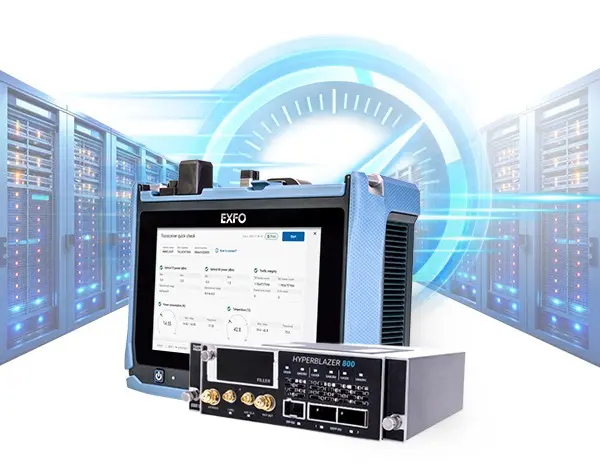
Purpose-built for hyperscale data centres and data centre interconnect (DCI) markets, HyperBlazer is engineered to tackle one of the most persistent operational bottlenecks in modern optical networking: high-speed transceiver validation and link activation. Built on EXFO’s modular, dual-slot FTB Duo platform, the solution supports comprehensive testing from 100GE to 800GE Ethernet. Crucially, it encompasses advanced 400ZR/ZR+ and 800ZR coherent optics across dominant modern form factors, including QSFP-DD, OSFP, and OSFP-RHS.
By shrinking transceiver validation timelines from minutes down to mere seconds, HyperBlazer aims to eliminate the massive pools of "stranded stock"—fully functional optics mistakenly sidelined in warehouses due to inadequate pre-deployment testing—while seamlessly scaling to meet the demands of next-generation 800G and future 1.6T data centre fabrics.
Detailed Chronology: The Launch and Engineering Blueprint
The unveiling of HyperBlazer at Capacity Europe marked the culmination of years of collaborative dialogue between test equipment manufacturers and hyperscale operators struggling to keep pace with rapid infrastructure deployments.
Traditionally, the velocity of modern data hall build-outs has forced a compromise in testing protocols. Under legacy workflows, transceivers were frequently installed directly into switches and routers without exhaustive pre-validation. If a unit failed during the chaotic installation phase, technicians typically pulled and swapped the component rather than spending valuable time diagnosing it on-site. Consequently, warehouses globally have accumulated vast inventories of unvetted, potentially reusable optical transceivers. With high-speed optics representing a major capital expenditure and global supply chains remaining tight, this backlog has introduced compounding delays into hyperscale deployment schedules.
HyperBlazer directly confronts this operational friction by introducing a dual-application architecture optimized for maximum efficiency:
- iOptics+ Application: Tailored for rapid transceiver and cable validation. Upon connecting a transceiver, the system auto-detects the unit, runs concurrent measurements, and delivers a definitive pass/fail verdict. This instantaneous feedback loop determines whether an optic can immediately return to active inventory or must be logged for a Return Merchandise Authorization (RMA).
- Ethernet Services Application: Designed for comprehensive Ethernet link activation, validation, and fault isolation across campus and long-reach data centre connections.
To fit within the sub-minute-per-step pace demanded by modern hyperscale construction sites, EXFO integrated HyperBlazer with its FIP-500 fibre inspection scope. This creates an automated, highly streamlined workflow sequence: Inspect $rightarrow$ Clean $rightarrow$ Inspect $rightarrow$ Test.
Furthermore, testing metadata does not remain trapped on individual testing devices. Every completed validation automatically captures the transceiver’s unique serial number and exact configuration parameters. This data streams instantly—via the always-connected FTB Duo platform—to EXFO Exchange, the company’s cloud-based analytics platform.
This automated data upload provides operators with unprecedented visibility. Instead of treating every deployment failure as a defective component, engineers can leverage EXFO Exchange to track failure patterns. Operators can instantly discern whether an issue stems from a specific transceiver model, a unique firmware configuration, a localized deployment environment, or improper technician handling.
Supporting Context & Metrics: Navigating the AI-Driven DCI Boom
The urgency behind HyperBlazer’s release lies in the macroeconomic and technical realities of the current infrastructure cycle. AI training and inference clusters require massive lateral movement of data between server racks, data halls, and distinct regional data facilities. This surge in east-west traffic has positioned Data Centre Interconnect (DCI) as the fastest-growing segment of the optical transport market.
While a significant portion of legacy inter-data-centre connectivity has relied on 100G and 400G architectures, operators are aggressively transitioning to 800G links to prevent bandwidth starvation as model parameters scale into the trillions. However, this generational shift introduces staggering optical complexity.
The Cost of Long-Haul Failures
For longer-reach DCI links, testing parameters change dramatically. Technicians routinely rely on bit error rate tests (BERT), which can take anywhere from 12 to 24 hours to thoroughly certify a metro or long-haul connection.
If a faulty transceiver is deployed and goes undetected prior to launching a BERT session, a single hardware failure can ruin a 24-hour testing window, forcing teams to restart the certification process from scratch. HyperBlazer mitigates this costly risk by introducing a 10-second Transceiver Quick Check embedded within the Ethernet Services application. This rapid diagnostic catches defective components before teams commit to extended, high-stakes test windows.
The "Birth Certificate" for Service Level Agreements (SLAs)
As hyperscalers increasingly outsource or lease dark fibre and lit services from wholesale network operators, proof of performance is paramount. Upon the completion of any test sequence via HyperBlazer, the FTB Duo platform generates what EXFO describes as a digital "birth certificate."
This automated compliance report confirms that the deployed link strictly adheres to its engineering parameters and Service Level Agreements (SLAs). Because the report is generated and uploaded without manual intervention, it removes human error and administrative lag, accelerating the formal handover of infrastructure from builder to tenant.
Official Industry Perspectives
The pressures facing network architects and the strategic positioning of HyperBlazer were summarized by EXFO leadership during the Capacity Europe rollout.
"We’re seeing unprecedented growth across the data centre ecosystem, driving new requirements for speed, scalability, and operational efficiency," noted Danny Sleiman, Group Manager of Network Test Solutions at EXFO.
Sleiman emphasized that HyperBlazer was forged in direct response to evolving customer pain points, engineered specifically to streamline workflows and drastically accelerate the validation of high-speed optical networks. By reducing validation times from minutes to seconds, Sleiman noted that testing every single transceiver on-site transforms from an operational burden into a streamlined, automated best practice.
Addressing the broader implications of stranded warehouse inventory and supply chain volatility, Sleiman added:
"When cutting validation from minutes to seconds makes testing every transceiver the obvious choice rather than rejecting it outright, you fundamentally shift the economics of deployment. Our goal is to provide absolute clarity—helping operators distinguish between a truly defective optic and one that simply needs to be re-routed back into active inventory."
Future Outlook: Scaling Toward 1.6T and Beyond
As the telecommunications and data centre sectors look beyond current deployments, the technological horizon is already shifting toward the next generation of high-speed interconnects. With 800G establishing itself as the hyperscale baseline, the industry is already anticipating the eventual transition to 1.6T optics.
EXFO has designed the HyperBlazer architecture with this inevitable trajectory in mind. By relying on a modular, future-proof platform (the FTB Duo) coupled with cloud-native analytics via EXFO Exchange, the solution is built to scale alongside the accelerating pace of network evolution.
As AI workloads continue to expand across distributed data centre clusters, the ability to rapidly validate physical layer components, eliminate supply chain bottlenecks, and guarantee high-speed link performance will separate market leaders from laggards. With HyperBlazer, EXFO has delivered a timely, comprehensive toolkit designed to keep pace with the relentless velocity of the modern digital economy.