Executive Overview
In the fast-paced ecosystem of modern social media, viral trends can materialize out of thin air, capture the collective imagination of millions, and permeate multiple digital platforms within a matter of days. The autumn of 2026 has brought forth one of the most eccentric, visually distinct, and widely replicated cultural phenomena in recent memory: the "Boo Trend." Characterized by users approaching their phone cameras, dramatically crossing their eyes, and uttering a sharp, mocking "boo"—frequently while making an exaggerated, comical face—this seemingly simple format has evolved into a sophisticated prank culture and a cross-platform juggernaut.
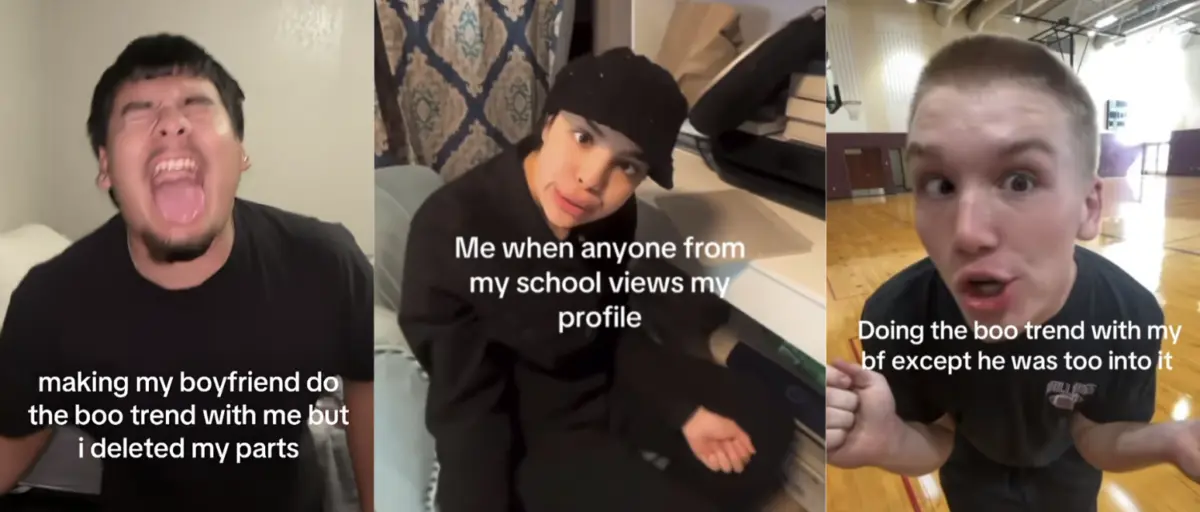
Emerging in mid-to-late September 2026, the trend has effortlessly bridged the gap between short-form video entertainment and interpersonal comedy. What began as an isolated, lighthearted clip on TikTok quickly mutated into a sophisticated weapon of playful deception. Users began tricking unsuspecting family members, romantic partners, and friends into participating in the awkward performance, only to subtly edit out their own presence or isolate their targets’ reactions for comedic effect. Furthermore, the trend’s flexibility has allowed it to bleed into niche digital subcultures, notably intersecting with K-pop fandoms who integrate archival footage of beloved idols making similar expressions.
This report provides a comprehensive examination of the Boo Trend, tracking its trajectory from a single, viral TikTok upload on September 20th, 2026, to its ubiquitous presence across Instagram Reels and beyond. Through a detailed chronology, platform metrics analysis, behavioral psychology context, and a forward-looking assessment, we explore how a cross-eyed grimace and a single syllable managed to capture the global digital consciousness.
Detailed Chronology: The Evolution of "Boo"
To understand the scale of the Boo Trend, one must retrace the precise timeline of its dissemination across the social media landscape. The phenomenon’s velocity highlights the hyper-connected nature of Gen Z and millennial digital spaces, where content can transition from obscurity to mainstream saturation in less than a fortnight.
Phase 1: Genesis (Late September 2026)
The origin of the movement can be traced directly to September 20th, 2026. On this date, TikTok user @v99191 uploaded a seemingly innocuous video featuring a close-up shot of themselves staring down the camera lens, abruptly crossing their eyes, and shouting, "Booooo." Captioned simply with “#boooo #relatable #funny #blowthisup,” the video was engineered to appeal to the platform’s appetite for absurd, low-barrier-to-entry humor.
The response was immediate and overwhelming. Within three weeks of its publication, the foundational video amassed over 8.4 million views and secured upwards of 1.1 million likes. The stark visual absurdity of the cross-eyed expression combined with the abrupt audio cue provided a ready-made template for imitation. Content creators across TikTok recognized the low production threshold required to replicate the joke, sparking an initial wave of derivative videos.
Phase 2: Platform Expansion and the Birth of the Prank (Late September – Early October 2026)
As the format stabilized within TikTok’s algorithmic loops, creators began innovating upon the basic premise. By late September, the trend had crossed platform boundaries, spilling over into Instagram Reels where users adopted the audio and visual motifs.
A significant milestone in the trend’s diversification occurred on September 28th, 2026, when TikTok user @cakeyruna merged the trend with the fervent world of K-pop stans. By incorporating footage of Sunoo, a member of the prominent boy group ENHYPEN, making similar playful facial expressions, the video garnered over 260,900 views and 77,000 likes in just two weeks, proving the format’s adaptability to fandom culture.
Concurrently, the prank variant of the trend was born. Creators realized that the most humorous execution of the concept involved psychological misdirection. Instead of performing the bit alone, users began orchestrating scenarios where they convinced boyfriends, parents, and cousins to stare into the camera and perform the cross-eyed "boo" sequence alongside them under false pretenses. Once captured on film, the editor would meticulously crop or edit out their own participation, leaving the unsuspecting relative isolated on screen performing the bizarre, out-of-context act.
- September 30th, 2026: Instagram user @siixuc published a stylized reel utilizing the trend’s thematic elements, accumulating over 22,400 likes in a fortnight.
- October 2nd, 2026: TikTok user @jayciebelcher3 capitalized on the momentum with a video captioned "Anyone hear that ghost??", driving over 1 million views and 241,200 likes.
- October 3rd, 2026: The prank subgenre solidified when user @93930.r tricked their boyfriend into performing the trend, pulling in 1.7 million views and 308,000 likes.
Phase 3: Peak Saturation and Family Invasions (Mid-October 2026)
By the second week of October, the Boo Trend had reached critical mass, infiltrating multi-generational households. The prank format became a staple for sibling and parent dynamics, shifting the humor from peer-to-peer performance to familial embarrassment.
- October 6th, 2026: User @kkk4t33 posted a high-performing iteration that clinched 2.6 million views and 641,300 likes in under a week.
- October 9th, 2026: TikTok user @nimrashamid uploaded a video featuring her father falling victim to the prank. The video struck a chord with "DadTok" audiences, securing over 735,300 views and 145,900 likes in four days.
- October 12th, 2026: User @lily_d.88 engaged cousins in the trend, highlighting the collaborative yet deceptive nature of the format, pushing past 1.3 million views within 24 hours.
Supporting Context & Metrics
The quantitative footprint of the Boo Trend offers clear insights into how modern internet culture consumes and discards content. While traditional metrics focus on overall view counts, an analysis of the engagement ratios reveals why platforms aggressively pushed the trend onto users’ "For You" pages (FYPs).
Engagement Velocity and Algorithmic Favorability
Short-form video algorithms prioritize completion rates and loop potential. The Boo Trend excelled in both categories due to its structural brevity. Typically lasting between three to six seconds, the videos practically demanded accidental re-watching, as users attempted to parse the sudden shift in facial expression.
| Date (2026) | Creator / Handle | Platform | Primary Subject / Angle | Total Views (Approx.) | Total Likes (Approx.) |
|---|---|---|---|---|---|
| Sept 20 | @v99191 | TikTok | Original Source Video | 8.4 Million | 1.1 Million |
| Sept 28 | @cakeyruna | TikTok | K-Pop Crossover (Sunoo / ENHYPEN) | 260,900 | 77,000 |
| Sept 30 | @siixuc | Fashion / Aesthetic Satire | N/A (22.4K+ Likes) | 22,400 | |
| Oct 2 | @jayciebelcher3 | TikTok | General Comedy / Audio Play | 1.0 Million | 241,200 |
| Oct 3 | @93930.r | TikTok | Boyfriend Prank Variant | 1.7 Million | 308,000 |
| Oct 6 | @kkk4t33 | TikTok | Direct Recreation | 2.6 Million | 641,300 |
| Oct 9 | @nimrashamid | TikTok | Familial / "Dad" Prank | 735,300 | 145,900 |
| Oct 12 | @lily_d.88 | TikTok | Cousin Collaboration / Fail | 1.3 Million | 334,700 |
The Psychology Behind the Prank
Sociologists and digital media researchers observing the Boo Trend point to the concept of "relatable vulnerability" as a primary driver of its success. In an era where highly curated, aesthetically polished content often dominates feeds, trends that encourage self-deprecation, silliness, and a deliberate abandonment of vanity frequently outperform traditional content.
By tricking a loved one into making an intentionally unflattering face—crossing one’s eyes and shouting into a lens—creators effectively weaponize harmless embarrassment for comedic relief. The target is momentarily rendered ridiculous, yet the universal adoption of the trend ensures that the joke is shared collectively rather than maliciously. It represents a return to playground-style humor mediated through high-definition smart devices.
Official Statements and Industry Perspective
While no formal corporate or institutional bodies have issued statements regarding the trend—as is typical for organic internet subcultures—digital marketing analysts and platform strategists have weighed in on its operational mechanics.
Industry observers note that the Boo Trend exemplifies the ongoing shift toward "micro-pranks" that avoid the cruelty or property damage historically associated with earlier prank eras on YouTube and Vine. Speaking anonymously on the condition of algorithmic trends, a social media strategist for a major digital agency remarked:
"What we are seeing with formats like the Boo Trend is a return to low-friction, high-irony engagement. Users are exhausted by overly complex challenges that require choreography or expensive production values. They want digital inside jokes that take five seconds to execute and can be played out on an unsuspecting roommate or parent. It’s safe, it’s funny, and most importantly, it weaponizes embarrassment in the most harmless way possible."
Furthermore, music labels and independent sound curators have taken note of how the original audio tracks embedded within these TikToks accumulate passive reach, demonstrating that even a non-musical meme can inadvertently boost a creator’s audio profile across the platform’s ecosystem.
Future Outlook: The Lifespan and Legacy of the Trend
As the calendar turns deeper into the fourth quarter of 2026, the vital question facing digital anthropologists is sustainability: How long can a cross-eyed "boo" retain its shock value?
Diminishing Returns and Saturation
Like the vast majority of TikTok-originated meme formats, the Boo Trend operates on a sharp curve of diminishing returns. Once a prank format is generalized to the point where parents and older relatives anticipate being tricked—such as fathers checking the framing of a smartphone camera before participating—the element of surprise evaporates.
Already, early signs of structural mutation are appearing. Creators are beginning to layer ironic commentary over the trend, mocking the ubiquity of the format itself. This meta-commentary is typically the final stage of a meme’s lifecycle before it transitions from an active trend into internet history.
The Lasting Cultural Footprint
Despite its eventual obsolescence, the Boo Trend leaves behind a distinct imprint on late-2026 digital culture. It has reinforced the viability of the "disappearing partner" editing technique—where one half of a collaborative video is systematically erased to frame the other as socially awkward or unhinged.
More broadly, the phenomenon underscores the enduring power of physical comedy in an increasingly digital world. By forcing individuals to disconnect from their digital personas and physically distort their features for the amusement of a faceless audience, the Boo Trend proved that humanity’s primal appreciation for a well-timed, silly face remains entirely undefeated.