Executive Overview
In a decisive escalation against international cybercrime and illicit state-backed financial networks, the United Kingdom has levied sweeping economic sanctions against Cryptomus, a chameleonic cryptocurrency platform. Operating under a rotating banner of corporate aliases—including Certa Payments, Xeltox Enterprises, and its most recent iteration, Heleket—the platform has served as a critical financial conduit.
According to blockchain intelligence firms and cybersecurity researchers, Cryptomus functioned as a powerhouse for processing payments linked to ransomware syndicates, narcotics trafficking, darknet marketplaces, fraud operations, and specialized cybercrime services. More alarmingly, the platform has played an instrumental role in helping Russian entities and financial institutions systematically circumvent international sanctions, directly supporting Moscow’s wartime economy.
The sanctions, formally issued by the U.K. government on October 8, freeze all domestic assets tied to Cryptomus held in British financial institutions and strictly prohibit UK-based entities, companies, and individuals from engaging in any commercial or virtual business relationships with the platform. Alongside Cryptomus, the U.K. Treasury targeted several other virtual payment platforms, including VexPay, TokenSpot, and the Tsunami Payments service, in an aggressive effort to dismantle the modern infrastructure of digital illicit finance.
What sets this enforcement action apart is not merely the targeted entity, but its unprecedented diplomatic and jurisdictional scope. Industry experts note that this marks the first known instance of a "Five Eyes" intelligence-sharing nation (comprising Australia, Canada, New Zealand, the United Kingdom, and the United States) officially sanctioning a cryptocurrency operation originally incorporated within another Five Eyes jurisdiction. By transitioning from monetary fines to total economic isolation, Western regulators have signaled a strategic shift: financial penalties can be absorbed or ignored by bad actors, but comprehensive economic sanctions kill operations.
Detailed Chronology: From Vancouver Shell Companies to Western Sahara Phantoms
The evolution of Cryptomus is a masterclass in corporate evasion, regulatory arbitrage, and the exploitation of international blind spots.
Emergence and the Canadian Connection (2022–2024)
Emerging onto the digital landscape in 2022, the platform initially incorporated under names such as Certa Payments and Xeltox Enterprises, listing a physical address in Vancouver, Canada. Subsequent investigations revealed that this Vancouver location was little more than a dead drop—a shared mail-drop address housing dozens of other foreign currency dealers and money transfer businesses, none of which maintained a genuine physical presence at the site.
From its inception, Cryptomus operated largely unchecked, quietly integrating into dozens of Russian-facing cryptocurrency exchanges and darknet portals. By processing billions of dollars in illicit transactions, the platform established itself as an indispensable liquidity provider for the Russian underground economy.
The Canadian Fine and the Birth of Heleket (2025)
The platform’s clandestine operations hit a major roadblock in late 2025 when Canadian regulatory authorities, cracking down on systemic anti-money laundering (AML) failures, slapped Cryptomus with a record-shattering CAD $176 million fine.
However, rather than complying with regulatory mandates or folding under the weight of the penalty, Cryptomus engaged in a multi-layered evasion strategy. The platform formally appealed the Canadian fine—an enforcement action that blockchain investigator Richard Sanders later described as ultimately unenforceable and uncollectible—while simultaneously launching a parallel, no-KYC (Know Your Customer) service known as Heleket. While the original Cryptomus interface briefly instituted stricter compliance checks (resulting in a temporary dip in transaction volume), Heleket seamlessly absorbed the unregulated flow of high-risk transactions.
The U.K. Sanctions and Operational Collapse (October 2026)
The turning point arrived on October 8, 2026, when the U.K. government issued its rigorous economic sanctions notice. The impact was immediate and disruptive. Within hours of the announcement, users attempting to access the platform encountered frozen systems. Telegram support bots for both Cryptomus and its spin-off Heleket were inundated with user inquiries regarding sudden transaction failures. Despite overwhelming blockchain and investigative evidence tying the platforms together, support agents on Telegram brazenly claimed that Heleket maintained no corporate or operational affiliation with Cryptomus—a defensive fiction quickly dismantled by on-chain forensics.

Supporting Context & Metrics: The Scale of Illicit Processing
To understand why international governments targeted Cryptomus with the full weight of economic sanctions, one must examine the staggering volume of illicit capital that coursed through its infrastructure.
Multi-Billion Dollar Volume
According to forensic data published by blockchain intelligence firm TRM Labs in April 2026, Cryptomus and its related entities had processed a cumulative total exceeding $7 billion in transactions since launching in 2022. While a significant portion of this volume was tied to commercial entities seeking to bypass traditional banking channels, a deeply concerning percentage was directly associated with high-severity crimes. TRM Labs identified transaction streams flowing directly to vendors of child sexual abuse material (CSAM), international terrorist financing networks, and sophisticated human trafficking operations.
Outpacing Traditional Crypto Mixers
Data compiled by Chainalysis underscores the unprecedented scale of illicit fund accumulation managed by these platforms. In a post published immediately following the U.K. sanctions, Chainalysis revealed that Cryptomus and Heleket had emerged as primary payment hubs for the global criminal underworld.
Most notably, the services received more illicit funds across tracked categories than traditional cryptocurrency mixing services (mixers) combined within the analytics firm’s dataset. The intensity of this illicit activity peaked in late 2025, when the number of distinct illicit counterparties interacting with the platform surged to more than 900 in a single month.
The Anatomy of a Phony Regulator
One of the most bizarre aspects of Cryptomus’s operational architecture involves the legal authority it used to project legitimacy. Entities like Cryptomus and Heleket often require regulatory licenses to establish banking relationships and project trust to wary customers. How did a shadow crypto processor operating out of shared Canadian office spaces secure these credentials?
Investigations into the ownership structure of Certa Payments (Cryptomus’s parent company) revealed that its sole shareholder was a 25-year-old Ukrainian woman. Concurrently, this individual served as the head of several other corporate entities, including the WS Management and Advisory Corporation.
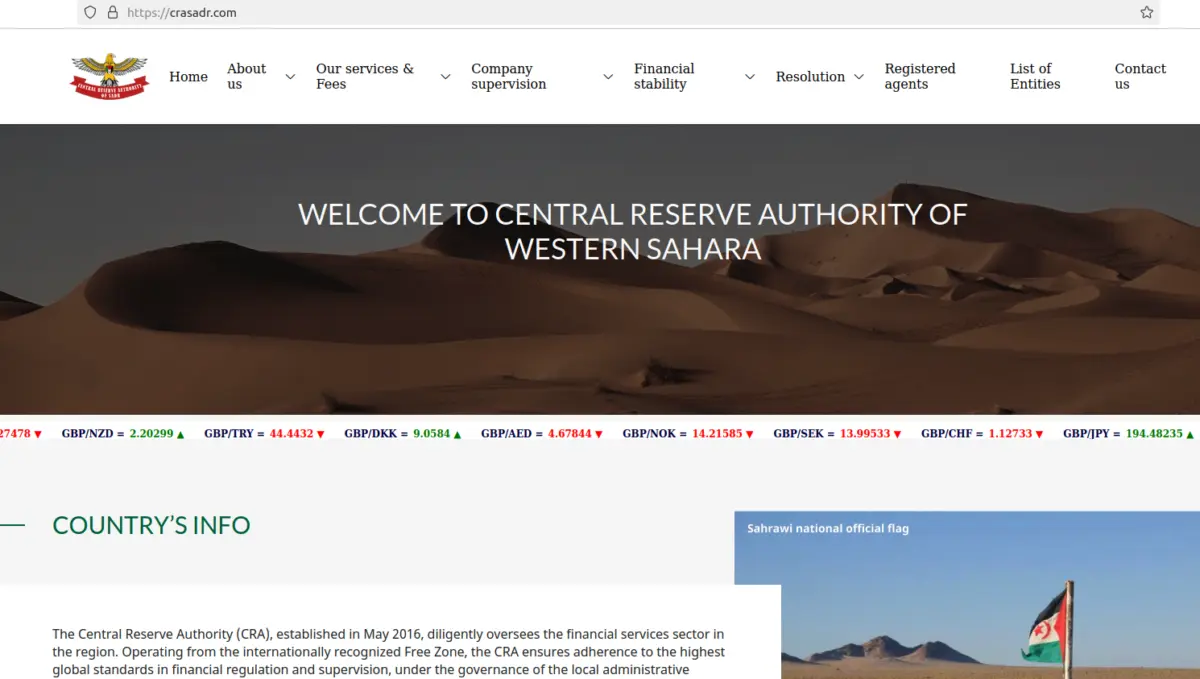
This corporation billed itself as an official regulatory body exclusively responsible for issuing licenses to cryptocurrency operations, foreign exchange brokers, and online gaming businesses incorporated within the Western Sahara—a disputed territory in northwest Africa that lacks widespread international recognition as a sovereign nation.
The regulatory body operated through the website crasadr.com, which purported to represent the Central Reserve Authority of the Western Sahara. Forensic domain analysis conducted by investigators revealed that a former primary domain used by Certa Payments shared a server network with 12 other distinct domains, including rasd-state.ws, further unmasking the circular, synthetic nature of the platform’s self-awarded regulatory compliance. By leveraging a fake regulatory agency based in a geopolitical no-man’s-land, Cryptomus successfully hoodwinked various third-party service providers into granting them operational clearance.
Official Statements and Expert Analysis
The international cybersecurity community has overwhelmingly praised the U.K.’s decisive intervention, contrasting the efficacy of economic sanctions with the limitations of administrative fines.
Richard Sanders, a veteran blockchain analyst and investigator who spent months painstakingly mapping out Cryptomus’s complex payment infrastructure and transacting directly with its illicit customer base, emphasized the fundamental difference between regulatory fines and state-level sanctions.

Writing on professional networks following the announcement, Sanders stated:
"A fine doesn’t stop a cryptocurrency payment processor from processing payments. Sanctions kill the operation. The distinction matters."
Sanders highlighted that while Canada’s record CAD $176 million fine made headlines, it lacked teeth because the underlying entity could simply ignore collection attempts, alter its corporate branding, and spin up parallel services like Heleket. By contrast, asset freezes and secondary enforcement risks imposed by the U.K. effectively sever a platform’s access to Western financial rails, insurance, and technological infrastructure.
Weighing in on the broader macroeconomic implications, Chainalysis noted in its analytical brief:
"Cryptomus and Heleket have emerged as major payment hubs for illicit activity. Together, these services received more illicit funds across tracked categories than the mixers in our dataset, and the number of illicit counterparties surged to more than 900 in a single month in late 2025."
The firm emphasized that these sanctions represent a vital blow not just to retail cybercrime, but to the sophisticated financial networks sustaining the Russian state apparatus amid ongoing Western economic restrictions.
Future Outlook
The sanctioning of Cryptomus and its sibling platforms marks a watershed moment in the global regulation of decentralized finance. As nation-states increasingly weaponize economic sanctions to combat hybrid warfare and state-sponsored cybercrime, cryptocurrency platforms that attempt to operate in the regulatory shadows can no longer rely on simple corporate rebranding or shell-company jurisdictions to shield themselves from accountability.
However, the takedown of Cryptomus also highlights the persistent adaptability of the cybercrime economy. Historically, when major payment hubs like Hydra Market, Garantex, or Cryptomus are disrupted or sanctioned, liquidity quickly fragments into smaller, harder-to-trace decentralized protocols, privacy coins, or emerging cross-border payment corridors operating in friendly or non-aligned jurisdictions.
For Western law enforcement and intelligence agencies, the immediate challenge will be enforcing compliance across international borders and ensuring that phantom regulatory bodies—such as those fabricated in Western Sahara—are systematically exposed and neutralized.
Ultimately, the U.K.’s actions against Cryptomus have drawn a hard red line. The era of multi-billion-dollar shadow payment processors acting as an unhindered bridge between global cybercriminals and sanctioned regimes is drawing to a close, replaced by a coordinated, cross-border enforcement posture designed to permanently sever the digital arteries of transnational crime.