By Global Financial Investigations Desk
Published October 2026
Executive Overview
In a decisive maneuver aimed at dismantling the financial architecture sustaining Russia’s wartime economy, the United Kingdom has levied sweeping economic sanctions against Cryptomus, a notoriously shape-shifting cryptocurrency platform. According to leading cybersecurity and blockchain intelligence experts, Cryptomus has long served as a primary conduit for a diverse array of illicit financial flows. The platform has allegedly facilitated transactions tied to ransomware extortion campaigns, narcotics trafficking, darknet markets, digital fraud, and cybercrime-as-a-service providers actively working to circumvent international financial restrictions imposed on the Russian Federation.
Unveiled on October 8, the U.K. Treasury’s sanctions target Cryptomus alongside several associated virtual payment platforms, including VexPay, TokenSpot, and the Tsunami Payments service. The administrative action legally freezes any assets held by Cryptomus within British financial institutions and strictly prohibits U.K. companies and citizens from engaging in commercial, virtual, or operational business with the entity.
Unlike previous financial penalties imposed by international regulators—which analysts argue possess limited enforcement power—the U.K.’s designation as an economic sanction strikes directly at the operational viability of the platform. By choking off access to traditional banking corridors, compliant liquidity providers, and Western technological infrastructure, the move marks a significant escalation in the global regulatory crackdown on illicit cryptocurrency networks laundering funds for the Kremlin and transnational cyber syndicates.
Detailed Chronology of an Illicit Empire
The Genesis and Evolution of Certa Payments
Cryptomus emerged onto the decentralized finance landscape in 2022. Originally incorporated under corporate entities such as Certa Payments and Xeltox Enterprises, the platform quickly established itself as a preferred payment processor for dozens of Russian cryptocurrency exchanges and underground websites hawking specialized cybercrime services.
Operating with minimal oversight, the platform experienced exponential growth. Forensic accounting and blockchain analytics have since revealed that Cryptomus functioned as a crucial bridge, allowing decentralized digital assets to be converted into fiat currency and integrated directly into Russian banking networks.
However, as law enforcement agencies and blockchain intelligence firms began mapping the platform’s infrastructure, regulatory scrutiny intensified. The turning point for the platform’s initial iteration arrived when Canadian authorities launched an exhaustive investigation into its anti-money laundering (AML) compliance failures.
Evasion Tactics: Fines, Aliases, and the Birth of Heleket
In October 2025, Canada levied a historic CAD $176 million fine against Cryptomus—marking one of the largest regulatory penalties ever issued against a cryptocurrency service for AML violations. Investigative disclosures revealed that Cryptomus shared a nominal Vancouver corporate address with dozens of other foreign currency dealers and money transfer businesses, none of which maintained a physical presence at the location.
Rather than submitting to regulatory authority or paying the record-breaking fine, the platform engaged in a series of evasive maneuvers. Cryptomus appealed the penalty while aggressively shedding its skin. To bypass tighter scrutiny and newly instituted "Know Your Customer" (KYC) requirements—which had briefly caused its transaction volumes to dip—the operators launched a parallel, no-KYC payment processing service named Heleket.
Despite overwhelming forensic evidence linking Heleket directly to the original Cryptomus infrastructure, customer support agents operating via encrypted channels like Telegram flatly denied any corporate affiliation. The rebranding strategy allowed the illicit network to maintain continuity of operations, continuing to process vast sums of capital for criminal enterprises and sanctioned Russian entities alike.

The October 2026 U.K. Sanctions
The labyrinthine evasion tactics finally encountered an insurmountable roadblock on October 8, 2026, when the U.K. government formally intervened. The sanctions notice targeted not only Cryptomus and its aliases but also its direct operational successors and sister platforms.
Immediately following the announcement of the U.K. sanctions, automated support bots for Cryptomus and Heleket on Telegram went offline or began issuing automated error messages to users, informing inquiries that the platforms were suddenly incapable of processing transactions. The swift operational disruption underscored the immediate and paralyzing impact of sovereign economic sanctions compared to civil monetary penalties.
Supporting Context & Metrics: Scale of the Illicit Economy
The sheer volume of capital processed by Cryptomus and its derivatives highlights the systemic risk such platforms pose to global financial security. Comprehensive data compiled by top-tier blockchain intelligence firms illustrate an enterprise operating on an industrial scale.
TRM Labs and Chainalysis Findings
In an extensive intellectual property briefing published in April 2026, blockchain analysis firm TRM Labs revealed that Cryptomus had processed more than $7 billion in transactions since its inception in 2022. A granular analysis of these funds uncovered disturbing associations well beyond conventional financial fraud. The platform’s transaction ledgers contained wallet addresses tied directly to:
- Vendors distributing child sexual abuse material (CSAM).
- International terrorist financing networks.
- Lucrative human trafficking operations.
- Ransomware syndicates targeting critical infrastructure in Western nations.
Furthermore, blockchain analytics leader Chainalysis detailed the explosive growth of the platform in an October 8 advisory. According to Chainalysis datasets, Cryptomus and Heleket emerged as dominant payment hubs, receiving more illicit funds across tracked categories than traditional cryptocurrency mixers. At the peak of its operations in late 2025, the number of distinct illicit counterparties utilizing the platform surged to more than 900 in a single month.
Official Statements and Expert Analysis
The international response to the U.K.’s actions has underscored a profound shift in how Western governments handle cross-border digital financial crime.
The Distinction Between Fines and Sanctions
Richard Sanders, a prominent blockchain analyst and investigator who spent months mapping Cryptomus’s intricate payment infrastructure and directly transacting with its customer base, emphasized the vital structural difference between the Canadian penalties and the British sanctions.
"A fine doesn’t stop a cryptocurrency payment processor from processing payments," Sanders wrote in a public analysis. "Sanctions kill the operation. The distinction matters."
Sanders pointed out that while Canada’s CAD $176 million fine was monumental in theory, it proved ultimately unenforceable and uncollectible given the shell-company structure of the platform. By contrast, the U.K. sanctions impose severe criminal liability on any domestic or international entity that touches the platform’s remaining liquidity, effectively cutting off its oxygen supply within Western-aligned financial ecosystems.
A "Five Eyes" Precedent
Beyond its operational impact, Sanders noted a profound geopolitical milestone: this enforcement action represents the first documented instance of a "Five Eyes" nation (comprising Australia, Canada, New Zealand, the United Kingdom, and the United States) officially sanctioning a cryptocurrency operation whose foundational corporate entities were incorporated within the jurisdiction of another Five Eyes partner. This cross-jurisdictional alignment signals unprecedented intelligence-sharing and cooperative resolve among Western intelligence and financial watchdogs.

The Phantom Regulator: Unraveling the Corporate Veil
One of the most enduring mysteries investigated by financial sleuths is how entities like Cryptomus and Heleket manage to establish nominal legitimacy, secure banking partnerships, and project operational authority. The answer exposes a shadowy ecosystem of fake financial institutions overseen by phony regulatory bodies positioned in disputed geopolitical territories.
The Western Sahara Connection
During foundational investigations into Cryptomus’s corporate lineage, analysts discovered that the sole shareholder of Certa Payments—the original parent company of Cryptomus—was a 25-year-old Ukrainian woman. Beyond her role in Certa Payments, she simultaneously headed several other corporate entities, including the WS Management and Advisory Corporation.
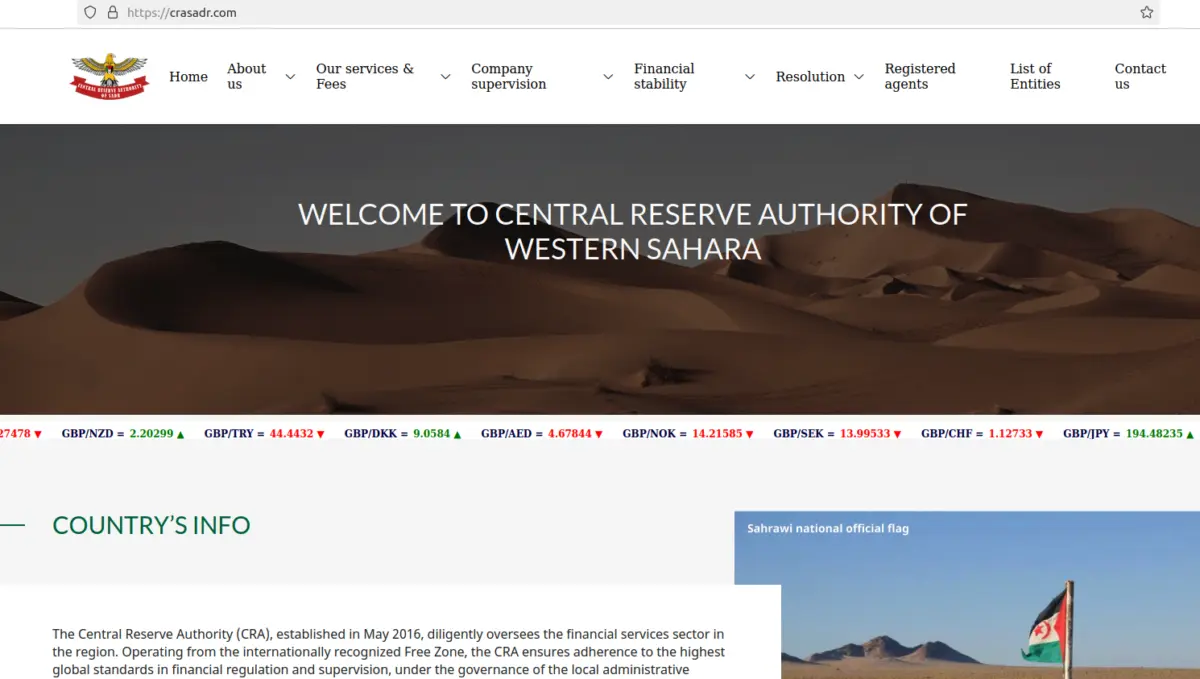
WS Management and Advisory Corporation markets itself aggressively as an exclusive regulatory oversight body. According to its public-facing materials, it claims the authority to issue official operating licenses for cryptocurrency exchanges, foreign exchange (forex) brokers, and online gaming enterprises. The catch? The jurisdiction it purports to regulate is the Western Sahara, a disputed territory in northwest Africa that lacks widespread international recognition as a sovereign nation.
The Infrastructure of Deception
Further technical analysis revealed deep operational overlaps between Cryptomus’s digital assets and this phantom regulatory apparatus:
- The Regulator Portal: The regulatory entity operated a website under the domain
crasadr.com, representing the "Central Reserve Authority of the Western Sahara." This site actively published registries of companies purportedly awarded legitimate licenses for cryptocurrencies and forex trading. - Shared Server Architecture: Forensic domain mapping exposed that one of Certa Payments’ historical domains (
certa.website) shared a physical hosting server with 12 distinct domains, includingrasd-state.ws—the primary web portal for the Central Reserve Authority of the Western Sahara.
This elaborate facade allowed the platform to weaponize regulatory arbitrage, presenting legitimate-looking compliance documentation to unwitting third-party service providers while operating entirely outside the boundaries of internationally recognized financial standards.
Future Outlook
The U.K.’s economic sanctions against Cryptomus, Heleket, TokenSpot, and VexPay represent a watershed moment in the global effort to police the intersection of decentralized finance and state-sponsored geopolitical evasion.
As blockchain intelligence firms continue to refine their attribution models and sovereign regulators adopt more aggressive enforcement postures, the era of anonymous, no-KYC payment processors operating with impunity is rapidly drawing to a close. However, as demonstrated by the transition from Certa Payments to Cryptomus and subsequently to Heleket, illicit networks remain deeply resilient, constantly adapting their corporate nomenclature and operational infrastructure to evade capture.
Moving forward, international financial watchdogs face the ongoing challenge of closing jurisdictional loopholes, preventing the exploitation of disputed territories for shell-company creation, and ensuring that allied sanctions regimes are applied uniformly across the global financial system. For Cryptomus and its digital progeny, the U.K. sanctions serve as a stark reminder that while blockchain transactions may be decentralized, the fiat bridges required to cash them out remain firmly within the crosshairs of sovereign power.