Executive Overview
In enterprise architecture, the concept of "least privilege" is a foundational security tenet. However, translating abstract access control policies into concrete, day-to-day operations remains a persistent engineering challenge. This challenge is uniquely magnified within the public sector—specifically within judicial operations.
In the California court system, information management is governed by strict legal boundaries. Under California Rules of Court, Rule 2.550(c), court records are presumed to be open unless confidentiality is required by law. Conversely, specific categories—such as juvenile case files under Rule 5.551—are strictly confidential by default. Maintaining these boundaries requires access control mechanisms that operate at a granular level, dynamically aligning with user functions rather than static organizational charts.
When evaluating access control for Large Language Model (LLM) deployments, traditional API management often falls short. Shared keys, unmonitored endpoints, and lack of fine-grained scoping create security vulnerabilities and compliance risks. To examine how modern infrastructure addresses this problem, an independent operational review was conducted using Bifrost, an open-source AI gateway developed by Maxim AI.
Operating under a simulated courtroom environment featuring three distinct user roles—interpreter, reporter, and clerk—this investigation tested whether an open-source AI gateway could successfully enforce strict access scopes, log unauthenticated or unauthorized attempts, and operate reliably under least-privilege principles. The results demonstrate that gateway-level governance can successfully intercept, evaluate, and log unauthorized model requests before they ever reach third-party providers like OpenAI, providing the verifiable audit trail required for sensitive civic technology deployments.
Detailed Chronology of the Operational Test
To rigorously test the scoping capabilities of the Bifrost gateway, an automated testing harness named Heimdall (hosted on GitHub under earlgreyhot1701D/heimdall) was deployed. The test plan was designed to simulate multi-role interactions with various AI model tiers, deliberately probing the boundaries of the access controls.

The Role-Based Matrix and Scoping Definitions
In court operations, system access is dictated by immediate functional requirements. If a courtroom clerk cannot access a specific docket entry or minute order during a live proceeding, operations stall. Consequently, access rights frequently run counter to traditional hierarchical org charts.
To mirror this reality, three distinct roles were provisioned within the Bifrost local environment, mapped against specific model tiers and strict daily budgetary limits:
- Interpreter: Requires access solely to basic calendar data, names, parties, dates, and hearing types.
- Gateway Scope: Routine models only.
- Daily Spending Limit: $0.05.
- Reporter: Requires all interpreter access, plus minute orders with notes, decision records on motions, and in-camera hearing logs.
- Gateway Scope: Routine and standard models.
- Daily Spending Limit: $1.00.
- Clerk: Requires extensive, real-time auditing access to the entire case file during active proceedings.
- Gateway Scope: Routine, standard, and restricted models.
- Daily Spending Limit: $5.00.
The Testing Phases and Rigorous Harness Validation
The evaluation was structured in distinct phases to ensure methodological integrity and eliminate false positives:
- Phase A (Dry Run & Harness Construction): The testing harness was built using AI-assisted development tools (Claude and Kiro) with a strict natural-language reporting requirement. Every test script was executed in a dry-run mode to validate logging logic without invoking live API keys.
- Self-Correction in Phase A: The harness initially attempted to write test logs directly to the primary evidence file (
raw_output.log) during dry runs. This flaw was caught and corrected to ensure evidentiary purity. Additionally, a string-matching bug tied to a variable rename (badge=versusrole=) was identified and patched, preventing silent test failures.
- Self-Correction in Phase A: The harness initially attempted to write test logs directly to the primary evidence file (
- Phase B (Connectivity Verification): A restricted API key was introduced to execute isolated, direct calls, verifying that underlying model providers were reachable and responding correctly.
- Phase C (Live Enforcement Execution): The live matrix run executed a total of nine calls—every role attempting to access every model tier.
Execution Results and Negative Controls
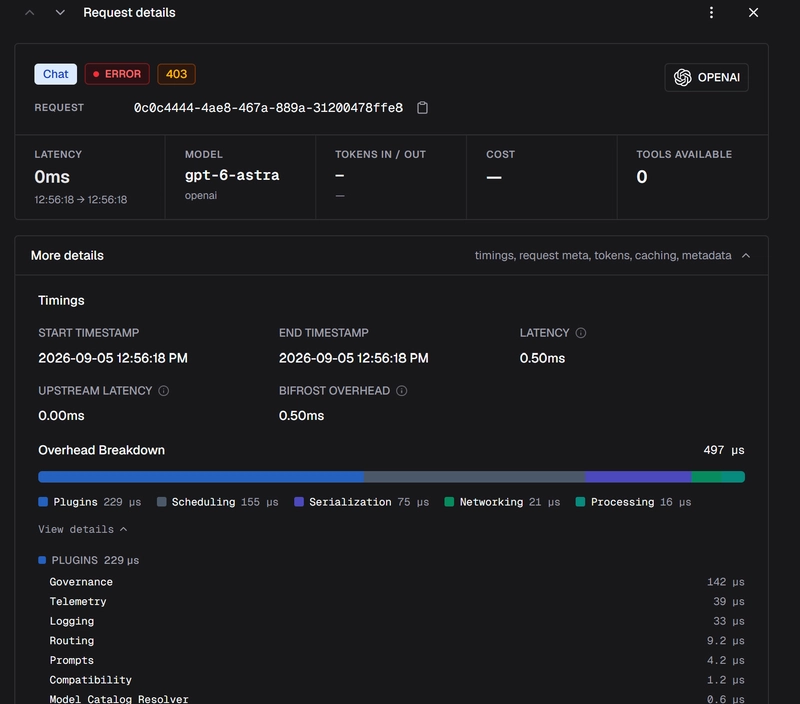
During the live run, the gateway successfully intercepted and blocked unauthorized requests. Out of nine total calls, six were permitted, and three were systematically refused at the gateway layer before reaching the upstream provider.
Every blocked request returned an HTTP 403 status code with a standardized JSON payload:

  "type": "model_blocked",
  "is_bifrost_error": false,
  "status_code": 403,
  "error":
    "message": "Model 'gpt-5.6-terra' is not allowed for this virtual key"
  ,
  "extra_fields":
    "routing_info": ,
    "provider": "openai",
    "original_model_requested": "gpt-5.6-terra",
    "resolved_model_used": "gpt-5.6-terra",
    "request_type": "chat_completion"
To validate that the harness was not merely echoing expected outcomes, a negative control test was performed. The scope for the interpreter role was manually expanded via the Bifrost local UI to include standard models, while the test harness expected a denial. The system correctly flagged the discrepancy as a MISMATCH, proving that the validation suite evaluated live server responses rather than hardcoded expectations. Finally, stopping the Docker container running Bifrost instantly resulted in standard local connection refused errors (curl: (7) Failed to connect to localhost port 8090), confirming that traffic was strictly routed through the gateway infrastructure.
Supporting Context and Metrics
Understanding the mechanics of an AI gateway requires examining how traditional API authentication contrasts with gateway-mediated governance.
Architecture: Direct API vs. Gateway-Mediated Access
| Feature | Direct API Integration (e.g., OpenAI, Anthropic) | Gateway-Mediated Access (Bifrost Open Source) |
|---|---|---|
| Credential Management | Real API keys distributed across applications and user groups. | Master keys remain secure within the gateway; clients use restricted virtual keys. |
| Scoping & Governance | Monolithic keys with broad access to all available models. | Fine-grained scoping per virtual key (model restrictions, rate limits, budgets). |
| Audit Capabilities | Provider-side logs lacking internal organizational context. | Centralized traffic logs capturing role assignments, timestamps, and specific error reasons. |
| Cost Control | Difficult to attribute consumption across distinct internal departments. | Hard spending caps and real-time expenditure tracking per virtual key. |
Configuration Nuances: Scoping vs. Budgetary Controls
A critical observation during the initial setup phase involved distinguishing between budgetary limitations and true model scoping. Within the Bifrost configuration UI, model budgets and access limits exist as distinct administrative controls:
- Model Budgets: Cap the monetary expenditure allowed for a specific model tier but do not inherently restrict access to unpermitted models unless explicitly configured.
- Access & Rate Limits: Dictate which specific models a virtual key can reach.
By default, new virtual keys inherit an "All Models" permission profile. Failing to explicitly modify this setting results in a bypass of model-tier restrictions, highlighting the importance of thorough configuration reviews in high-security environments.
Official Statements and Architectural Insights
The integration of artificial intelligence into administrative and legal workflows necessitates robust auditing frameworks. When evaluating tools like Bifrost, system architects must distinguish between open-source capabilities and enterprise features.

- Audit Logging and Traceability: While advanced, dedicated compliance suites and automated audit log retention policies are frequently restricted to enterprise-tier offerings, the open-source distribution of Bifrost successfully captures critical security events within its standard traffic logs.
- Evidentiary Standards: In public sector compliance, proving that a restricted action was successfully denied is as vital as recording successful transactions. As demonstrated in the test logs, unauthorized attempts generate structured JSON entries containing exact timestamps, error classifications (
model_blocked), HTTP status codes (403), and precise virtual key attribution (e.g.,"virtual_key_name": "reporter"). - Performance Overhead: Analysis of the exported log data revealed that the governance plugin evaluation consumed approximately 141 microseconds (
plugin.governance": 141.562) per request. This minimal computational latency ensures that security enforcement does not degrade application responsiveness.
Future Outlook
As municipal, county, and state agencies increasingly adopt generative AI tools to summarize transcripts, manage administrative calendars, and draft routine legal documentation, the reliance on insecure, shared API credentials must end.
The successful implementation of role-based virtual keys via open-source gateways signals a shift toward democratized, lightweight security hygiene. Organizations no longer need to wait for massive, proprietary enterprise platforms to implement least-privilege access controls. By utilizing containerized, self-hosted gateways like Bifrost, technical operators can establish clear organizational boundaries, enforce precise spending caps, and maintain verifiable audit logs of every system interaction.
Future developments in this space will likely focus on native integration with standard enterprise identity providers (IdPs), expanded role-based access control (RBAC) within open-source builds, and automated compliance reporting tailored to government transparency mandates. For civic technologists and public sector engineers, the tools to secure AI infrastructure are increasingly viable, transparent, and ready for deployment.