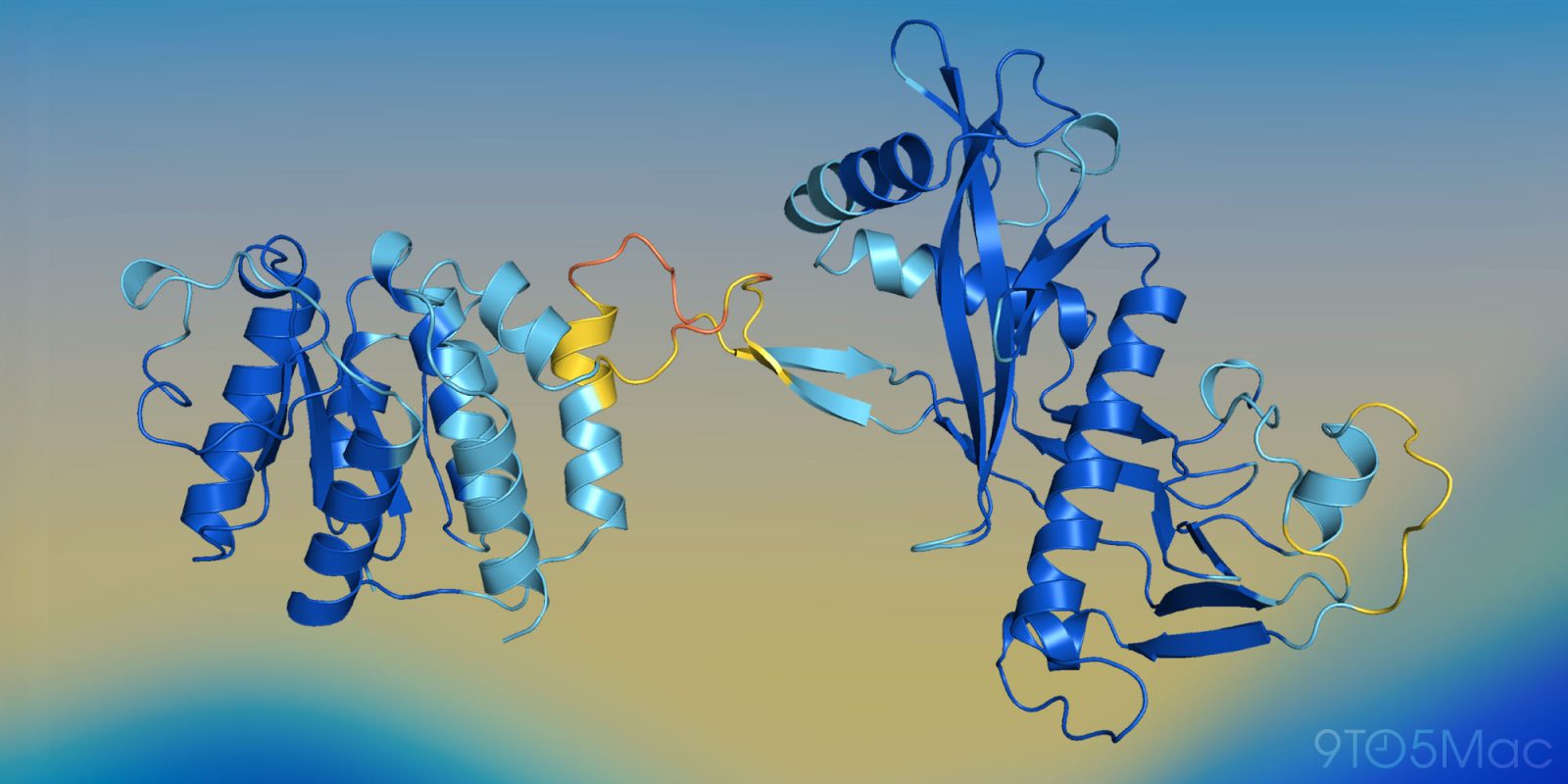
In the rapidly evolving landscape of computational biology, artificial intelligence has fundamentally shifted how scientists understand the building blocks of life. From predicting how a single string of amino acids folds into a complex three-dimensional machine to engineering entirely novel enzymes, AI is rewriting the rules of biochemistry.
Building upon their earlier architectural breakthroughs, Apple’s machine learning research division has introduced SimpleDesign—a streamlined, unified artificial intelligence model capable of jointly generating protein sequences and their corresponding 3D structures.
Traditional approaches to computational protein design have long relied on multi-stage, highly complex pipelines. These legacy systems typically employ autoencoders to tokenize data into latent spaces before applying separate generative models. Apple’s latest research challenges this orthodoxy. By discarding intermediate representation steps and training directly on raw data space, SimpleDesign demonstrates that performant, multimodal protein design can be achieved with remarkable elegance.
Utilizing a robust dataset of over two million protein sequence-and-structure pairs, the model leverages a unique corruption-and-recovery training paradigm. By dynamically masking amino acid sequences and injecting spatial noise into 3D coordinates, SimpleDesign effortlessly pivots between protein folding, inverse folding, and full-scale co-design.
While the model’s evaluations remain firmly rooted in computational benchmarks—awaiting physical, wet-lab validation—the implications of Apple’s research extend far beyond consumer technology. As tech giants increasingly channel their deep pockets and elite computing talent into foundational life sciences research, breakthroughs like SimpleDesign signal a profound convergence of artificial intelligence and molecular biology.
Detailed Chronology: The Evolution of Apple’s Structural Biology Research
To understand the magnitude of SimpleDesign, one must retrace the methodological breadcrumbs left by Apple’s machine learning team over the past year. Apple’s foray into structural biology is not an isolated detour into biotech, but rather a logical extension of its broader push into efficient, general-purpose generative architectures.
September 2025: The Genesis of SimpleFold
The foundational groundwork for SimpleDesign was laid in September 2025, when Apple researchers published a landmark study titled "SimpleFold: Folding Proteins is Simpler than You Think." For decades, predicting a protein’s 3D structure from its linear amino acid sequence had been dominated by massive, computationally demanding systems—most notably DeepMind’s revolutionary AlphaFold.
While AlphaFold achieved near-oracle status in structural biology, its architecture relied heavily on intricate, resource-intensive pipelines. Apple sought to streamline this paradigm. The SimpleFold model bypassed traditional iterative diffusion architectures—which work by painstakingly removing noise step-by-step from a random starting point—in favor of flow-matching.
Flow-matching maps a direct, highly efficient trajectory from a noisy, random baseline straight to the final structural output. By coupling this flow-matching technique with general-purpose Transformer blocks typically reserved for text generation, Apple proved that protein folding could be democratized and accelerated without sacrificing accuracy.
The Bridge from Prediction to Generation
While SimpleFold solved the forward problem—taking a known sequence and predicting its 3D shape—biological engineering requires the inverse capability: designing completely new proteins with specific structural and functional properties. This requires "co-design," a simultaneous optimization of both the amino acid sequence and the 3D atomic coordinates.
Rather than treating sequence generation and structure prediction as siloed problems requiring disparate pipelines, Apple’s researchers asked a fundamental question: Could the minimalist, direct-learning philosophy of SimpleFold be scaled to handle both tasks simultaneously?
This inquiry directly birthed SimpleDesign. Unveiled in Apple’s subsequent research paper, "SimpleDesign: A Joint Model for Protein Sequence and Structure Codesign," the new architecture represents a total rejection of the multi-stage tokenization frameworks that have bottlenecked computational protein design for years.
Supporting Context & Metrics: Unpacking the SimpleDesign Architecture
To fully grasp why SimpleDesign represents a paradigm shift, one must examine the technical friction points of legacy computational biology models.
Dismantling Multi-Stage Latent Spaces
Historically, deep learning models tackling protein co-design have labored under a heavy structural tax. Because raw 3D atomic coordinates and discrete amino acid tokens exist in fundamentally different mathematical spaces, researchers historically relied on a fragmented, multi-stage training pipeline:
Stage One: Researchers trained separate autoencoder models to compress complex 3D protein structures into compressed, discrete representations known as "tokens" within a hidden latent space.
Stage Two: A separate generative model was trained purely on those latent representations to synthesize new structural designs.
Stage Three: Additional post-processing heuristics were deployed to map those latent tokens back into actionable amino acid sequences.
Apple’s research hypothesis was straightforward: This multi-stage training scaffolding is entirely unnecessary.
By developing SimpleDesign as a unified, multimodal framework, Apple successfully trained the model directly in the native data space. SimpleDesign processes continuous 3D atomic coordinates and amino acid sequences concurrently, eliminating the information loss and cumulative error inherent in tokenized latent-space compression.
The 2-Million-Pair Training Paradigm
The sheer scale of SimpleDesign’s training regimen underscores its industrial-grade execution. Apple researchers curated a massive training corpus comprising over 2 million protein sequence-and-structure pairs. The bulk of this data was harvested from the AFESM dataset, which synthesizes experimentally validated structures alongside high-confidence predictions generated by the AlphaFold Database.
The true brilliance of SimpleDesign lies in its dynamic corruption-and-recovery training loop:
The Masking Mechanism: During training, the model is fed paired protein data where both modalities are deliberately degraded. Amino acid sequences are partially masked, while corresponding 3D structures are injected with spatial noise.
Task Fluidity: By algorithmically modulating the degree of corruption on each side, the model naturally transitions between distinct biological tasks.
Protein Folding: If the sequence is left pristine while the structure is heavily corrupted, the model is forced to reconstruct the 3D architecture from the sequence alone.
Inverse Folding: If the 3D structure is left intact while the sequence is heavily masked, the model must act as an inverse folder, generating an amino acid sequence capable of stabilizing that specific spatial geometry.
Co-Design: When both sequence and structure are partially scrambled simultaneously, the model learns the intricate bidirectional dependencies required for true co-design.
Official Statements and Research Insights
In their official publication, Apple’s research team articulated the core philosophy guiding the project. Rather than treating biological data as an exotic, walled-garden modality requiring entirely custom mathematical frameworks, Apple continues to push for the unification of AI architectures.
"Existing models often rely on a multi-stage training process where autoencoders that tokenize data into latent representations are trained in a first stage. Secondly, a generative model is trained on the latent representation of the autoencoder(s)… We hypothesize that this multi-stage training is not necessary to obtain performant co-design models and thus present SimpleDesign, an effective multi-modal protein design model trained directly in the data space."
Independent computational biologists tracking the release have noted that Apple’s insistence on architectural minimalism could radically lower the hardware barrier for structural biology research. By shedding the heavy computational overhead required to manage multi-stage autoencoders, models like SimpleDesign point toward a future where complex molecular modeling can be executed faster, cheaper, and with fewer points of failure.
Furthermore, benchmark evaluations detailed in the study reveal that SimpleDesign punches well above its weight class. Despite utilizing a dramatically simpler training pipeline than its heavily engineered competitors, SimpleDesign delivers exceptionally competitive performance across standard structural generation, sequence recovery, and joint co-design benchmarks. The generated amino acid sequences match or exceed the biological plausibility scores of far more complex multimodal architectures.
Future Outlook and Limitations
Despite the profound technical elegance of SimpleDesign, Apple’s researchers maintain a stance of rigorous scientific caution regarding the immediate real-world applications of their work.
The Computational vs. Biological Divide
The most critical caveat highlighted in the study is that SimpleDesign’s evaluations remain entirely in silico (computer-based).
In computational biology, generating a mathematically coherent amino acid sequence and a plausible 3D folding structure on a screen is only half the battle. Nature operates under punishing physical and chemical constraints. A protein generated by an AI model must not only look correct in a digital environment; it must actually fold correctly in an aqueous biological environment, remain stable against thermal denaturation, interact correctly with target molecules, and—crucially—pose no toxic or unintended biochemical hazards in living systems.
To confirm these capabilities, computational designs must transition from silicon servers to wet-lab environments, where researchers physically synthesize the DNA, express the proteins, and use techniques like X-ray crystallography or cryogenic electron microscopy (cryo-EM) to verify their real-world structures. Apple’s current study does not yet include experimental wet-lab validation.
The Horizon of Apple’s AI Strategy
As tech giants vie for supremacy in foundational artificial intelligence, Apple’s quiet, methodical contributions to structural biology reveal a diversified long-term strategy. While consumer-facing features like Apple Intelligence dominate public headlines, foundational research divisions continue to publish open, peer-reviewed contributions to fields that will fundamentally define the 21st-century bio-economy.
Whether SimpleDesign will eventually be integrated into commercial drug discovery pipelines, partnered with biotech enterprises, or simply serve as an open-source academic milestone remains to be seen. What is certain, however, is that Apple has once again demonstrated that simplicity, when executed with mathematical rigor, can disrupt deeply entrenched paradigms across complex scientific domains.