For years, the discourse surrounding artificial intelligence in the business world has been dominated by enterprise-level narratives, multi-million-dollar implementation strategies, and speculative futuristic forecasts. Yet, as the business landscape moves deeper into 2026, a fundamental shift has occurred. AI is no longer a corporate luxury or an experimental playground for tech conglomerates; it has become the daily operational baseline for independent enterprises and lean teams.
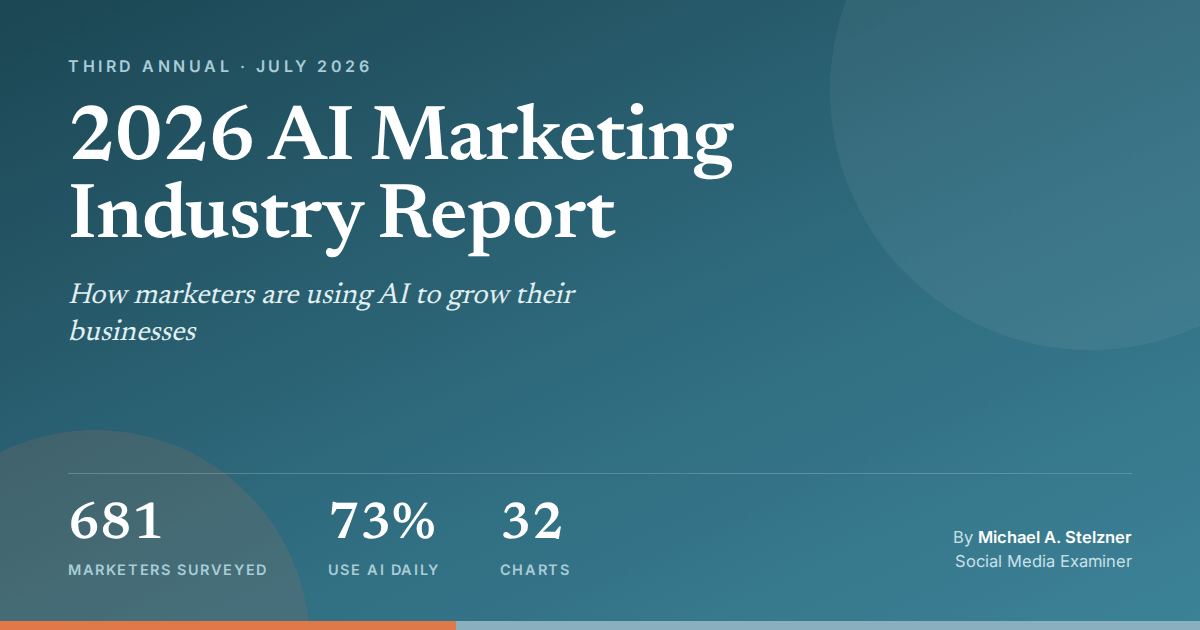
According to the newly released 2026 AI Marketing Industry Report compiled by Social Media Examiner, the transformation is staggering. Within a mere two-year span, daily utilization of artificial intelligence among marketing professionals has nearly doubled, vaulting from approximately one-third to nearly three out of every four practitioners. Crucially, this data is not skewed by massive, bureaucratic corporate entities: 60% of survey respondents hail from organizations with ten or fewer employees.
This research shatters the myth that leveraging advanced machine learning requires institutional budgets, dedicated engineering departments, or formal corporate training protocols. Instead, the modern small business is pioneering an era of self-taught, highly agile automation. From the quiet rise of autonomous AI agents to the massive untapped frontier of video generation, this report presents five eye-opening findings that redefine how lean enterprises operate, strategize, and compete in a hyper-accelerated market.
Detailed Chronology: The Rapid Acceleration of AI Adoption
To understand where small business technology stands today, one must examine the compressed timeline of its evolution. The trajectory from novelty to necessity is one of the fastest technological migrations in modern commercial history.
The 2024 Baseline: A Divided Workforce
Just two years prior, the integration of artificial intelligence was highly polarized. While forward-thinking innovators recognized the potential of early large language models, the broader professional ecosystem remained hesitant. In 2024 industry benchmarks, only 37% of marketers utilized AI on a daily basis. At the other end of the spectrum, nearly a quarter of professionals (23%) rarely or never touched these tools, viewing them as transient trends or unproven novelties with questionable utility and copyright safety.
The 2025 Transition: Crossing the Chasm
Throughout the subsequent twelve months, adoption shifted from experimentation to structural integration. The democratization of generative platforms—characterized by lowered subscription costs, improved conversational reasoning, and expanded multimodal capabilities—pulled the early majority into regular workflows. Weekly usage spiked, while the cohort of skeptics who completely avoided AI shrank into the single digits. Businesses began recognizing that manual workflows in content creation, data organization, and customer correspondence were placing them at an operational disadvantage against agile competitors.
The 2026 Reality: The New Normal
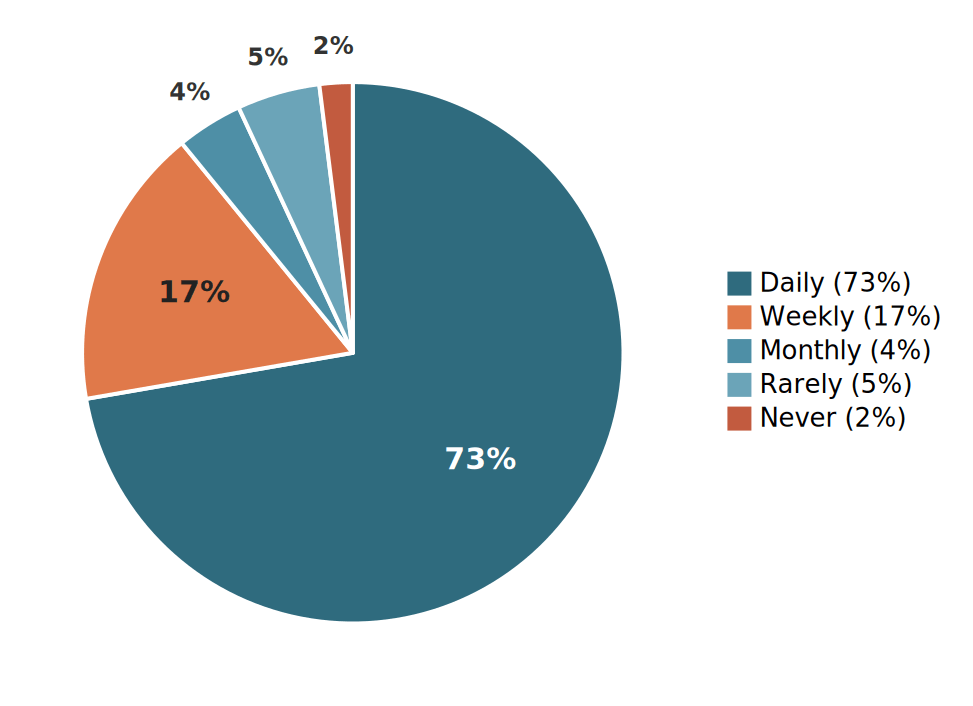
Today, the data confirms that AI has crossed the threshold into permanent infrastructure. Daily usage has surged to 73%, while an overwhelming 90% of marketers engage with AI at least weekly. Conversely, the group of non-users has collapsed to a mere 7%.
This trajectory reveals an unyielding momentum: 84% of surveyed professionals report that their AI usage increased over the past year, and 78% anticipate continued expansion in their operational reliance moving forward. The window for effortless entry is narrowing rapidly; what was once a competitive differentiator is fast becoming a baseline requirement for market survival.
Supporting Context & Metrics: Five Defining Findings
A closer examination of the 2026 AI Marketing Industry Report uncovers nuances that challenge conventional wisdom regarding budgets, execution, and performance measurement.
Finding #1: The Normalization of Daily AI Operations
The sheer volume of daily engagement cements AI as core infrastructure. With 90% utilizing these tools on a weekly or daily basis, the technology has transitioned away from the "hype cycle." The survey data indicates that integration is deep and pervasive. However, because 84% report climbing usage curves, the ecosystem has not yet reached a plateau. Businesses that delay integration are no longer just falling behind; they are attempting to outpace competitors who operate with exponential multipliers in output and efficiency.
Finding #2: The Autodidactic Small Business Model
Corporate America often assumes that technology adoption requires structured onboarding, certified training courses, and departmental budgets. The small business reality is radically different—and vastly more resourceful.
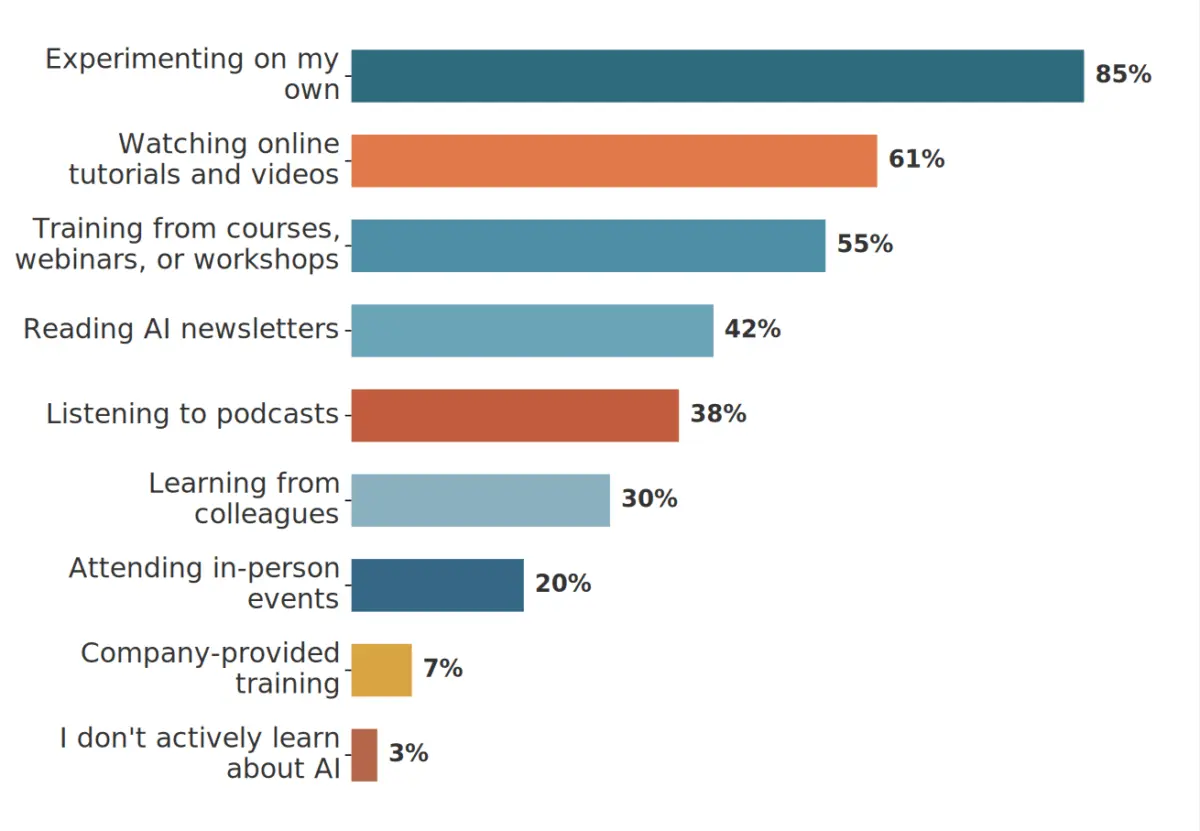
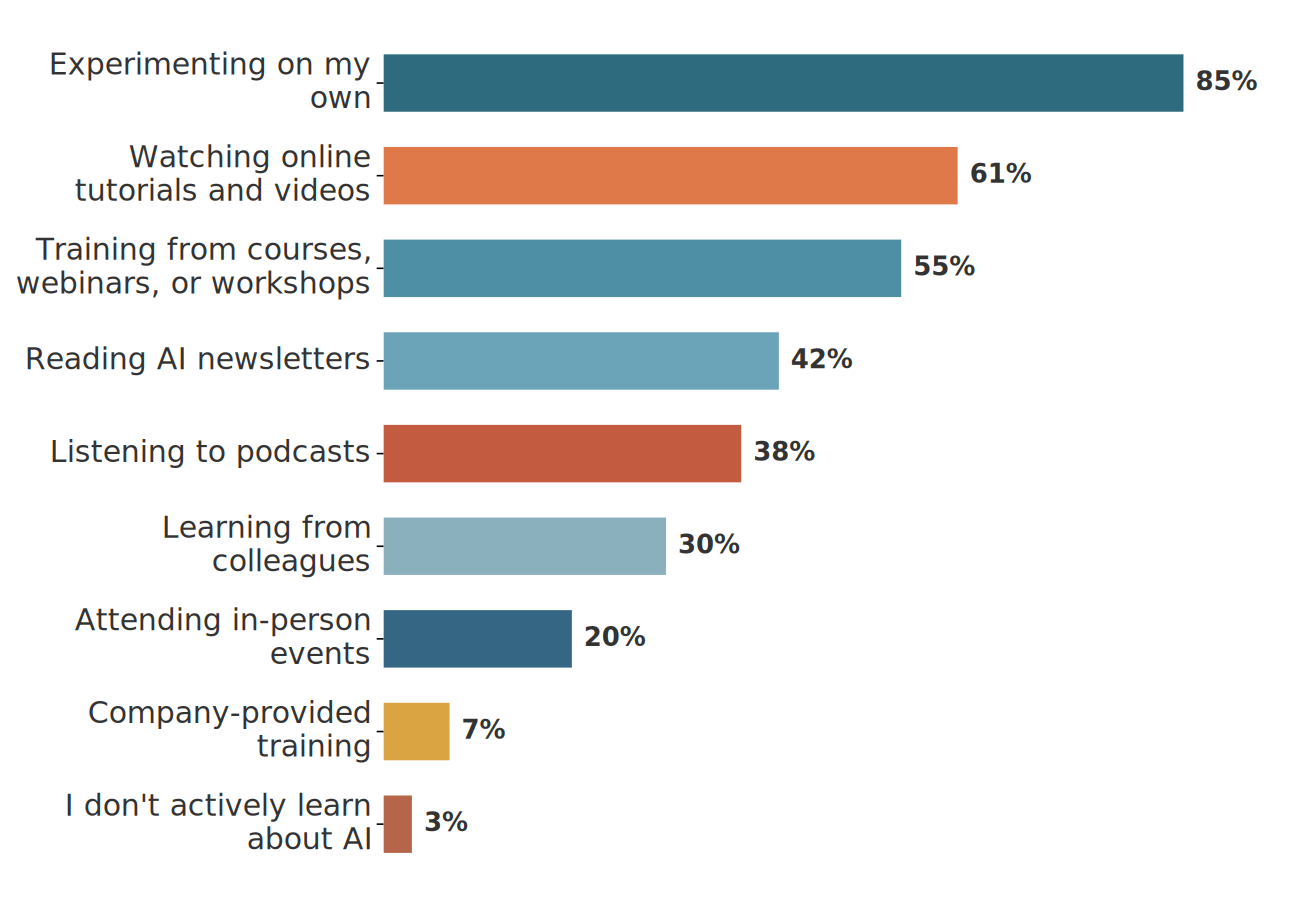
Self-Taught Execution: An astonishing 85% of marketers learn to use AI entirely through independent experimentation, rolling up their sleeves and testing capabilities firsthand.
The Training Gap: Only 7% of professionals receive formal, company-provided training.
Financial Investment: The era of exclusively free tiers is closing. 85% of marketers now pay for AI tools in some capacity, with 53% funding these subscriptions out of their own pockets to maintain a competitive edge.
When asked who drives AI adoption within their organizational structures, 55% of respondents answered simply: "Me." This decentralized, founder-led experimentation proves that small business owners do not need massive institutional backing to master advanced tools.
Finding #3: The Productivity Paradox and the Measurement Gap
Perhaps the most striking tension highlighted in the research centers on the disparity between perceived value and quantifiable metrics.
The Value Consensus:86% of marketers agree that AI saves them time, and an identical 86% report measurable boosts in day-to-day productivity.
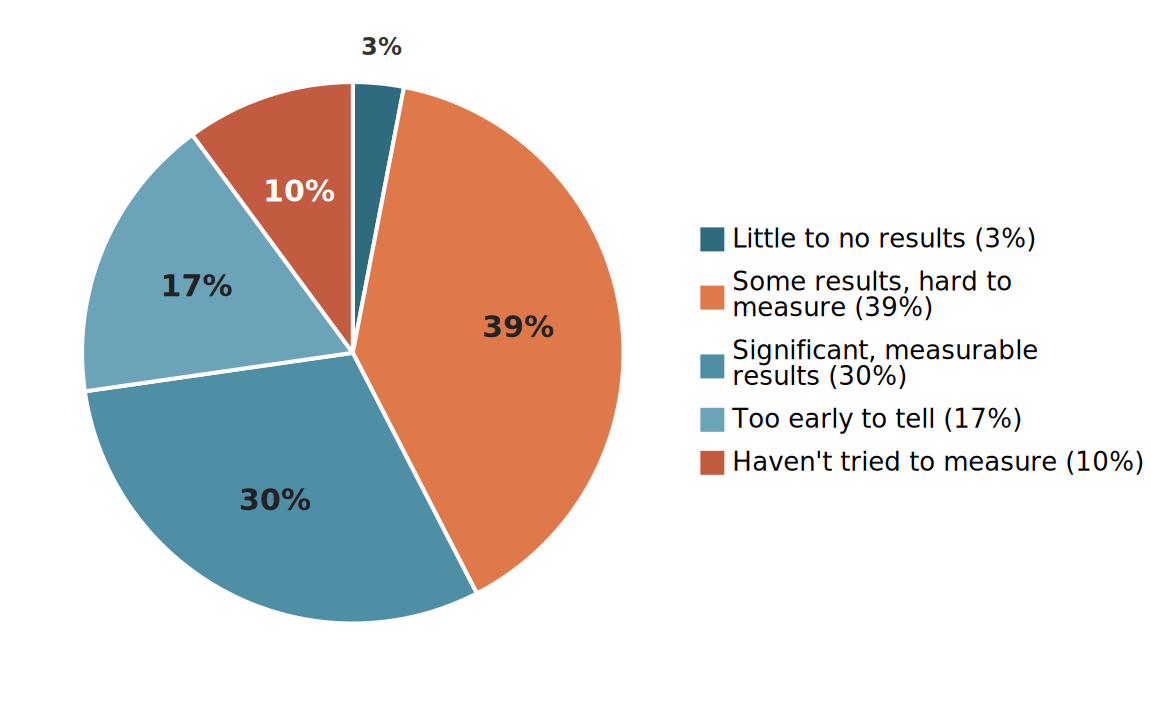
The Accountability Void: When asked to substantiate these gains with hard data, only 30% could point to significant, quantified results. An additional 39% acknowledge seeing positive impacts but admit they cannot formally measure them, while 10% have made no attempt to track outcomes at all.
This reveals a profound "measurement gap." While the qualitative relief of reduced administrative burdens is universally felt, the absence of systematic tracking creates a unique opportunity. Businesses that implement basic performance metrics—such as hours saved per week, output velocity, or cost per asset produced—will instantly outpace the 70% of competitors who operate purely on intuition.
Finding #4: The Video and Visual Content Frontier
While textual generation achieved near-universal saturation—with 95% of marketers using AI for written content—multimedia creation tells a starkly different story.
The Video Deficit: Only 37% of marketers currently utilize AI for video production.
The Demand Surge: A massive 74% of respondents state that video is the #1 content type they want to learn to create using artificial intelligence.
This creates a monumental 37-point gap between demand and adoption—the widest disparity measured in the study. Similarly, image creation has surged, nearly doubling from 39% to 67% since 2024. For small businesses willing to experiment with foundational AI video tools, the early-mover advantage remains wide open.
Finding #5: The Dawn of Autonomous AI Agents
Introduced as a formal survey category in 2026, AI agents represent the next technological leap. Unlike traditional prompt-response tools that require constant human micro-management, AI agents are designed to execute complex, multi-step workflows autonomously.
Current Usage: Only 11% of marketers use agents regularly, with 24% actively experimenting.
Future Intent:44% plan to adopt agents soon, bringing total current and prospective adoption to an impressive 79%.
Educational Priority: Utilizing AI agents ranks as the #1 topic marketers want to master, cited by 74% of participants.
For lean teams of fewer than ten people, autonomous agents represent the digital equivalent of hiring a support staff. The capability to delegate automated email sequences, continuous analytics monitoring, and routine customer inquiries without constant oversight provides a leverage multiplier previously unavailable to small enterprises.
Official Statements and Industry Insights
Michael Stelzner, founder of Social Media Examiner and architect of the comprehensive research initiative, emphasizes that the primary objective of the study is to strip away speculative media noise and deliver actionable intelligence for independent operators.
"We surveyed marketers to find out how they’re actually using AI. Not the hype. Not the headlines. The real story," Stelzner noted in the report’s framing. Noting that the vast majority of participants manage micro-businesses, he stressed that the findings reflect the authentic realities of constrained budgets and high ambitions. "I put this research together because I believe small business marketers deserve data they can act on. I hope it helps you make smarter decisions about AI in your business."
Industry analysts reviewing the 2026 data point out that the rapid shift from platforms like ChatGPT toward more advanced conversational and analytical models—such as Anthropic’s Claude—illustrates a maturing user base. Professionals are no longer satisfied with generic outputs; they are seeking nuanced, domain-specific intelligence that integrates seamlessly with specialized operational workflows.
Future Outlook: Navigating the Next Wave
As the business ecosystem digests the implications of the 2026 AI Marketing Industry Report, the path forward for small businesses is clear. The era of passive observation has officially closed.
The data indicates that future market leaders will not necessarily be those with the largest capital reserves, but rather those who master three core imperatives over the next twelve to twenty-four months:
Closing the Measurement Gap: Transitioning from subjective feelings of productivity to rigorous tracking of time-to-market, cost reduction, and output volume.
Conquering the Video Gap: Capitalizing on the underdeveloped market for AI-generated video and visual content before it reaches the saturation point currently experienced by text-based applications.
Preparing for Agentic Workflows: Moving beyond basic conversational prompting to implement autonomous AI agents capable of running background operational loops, freeing human capital for high-level strategy and relational growth.
For the independent business owner, the message of the 2026 data is ultimately empowering. You do not need a corporate training department, an enterprise budget, or a Silicon Valley pedigree to win. You need curiosity, a willingness to experiment independently, and a strategic focus on the tools—like video generation and autonomous agents—that your competitors are still hesitant to touch.