Executive Overview
Cloud architecture has long relied on strict administrative boundaries to maintain security, governance, and compliance. For organizations scaling across dozens—or even hundreds—of AWS accounts, keeping environments synchronized while preserving rigorous isolation has historically introduced friction, complexity, and operational overhead.
Addressing this core challenge, Amazon Web Services (AWS) has announced a significant evolution of its storage portfolio: the introduction of cross-account copy support for Amazon Elastic Block Store (Amazon EBS) Volume Clones. Building upon the foundational single-zone volume cloning capabilities launched last year, this new feature allows cloud engineers, database administrators, and DevOps teams to create instantaneous, point-in-time copies of EBS volumes directly across distinct AWS accounts.
By integrating natively with AWS Resource Access Manager (AWS RAM) and AWS Key Management Service (AWS KMS), the capability bridges the gap between secure production isolation and efficient staging workflows. Enterprises can now safely ingest live production data snapshots into segregated testing, development, and data-science environments, applying custom cryptographic keys in the target account without exposing underlying production infrastructure.
This deep-dive report examines the technical architecture, operational workflows, security implications, and strategic utility of cross-account EBS volume clones, detailing how organizations can harness this feature to modernize their multi-account development pipelines.
Detailed Chronology: The Evolution of EBS Storage Operations
To appreciate the significance of cross-account volume clones, one must trace the historical trajectory of data replication and backup management within Amazon EC2 and EBS.
The Traditional Snapshot Paradigm
For over a decade, copying data between AWS accounts required a multi-step orchestration of Amazon EBS snapshots. Administrators had to:
- Create a point-in-time EBS snapshot of the source volume.
- Modify the snapshot’s access permissions to explicitly grant sharing privileges to a designated target AWS account ID.
- Log into the target AWS account, locate the shared snapshot, and initiate a new EBS volume creation from that snapshot.
- Manually configure volume types, sizing, and encryption profiles in the target environment.
While robust, this snapshot-based workflow introduced noticeable latency, consumed additional storage management overhead, and required complex programmatic coordination via AWS Identity and Access Management (IAM) cross-account roles, particularly when dealing with customer-managed AWS KMS keys.
The Rise of Same-Account Volume Clones
Recognizing the demand for faster, storage-efficient mechanisms to duplicate stateful workloads, AWS introduced Amazon EBS Volume Clones. Utilizing native redirect-on-write storage mechanics, Volume Clones provided instant, point-in-time copies of EBS volumes within the same Availability Zone. Unlike standard snapshots—which require background initialization or restoration phases—Volume Clones were instantly available for attachment and I/O operations, drastically accelerating sandbox creation, database refreshes, and software patching verification.

The Cross-Account Milestone
While single-account clones solved local staging bottlenecks, enterprise architectures are almost universally multi-account, structured around AWS Organizations, Control Tower guardrails, and isolated security perimeters (e.g., separate environments for Production, Staging, Development, and Quality Assurance).
By extending Volume Clones to support cross-account operations, AWS has effectively bridged the gap between rapid, high-performance local cloning and multi-account administrative boundaries. Teams can now execute instantaneous clone operations across distinct account borders, marrying the speed of redirect-on-write technology with enterprise-grade multi-account governance.
Technical Architecture & Operational Workflows
Operating cross-account EBS volume clones requires an orchestrated interaction between Amazon EBS, AWS RAM, and AWS KMS. Understanding the mechanics of these underlying services ensures secure, compliant, and frictionless execution.
[ Production Account (Source) ]                    [ Target Account (Staging/Dev) ]
+-------------------------------+                  +-------------------------------+
|  Amazon EBS Volume            |                  |                               |
|         │                     |                  |                               |
|         ▼ (Share via)         |                  |                               |
|  AWS Resource Access Manager  | ────(RAM Share)─>|  Accepts Resource Share       |
|         │                     |                  |         │                     |
|         ▼                     |                  |         ▼                     |
|  Source KMS Key (Optional)    |                  |  Target KMS Key (Re-encrypt)  |
+-------------------------------+                  +-------------------------------+
                                                                  │
                                                                  ▼
                                                   [ Execute "Copy Volume" Action ]
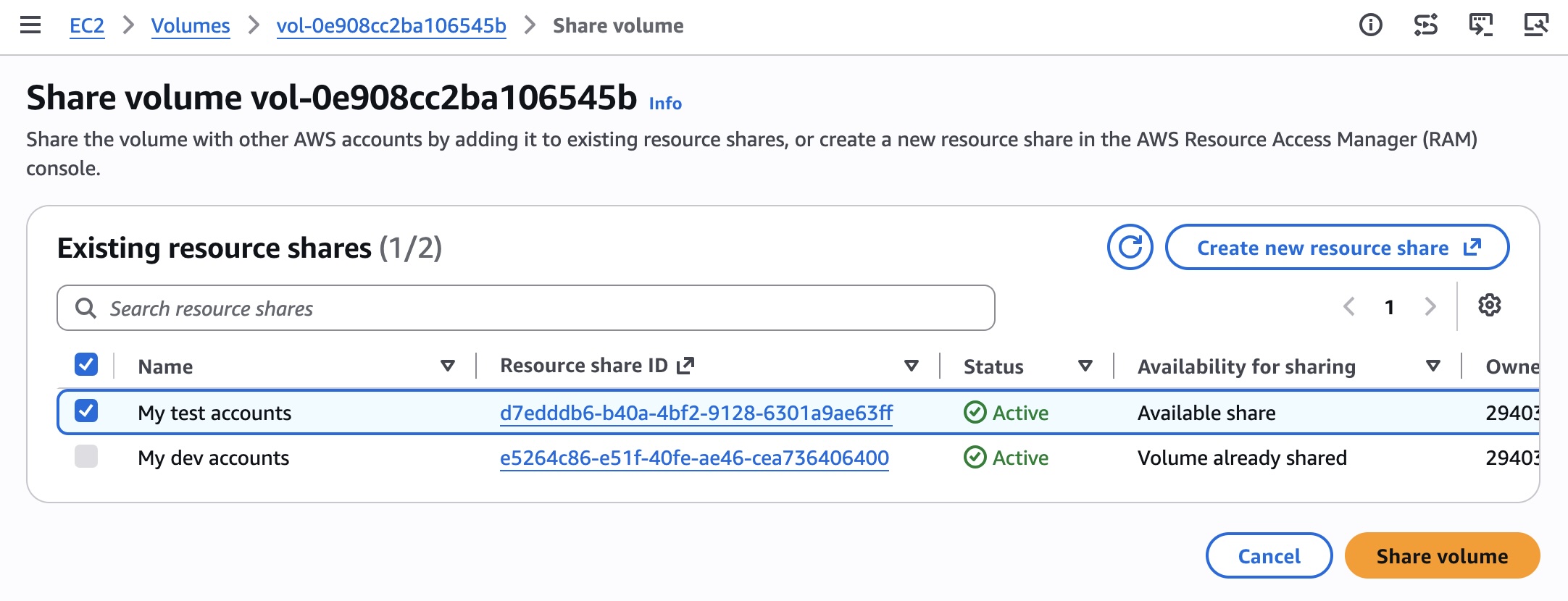
1. Initiating the Share via AWS Resource Access Manager (RAM)
The administrative journey begins in the source AWS account—typically the production environment housing the canonical data volume.
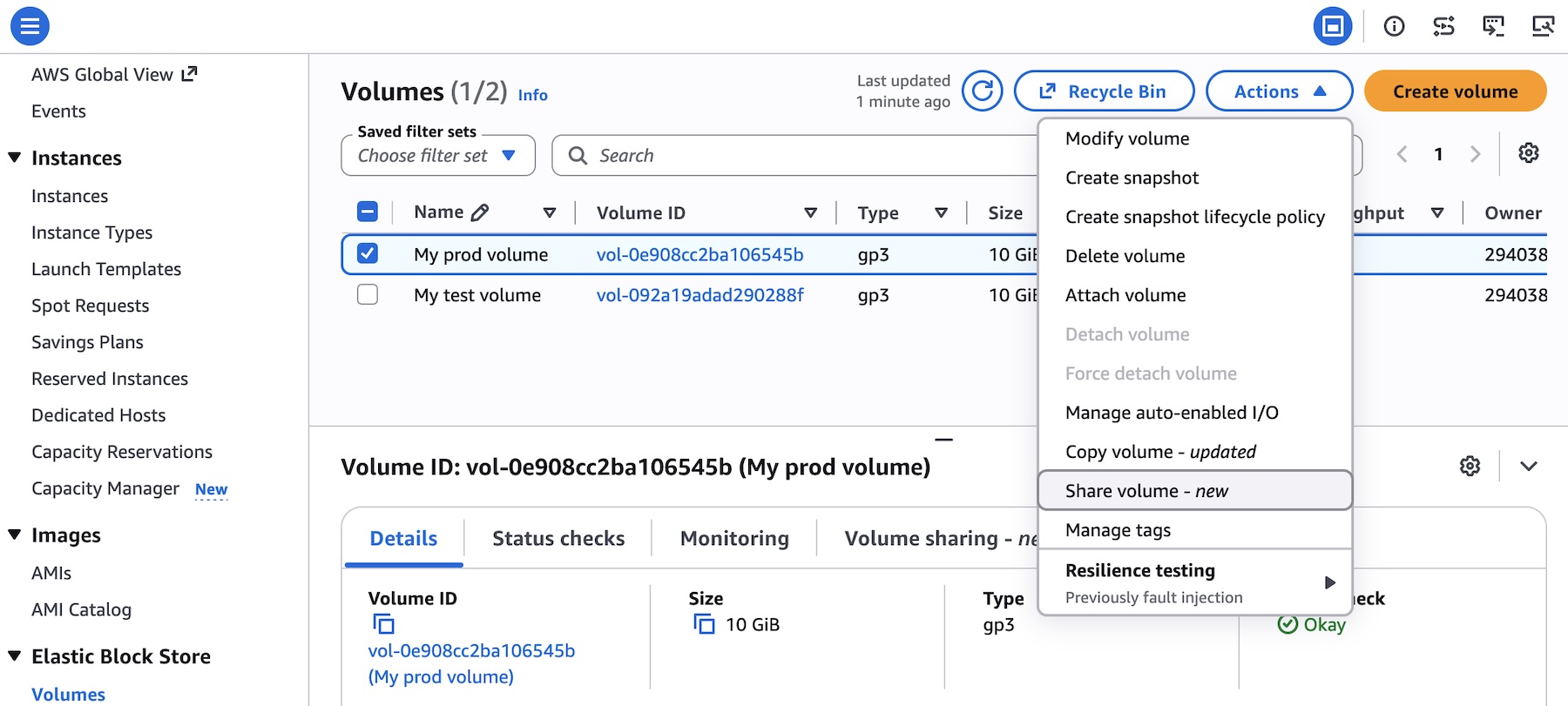
- Action: In the Amazon EBS console, the volume owner selects the target volume and chooses Share volume.
- Integration: AWS RAM abstracts the complexities of cross-account resource sharing. Administrators can add the volume to existing resource shares or instantiate a new resource share within the AWS RAM console. This ensures that sharing policies align seamlessly with broader AWS Organization structures, SCPs (Service Control Policies), and permission boundaries.
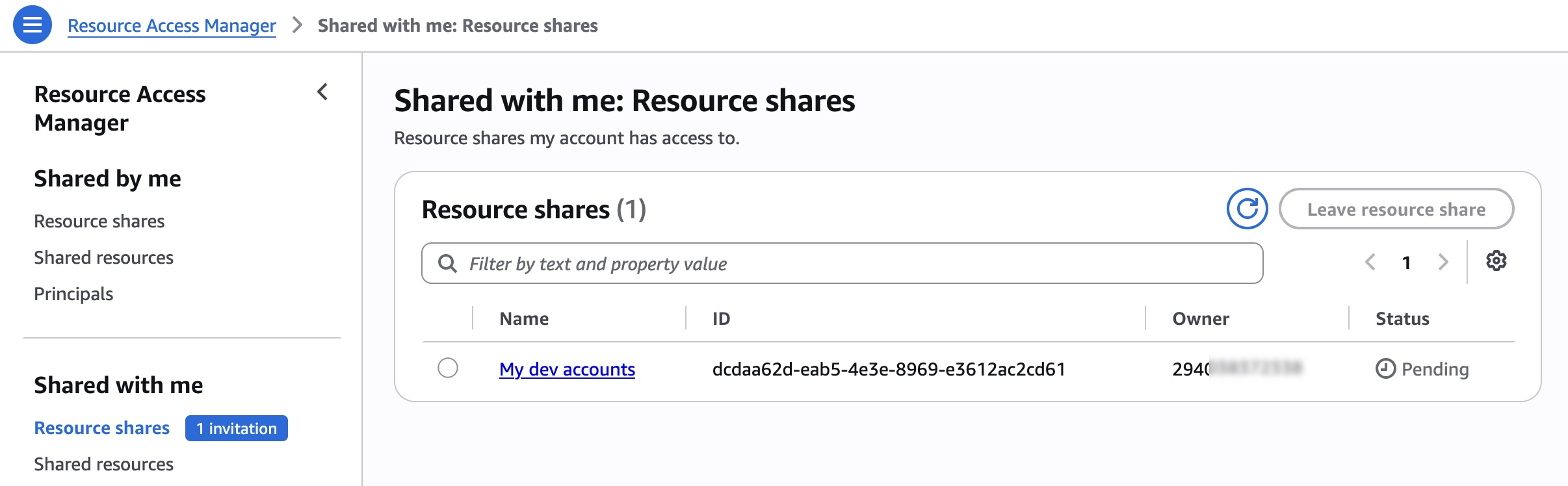
2. Accepting the Resource Share in the Target Account
Security governance dictates that resources cannot be forcefully pushed into an AWS account without explicit consent.
- Action: Administrators within the target account (e.g., a dedicated Dev/Test account) navigate to the AWS RAM console to review incoming resource invitations.
- Validation: Upon accepting the resource share, the shared EBS volume magically surfaces within the target account’s Amazon EBS console view, tagged and marked as a shared external asset.
3. Executing the Cross-Account Copy and Re-Encryption
Once visibility is established, the target account operator initiates the final phase of the workflow.
- Action: The user selects Copy volume directly from the shared volume interface in the target account.
- Security & KMS Handling: During this copy operation, the target account owner has the option to apply a custom AWS Key Management Service (AWS KMS) key native to the target account. This ensures cryptographic isolation—production encryption keys never traverse account boundaries, satisfying strict compliance frameworks (such as SOC 2, HIPAA, and PCI-DSS) that mandate strict separation of cryptographic domains between production and non-production systems.
Programmatic Integration & Modern Developer Tooling
For organizations embracing Infrastructure as Code (IaC) and AI-assisted engineering pipelines, manual console workflows are supplemented by comprehensive API and CLI support. AWS has integrated documentation and API guidance for cross-account volume sharing into modern developer toolkits, including the AWS MCP Server and associated plugins. Developers can prompt AI-assisted coding tools to generate scripts, CLI commands, or Terraform/CloudFormation snippets required to automate the sharing, acceptance, and copying lifecycle across enterprise landing zones.
Supporting Context, Metrics, and Business Value
The introduction of cross-account EBS volume clones is not merely a backend storage optimization; it addresses profound economic and operational bottlenecks inherent in modern enterprise software development.
Quantifying the Impact on Developer Velocity
In traditional software development life cycles (SDLC), keeping staging and testing databases synchronized with production data is notoriously tedious. When developers rely on outdated seed data, bugs related to data edge-cases, schema anomalies, and performance regressions often slip past staging and manifest in production.
By enabling instant cross-account clones:
- Time-to-Data Reduction: Data freshness latency drops from hours (waiting for snapshot creation, cross-account sharing, volume provisioning, and data initialization) to seconds.
- Infrastructure Cost Optimization: Because clones leverage space-efficient storage paradigms, organizations can spin up multiple isolated test environments without incurring linear storage cost penalties.
- Risk Mitigation: Developers can work against exact replicas of production anonymized datasets, improving bug reproduction rates without risking live data integrity.
Strengthening Security Posture
A common anti-pattern in cloud management involves loosening production environment permissions to allow downstream teams direct access to data snapshots. Cross-account volume cloning eliminates this security vulnerability:
- Principle of Least Privilege: Production teams retain absolute ownership of the source volume. They grant transient, auditable viewing rights via AWS RAM rather than handing over administrative snapshot credentials.
- Cryptographic Boundary Enforcement: Re-encryption at the target boundary ensures that even if a non-production account experiences a credential leak, the data remains locked behind separate, independently audited KMS keys.
Strategic Implications and Future Outlook
As cloud infrastructures grow increasingly distributed, the operational maturity of an enterprise is defined by how frictionlessly its data moves across organizational boundaries without sacrificing governance.

What This Means for Multi-Account Strategies
Organizations leveraging AWS Control Tower or customized multi-account landing zones often struggle with data gravity—the tendency for large datasets to remain trapped in single accounts due to the administrative drag of moving them securely. Cross-account EBS volume clones act as a lubricating mechanism for data gravity, empowering data mesh architectures, distributed microservices, and centralized analytics pipelines to draw fresh stateful data from operational systems safely and instantaneously.
Regional Availability
At launch, cross-account volume clones for Amazon EBS are available across all commercial AWS Regions that currently support standard Amazon EBS Volume Clones. Administrators seeking specific regional rollouts or evaluating roadmap milestones can consult the official AWS Capabilities by Region documentation portal.
Conclusion
The rollout of cross-account Amazon EBS volume clones represents a vital maturation of AWS’s block storage ecosystem. By harmonizing instantaneous cloning mechanics with enterprise-grade access management (AWS RAM) and robust cryptographic controls (AWS KMS), AWS has eliminated a persistent operational friction point for multi-account organizations.
For DevOps leaders, platform engineers, and security officers alike, this feature delivers the trifecta of modern cloud management: speed, security, and simplicity. By bridging the gap between production isolation and developer agility, cross-account EBS clones set a new benchmark for how stateful enterprise workloads should be managed, shared, and protected in the cloud era.
To explore the feature firsthand, access the Amazon EC2 Console or review the Amazon EBS User Guide. Feedback and technical inquiries can be directed to the AWS re:Post for Amazon EBS community.