Executive Overview
For the first three years of the generative artificial intelligence boom, the dominant narrative surrounding Nvidia was deceptively simple: the enterprise that controlled the supply of state-of-the-art Graphics Processing Units (GPUs) controlled the pipeline of modern computing. Between early 2023 and mid-2025, that near-monopolistic grip on AI acceleration expanded Nvidia’s market capitalization by tenfold. However, as cloud hyperscalers like Amazon, Google, and Microsoft accelerated the deployment of bespoke in-house silicon, market consensus began to shift. Investors routinely questioned the long-term durability of Nvidia’s core margins, framing compute power as an inevitable commodity and predicting a steady erosion of the company’s competitive moat.
That narrative underwent a fundamental shift following Nvidia’s recent quarterly earnings report. Wall Street and enterprise infrastructure analysts are coming to a significant realization: Nvidia’s primary structural advantage is no longer restricted to raw floating-point operations per second (FLOPS) on individual graphics cards. As artificial intelligence clusters expand from tens of thousands of chips to multi-gigawatt data center footprints, the primary bottleneck in machine learning has transitioned from sheer processing power to multi-node data orchestration.
+-----------------------------------------------------------------------------------+
|                        GIGAWATT-SCALE DATA CENTER MATRIX                          |
|                                                                                   |
|  +-----------------------------------------------------------------------------+  |
|  |                        VERA RUBIN RACK ARCHITECTURE                         |  |
|  |                                                                             |  |
|  |  +-------------------+   NVLink Network Fabric   +-----------------------+  |  |
|  |  |    Vera CPU       | <=======================> |       Rubin GPU       |  |  |
|  |  | (Orchestration &  |                           |  (Token Generation &  |  |  |
|  |  | Memory Routing)   |                           |    Matrix Compute)    |  |  |
|  |  +-------------------+                           +-----------------------+  |  |
|  |            |                                                 |              |  |
|  |            v                                                 v              |  |
|  |  +-------------------+                           +-----------------------+  |  |
|  |  | High-Speed Flash  |                           |  Groq 3 LPX Inference |  |  |
|  |  | Storage Fabrics   |                           |      Accelerators     |  |  |
|  |  +-------------------+                           +-----------------------+  |  |
|  +-----------------------------------------------------------------------------+  |
|                                                                                   |
|               Objective: Eliminate the Data Movement Bottleneck                   |
|                   Maximal Throughput (Tokens per Watt)                            |
+-----------------------------------------------------------------------------------+
By engineering the specialized CPUs, networking fabrics, storage architectures, and low-latency interconnects required to keep gigawatt-scale systems operating efficiently, Nvidia is building an end-to-end data center platform. While competitors attempt to build standalone chips capable of matching Nvidia’s GPUs on a unit-cost basis, Nvidia has shifted the competitive baseline toward total-system efficiency, orchestrating traffic across vast server clusters where data movement—rather than arithmetic logic—presents the primary engineering hurdle.
Detailed Chronology
Phase I: The Scarcity Era and Monopoly Multiples (2023–Mid-2025)
The initial phase of the AI infrastructure expansion was defined by an unprecedented hardware land grab. Large language model (LLM) developers and cloud service providers bought up Nvidia’s Hopper and Blackwell architecture GPUs at almost any price point.
During this era:
- Enterprise buyers experienced compute deficits, treating GPUs as rare assets.
- Nvidia recorded historic revenue growth, expanding its valuation by 10x as software developers scaled up model parameter counts.
- The dominant industry concern centered entirely on supply chain constraints, foundry yields, and memory packaging allocations (such as High Bandwidth Memory, or HBM).
Phase II: The Hyperscaler Counteroffensive and Market Plateau (Mid-2025–Early 2026)
As capital expenditures at major cloud providers reached historic peaks, hyper-scalers sought to reduce their dependence on Nvidia’s high-margin hardware.
Key developments during this consolidation phase included:
- In-House Silicon Maturity: Google expanded TPU deployments, Amazon expanded its Trainium and Inferentia footprints, and Microsoft broadened deployments of custom accelerators.
- Wall Street Skepticism: Analysts modeled a margin contraction for Nvidia, arguing that internal cloud chips would cap the market price of standalone GPUs.
- Commoditization Initiatives: Emerging financial markets even attempted to index compute as a liquid, tradable commodity, assuming raw matrix multiplication cycles were interchangeable across hardware platforms.
- Plateauing Share Price: Nvidia stock traded within a broader horizontal range for nearly a year as investors debated the long-term defense of the company’s enterprise moat.
Phase III: The Orchestration Pivotal Point (Present)
Nvidia’s latest earnings reporting cycle signaled the arrival of a third phase in the AI infrastructure buildout. Financial results and technical disclosures highlighted that enterprise buyers are no longer purchasing isolated accelerators; they are procuring integrated, rack-scale computing fabrics.
+-----------------------------------------------------------------------------------+
|                        EVOLUTION OF THE AI PARADIGM                               |
|                                                                                   |
|  Phase I (2023-2025)       Phase II (Mid-2025-2026)      Phase III (Present)   |
|  -------------------       ------------------------      -------------------   |
|  • Raw GPU Scarcity        • Hyperscaler Custom ASICs    • Gigawatt-Scale      |
|  • Exponential Valuation   • Wall Street Skepticism        Orchestration       |
|  • Hardware Land Grab      • Compute as Commodity        • System-Level Moat   |
+-----------------------------------------------------------------------------------+
The roll-out of the Vera Rubin architecture demonstrated that Nvidia’s value proposition has moved up the stack. With compute demands straining municipal power grids and testing the physical limitations of server racks, the primary challenge has evolved from raw token generation to complex traffic management, dynamic memory routing, and interconnect bandwidth.
Supporting Context & Metrics
The Physics of Megascale Compute: The Memory Wall and Power Limits
Operating an AI cluster at gigawatt scales introduces severe physical and thermal challenges. While public attention focuses on peak theoretical FLOPS, real-world data center efficiency is constrained by data transfer latency and the energy cost of moving bits between disparate chips.
+-----------------------------------------------------------------------------------+
|                           THE MEMORY WALL BOTTLENECK                              |
|                                                                                   |
|    +--------------------+       High Energy & Latency       +-----------------+   |
|    |    System Memory   | ================================> |    Rubin GPU    |   |
|    |   (Off-Chip DDR)   |    (Data Movement Bottleneck)     | (Execution Core)|   |
|    +--------------------+                                   +-----------------+   |
|              ^                                                       ^            |
|              |               Optimized Data Traffic                  |            |
|              +------------------ [ Vera CPU ] -----------------------+            |
|                                (Traffic Controller)                               |
+-----------------------------------------------------------------------------------+- Data Movement Penalties: Fetching data from off-chip memory or adjacent server nodes can consume orders of magnitude more energy than conducting a matrix multiplication operation on an active core.
- The "Tokens-per-Watt" Metric: As data centers hit local grid power ceilings, cloud operators no longer evaluate hardware solely on capital expenditure per device, but on tokens per watt delivered at scale. Unutilized GPU cycles caused by memory bottlenecks represent direct operational loss.
- Memory Market Spillover: High-performance memory manufacturers, such as Micron, experienced massive valuation tailwinds during this infrastructure buildout. High Bandwidth Memory (HBM) remains essential, but physical limits on how much memory can fit on a single chip substrate force systems to rely on external, cross-rack orchestrators.
Dissecting the Vera Rubin Architecture
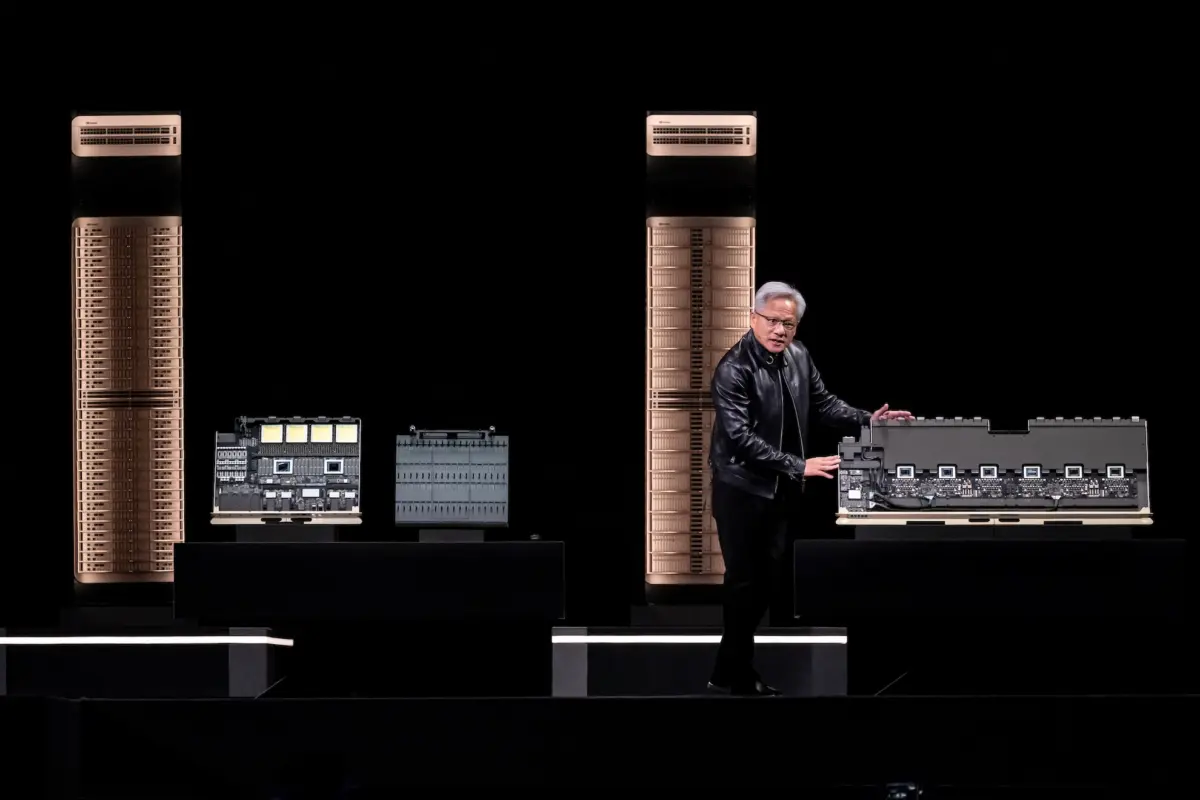
Nvidia’s Vera Rubin architecture illustrates this full-system strategy. Rather than offering a standalone accelerator chip, the architecture operates as a multi-tier, fully integrated computing platform:
| Component | Primary Architectural Function | Infrastructure Objective |
|---|---|---|
| Rubin GPU | Core token generation and heavy matrix operations. | Maximizes compute density per square millimeter of silicon. |
| Vera CPU | High-throughput data orchestration and memory management. | Routes data pipelines to keep processing cores fed without delay. |
| Groq 3 LPX | Specialized low-power inference acceleration unit. | Offloads predictable execution paths to minimize energy overhead. |
| NVLink / Network Racks | Direct fabric linking nodes across the data center floor. | Reduces inter-node communication latency at the rack level. |
By coupling the Rubin GPU with the custom Vera CPU, Groq 3 LPX inference accelerators, and specialized storage fabrics, Nvidia ensures that data flows continuously through execution pipelines without encountering traditional Von Neumann bottlenecks.
                 +---------------------------------------+
                 |       Vera Rubin Architecture         |
                 +---------------------------------------+
                                     |
         +-------------------+-------+-------+-------------------+
         |                   |               |                   |
         v                   v               v                   v
 +---------------+   +---------------+   +---------------+   +---------------+
 |   Rubin GPU   |   |   Vera CPU    |   |  Groq 3 LPX   |   | NVLink Rack   |
 | (Heavy Matrix |   | (Data Memory  |   |  (Inference   |   |   Fabric      |
 |  Operations)  |   | Management)   |   | Acceleration) |   | (Interconnect)|
 +---------------+   +---------------+   +---------------+   +---------------+
Strategic Alternatives: The Integrated Chip Approach
The structural friction of moving data across large networks has prompted alternative design methodologies across the tech industry. OpenAI’s custom silicon initiative, code-named Jalapeño, presents a distinct approach to the data movement problem.
Rather than deploying complex, multi-rack traffic controllers across a dispersed node network, the Jalapeño design aims to consolidate larger domain workloads directly within an expanded, unified chip infrastructure. By keeping an entire operational context within a single, highly connected system, this model seeks to bypass traditional network routing layers altogether.
These contrasting methodologies highlight a key industry reality: modern hardware engineering is no longer defined by raw processor cycles alone, but by strategic trade-offs in data traffic management.
+-----------------------------------------------------------------------------------+
|                     DATA MANAGEMENT STRATEGY COMPARISON                           |
|                                                                                   |
|   NVIDIA APPROACH (Vera Rubin):                                                   |
|   Distributed System Fabric -> Rack-Scale Orchestration -> Dynamic Data Routing   |
|                                                                                   |
|   OPENAI APPROACH (Jalapeño):                                                     |
|   Ultra-Large Monolithic System -> Extended Context On-Chip -> Zero External Move |
+-----------------------------------------------------------------------------------+
Official Statements
The core challenge facing enterprise data centers was detailed during conversations with Nvidia leadership following their latest architectural updates.
Jason Hardy, Vice President of Storage Technology at Nvidia, emphasized that physical memory limitations dictate modern system architecture:
"Vera is important because there’s only so much memory that you can put in a single server or any sort of compute platform."
Addressing the challenges of system utilization and data flow bottlenecks, Hardy outlined the operational gains achieved by assigning CPU hardware specifically to orchestration duties:
"We saw upwards of 3x improvement in these operations, where the Vera CPU is allowing for acceleration. So now we can use our flash to its fullest potential, because we can get all that performance out of it without bottlenecking."
This shift toward minimizing systemic data movement is matched by custom-silicon initiatives elsewhere in the AI ecosystem. Disclosing initial performance results for its custom "Jalapeño" silicon, OpenAI emphasized identical efficiency goals in an official technical post:
"We designed Jalapeño to minimize data movement and communication delays. Its large domain allows the entire workload to remain within one connected system, minimizing data movement and helping the complete request stay fast and efficient from beginning to end."
Future Outlook
The New Battleground: System Architecture vs. Component Pricing
As AI models scale toward multi-trillion parameter bases, the competitive baseline for semiconductor manufacturers will continue to shift away from individual component costs toward rack-level performance efficiency.
+-----------------------------------------------------------------------------------+
|                        THE NEW COMPETITION FRAMEWORK                              |
|                                                                                   |
|   OLD METRIC:  [ Unit Cost per GPU ]    ---> Commodity Competition                |
|                                                                                   |
|   NEW METRIC:  [ Total System Efficiency ] -> Orchestrated Enterprise Advantage   |
|                (Tokens / Watt / Dollar)                                           |
+-----------------------------------------------------------------------------------+- System Integration Over Standalone ASICs: Hyperscalers building proprietary chips may succeed in replacing basic GPU functions for specific workloads. However, replicating Nvidia’s integrated fabric—spanning CPUs, GPUs, optical interconnects, and dynamic software routing—presents a much broader engineering challenge.
- The Imperative of Power Efficiency: Grid capacity restrictions will force cloud providers to prioritize architectures that deliver maximum token output per megawatt consumed. Devices that experience latency spikes due to suboptimal storage or CPU links will become increasingly uneconomical to operate.
- Erosion of the "Compute as a Commodity" Thesis: Financial products attempting to tokenize compute cycles face structural challenges. Standardizing a unit of compute assumes hardware execution is uniform; in practice, a workload running on an orchestrated system with optimized memory delivery will vastly outperform the same theoretical TFLOPS running on fragmented hardware.
Key Risks and Challenges
Despite its dominant market posture, Nvidia faces several long-term structural risks:
- Hyperscaler System Expansion: Cloud platforms like Alphabet and Amazon are expanding their internal chip designs into custom rack-scale architectures, aiming to solve orchestration challenges within their proprietary data centers.
- Manufacturing and Packaging Chains: Assembling complex architectures like Vera Rubin requires advanced multi-chip packaging technology. Supply disruptions at major foundry partners present an ongoing operational risk.
- Capital Expenditure Thresholds: Should cloud providers slow their capital investments before AI software applications reach full commercial maturity, overall demand for massive data center infrastructure builds could experience cyclical compression.
Strategic Conclusion
Nvidia’s long-term competitive moat appears far more resilient than simplified GPU-focused analysis suggests. By extending its architectural reach across the entire data center infrastructure—addressing system bottlenecks from storage routing to rack-level interconnects—Nvidia has repositioned itself from a component vendor into an indispensable system architect for gigawatt-scale computing.