In the contemporary cinematic landscape, science fiction dominates the global box office, commanding tens of billions of dollars and shaping the cultural zeitgeist. An examination of the top ten highest-grossing films in history reveals that an overwhelming majority—eight out of ten—belong to the speculative fiction genre. From the sprawling expanse of the Marvel Cinematic Universe to cross-cultural phenomena like China’s animated fantasy Ne Zha 2, audiences continually demonstrate an insatiable appetite for futuristic spectacles and world-building. At the apex of this commercial pyramid sits visionary filmmaker James Cameron.
Cameron holds an unprecedented position in Hollywood history, having directed two of the top three highest-grossing films of all time: 2009’s revolutionary Avatar and its 2022 follow-up, Avatar: The Way of Water. These technological behemoths rewrote the financial rules of the industry, pushing digital capture and stereoscopic 3D to their absolute limits. Yet, despite the staggering financial triumphs and global cultural footprints of the Avatar franchise, a critical consensus among cinephiles, industry veterans, and technical historians points to a different conclusion: James Cameron’s absolute creative zenith occurred decades earlier.
That distinction belongs to Terminator 2: Judgment Day (1991). Released during a transitional era between practical filmmaking and the digital revolution, the film fundamentally redefined what a blockbuster could achieve both in front of and behind the camera. While it expanded exponentially upon the gritty, low-budget foundations of its 1984 predecessor, it deftly avoided the sophomore slump that plagues most high-profile sequels. More than three decades after its theatrical debut, Terminator 2 stands not merely as an exemplary action movie, but as a near-perfect synthesis of narrative depth, character transformation, emotional resonance, and pioneering special effects that even Cameron’s subsequent billion-dollar epics have failed to surpass.
Detailed Chronology: The Genesis and Execution of a Sci-Fi Masterpiece
From Indie Horror to Industrial Blockbuster
To understand the monumental achievement of Terminator 2, one must examine the precarious conditions under which the original The Terminator was produced in 1984. Operating on a modest budget with Orion Pictures, Cameron crafted a lean, mean, tech-noir thriller about a cybernetic assassin sent back in time to murder Sarah Connor. The film was a surprise commercial hit, establishing Cameron as a director with an uncompromising vision and a meticulous eye for pacing and tension. However, the rights to the franchise were tangled for years, and it was not until Carolco Pictures secured financing in the late 1980s that Cameron was given the green light—and unprecedented financial backing—to realize a sequel on a scale previously unseen in Hollywood.
Production on Terminator 2: Judgment Day was a massive logistical undertaking that stretched the limits of 1990s studio filmmaking. Principal photography commenced in the spring of 1990 and ran through the autumn, utilizing locations across Los Angeles, the Mojave Desert, and industrial sites throughout California. Cameron and his director of photography, Adam Greenberg, engineered visual strategies that merged the gritty, atmospheric shadows of the original film with a grander, widescreen canvas that mirrored the scope of classical epic cinema.
The Narrative Architecture
The script, co-written by Cameron and William Wisher Jr., introduced a brilliant narrative inversion that elevated the source material. In the 1984 original, Arnold Schwarzenegger’s T-800 was an unstoppable, relentless engine of death. In Terminator 2, he returns as a reprogrammed protector, tasked by the future resistance led by a mature John Connor to save his younger self.
The plot unfolds against the ticking clock of August 29, 1997—the designated date of "Judgment Day," when the military defense network Skynet becomes self-aware and launches a nuclear holocaust against humanity. The emotional anchor of the narrative is the frantic race to not only survive the relentless pursuit of the T-1000—an advanced liquid-metal assassin sent back by Skynet—but to actively rewrite history and avert global annihilation. This shift transformed the franchise from a straightforward survival horror into a complex meditation on fate, free will, human nature, and the ethics of artificial intelligence.
Supporting Context & Metrics: Technical Innovation and Box Office Dominance
Shattering Financial and Technical Ceilings
When TriStar Pictures released Terminator 2: Judgment Day on July 3, 1991, it arrived with the highest production budget in cinematic history up to that point, estimated between $94 million and $102 million. This immense financial gamble paid off spectacularly. The film dominated the global box office, grossing over $520 million worldwide during its initial theatrical run (a figure that climbs significantly higher when accounting for subsequent re-releases and home video syndication). It became the highest-grossing film of 1991, outperforming major studio competitors and cementing R-rated action cinema as a dominant commercial force.
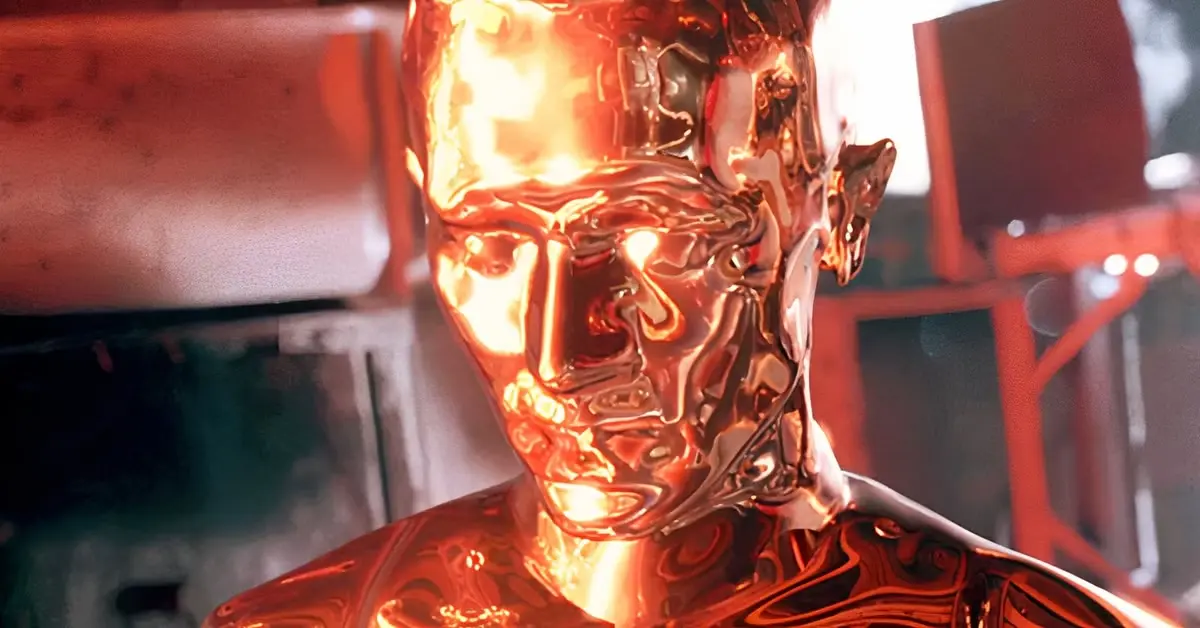
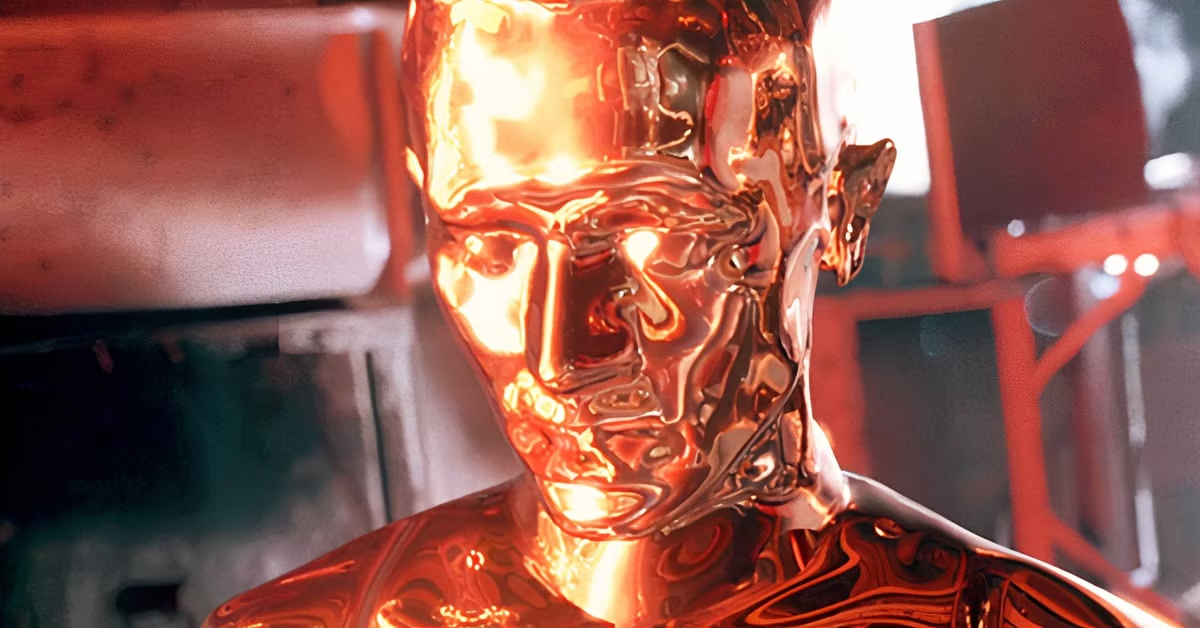
Beyond its box office receipts, Terminator 2 occupies a sacred space in film history due to its revolutionary integration of computer-generated imagery (CGI). While films like The Abyss (1989) served as digital testbeds for Cameron, T2 represented the commercial and artistic breakthrough for photorealistic CGI, primarily through the creation of the T-1000, played with icy perfection by Robert Patrick.
Collaborating with Industrial Light & Magic (ILM) and Stan Winston Studio, Cameron achieved a seamless blend of practical animatronics, prosthetic makeup, and cutting-edge digital morphing. The T-1000’s liquid-metal capabilities—its ability to flow through iron bars, reform from shattered fragments, and shape its limbs into lethal bladed instruments—stunned audiences in 1991.
Crucially, Cameron avoided the trap of relying solely on digital spectacle. The computer-generated effects were anchored by tangible, physical stunts supervised by master coordinators like Joel Kramer. From the high-octane canal chase featuring a semi-truck and a dirt bike to the climactic industrial showdown inside a steel mill, the action sequences relied heavily on practical pyrotechnics, heavy metal, real weight, and genuine physical peril. This hybrid approach has allowed the film’s visual fidelity to endure remarkably well, looking more tactile and grounded than many fully digital blockbusters produced decades later.
Official Statements and Critical Retrospectives
The enduring legacy of Terminator 2 is reflected not only in its commercial and technical milestones, but in the critical reassessments offered by filmmakers, actors, and cultural historians over the past three decades.
James Cameron himself has frequently discussed the grueling physical and psychological demands of bringing T2 to the screen, noting that the technological hurdles pushed his production crew to the absolute brink of exhaustion. Reflecting on the evolution of visual effects, Cameron noted in retrospective interviews that the gamble on ILM’s digital pipeline changed the trajectory of the entire industry:
"We were crossing a bridge into an entirely unknown digital frontier. There was no manual for how to make a liquid-metal man look like he possessed physical mass and reflectivity in a live-action environment. If the tech failed, the entire movie collapsed under its own weight. But the marriage of Stan Winston’s practical wizardry with ILM’s digital pixels created something that had never been seen before on a movie screen."
Cast members have similarly highlighted the intense physical discipline required for the production. Linda Hamilton, whose physical and emotional transformation into the hardened, militarized survivor Sarah Connor remains one of the greatest character arcs in action cinema history, underwent months of rigorous firearms training, weightlifting, and psychological preparation. Hamilton remarked on the deliberate subversion of traditional gender roles in 1990s action cinema:
"Sarah Connor wasn’t written as a damsel in distress who needed saving; she was driven by a primal, apocalyptic trauma that forced her to become a warrior. Playing her required an absolute stripping away of vanity. We wanted her to look like a woman forged in the fires of an impending nuclear nightmare—focused, unyielding, and terrifyingly competent."
Robert Patrick, whose chillingly subdued, expressionless performance as the T-1000 created an iconic cinematic antagonist, spoke on the psychological challenge of portraying a machine that felt entirely alien compared to Arnold Schwarzenegger’s heavy-metal brute:
"Arnold was a freight train—loud, powerful, and imposing. I knew the T-1000 had to be the exact opposite: a silent, efficient predator. I modeled my movement on Olympic sprinters and martial artists, keeping my eyes wide open without blinking, never breathing heavily, so the audience would feel the absolute inevitability of an apex hunter that felt no pain, fatigue, or emotion."
Future Outlook: The Unmatched Standard of Modern Blockbusters
As Hollywood continues to grapple with franchise fatigue, endless reboots, and an over-reliance on weightless, algorithm-driven CGI, the blueprint left behind by Terminator 2: Judgment Day grows increasingly valuable. While subsequent entries in the Terminator franchise attempted to recapture the magic of Cameron’s 1991 masterpiece—ranging from Terminator 3: Rise of the Machines to more recent installments like Terminator: Dark Fate—none have managed to replicate the precise alchemy of high-stakes action, philosophical weight, and character-driven storytelling that defined the original duo of films.
James Cameron’s career trajectory following T2 has unquestionably broken financial records. The Avatar franchise continues to push the boundaries of stereoscopic technology, high frame rates, and performance-capture digital worlds, captivating billions of moviegoers across the globe. Yet, narrative purists and action auteurs continue to point back to the sweltering asphalt of Los Angeles in 1991 as the pinnacle of Cameron’s directorial craft.
Terminator 2: Judgment Day proves that scale and spectacle do not need to come at the expense of narrative intimacy. By pairing the cold, calculating menace of a cybernetic apocalypse with the tender, fragile bond forming between a traumatized mother, a rebellious child, and a reprogrammed machine, Cameron achieved a rare cinematic feat. It is a film where every explosion carries emotional weight, every digital innovation serves a storytelling purpose, and every thematic beat resonates with urgency. Decades after its release, Terminator 2 remains not just a high-water mark for science fiction cinema, but the definitive masterpiece of James Cameron’s illustrious career.