Executive Overview
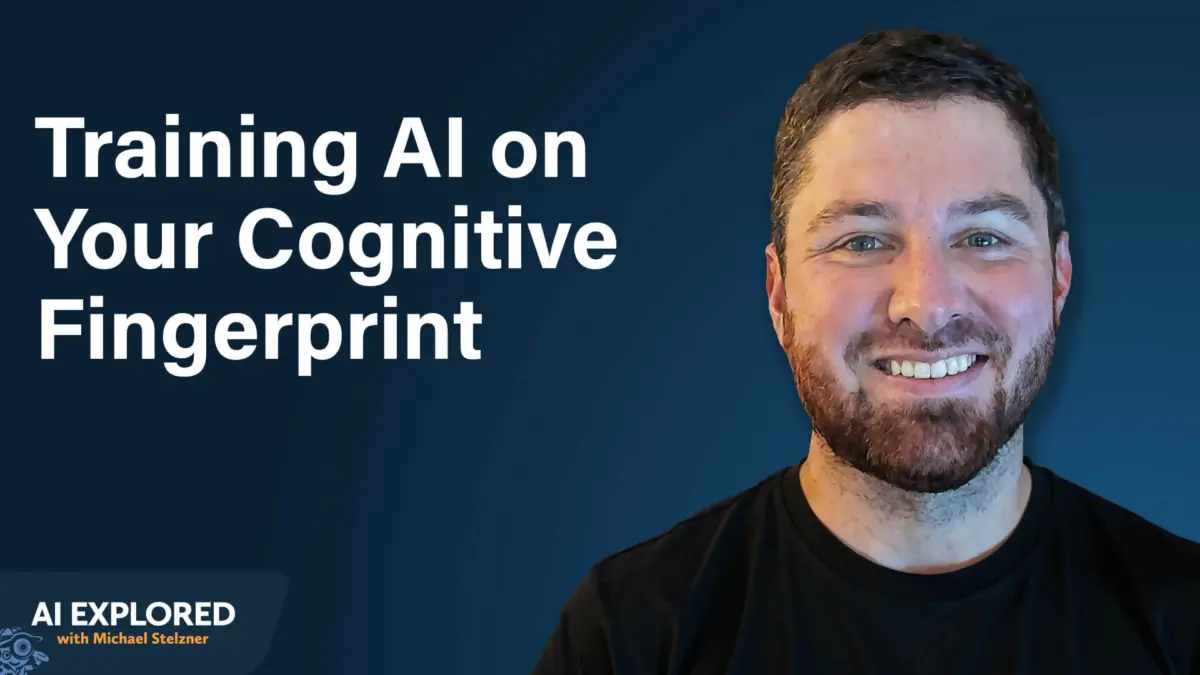
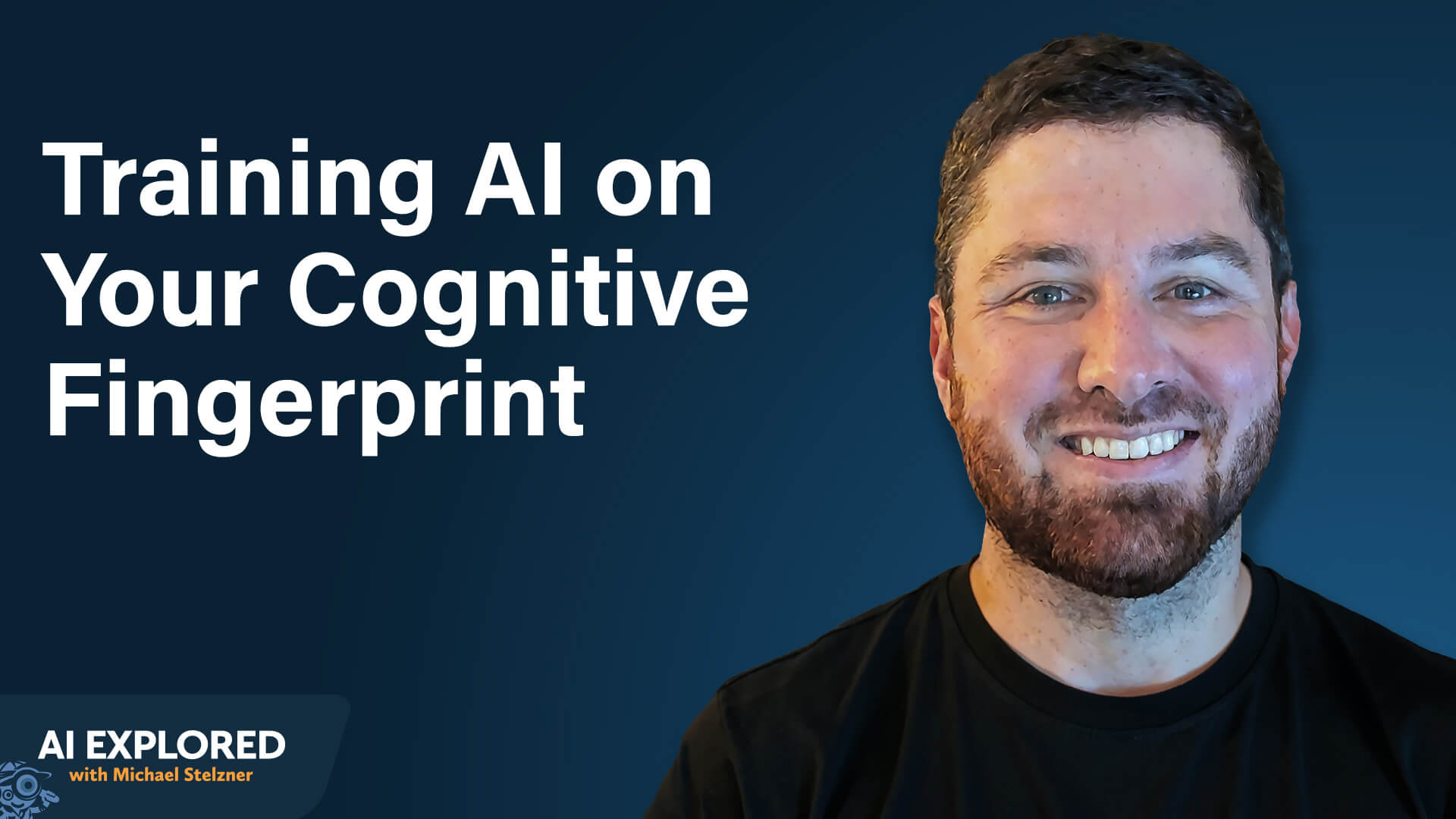
As generative artificial intelligence systems flood the modern professional landscape, knowledge workers face an existential anxiety. The prevailing narrative suggests that Large Language Models (LLMs) will inevitably commoditize professional expertise, rendering human insight interchangeable and devalued. Yet, according to AI strategist Max Bernstein—speaking on a recent episode of the AI Explored podcast co-created with Michael Stelzner—the solution to this impending homogenization is not to work harder at writing generic prompts, but rather to teach AI how you actually think.
Most individuals attempting to personalize AI rely on surface-level interventions: answering questionnaires about their communication style, defining their preferred tone, or attempting to manually describe their professional approach. Bernstein argues that this method suffers from a fundamental limitation. It only captures what a human can consciously articulate in a structured interview setting, which represents a mere fraction of true professional expertise.
To bridge this gap, Bernstein developed the "Cognitive Fingerprint" framework. Rooted in decades-old cognitive science—specifically philosopher Michael Polanyi’s principle of tacit knowledge—this methodology utilizes everyday meeting transcripts, client coaching sessions, and unscripted problem-solving audio to build a rich, portable AI context document. By extracting four distinct layers of knowledge (declarative, procedural, conditional, and metacognitive), professionals can create a customized AI profile that authentically replicates their decision logic, mental models, and unique reasoning patterns.
Detailed Chronology: The Evolution of Personalizing Artificial Intelligence
Phase 1: The Limitations of Traditional AI Prompting
For the past several years, the standard playbook for customizing AI outputs has involved static onboarding parameters: setting custom instructions, establishing a preferred persona, or feeding the model bullet points about one’s industry and background.
While these adjustments can slightly skew the vocabulary of a model, they fail to capture the nuances of deep professional judgment. When users attempt to manually list their rules of thumb or strategic frameworks, they invariably suffer from the curse of knowledge. They omit the foundational assumptions they take for granted, and they gloss over the automatic micro-decisions that occur when navigating complex client scenarios. Consequently, the resulting AI output sounds like an articulate, albeit generic, corporate consultant rather than a specific expert.
Phase 2: Unearthing Tacit Knowledge via Cognitive Science
Recognizing this bottleneck, Bernstein looked outside the computer science domain to cognitive psychology and philosophy. In the mid-20th century, Michael Polanyi famously posited that human beings "know more than they can say." This concept—known as tacit knowledge—describes expertise that operates largely below conscious awareness.
Tacit knowledge does not surface when an expert sits down in a quiet room to fill out a questionnaire. Instead, it reveals itself dynamically: when coaching a struggling client, reading a shifting room in a high-stakes sales pitch, or thinking out loud while untangling a knotty operational challenge.
Bernstein’s framework shifts the data collection paradigm. Instead of asking AI to interview the user, the methodology uses unscripted recordings of the user actually working. The AI is then deployed as an analytical engine to mine these conversational artifacts, turning unstructured dialogue into explicit architectural logic.
Phase 3: The Four-Layer Knowledge Extraction Framework
To systematically convert raw conversation into a coherent digital profile, Bernstein established a four-tier framework that categorizes thinking styles by depth:
- Declarative Knowledge (The Surface Layer): This represents what an individual states they do when asked for a job description or an elevator pitch. It is the information found on a standard LinkedIn bio or introductory resume. Most amateur AI personalization efforts begin and end here.
- Procedural Knowledge (The Execution Layer): This tier maps out the step-by-step sequences and standard operating procedures (SOPs) an expert follows to achieve a specific outcome. While declarative knowledge names the goal, procedural knowledge documents the method.
- Conditional Knowledge (Decision DNA): This is where personalization becomes granular. Conditional knowledge represents the "if-then" logic governing professional behavior—the precise triggers, client characteristics, or project variables that dictate when and why a specific tactical pivot should occur.
- Metacognitive Knowledge (Mental Models): The deepest and most valuable layer, metacognitive knowledge dictates how a person thinks about thinking. Interestingly, when experts attempt to self-diagnose their own mental models, their self-assessments frequently clash with reality. Transcripts, however, do not lie; they expose the true cognitive frameworks governing real-world behavior.
Phase 4: Harvesting and Curating Transcript Data
Building a reliable cognitive fingerprint requires raw materials that bypass the filters of presentation and performance. Highly scripted formats—such as webinars, pre-recorded keynotes, or polished marketing videos—fail to yield strong results because they capture packaged knowledge rather than live reasoning.
Instead, the framework relies on high-yield, unscripted environments:

- Client Calls and Coaching Sessions: Characterized by back-and-forth friction, these interactions naturally force tacit expertise to the surface.
- Sales and Strategy Discussions: These conversations reveal how an expert reads dynamic situations, handles objections, and tailors arguments in real-time.
- Brainstorming and Team Meetings: These sessions capture the generative phase of ideation, highlighting how ideas are proposed, tested, and discarded.
- Solo Voice Memos: Quick recordings captured while driving, walking, or processing operational bottlenecks between tasks.
Phase 5: Technological Enablement and Multi-Tool Integration
The logistical barrier to capturing this data has plummeted thanks to modern transcription and recording technology. Virtual meeting platforms like Google Meet, Zoom, and Fathom capture baseline digital conversations, while specialized background tools like Granola offer deep template customization and workspace integration without deploying an intrusive virtual meeting bot. For in-person interactions, wearable hardware such as Plaud clips onto apparel to capture physical dialogue, and voice-to-text tools like Wispr Flow allow users to speak complex frameworks directly into AI workspaces rather than typing them out manually.
Supporting Context & Metrics: The Mechanics of Fingerprint Creation
Once a curated collection of 3 to 5 distinct transcripts—ideally supplemented by brief contextual notes regarding the setting—is uploaded into an advanced AI environment (such as a ChatGPT Project, Claude Project, or Gemini Gem), the extraction process begins in earnest.
The Extraction Prompt Protocol
Rather than offering vague prompts, users instruct the AI to evaluate the uploaded transcripts simultaneously across all four knowledge layers. The model is explicitly tasked with:
- Locating exact instances of declarative statements, procedural steps, conditional logic rules, and metacognitive mental models.
- Identifying underlying blind spots, unstated assumptions, and recurring cognitive biases within the reasoning.
- Synthesizing these findings into a unified, evolving document that grows more accurate with each newly ingested transcript.
The Scale and Portability of the Output
When successfully executed, a fully compiled cognitive fingerprint document typically spans 20 to 30 pages. While reading through this exhaustive psychological and professional profile serves as a profound exercise in self-awareness for executives and creators, its true utility lies in its operational portability.
Because the fingerprint file functions as a standalone context layer, it is model-agnostic. As the artificial intelligence landscape rapidly shifts and superior foundational models emerge, the user does not need to reinvent their custom prompts. They simply upload their fingerprint file into the new environment, instantly endowing the generic model with their specific professional identity.
Official Insights & Expert Perspectives
Max Bernstein’s methodology addresses a core frustration shared by modern knowledge workers: the feeling that while AI tools are undeniably powerful, they produce homogenized, soulless outputs unless relentlessly micromanaged.

By externalizing the internal monologue through conversational transcripts, professionals transform their intuitive expertise into quantifiable intellectual property. As Michael Stelzner, host of the AI Explored podcast, highlights, the journey into advanced AI utilization is no longer just about mastering software interfaces—it is about achieving deep self-clarity regarding one’s own unique value proposition.
Furthermore, Bernstein notes that the benefits of this process extend far beyond immediate AI optimization. Once an expert’s hidden decision logic is explicitly mapped out in a cognitive fingerprint file, several strategic advantages emerge:
- Enhanced Professional Confidence: Articulating previously intuitive processes makes it significantly easier to sell, teach, and delegate high-value services.
- IP Generation: The underlying data provides a robust foundation for building signature coaching programs, proprietary sales frameworks, and comprehensive educational courses.
- Team Synergy: When scaled across an entire organization, individual fingerprint files illuminate team-wide cognitive diversity—revealing who excels at analytical breakdown, who leverages narrative framing, and where collective blind spots lie.
Future Outlook: The Next Frontier of Human-AI Collaboration
As generative AI models evolve from general-purpose assistants into specialized cognitive partners, the competitive advantage will no longer belong to those who know how to construct clever prompt engineering hacks. Instead, it will belong to professionals who successfully codify their unique cognitive signatures.
The cognitive fingerprint model signals a paradigm shift in how we conceptualize professional value. By treating human conversation as the ultimate training dataset, experts can construct digital extensions of themselves that do not merely mimic their writing style, but genuinely replicate their problem-solving acumen. In an era where technological commoditization threatens to flatten human expertise, training AI to think like you offers a definitive path forward—transforming artificial intelligence from a generalized replacement into a powerful multiplier of individual genius.