

Executive Overview
For years, automotive enthusiasts and Wall Street analysts alike have tried to interpret the erratic trajectory of Elon Musk’s corporate empire. Is Tesla a traditional car manufacturer scaling the peaks of mass adoption, or is it an artificial intelligence and robotics laboratory masquerading as an EV maker? The answer arrived on a crisp Thursday evening in Texas, wrapped in a theatrical, high-octane spectacle complete with pyrotechnics, hyper-accelerated hyperbole, and a heavily engineered vehicle designed to briefly defy gravity.
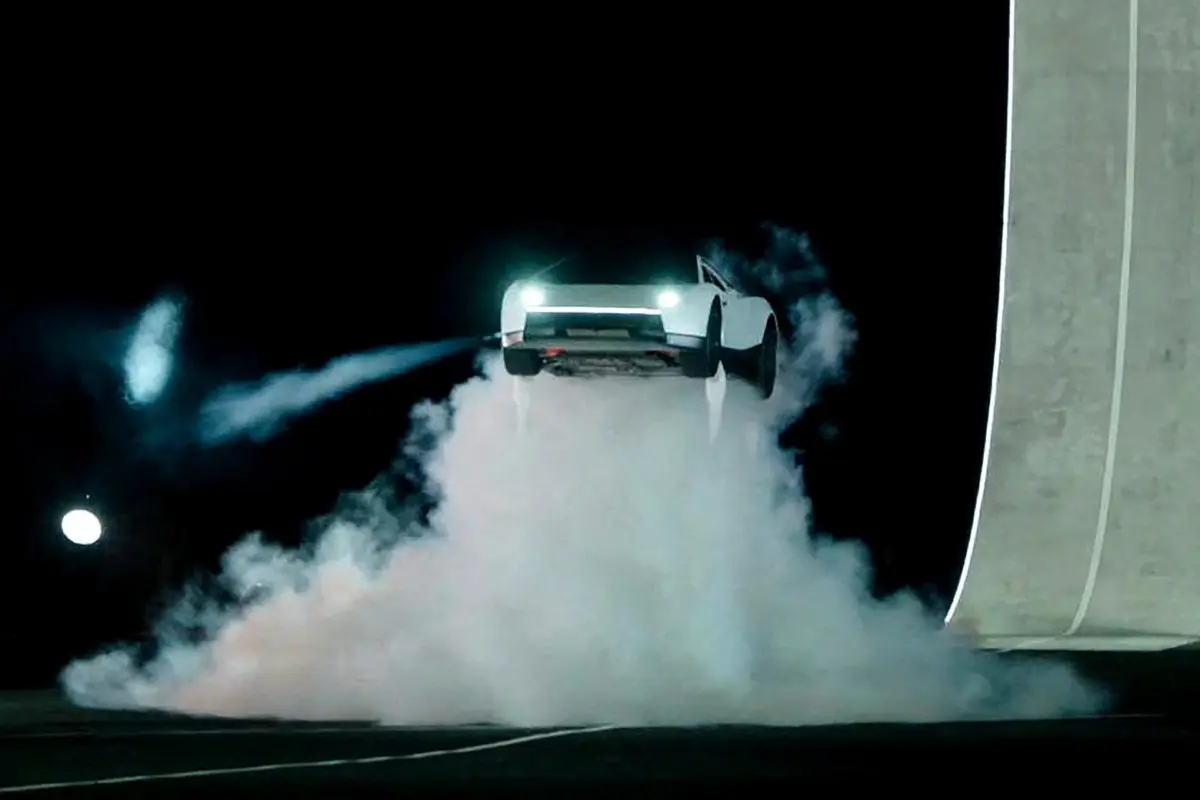
Unveiling the long-delayed, radically redesigned Tesla Roadster, Musk leaned heavily into showmanship, declaring to a roaring crowd: "What you see with your eyes, you will not believe!" The vehicle—a stylistic hybrid of a 1970s Lotus Esprit and an SR-71 Blackbird spy plane—boasts staggering specifications, including an electric drivetrain capable of launching from zero to 60 mph in a blistering 0.8 seconds. Yet, the headline-grabbing capability that stole the show was its purported "flight" feature, enabled by SpaceX-designed cold-gas thrusters.
However, industry insiders and astute market observers recognized the event for what it truly was: a carefully orchestrated masterclass in misdirection. The spectacle of a "flying" car was not merely a nostalgic nod to Musk’s penchant for sci-fi stunts; it was a profound strategic signal. Tesla as a standalone electric vehicle manufacturer is effectively sunsetting. Beneath the veneer of consumer automotive promises lies the groundwork for the mother of all corporate maneuvers: a mega-merger between Tesla and SpaceX.
As shrinking profit margins, intense international competition, and shifting regulatory landscapes batter Tesla’s core automotive business, Musk is pivoting toward a futuristic horizon dominated by autonomous Cybercabs, humanoid Optimus robots, and space-based data infrastructure. By co-opting SpaceX technology to star in a Tesla showcase, Musk is preparing to rescue Tesla’s balance sheet, merge the entities into a multi-trillion-dollar galactic juggernaut, and secure unprecedented access to public capital markets.
Detailed Chronology: From the Texas Spectacle to the Vision of 2028
The Texas Reveal
The rollout in Texas was vintage Musk. Tesla constructed a gigantic, C-shaped ramp designed to test the limits of physics and audience credulity. The new Roadster ascended to the curve’s apex, utilized a specialized downforce-generating fan system to adhere upside down, and then blasted free. As it flipped through the air and touched down amid a dramatic cloud of compressed air, it subsequently cleared a lineup of parked Tesla vehicles with another airborne roll.
The stunt immediately drew comparisons to Musk’s 2018 PR masterstroke: launching his own personal red Roadster into space atop a SpaceX Falcon Heavy rocket, where it remains in solar orbit to this day. Yet, while the aerospace theatrics delighted the faithful, the operational reality of the new Roadster tells a more sobering story.
The Financials of Fantasy
When the original Roadster update was first teased in 2017, true believers flooded Tesla with $50,000 baseline reservations, alongside $250,000 deposits for the exclusive Founder Series. Fast forward to the modern era, and the pricing structure has evolved into a tiered menu of futuristic promises:
- The Performance Trim: Priced at $50,000.
- The Thrust Version: Priced at $250,000.
- The Rocket Trim (The "Flying" Variant): Available only via an invite-only, undisclosed sum.
Despite taking deposits, Tesla has set a tentative delivery window of 2028 for the vehicle. In the world of Musk-led enterprises, the maxim caveat emptor remains the golden rule. More importantly, Musk explicitly stated that the Roadster will be the final manually drivable vehicle the company ever builds. The era of the human-piloted Tesla is coming to a close, making room for a fully automated, robotics-driven paradigm.
Supporting Context & Metrics: The Mechanics of a Declining EV Market
To understand why Musk is orchestrating a pivot away from traditional automotive manufacturing, one must examine Tesla’s recent financial and operational metrics.
The Core Automotive Crunch
In 2025, Tesla delivered more than 1.6 million manually driven vehicles, generating roughly $95 billion in revenue primarily from its automotive division, complemented by solar and energy storage operations. By any traditional metric, these numbers are staggering. Yet, beneath the surface, the business model is facing severe headwinds:
- Shrinking Margins: Tesla has not introduced a brand-new, non-flying consumer vehicle since the Cybertruck debuted in 2019.
- Product Line Contraction: Production of the high-priced Model S sedan and Model X SUV has quietly ended, leaving the Model 3 sedan and Model Y crossover to shoulder the entirety of the volume-manufacturing burden.
- Global Competition: A massive wave of low-cost competition from Chinese automakers—particularly across European markets, where Musk’s political alignments and support for right-wing factions have damaged brand sentiment—has eroded market share.
- Regulatory and Tax Shifts: Governments have steadily phased out the lucrative regulatory emissions credits that historically padded Tesla’s net income by billions of dollars. Simultaneously, the reduction of federal consumer tax credits has weakened the broader U.S. electric vehicle market.
The Pivot to Autonomy and Robotics
Recognizing that selling millions of moderately priced EVs yields tightening profit margins, Musk has accelerated his push into higher-margin, software-driven sectors. The future, according to Tesla’s roadmap, belongs to two primary pillars:
- The Cybercab: A purpose-built, autonomous robotaxi featuring neither steering wheels nor pedals, designed to populate a massive, on-demand urban transport fleet.
- Optimus Humanoid Robots: Automated laborers projected by Musk to eventually retail for $30,000 apiece. Musk has claimed these androids will perform everything from factory assembly line labor and lawn mowing to bartending, eldercare, and assisting in extraterrestrial colonization on the moon and Mars—projections that he argues will inflate Tesla’s market capitalization from $1.4 trillion to an astronomical $25 trillion.
Official Statements & Industry Analysis
The mounting financial pressures and strategic realignment have turned rumors of a Tesla-SpaceX merger into an open secret on Wall Street.
Recently, Barclays analyst Dan Levy suggested that a consolidation between the two entities is virtually inevitable, projecting that a deal could materialize before the end of 2026. Under the anticipated structure, SpaceX would act as the acquiring entity, with Tesla investors swapping their equity for SpaceX stock. The combined mega-firm would command an initial valuation in the vicinity of $3.5 trillion.
Financial analysts point out clear motivations for this corporate marriage:
- Capital Access: SpaceX possesses a proven, unparalleled ability to raise immense amounts of capital from public and private markets. This liquidity is desperately needed to fund the multi-billion-dollar conversion of Tesla’s manufacturing lines toward Cybercabs and Optimus units.
- AI and Infrastructure Scaling: To remain competitive against artificial intelligence heavyweights like OpenAI and Anthropic, Tesla must invest heavily in data-center construction.
- Orbital Synergy: Musk has previously floated ambitious, capital-intensive plans for SpaceX to launch orbital data centers designed to harvest uninterrupted, free solar power from space—bridging the technological ambitions of both companies.
Industry observers note that while traditional automakers spent decades wondering why Tesla was abandoning lucrative luxury segments in favor of mass-market volume, Musk viewed traditional EVs merely as a bootstrapping mechanism. They served as a means to develop global supply chains, manufacturing prowess, and engineering expertise capable of cranking out a Cybercab every 10 seconds and deploying armies of Optimus robots.
Future Outlook: The Rise of the Galactic Mega-Entity
The theatrical debut of the thruster-equipped Roadster served as a nostalgic throwback to the early days of Tesla’s public relations playbook—a moment where Musk channeled his inner carnival barker and embraced the sheer joy of spectacle. The integration of cold-gas thrusters was a direct technological descendant of the reusable rocket boosters that SpaceX has perfected over the past decade, landing upright on concrete pads or being caught mid-air by mechanical launch towers.
However, sentimentality cannot obscure corporate destiny. The standalone entity known as Tesla is quietly being prepared for absorption. As it dissolves into SpaceX, the resulting enterprise will no longer be judged by quarterly vehicle delivery numbers or automotive sector margins. Instead, it will operate as a monolithic, multi-planetary technology conglomerate.
For customers and early investors who bankrolled the electric vehicle revolution, the journey has been nothing short of a roller coaster. Yet, as Tesla transitions out of the automotive era and into Musk’s grand vision of a unified galactic enterprise, one reality remains certain: the corporate landscape has never witnessed anything quite like it, and the stakes for the future of global transportation, artificial intelligence, and space commercialization have never been higher.




