Executive Overview
In a sleek, corporate meeting room tucked away in the heart of King’s Cross, London, Hannah Einbinder is entirely unbothered. Stretched casually across a chair with the easy familiarity of someone sitting in their own living room, the 31-year-old American actor and comedian balances a glass of water on a slim armrest without so much as a glance. She radiates an effortless, grounded warmth—a striking subversion of the enduring stereotype that stand-up comedians are inherently neurotic creatures the moment they step off the stage.
“As a person sitting across from you today, I feel the most comfortable in myself now,” Einbinder says with a serene conviction. “It took me a long time to feel comfortable and good in myself.”
This profound sense of internal security has been hard-won, but it is increasingly impossible to ignore. Einbinder’s trajectory over the past several years has been nothing short of meteoric. At just 23, she etched her name into late-night television history as the youngest comic ever to perform on The Late Show with Stephen Colbert. Last year, that promise culminated in a Primetime Emmy Award for her tour-de-force performance as the sharp-tongued, fiercely ambitious comedy writer Ava Daniels in the critically acclaimed Max sitcom Hacks. True to form, Einbinder used her global television platform during her acceptance speech to deliver a blistering, unvarnished political statement: “Go Birds, fuck ICE, and free Palestine.”
Yet, Einbinder is currently in the UK capital for an entirely different creative endeavor: the British premiere of Jane Schoenbrun’s Teenage Sex and Death at Camp Miasma. A dizzying, meta-comedy-horror that dissolves the boundaries of traditional narrative cinema, the film features Einbinder in a startlingly vulnerable departure from her usual typecasting—playing a jittery, deeply insecure filmmaker named Kris. The performance is so completely inverted from the swaggering confidence of Ava Daniels that it forces an inevitable question: is Hannah Einbinder, beneath the awards and the accolades, actually more Kris than Ava?
Detailed Chronology: From Late-Night Prodigy to Avant-Garde Horror
To understand Einbinder’s artistic evolution is to trace a path from the polished, laugh-track-driven machinery of studio television to the murky, blood-splattered auteurism of contemporary independent film.
Her early breakout on Stephen Colbert’s show established her as a master of deadpan timing and observational wit. But rather than resting on the laurels of traditional stand-up, Einbinder leveraged her growing platform to explore more experimental comedic avenues. By 2024, she had released her critically lauded stand-up special, Everything Must Go. Opening with a striking sequence under a stark blue spotlight where she swoons to slow jazz against a backdrop of deep red curtains—a visual homage straight out of David Lynch’s Twin Peaks—the special signaled an artist eager to push the boundaries of her medium.
It was precisely this theatricality and playfulness that caught the eye of visionary filmmaker Jane Schoenbrun. Schoenbrun, the celebrated trans director behind indie sensations We’re All Going to the World’s Fair and I Saw the TV Glow, did not cast Einbinder because of her mainstream success in Hacks. Instead, Schoenbrun saw in Einbinder an innate understanding of performance art and genre subversion.
In Teenage Sex and Death at Camp Miasma, Einbinder plays Kris, a young filmmaker who, fresh off a celebrated Sundance indie hit, accepts a studio assignment to reboot a fictional 1980s slasher franchise titled Camp Miasma (an affectionate, blood-soaked parody of Friday the 13th). The studio’s motivations are transparently cynical: Kris is queer, and her involvement checks a corporate diversity box.
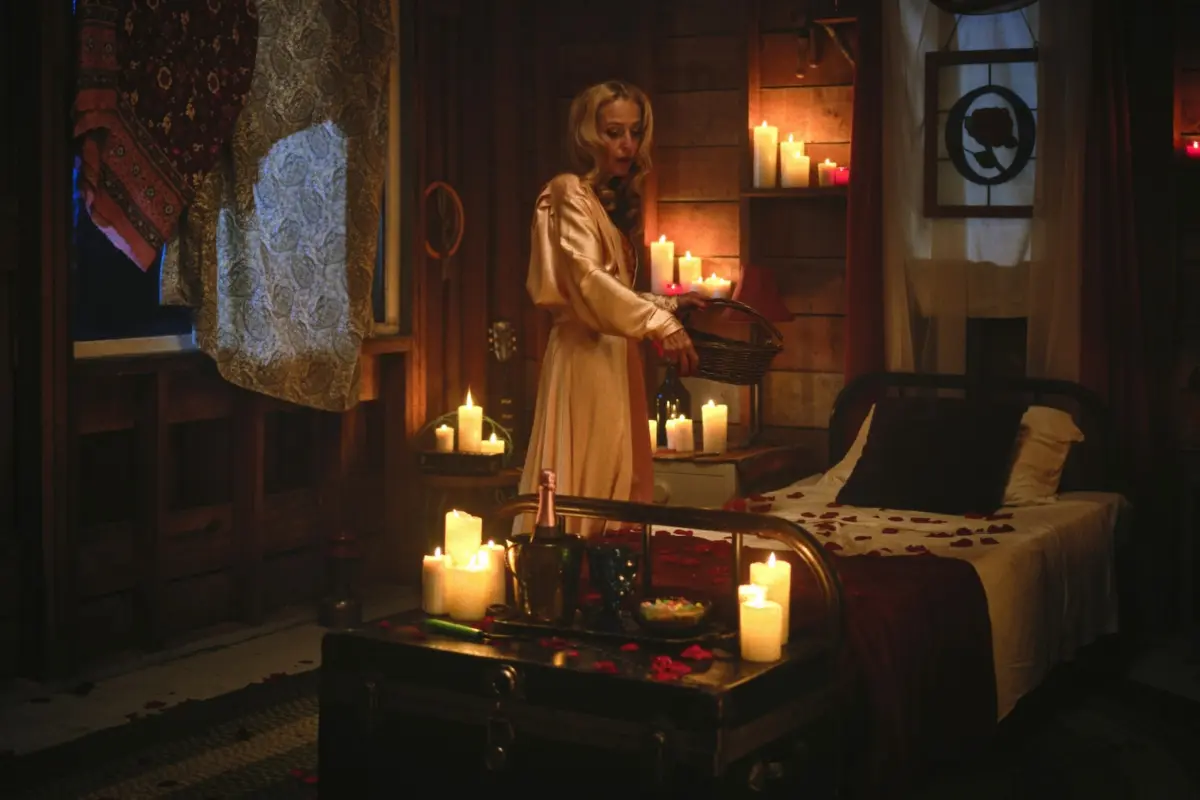
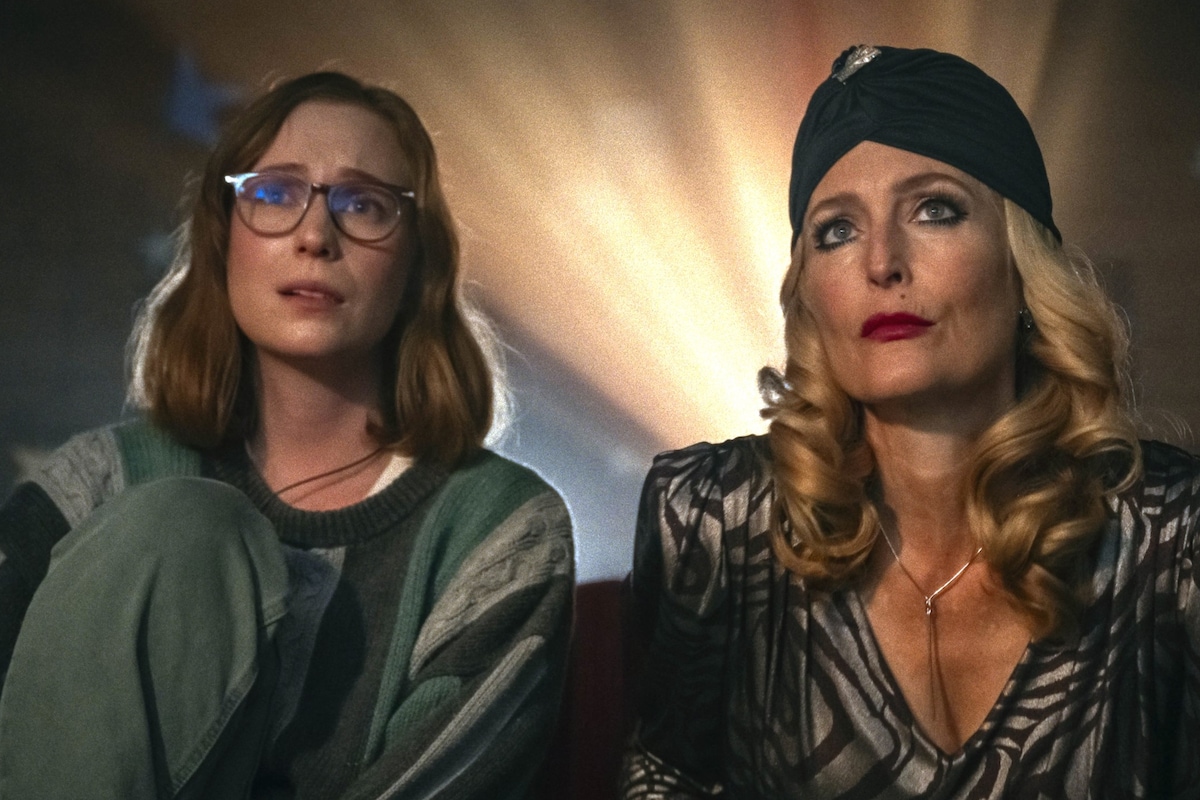
However, Kris has no interest in playing the Hollywood game or unearthing the next young starlet. Instead, she embarks on an obsessive quest to track down Billy Preston (played with iconic detachment by Gillian Anderson), the legendary "Final Girl" from the original 1930s-style Camp Miasma. Now a recluse living in an isolated cabin on the very grounds where the original slasher was filmed, Billy and Kris enter into a strange, psychosexual dynamic that continually bends the rules of time, physics, and conventional gender expression.
Supporting Context & Metrics: Unpacking the Physicality of Insecurity
Transforming into Kris required Einbinder to completely deconstruct her public persona, starting with her physical instrument.
“Kris is, physically in her body, completely the opposite of me,” Einbinder explains. “Ava in Hacks walks into a room dick first. But Kris is more insecure, subdued, and kind of nerdy. My awareness of my physical instrument helped determine how Kris walked, her twitchiness, and the way she shrinks. I cut little bangs for myself and wore glasses. There are outfits modelled on Maggie Gyllenhaal in Secretary with the tall socks, the long skirt, the Mary Janes. It’s so different from the way I present in the world.”
To build Kris’s jittery cadence and defensive posture, Einbinder actually drew inspiration from the film’s director. “I stole some mannerisms from Jane,” she admits with a laugh. “They bottle up their sweatshirt, and pick at their hands.”
Mid-sentence, Einbinder catches herself as she realizes she is describing the exact body language of her interviewer. “I won’t lie: if I’d met you before the part, I’d be stealing some stuff! Physicality communicates so much. I grew to love Jane so instantly. Representing them felt fun, endearing, and like, ‘This is my little impression of my friend.’”
Schoenbrun’s body of work has consistently explored themes of alienation, media consumption, and identity. While We’re All Going to the World’s Fair and I Saw the TV Glow served as profound allegories for Schoenbrun’s personal transition, Teenage Sex and Death at Camp Miasma is the director’s first feature film created entirely post-transition. Although Kris is not explicitly trans, she suffers from a profound alienation from her own flesh—plagued by chronic dissociation, body dysmorphia, and a total lack of sexual fulfillment. It is only through her intense encounters with Billy Preston and the surreal re-enactment of the slasher tropes that define Camp Miasma that Kris slowly begins to inhabit her own skin.
“I tend not to speak explicitly about Jane’s experience in ways they haven’t spoken about, because the film is representative of the journey they’ve been on,” Einbinder reflects. “It’s also something we can all relate to. I think shame around sex, and discomfort in one’s body, is incredibly universal. I feel so lucky to work with Jane. When you’ve done so much work to meet yourself deeply, it’s hard to conceal all of that. Jane being candid makes space for all of us to be candid. It’s the greatest offering an artist can make, being like, ‘Here’s everything I’m going through.’ I’m a pretty open person, and Jane has inspired me to be honest and say, ‘Yeah, I relate to Kris’s experience.’ I think pretty much fucking everybody on Earth does in some way, or at some time.”
Official Statements & Unfiltered Truths: Politics and Public Persona
Einbinder’s commitment to radical honesty extends far beyond her acting choices and directly into her sociopolitical convictions. Just hours before sitting down for this interview, she utilized her social media platforms to post a series of Instagram stories expressing unequivocal solidarity with Palestine—a practice that has become a regular fixture of her digital footprint.
This absolute clarity of purpose helps explain why Einbinder projects such an enviable aura of calm during media engagements: she has fundamentally decoupled her public expression from the fear of corporate reprisal.
“When it comes to Palestine, I’m so sure of my views on this issue, and that what I’m seeing before my eyes is a genocide, that it doesn’t make me nervous at all… it’s just become very clear that I can’t be concerned with the repercussions.”
“You have to take that leap initially to start speaking about it at a certain point,” she elaborates. “But for me, it’s just become very clear that I can’t be concerned with the repercussions.”
This self-awareness is rooted in a lifetime of introspection. Having been in therapy since the age of 15, Einbinder possesses a near-clinical understanding of her own psychological makeup. When the conversation touches on the Enneagram—the popular personality profiling system that divides human behavior into nine distinct typologies—she identifies her type instantly.
“I’m a three,” she says without hesitation. “‘The Achiever.’”
When her publicist, entering the room mid-interview, admits he has never heard of the system, Einbinder deadpans: “It’s like if astrology was real. You have to take the test.”
The conversation briefly derails over a humorous digital discrepancy: a Google AI Overview—the ubiquitous search engine summary box—erroneously classifies Einbinder as a Type Seven ("The Enthusiast"), a profile typically characterized by a relentless avoidance of emotional pain and trauma.
Einbinder screams with laughter. “That’s so funny! Hello? They don’t think I’m ‘The Achiever’?”
After double-checking their smartphones to confirm the internet’s absurd misclassification, she sets the record straight. “Girl. I’m pretty real in my public persona! I’m a three! I’ve talked a lot about how, when I started, stand-up was my way of feeling good when I felt bad all the time. But that’s not all there is.”
Interestingly, despite her comfort with radical vulnerability on stage and screen, Einbinder maintains strict boundaries when it comes to certain comedy tropes. While generations of stand-ups have built entire careers mining their dating lives and sexual misadventures for material, Einbinder actively avoids the subject.
“I’m an open book, and I don’t hide what I think—ever. But when it comes to stand-up, I never talk about sex or dating. I think I still won’t, but that’s because it’s kind of hack.”
When asked if this stems from the traditional disparity where comedians comfortably mine their sex lives for laughs while filmmakers approach sexuality with dramatic gravity, she pushes back on the premise.
“Well, comedians aren’t talking about their sex life negatively. It’s overdone as a topic. Even when I was starting stand-up at 20, I was like, ‘OK, what else?’ It’s not the topic, but how you discuss it. This film discusses sex in a new way. There are tons of films about sex, but not many about how hard, unglamorous, painful, and not sexy it can be. To me, this film is incredibly radical and brave.”
Future Outlook
As Hannah Einbinder continues to bridge the worlds of prestige television, avant-garde independent cinema, and uncompromising sociopolitical activism, her trajectory points toward an artistic future completely untethered by industry expectations.
With her Emmy in hand, a critically lauded run on Hacks, and her bold transition into the surreal, blood-soaked horror landscape of Jane Schoenbrun’s universe, Einbinder is proving that true comedic and dramatic longevity comes not from playing the Hollywood game, but from tearing up the rulebook entirely.
Teenage Sex and Death at Camp Miasma is scheduled to open in UK and Irish cinemas on August 21, inviting audiences to witness a brilliant performer stepping entirely out of her comfort zone—and finding, for the very first time, absolute comfort within herself.