Executive Overview
The powerful cultural reckoning of the #MeToo movement has fundamentally transformed how society addresses sexual misconduct, initially focusing its lens on high-profile, white-collar industries such as Hollywood, elite politics, and major newsrooms. However, beneath the glare of the media spotlight lies a vast, often overlooked landscape of blue-collar and corporate service environments—including the call centers and customer service hubs that power America’s largest telecommunications giants.
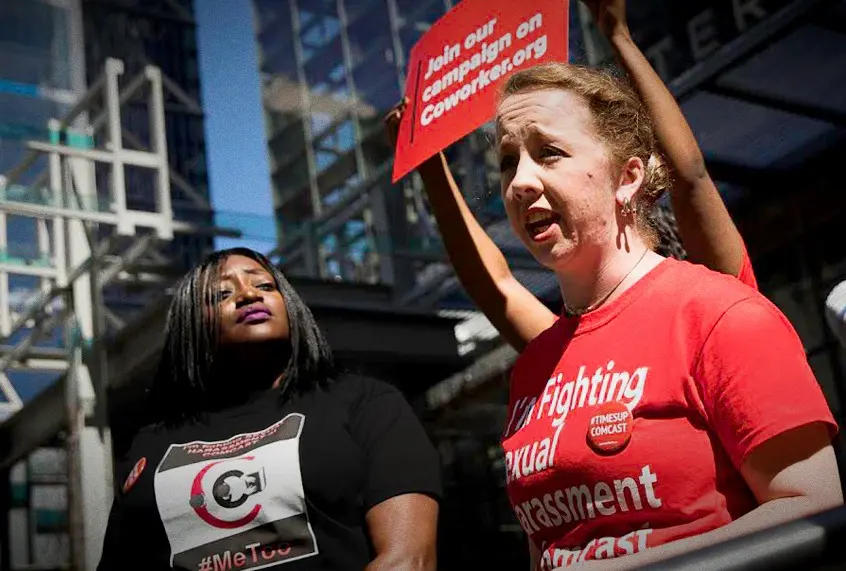
In May 2018, this reality was thrust into the open when former employees of telecommunications conglomerate Comcast stepped forward to challenge what they described as a deeply entrenched corporate culture of sexual harassment and institutional retaliation. Led by former Memphis sales representative Laterrica Perry and former dispatch representative Rylinda Rhodes, a coalition of current and former workers delivered a petition to Comcast’s corporate headquarters in Philadelphia. Signed by more than 4,000 supporters—including dozens of individuals identifying as current or former Comcast personnel and customers—the petition demanded immediate executive action from CEO Brian Roberts to dismantle systemic barriers to reporting misconduct and to protect workers who speak out.
The campaign highlights a stark dissonance between Comcast’s stated corporate values and the harrowing daily realities reported by frontline workers. For years, women like Perry and Rhodes navigated environments where reporting inappropriate behavior frequently resulted in professional marginalization, psychological distress, and sudden termination. As scrutiny intensifies around corporate accountability in the telecommunications sector, these women’s accounts offer an urgent look at the heavy toll exacted on workers who dare to challenge corporate power.
Detailed Chronology: The Anatomy of Harassment and Retaliation
The Ordeal of Laterrica Perry
The seeds of Laterrica Perry’s public stand were sown in July 2017, when the then-30-year-old Comcast sales representative in Memphis, Tennessee, made an anonymous report to the company’s Human Resources department. Perry provided concrete evidence—including text messages and phone call records—detailing months of persistent sexual misconduct by her direct supervisor, which included unwanted sexual advances and inappropriate commentary.
According to Perry, the situation deteriorated rapidly after she rejected her supervisor’s advances. She alleges that her boss systematically retaliated against her by denying her entitled sick time and withholding a critical letter of recommendation necessary for career advancement. Despite the immediate submission of documentary evidence, Perry claims that Comcast’s HR department dragged its feet, failing to terminate the supervisor until October 2017. During those intervening months, Perry alleges that the supervisor actively worked to tarnish her professional reputation within the organization.
The psychological toll of the harassment and subsequent retaliation was profound. Perry was diagnosed with post-traumatic stress disorder (PTSD), requiring intensive psychiatric treatment and regular therapy sessions. Her medical condition necessitated an extended disability leave that lasted through March 2018, leading to a drastic reduction in her income. To make ends meet during this period of forced medical leave, Perry was compelled to make a financial hardship withdrawal from her 401(k) retirement account.
The ordeal culminated on April 30, 2018, when Perry discovered she had been terminated by the company while awaiting a formal separation package.
"The only information I got was via e-mail saying that they had proceeded with the actual separation, but I didn’t get the actual package that showed why I was separated," Perry recounted. "I received everything, as far as my COBRA coverage, my 401(k) information. The only thing that I had not received is the explanation for my termination. I kind of felt like that was something suspicious."
The Journey of Rylinda Rhodes
Perry’s fight mirrors the experiences of Rylinda Rhodes, who spearheaded the broader worker advocacy campaign in November 2017 during the height of the #MeToo movement. Rhodes worked across four different Comcast call centers between 2007 and 2012, serving as a dispatch representative. Over the course of her tenure, she claims to have experienced sexual harassment at all but one of the locations where she was stationed.
The defining incident of Rhodes’s employment occurred when a male co-worker entered her office and physically groped her breasts. When Rhodes formally reported the incident, the internal response proved hostile to her wellbeing. She was forced to take short-term medical leave to seek talk therapy for trauma induced by the workplace environment. While she was on leave and the company was ostensibly investigating her claims, management instructed her to apply for other internal jobs.
Ultimately, Rhodes was fired on August 1, 2012. While her official termination letter cited health reasons, Rhodes maintains that her dismissal was direct retaliation for reporting sexual battery and demanding a safe workplace. Refusing to let her experience remain isolated, Rhodes filed a lawsuit against Comcast and subsequently launched an online petition on Coworker.org to unite other victimized workers.
Supporting Context & Metrics: The Blue-Collar Blind Spot
While public attention has largely centered on high-profile figures in entertainment and broadcast journalism—such as the ousting of Today show host Matt Lauer and misconduct allegations against veteran anchor Tom Brokaw at Comcast subsidiary NBCUniversal—systemic harassment is deeply entrenched across diverse employment sectors.
Data from the U.S. Equal Employment Opportunity Commission (EEOC) highlights the scale of the issue in the corporate service and information sectors. Between 2005 and 2015, approximately 1,200 charges of sexual harassment were filed with the EEOC within the information industry alone, which encompasses telecommunications giants like Comcast.
Industry analysts and labor advocates point out that corporate oversight mechanisms frequently fail blue-collar and customer-service workers. Unlike corporate executives or media personalities with personal legal representation and public platforms, call center employees—disproportionately women and women of color—often occupy positions of lower economic leverage. For these workers, reporting a supervisor or a peer can mean immediate financial destabilization, loss of health insurance, and the destruction of a livelihood. The systemic failure to protect these employees underscores an urgent need for institutional reform that extends far beyond the C-suite and elite newsrooms.
Official Statements and Corporate Responses
When confronted with the mounting public pressure and the delivery of the petition to corporate headquarters on May 2, 2018, Comcast executives declined to meet with Perry, Rhodes, and their supporters. Despite the snub, the delegation viewed the direct action as a significant milestone in holding the telecommunications giant publicly accountable.
In response to initial reporting regarding the allegations in February 2018, Jenni Moyer, Senior Director of Corporate Communications at Comcast, issued a definitive statement defending the company’s anti-harassment policies:
"Sexual harassment, or harassment of any kind, is not tolerated at Comcast. The company was founded on a foundation of respect, integrity and trust. We have strong policies against sexual and other forms of harassment and encourage employees to report any harassing behavior. Any allegation of harassment is taken very seriously."
Despite these assurances, activists and former employees argue that a vast gulf exists between corporate policy on paper and the lived enforcement of those rules within regional call centers and local management structures. The company’s refusal to engage directly with the petitioners has only deepened skepticism regarding its internal accountability frameworks.
Future Outlook: A Movement Beyond Comcast
Although the immediate outcome of the petition delivery remains uncertain, the ripple effects of Perry and Rhodes’s activism are already being felt.
Rhodes remains cautiously optimistic that public pressure can compel corporate leadership to reevaluate and improve its internal compliance and grievance procedures. She emphasizes that her campaign is fundamentally designed to let isolated workers know they are not alone.
"Going through this can be a very lonely process," Rhodes reflected. "And to be able to unite with the people that have gone through this and are struggling with this has been the greatest sense of relief… All women should have the freedom to be their authentic self and not a scared version because of sexual harassment."
Perry, while expressing deep skepticism that Comcast leadership will voluntarily initiate structural reform or meaningfully resolve its institutional shortcomings, harbors no regrets about stepping forward. Drawing inspiration from the broader cultural shifts of the #MeToo movement, she views her public stand as a vital mechanism for empowering others.
"What I’m doing is giving a voice to the voiceless," Perry said. "I’m also empowering people to step forward and say if something happens to them, whether it be at Comcast or any other corporation… That’s my silver lining."
Moving forward, Perry plans to dedicate her efforts to building resource networks and advocacy platforms designed to guide victims of workplace harassment through the daunting process of reporting incidents, navigating institutional hurdles, and accessing vital psychological and legal support. As the collective push for corporate accountability gains momentum, the bravery of these former Comcast employees signals that the demand for safe, dignified workplaces can no longer be ignored—regardless of industry or corporate rank.