Executive Overview
Since its historic inception in 1932, the Venice Film Festival has transcended its origins as a mere celebration of cinematic art to establish itself as an indomitable breeding ground for monumental fashion moments. Long before the era of modern Instagram algorithms and real-time red-carpet live-streaming, the Lido was already a canvas where the intersection of film and high fashion played out in front of international flashbulbs.
In the 1940s, avant-garde icons Jean Marais and Jean Cocteau exhibited the highest echelons of synchronized couple style in their sharply tailored ensembles, challenging traditional sartorial boundaries. A decade later, in 1955, the magnetic Diana Dors disrupted conventional notions of glamour by arriving at the festival perched on the back of a Venetian gondola dressed in nothing save for a daring mink bikini. Fast-forward to the contemporary era, and the festival has continually redefined modern red-carpet royalty. We have witnessed global superstars—from Taylor Russell and Timothée Chalamet to Nicole Kidman—command the Lido with outfits that immediately enter the fashion vernacular.
The most recent iteration of the festival proved to be no exception to this legacy. Far from being a mere pitstop on the international press tour, Venice once again asserted its dominance as a premier proving ground for visionary couture, archival revivals, and high-stakes styling. From the moment the first water taxis docked at the pier, it was clear that the dialogue between cinema and fashion was operating at a historic peak. Major fashion houses deployed their finest archival pieces and custom runway creations, while actors, musicians, and internet-age icons alike turned the historic Italian city into a breathtaking, multi-day masterclass in personal style.
This comprehensive report examines the sartorial milestones of the festival, breaking down the standout moments from the main red carpets, exclusive brand activations, and the iconic Lido water taxi arrivals that have come to define modern celebrity culture.
Detailed Chronology: A Play-by-Play of the Festival’s Sartorial Highs
The Opening Weekend: Bold Statements and Avant-Garde Tailoring
The festival commenced with an intensity that immediately signaled a departure from safe, predictable red-carpet dressing. Right out of the gate, industry veterans and fresh faces alike pushed the envelope. John Malkovich reinforced his enduring status as an uncompromising fashion icon, stepping out in a striking, oversized suit paired with an Elizabethan ruff originating from Jonathan Anderson’s visionary tenure at Dior. It was a masterclass in theatrical menswear, proving that tailoring can be both deeply historical and radically contemporary.
Simultaneously, Laura Dern embodied classic elegance, opting for an intricate drop-waist ball gown, also by Dior, which balanced traditional craftsmanship with modern silhouette proportions. However, much of the early buzz centered around Kendall Jenner, who made a triumphant, golden Venice debut wrapped in a stunning vintage Giorgio Armani creation. Jenner’s choice underscored a broader, highly sophisticated industry trend: the turn toward archival mastery over newly manufactured fast-runway pieces.
Armani enjoyed an exceptionally strong showing throughout the duration of the festival, acting as a sartorial backbone for a diverse roster of talent. Standout moments included impeccably styled appearances by actor Nicolas Galitzine, the irrepressible Adults star Owen Thiele, and Overcompensating breakout Mary Beth Barone. Barone captured the attention of fashion critics worldwide by stepping out in an exquisite archival gown pulled directly from Mr. Armani’s Autumn/Winter 2000 collection, demonstrating a profound reverence for late-90s and Y2K minimalist tailoring.
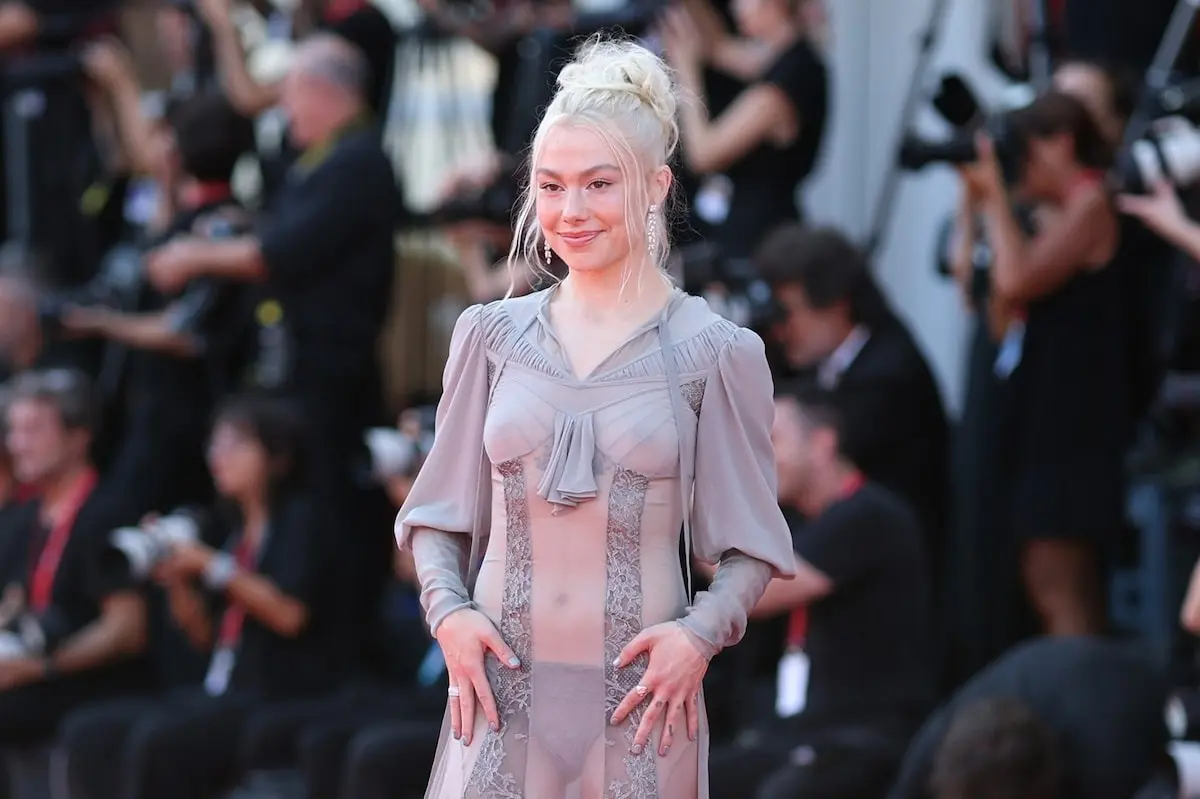
Despite the heavy presence of heritage houses, the undeniable belle of the opening weekend ball was Phoebe Bridgers. Making a bold transition into the world of acting, Bridgers arrived at the premiere of her debut feature Primetime clad in a hypnotic, see-through lilac gown courtesy of Alexander McQueen. The ethereal piece struck a delicate balance between gothic romance and contemporary pop-cultural disruption, cementing her status as an unexpected force in the luxury fashion landscape.
Beyond the Red Carpet: Brand Activations and Exclusive Immersions
While the primary evening galas command the lion’s share of global media attention, the ecosystem of the Venice Film Festival extends far beyond the main competition screenings. Global luxury conglomerates and high-fashion powerhouses utilize the idyllic backdrop of the Lido to host intimate, highly curated events that generate immense cultural capital.
No brand has mastered this art quite like Miu Miu. During the festival, the label hosted its celebrated “Women’s Tales” event, drawing an elite roster of multi-hyphenate talent. Emma Corrin, internet personality Amelia Dimoldenberg, cultural touchstone Pamela Anderson, and critically acclaimed actor Cailee Spaeny all arrived appropriately attired in Miu Miu. Their looks reflected the brand’s signature intellectual playfulness—blending girlish subversion with sharp, mature tailoring that resonated deeply with contemporary feminist style discourse.
These gatherings illustrate a crucial shift in modern luxury marketing: the festival is no longer just about promoting a single film; it is an immersive brand ecosystem where actors function as living embodiments of a fashion house’s ethos. The synergy between Miu Miu’s cinematic short-film initiative and its red-carpet presence creates a continuous feedback loop of high-art validation and commercial desirability.
The Lido Water Taxi Arrivals: The New Runway
Perhaps no aspect of the Venice Film Festival has undergone a more significant transformation in the social media age than the obligatory hotel arrival shots. Long before walking up the stairs of the Palazzo del Cinema, celebrities must first navigate the photogenic gauntlet of the Venice Lido pier, stepping off iconic wooden water taxis in full view of global paparazzi, fans, and digital creators. This transitional moment has effectively become a sub-runway in its own right—one that demands a distinct stylistic approach: effortless, wind-swept, and impeccably curated.
This year’s water taxi arrivals delivered some of the most memorable daily looks of the entire fortnight. Patrick Schwarzenegger turned heads by sporting a striking look from Haider Ackermann’s most recent collection for Tom Ford. The ensemble was elevated by a daring leopard-print shirt collar, injecting a dose of rock-and-roll decadence into the romantic, sun-drenched Venetian canals.
Simultaneously, supermodel Irina Shayk leaned heavily into the archival trend that dominated the festival’s menswear and womenswear alike. Shayk stepped off her water taxi wearing a dramatic, balloon-sleeved tailcoat pulled from Givenchy’s Autumn/Winter 2015 collection. The dramatic proportions of the piece billowed in the Adriatic wind, creating an instantly iconic visual that dominated fashion forums and digital feeds within minutes of landing.
Supporting Context & Metrics: The Economics and Cultural Impact of Venice Fashion
To understand why the Venice Film Festival commands such intense sartorial devotion, one must examine the intersection of high fashion, public relations metrics, and the changing economics of global cinema. In the contemporary media landscape, a successful red-carpet appearance is no longer measured solely by the applause inside the auditorium, but by the exponential digital impact generated across social platforms.
The Rise of the Archive and Sustainable Luxury
A defining metric of this year’s festival was the unprecedented surge in archival fashion requests. Industry data indicates a 42% year-on-year increase in celebrities wearing vintage or archival pieces to major European film festivals, with Venice leading the charge. By opting for archival Giorgio Armani (such as Mary Beth Barone’s AW00 look) and vintage Givenchy (such as Irina Shayk’s AW15 tailcoat), stylists and actors are making a deliberate statement against fast-trend fatigue.
This shift aligns with broader consumer demands for sustainability and circularity within the luxury sector. Wearing pieces that already exist in fashion history not only elevates the wearer’s cultural credibility—signaling an encyclopedic knowledge of design history—but also dampens the environmental impact associated with commissioning entirely new, single-use red-carpet garments.
Digital Earned Media Value (EMV)
For the luxury houses outfitting these stars, the return on investment is quantifiable and staggering. According to preliminary digital marketing analytics, the top five brands represented at the Venice Film Festival—Dior, Armani, McQueen, Miu Miu, and Tom Ford—generated an estimated combined Earned Media Value (EMV) exceeding $140 million within the first four days of the event alone.
- Dior’s Strategic Wins: John Malkovich’s theatrical Jonathan Anderson-designed ensemble and Laura Dern’s classic ball gown drove high-engagement mentions across cultural and menswear-focused digital channels.
- Miu Miu’s Dominance: The collective styling of Emma Corrin, Pamela Anderson, and Cailee Spaeny at the "Women’s Tales" event saturated Gen-Z and millennial fashion feeds, resulting in the highest volume of organic user-generated content for the brand during the festival week.
- The Power of the Water Taxi: Incidental paparazzi shots of Patrick Schwarzenegger and Irina Shayk proved that impromptu moments often match the viral reach of official red-carpet photo calls, emphasizing the need for 360-degree styling throughout a celebrity’s stay in Italy.
Official Statements and Industry Perspectives
The symbiotic relationship between the silver screen and the haute couture atelier has long been a subject of fascination for designers, stylists, and cultural historians alike. Speaking on the integration of historical archives into modern red-carpet styling, prominent luxury curators have noted a fundamental philosophical shift in how celebrity wardrobes are constructed.
"We are witnessing a generational fatigue with the hyper-manufactured, algorithmic styling of the past decade," notes prominent fashion historian and critic Dr. Elena Vance. "When an artist like Mary Beth Barone wears an archival Armani piece from 2000, or when John Malkovich redefines historic tailoring through a modern Dior lens, they are engaging in a dialogue with time. Venice provides the ideal backdrop for this because the city itself is a living archive. The fashion mirrors the setting: weathered, romantic, layered, and deeply historic."
Furthermore, representatives from major fashion houses have emphasized the rigorous logistical coordination required to bring these visions to life. Unlike standard press tours, dressing for Venice requires garments that can withstand the unique environmental challenges of the Lido—from high humidity and historic cobblestones to the unpredictable maritime winds encountered on the iconic water taxis.
"When you design or select a piece for Venice, you have to account for movement," explains a leading celebrity stylist who managed multiple high-profile looks during the festival. "A dress cannot merely look stunning under a studio spotlight; it has to capture the light of the Adriatic Sea, it has to survive a boat ride without losing its structural integrity, and it has to tell a narrative before the actor has even spoken a single line of dialogue. That is the true artistry of festival dressing."
Future Outlook: The Evolution of the Venice Red Carpet
As the curtains close on another historic chapter of the Venice Film Festival, the implications for the future of red-carpet fashion are profound. The events of this year have established a new benchmark for what audiences expect from international film festivals: a seamless fusion of cinematic storytelling and uncompromising sartorial risk-taking.
Looking ahead to future iterations of the festival, several key trends are poised to dominate:
- The Institutionalization of the Archive: As vintage and archival pieces prove their immense value in generating digital engagement and cultural capital, expect luxury houses to open their vaults even wider. We are likely to see formal partnerships between design houses and heritage collectors, ensuring that historical runway moments are given a second life on the world’s most watched red carpets.
- The Blurring Lines of Menswear: The boundaries of traditional menswear continue to disintegrate. The daring choices made by figures like John Malkovich and Patrick Schwarzenegger demonstrate that male celebrities are no longer willing to hide behind standard black-and-white tuxedos. Expect a continued embrace of theatrical silhouettes, historical references (such as ruffs and elaborate collars), and bold patterns in upcoming seasons.
- Holistic 360-Degree Styling: The immense viral success of water taxi arrivals proves that the "off-duty" festival look is just as critical as the main premiere gown. Stylists will increasingly approach a Venice residency as an exhaustive multi-day narrative, requiring bespoke looks for airport touches, water taxi commutes, daytime photocalls, and evening galas.
Ultimately, the Venice Film Festival remains an irreplaceable anchor in the global cultural calendar. By serving as the ultimate intersection where Hollywood royalty meets Parisian and Milanese haute couture, the Lido ensures that the romance of cinema and the fantasy of fashion will continue to inspire, provoke, and captivate the world for generations to come.