For victims of a ransomware attack, the feeling of helplessness is absolute. When critical business servers screech to a halt, data is encrypted into unreadable blocks of algorithmic gibberish, and a stark digital ransom note demands thousands—or millions—of dollars in cryptocurrency, companies often feel their backs are against the wall. Enter the so-called "incident response and decryption experts," self-proclaimed digital white knights promising to rescue trapped corporate databases without giving in to cybercriminal extortion.
Yet, beneath the glossy veneers of high-tech branding, some of these remediation firms are nothing more than wolves in sheep’s clothing.
The co-founder and chief technology officer of ransomwarehelp.com, a six-year-old Florida-based operation, has been formally indicted on federal wire fraud charges. According to a recently unsealed indictment in Rhode Island, Juan Ricardo Palacio Escobar—52, residing in Miami and Medellín, Colombia—perpetrated a sophisticated fraud against desperate businesses. Rather than utilizing the "advanced cryptographic tools" and proprietary algorithms advertised on their website, Palacio and his firm were simply acting as unauthorized middlemen. They quietly negotiated with the real cybercriminals, paid them off for a decryption key, and then slapped exorbitant, fraudulent markups onto victims—billing them hundreds of thousands of dollars for non-existent engineering work.
Palacio’s indictment represents a major milestone in an aggressive, cross-agency crackdown by the U.S. Department of Justice (DoJ) and the FBI. Federal authorities are increasingly casting their net toward unscrupulous operators within the cybersecurity industry who profit off corporate misery by double-crossing the very clients they are hired to protect.
Detailed Chronology of the FBI Sting Operation
The unraveling of ransomwarehelp.com began not from a random tip, but from a calculated, multi-layered federal sting operation orchestrated by the FBI. Law enforcement agencies, growing wise to opportunistic intermediaries operating in the grey market of ransomware negotiation, set a trap to catch Palacio red-handed.
The Honeypot and the Pitch
Federal investigators established a fictitious company and purposefully infected a controlled network with a simulated ransomware attack, planting a phony ransom note. Operating under the guise of desperate corporate executives who resolutely "did not wish to pay a ransom," undercover agents reached out to ransomwarehelp.com for emergency assistance.
True to form, ransomwarehelp.com responded by explicitly pointing back to its public policy declaration: "We never promote, intermediate or pay ransom to threat actors on behalf of our clients." The site’s representatives assured the supposed victims that their team of cryptography experts possessed proprietary tools to achieve a 100% data recovery rate without ever yielding to criminal extortion.
The Double Game in Motion
Shortly after receiving the fake victim’s inquiry, Palacio contacted a second undercover FBI-run entity—this one posing as the fictitious ransomware group responsible for the attack. Posing as an intermediary, Palacio aggressively negotiated for the lowest possible price to obtain a decryptor.
Undercover agents acting as the threat actors quoted Palacio a baseline price of 0.2 bitcoin, valued at approximately $13,000 at the time. Less than 48 hours later, Palacio turned back to the undercover "victim" company—the FBI’s first persona—and reported that his diagnostic assessment was successful. He quoted them a decryption fee of $13,260.
Behind the scenes, however, Palacio continued to play both ends against the middle. The day after quoting the victim, Palacio messaged the FBI’s fake ransomware group again, haggling to reduce the price down to $4,000. They ultimately settled on a figure of roughly $6,000 in Bitcoin.
When all was said and done, Palacio billed the undercover FBI victim firm a total of $16,010—incorporating an initial $2,750 "diagnostic fee" alongside the inflated $13,260 decryption charge. He had pocketed a clean, effortless profit margin by lying to both sides of the transaction.
Supporting Context & Metrics: Unmasking the Technical Charade
While the federal sting provided the legal smoking gun, independent cybersecurity professionals had been sounding the alarms on ransomwarehelp.com for years. Paul Ihme, co-founder of the security firm Soteria, detailed a particularly egregious case from 2024 involving a small, panic-stricken accounting firm whose entire operational database had been locked by the LockBit ransomware gang.
Farcical Technical Claims
When the accounting firm engaged ransomwarehelp.com, they received an eye-watering proposal demanding $438,880 for data recovery. To justify this astronomical price tag, the proposal cited an elaborate, pseudo-scientific recovery process involving:
The "professional configuration of forensic servers."
"Expert engineering hours of programming to configure decryption algorithms."
Eight separate processing cycles to handle the decryption process.
The utilization of "510 preconfigured forensic servers of maximum quantitative capacity located in different parts of the world."
The proposal even claimed that their programmers would use brute-force processes to randomly inject encryption codes extracted during "cryptographic analysis." Technical experts like Ihme immediately recognized these assertions as patently absurd.
"If it were really true these guys could decrypt any ransomware out there, this guy would be a billionaire," Ihme remarked to KrebsOnSecurity. "They were going after people who don’t have any technical knowledge, are desperate, and don’t have anyone advising them about how any of this stuff works."
To add to the farcical nature of the claims, the proposal stated the firm could break six types of encryption, yet bizarrely listed irrelevant password hashing algorithms, such as SHA-256, which have nothing to do with symmetric file-encrypting ransomware.
The AnyDesk Cover-Up
To execute their scheme, ransomwarehelp.com insisted on obtaining unrestricted remote access to the victim’s network via the AnyDesk remote desktop software installer. While the firm claimed this access was necessary to run diagnostic checks, Ihme uncovered a far more sinister motive: systematically deleting all copies of the actual ransom notes.
Typically, ransomware variants leave text files on every infected machine containing darknet chat URLs or direct contact emails for the extortionists. By logging in and wiping these files clean, ransomwarehelp.com ensured that the victim organization could not independently discover the real threat actors or initiate direct communication.
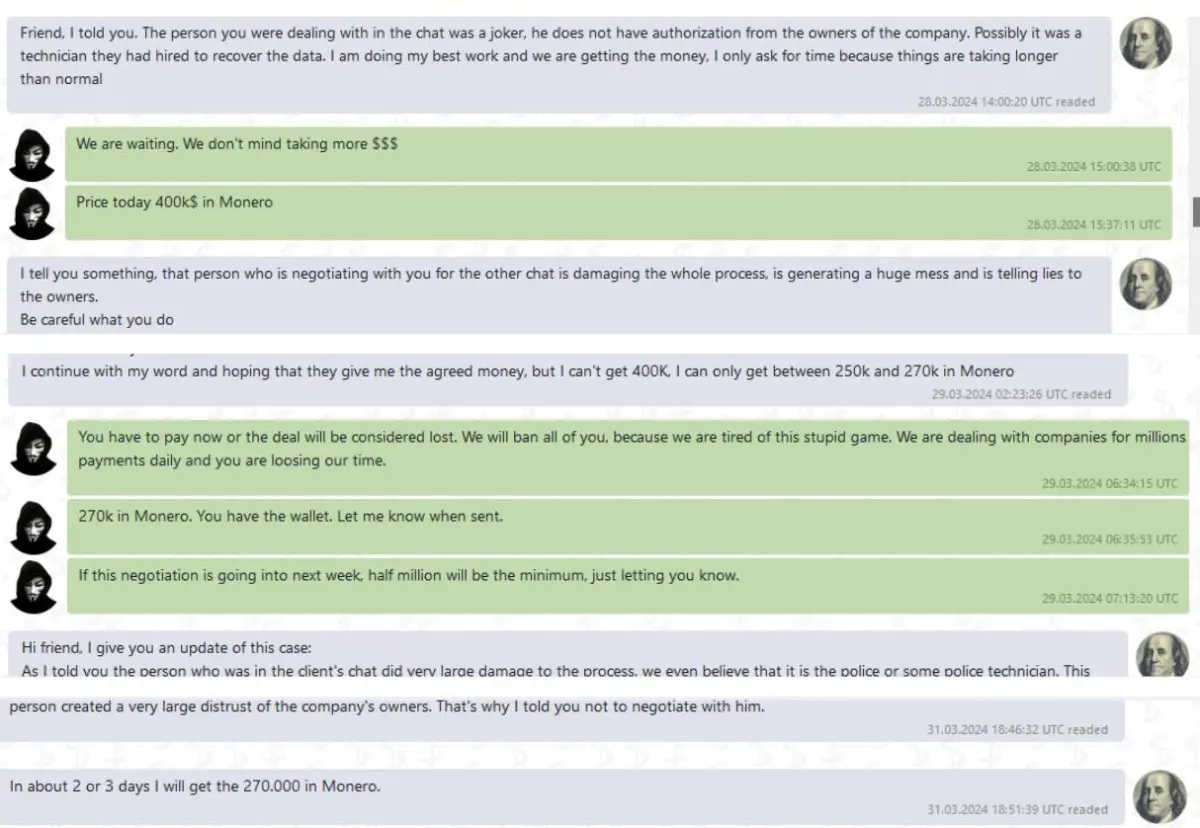
However, forensic analysis of a backup snapshot revealed a surviving ransom note. When Soteria connected to the LockBit chat server using the provided credentials, they discovered that someone—specifically, Palacio’s team—had already been secretly negotiating with the gang for days.
Chat logs show RansomwareHelp desperately pleading with the LockBit operators to keep their involvement a secret:
"I tell you something, that person who is negotiating with you for the other chat is damaging the whole process," RansomwareHelp wrote to LockBit, frantically trying to stave off confusion. "Please do not change the price. I am doing my best to achieve it."
Ultimately, the accounting firm ignored RansomwareHelp’s inflated $438,000 quote, followed Soteria’s advice, and engaged a reputable incident response firm. They successfully recovered their data by paying the actual extortionists roughly half of what Palacio’s firm had demanded.
Official Statements and Industry Fallout
The indictment of Juan Ricardo Palacio Escobar is not an isolated incident. It highlights a burgeoning focus by the U.S. Department of Justice on corrupt actors masquerading as legitimate cyber defense firms. The broader enforcement landscape reflects a coordinated federal effort to cleanse the cybersecurity ecosystem of parasitic intermediaries.
The Edward Dubrovsky Case: In early October, federal authorities charged 54-year-old Edward Dubrovsky, an executive at Canadian cybersecurity firm Cybersteward, with cyber extortion and conspiracy. While details remain partially sealed, the indictment signals a growing intolerance for executives crossing ethical and legal boundaries during crisis negotiations.
MonsterCloud CEO Indicted: Around the same time, the DoJ dropped wire fraud and conspiracy charges against Zohar Pinhasi, the 50-year-old CEO of Florida-based remediation firm MonsterCloud. Charging documents revealed that Pinhasi allegedly collected $19 million from corporate clients under the guise of non-payment remediation, while secretly paying hackers $8 million behind their backs.
Angelo Martino Sentenced: In July, the federal crackdown yielded a stark prison sentence for 41-year-old ransomware negotiator Angelo Martino. Martino was sentenced to 70 months behind bars for conspiring directly with the BlackCat/ALPHV ransomware gang. Investigators proved Martino had leaked confidential client negotiation strategies back to the hackers, actively helping the cybercriminals maximize their extortion payouts at the expense of his own employers’ clients.
These coordinated actions signal a paradigm shift: federal prosecutors are treating corrupt remediation firms not merely as shady business operations, but as co-conspirators in cyber extortion schemes.
Future Outlook: Protecting Organizations from Predator Intermediaries
The exposure of ransomwarehelp.com and its contemporaries serves as a stark warning to businesses worldwide. As ransomware threats continue to evolve, the market for incident response and remediation services has ballooned into a multi-billion-dollar industry, inevitably attracting bad actors looking to exploit the panic of vulnerable executives.
Moving forward, corporate boards, Chief Information Security Officers (CISOs), and legal teams must exercise rigorous due diligence when selecting third-party partners to handle cyber incidents. Key preventative measures include:
Verifying Industry Accreditation: Relying on vetted, reputable incident response firms recognized by cyber insurance providers and recognized industry bodies (such as CREST or Mandiant).
Maintaining Direct Oversight: Demanding absolute transparency in communications with threat actors. Legitimate negotiators should never hide ransom note communications or block victims from reviewing direct dialogue transcripts.
Skepticism of "Magic Bullet" Claims: Any firm that guarantees a 100% data recovery rate without consulting the specific cryptographic mechanics of a unique ransomware variant should be treated as an immediate red flag.
The takedown of Juan Ricardo Palacio Escobar and the shuttering of ransomwarehelp.com demonstrate that while digital extortionists remain a pervasive global threat, the shadowy middlemen who feed off corporate desperation are increasingly finding themselves in the crosshairs of federal law enforcement.