Executive Overview
It is a well-established rite of passage in the modern fashion landscape that emerging designers require several seasons to calibrate their creative compass. Industry observers have long grown accustomed to extending a generous margin of error to debutants navigating the grueling, high-stakes marathon of international fashion weeks. We forgive the occasionally frayed hemline, the precarious footwear scaling heights far beyond a model’s stability, or the narrative disjointedness born from the sheer, industrial-scale velocity of the contemporary design cycle. The demands placed upon young creative directors today are nothing short of crushing, often turning the runway into an incubator for unfinished thoughts.
Yet, every so often, a disruptor bypasses the probationary period entirely.
Enter Petra Fagerström. The Swedish-born designer commanding the attention of the international style capitals delivered an on-schedule runway debut at London Fashion Week’s NEWGEN show space inside 180 Strand that completely obliterated expectations. Marking a monumental step up from her celebrated presentation format just a season prior, Fagerström’s catwalk outing was remarkable not for its raw potential, but for its astonishing precision. In an industry obsessed with the polished and the provisional, Fagerström presented a collection that was virtually flawless—not in the sense of sterile corporate luxury, but in the rigorous execution of a complex, highly intellectual design thesis.
Stepping onto the schedule for Day Two of London Fashion Week AW26, Fagerström did not merely present clothes; she mounted a full-scale ideological critique. Trading the stark, crystalline memories of her competitive ice-skating past—which heavily informed her inaugural winter outing—for the stifling, sun-drenched anxieties of a psychological thriller, the designer delivered Swedish Summer. Evoking comparisons ranging from Ari Aster’s sun-bleached folk horror Midsommar to Olivia Wilde’s psychological critique Don’t Worry Darling, Fagerström’s latest collection is a masterclass in subversion.
By dissecting the architectural signifiers of 1940s and 1950s hyper-femininity, the designer took direct aim at the contemporary "tradwife" aesthetic and the insidious commodification of female purity. Through clever manipulations of mid-century silhouettes, uncanny trompe l’œil printwork, and a sharp visual pushback against the flatness of AI-generated imagery, Fagerström proved that she is not merely participating in the fashion conversation—she is actively rewriting its vocabulary.
Detailed Chronology: Inside the 180 Strand NEWGEN Showcase
The atmosphere inside the brutalist corridors of 180 Strand on Day Two of London Fashion Week crackled with a distinct sense of anticipation. Unlike the sprawling, theatrical warehouse spaces favored by heritage houses, the NEWGEN incubator environment forces an intimate, almost clinical proximity between the garments and the audience. For Fagerström, this architectural constraint proved to be an asset. There was nowhere to hide poorly constructed seams or derivative tailoring, and the designer wisely chose to showcase an unyielding mastery of craft.
Setting the Stage: From Ice Rinks to Psychological Thrillers
To understand the architecture of Swedish Summer, one must trace the trajectory of Fagerström’s brief but impactful career. Her graduate collection at Central Saint Martins established her penchant for weaponizing garments against patriarchal archetypes. Last season, she leaned heavily into her formative years as a competitive ice dancer, exploring the tension between the rigorous, hyper-controlled discipline of the sport and the organic fragility of the human body moving across ice.
For her AW26 runway debut, the tonal shift was palpable. Despite the titular reference to Swedish Summer—a geographic and seasonal concept that immediately sent satirical shockwaves through Scandinavian pop culture circles—the collection bore little resemblance to the rustic floral garlands of traditional Nordic folklore. Instead, Fagerström channeled the claustrophobic dread of a suburban dystopia.
"I want to create a woman who fractures the ideals of purity, passivity, and cleanliness tied to the image of a ‘traditional wife,’" Fagerström noted in interviews following her breakthrough CSM graduate showcase. That conceptual ambition crystallized under the spotlights of 180 Strand, translating abstract sociological critique into tangible, wearable art.
The Runway Narrative: Silhouette, Subversion, and the Dior Bar Jacket
The collection opened with a series of looks that directly engaged with the sartorial armor of the post-war era. Fagerström dissected the 1940s and 1950s hourglass silhouette—the very blueprint of domestic obedience characterized by cinched waists, voluminous full skirts, and an emphasis on passive grace.
Most notably, the designer offered a radical, deconstructed interpretation of Christian Dior’s legendary Bar jacket. Originally introduced in 1947 as the anchor of the "New Look," the Bar jacket celebrated a return to traditional, highly structured luxury and ultra-defined curves after the austerity of World War II. In Fagerström’s hands, this symbol of post-war domestic restoration was subjected to a digital and psychological glitch. Shoulders were exaggerated, waists were cinched to discomforting degrees, and fabrics behaved in ways that defied traditional tailoring logic.
As the models strode down the runway, the narrative of the Swedish Summer protagonist began to unfold. Much like Florence Pugh’s character Alice in Don’t Worry Darling, who slowly realizes that her utopian 1950s desert community is built on a foundation of systemic control and digital-age illusion, the Fagerström woman began to unravel.
This unravelling was not depicted as a tragedy, but as a liberation.
The Digital Glitch and Trompe L’œil Tech
One of the most technically accomplished elements of the AW26 collection was Fagerström’s commentary on contemporary visual culture, specifically the rise of artificial intelligence. In an era where digital Moodboards and generative AI tools flood the internet with frictionless, hyper-smoothed imagery devoid of human friction, Fagerström pushed back through material manipulation.
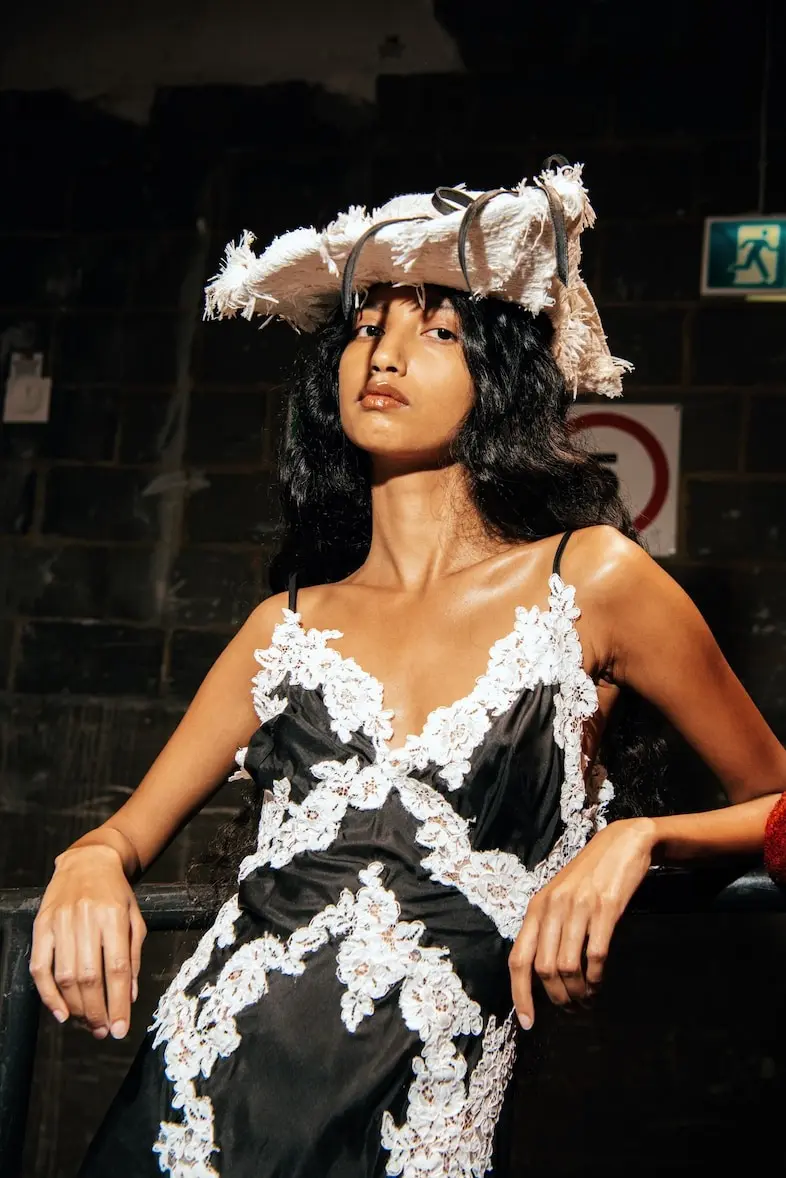
She incorporated intricate trompe l’œil prints—optical illusions painted or printed onto fabrics to deceive the eye—alongside garments that appeared unnaturally stuck together, as if rendered by a malfunctioning algorithm. Seams manifested where they had no structural business being; prints warped across the bias of the fabric, mimicking the digital artifacts of a corrupted file.
This aesthetic of the "glitch" served as the conceptual heart of the show. By visually breaking down the garments, Fagerström argued that true humanity—and true radical femininity—exists precisely in our capacity to malfunction, to resist seamless integration, and to reject the impossible cleanliness demanded by modern society.
Supporting Context & Metrics: The NEWGEN Engine and the Rise of Fagerström
To fully appreciate the gravity of Petra Fagerström’s runway debut, one must examine the broader economic and cultural machinery supporting her ascent. London Fashion Week’s NEWGEN scheme, supported by the British Fashion Council (BFC) and luxury online retailer BFC NEWGEN Patronage, remains the gold standard for incubating avant-garde design talent globally.
The Economics of Emerging Design
The financial realities facing young designers in the post-pandemic landscape are daunting. Soaring fabric costs, supply chain bottlenecks, and the steep overhead of staging a physical runway presentation have forced many independent brands into digital-only formats or premature liquidation. For Fagerström, securing a coveted slot on the NEWGEN roster provided not only financial subsidy but critical infrastructural support—from production logistics to global PR positioning.
| Metric / Indicator | Contextual Overview | Industry Impact |
|---|---|---|
| Platform | NEWGEN Show Space (180 Strand) | Provides institutional validation and high-visibility buyer access. |
| Design Heritage | Central Saint Martins (CSM) | Cultivates rigorous conceptual frameworks and technical tailoring foundations. |
| Collection Focus | AW26 (Swedish Summer) | Shifts from niche autobiographical narratives (ice dancing) to broader socio-political critiques. |
| Media Resonance | High digital engagement via trompe l’œil and viral thematic nods (tradwife critique). | Drives high Earned Media Value (EMV) essential for commercial backing. |
The Sociological Backdrop: The "Tradwife" Phenomenon
Fagerström’s timely fixation on the "tradwife" (traditional wife) subculture is not occurring in a vacuum. Over the past three years, social media platforms—particularly TikTok and Instagram—have witnessed a surge in content creators championing hyper-traditional gender roles, domestic labor, and retro aesthetics. Characterized by baking sourdough from scratch, wearing pristine floral dresses, and espousing the virtues of subservience to male breadwinners, the movement has sparked intense cultural debate.
While proponents view the lifestyle as an aesthetic rebellion against corporate burnout and the pressures of modern hyper-independence, critics argue it is a Trojan horse for regressive patriarchal ideologies and whitewashed historical revisionism.
By taking the sartorial markers of this movement—the hourglass dresses, the pristine pastels, the architectural precision of 1950s couture—and deliberately "glitching" them, Fagerström performs a vital cultural intervention. She exposes the underlying authoritarianism of the aesthetic by visualizing its inevitable mechanical and psychological collapse.
Official Statements & Industry Reception
The immediate critical response to Swedish Summer solidified Fagerström’s transition from a promising CSM graduate to a formidable creative force on the international calendar. Buyers, critics, and editors alike praised the intellectual depth underpinning the aesthetic execution.
Decoding the Designer’s Intent
In backstage commentary following the show, Fagerström elaborated on her fascination with systemic control and the cracks within idealized imagery:
"We live in a culture that demands female perfection on an algorithmic scale. Whether it’s the historical fantasy of the 1950s housewife or the terrifyingly clean, frictionless output of artificial intelligence, we are constantly being sold an image of passivity. My goal with this collection was to take those pristine structures—the Bar jacket, the hyper-cinched waist, the pastel innocence—and introduce a systemic failure. The woman I am dressing is breaking the mold by breaking down."
Industry veterans noted the rarity of a designer executing such a complex conceptual brief with such material maturity so early in their career. Unlike many debut collections that rely on shock value or heavy-handed styling to mask technical deficiencies, Fagerström’s garments stood on their own architectural merit.
Critical Acclaim from the Front Row
Prominent fashion critics highlighted the collection’s duality—its ability to balance severe intellectual critique with highly commercial, covetable separates. While the conceptual trompe l’œil pieces and distorted hourglass gowns dominated the runway discourse, the underlying tailoring—the sharp lapels, the restructured suiting, and the impeccably draped knitwear—pointed toward a brand capable of building a sustainable, multifaceted luxury business.
Buyers from premier international stockists noted a palpable shift in energy during the presentation, observing that Fagerström’s clothes addressed a distinct gap in the current market: intellectual womenswear that refuses to take itself too seriously, yet maintains an uncompromising standard of execution.
Future Outlook: Petra Fagerström’s Trajectory Beyond AW26
As the dust settles on London Fashion Week AW26, the question facing the international fashion community is no longer whether Petra Fagerström has potential, but how she plans to scale her distinct brand of disruptive design.
Scaling the Brand: Commercial Viability vs. Avant-Garde Integrity
The primary challenge for any designer emerging from the NEWGEN incubator is bridging the gap between runway conceptualism and commercial reality. Fagerström’s integration of digital motifs and historical subversion has struck a chord with digital-native consumers and fashion purists alike, but translating runway spectacles into retail success requires rigorous supply chain management and strategic wholesale partnerships.
However, her background in technical tailoring—honed through her rigorous academic training and her obsessive material investigations—positions her well for sustainable growth. By balancing high-concept runway pieces with wearable, structurally subversive everyday garments (such as her re-engineered suiting and knitwear separates), Fagerström has created a viable dual-track product offering.
The Next Frontier: Expanding the Narrative
With Swedish Summer, Fagerström has successfully expanded her narrative universe beyond the insular confines of her personal history. Having moved from the pristine ice rinks of her youth to the suffocating suburban lawns of 1950s psychological thrillers, her upcoming collections are anticipated to continue interrogating the architectures of control.
As artificial intelligence continues to reshape the visual arts and traditional gender politics remain a fierce ideological battleground, Fagerström’s voice is not merely timely—it is necessary. Her work reminds the fashion industry that clothes are never just clothes; they are ideological frameworks, political statements, and psychological maps.
Petra Fagerström has arrived, flaws and all—though in a world so desperately clinging to artificial perfection, her brilliant, calculated malfunctions are precisely what we need.