Executive Overview
In the modern software-as-a-service (SaaS) landscape, few paradigms have been heralded with as much blind reverence as the Freemium and Product-Led Growth (PLG) model. For over a decade, startups have operated under the assumption that offering a robust, frictionless, zero-dollar tier is the definitive shortcut to viral scale, hockey-stick growth, and unicorn valuation. However, according to industry veterans and recent market data, this dogma is cracking.
Freemium does not always work. In fact, when deployed incorrectly, it can act as a massive drag on resources, pulling engineering focus away from enterprise monetization and masking fundamental product-market fit issues with vanity metrics.
As SaaS powerhouse and SaaStr founder Jason Lemkin bluntly notes:
"For Freemium and PLG to work at scale, you probably need millions of folks to use your product. If it’s 1,000s… then go sell it."
This investigative analysis delves into the economic realities of the freemium model, examining why it fails for niche products, analyzing the hybrid success stories of market giants like Zoom, Asana, and MongoDB, and providing a framework for founders to decide whether they should give their software away—or start selling it from day one.
Detailed Chronology: The Rise, Fall, and Realities of PLG
The Genesis of the Free-To-Scale Era
The freemium playbook gained massive traction in the late 2000s and early 2010s, riding the wave of consumerized enterprise software. Companies like Dropbox, Slack, and Evernote proved that if a product was intuitive enough, users would adopt it personally, bring it into their workplaces, and eventually force their IT departments to purchase enterprise licenses—a phenomenon known as the "bottom-up" motion.
During this era, VCs and tech accelerators aggressively pushed founders to implement free tiers. The prevailing wisdom suggested that marketing budgets should be replaced entirely by product utility. If a tool was good enough, acquisition would take care of itself.
The Correction: Freemium Is Not a Marketing Strategy
As the macroeconomic climate shifted in the early 2020s, the cracks in this philosophy began to show. Startups building high-complexity, low-volume enterprise software realized that acquiring thousands of free users who would never upgrade was an expensive distraction.
By late 2023, industry leaders began pushing back against the narrative that freemium was mandatory. As Lemkin highlighted in widely circulated commentary: "Freemium Is Not a Marketing Strategy."
Even masterclasses of SMB software, such as Monday.com and HubSpot, deliberately delayed launching free tiers. Monday.com, for instance, famously waited until just before its blockbuster IPO to introduce a true free plan. They built a massive, multi-hundred-million-dollar ARR business relying primarily on sales-assisted and targeted self-serve paid motions long before giving away the keys to the kingdom.
[Traditional Top-Down Sales] ---> High-Touch, High Price Point (Enterprise)
[Product-Led Growth (PLG)]    ---> Millions of Users, Low Price Point (Mass Market)
[The Hybrid Reality]         ---> Self-Serve Acquisition + Dedicated Enterprise Sales
Supporting Context & Metrics: When Freemium Works (And When It Doesn’t)
To understand whether freemium makes sense for a specific business model, leaders must examine the scale of their potential total addressable market (TAM). Freemium math is ruthless: conversion rates from free-to-paid typically hover between 1% and 5%.

If your software solves a specialized workflow for a niche industry—say, compliance management software for maritime logistics firms—there may only be a few thousand potential buyers globally. If you offer a free tier to a universe of 5,000 prospects, a 2% conversion rate yields just 100 paying customers. At standard SMB price points, that business dies a quiet death.
The Hybrid Playbook: Lessons from Zoom, Asana, and MongoDB
While pure-play freemium is difficult to execute, companies that utilize hybrid monetization models often achieve staggering scale. The data from major tech IPOs demonstrates that freemium does not have to be an all-or-nothing proposition to deliver explosive growth.
1. Zoom: The Power of the Free Session
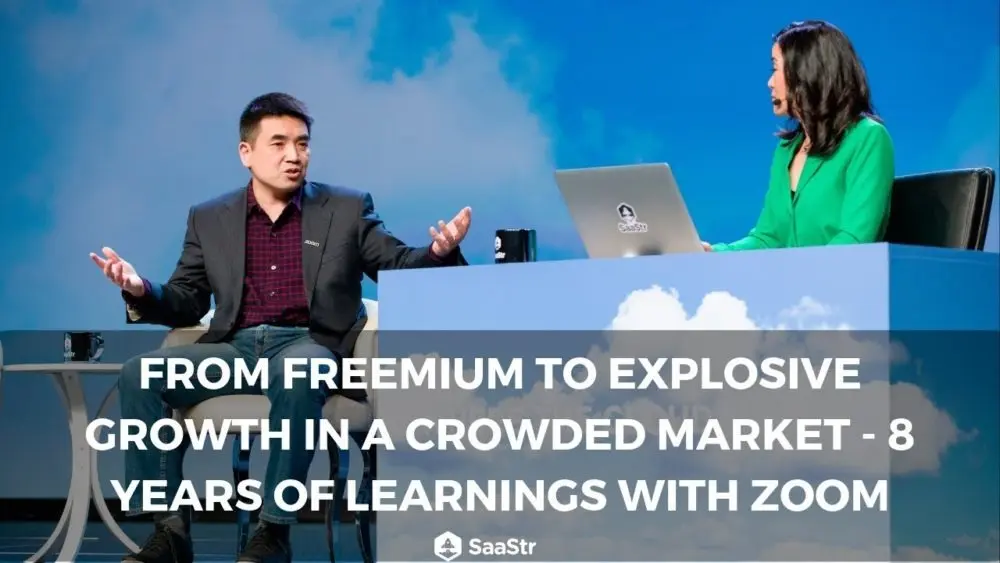
At the time of its initial public offering, video communications titan Zoom generated roughly 55% of its total customers via free initial sessions. However, the remaining 45% of customers converted directly to paid plans without ever utilizing a persistent free tier. Zoom proved that free experiences can act as a potent trust-builder, but enterprise monetization can happen in parallel through direct sales and targeted tiering.
2. Asana: Balancing Self-Serve and Enterprise Sales
Work management platform Asana took a similarly balanced approach. At its IPO, Asana reported that 60% of its customers originated through self-serve channels, while 40% were driven by its dedicated enterprise sales team. Without the self-serve engine feeding the top of the funnel, Asana’s user acquisition costs would have been prohibitively high, yet the enterprise sales force was essential for landing high-value, multi-seat contracts.
3. MongoDB: Developer-Led Enterprise Scale
Database giant MongoDB shattered the myth that infrastructure software cannot be product-led. At its IPO, an astounding 85% of MongoDB’s customers were self-serve. This highlights a critical truth: developer-focused (B2D) models thrive on frictionless adoption. Engineers want to test, deploy, and validate code before talking to a salesperson. Yet, once those developers scaled their applications, MongoDB’s enterprise sales motion stepped in to upsell them into massive, six-figure database contracts.
Official Statements and Industry Insights
The debate over product-led growth versus sales-led growth continues to dominate executive boardrooms. Industry leaders emphasize that the choice of distribution model must be dictated by product complexity and target audience size, rather than current Silicon Valley trends.
"If you can’t pull off both massive top-of-funnel volume and extreme product simplicity, you’ll most likely need a product with a higher price point and a sales-driven model to support it," industry experts reiterate.
Furthermore, data suggests that even a modest contribution from a freemium or self-serve channel can alter a company’s trajectory. Companies that secure just 8% to 10% of their total customer base from a freemium tier often experience a compounding growth flywheel that lowers overall Customer Acquisition Cost (CAC) and accelerates brand awareness.
However, founders are continually warned against treating freemium as a cure-all for a weak value proposition. If users do not find immediate, compounding value in the paid product, a free tier simply accelerates the rate at which they discover that the software does not solve their core problems.
Future Outlook: The Next Generation of SaaS Go-To-Market Strategies
As we look toward the future of software distribution, the binary choice between "pure enterprise sales" and "pure freemium PLG" is dissolving. The winning playbook for the next decade is nuanced, adaptable, and deeply hybrid.
- AI-Driven Personalization and Paywalls: Artificial intelligence tools are changing how software is demonstrated. Instead of relying on static free tiers that give away core features, future SaaS companies will utilize hyper-personalized, AI-guided interactive demos that simulate value before requiring installation or long-term free access.
- Usage-Based and Hybrid Pricing Models: Modern buyers dislike rigid seat-based pricing. Combining a lightweight trial with usage-based metrics (such as API calls, data processed, or generative tokens consumed) aligns the free-to-paid transition directly with customer value realization.
- Intent-Driven Sales-Assisted PLG: Rather than waiting passively for free users to upgrade via self-serve prompts, modern PLG engines use telemetry data to flag high-intent accounts and route them immediately to human sales representatives for expansion conversations.
Conclusion
Freemium is a powerful tool, but it is ultimately just one mechanism in a broader go-to-market toolkit. For startups with millions of potential users, a well-executed free tier can build an unassailable competitive moat. But for those operating in niche markets with specialized, high-ticket offerings, the smartest move isn’t to give the product away—it is to pick up the phone, pitch the value, and go sell it.