Executive Overview
Everyone carries a distinct, deeply ingrained mental image of Gucci. Second only to Louis Vuitton in the dubious global honor of being the world’s most-copied luxury brand, Gucci occupies a singular, almost mythic space in the cultural consciousness. For millions across the globe, the illegal counterfeit trade serves as their foundational introduction to the Italian powerhouse—whether they possess the discernment to recognize a genuine article from a street-market knock-off or not.
While mass-market piracy is ostensibly detrimental to the financial and exclusivity metrics of any heritage luxury label, it paradoxically yields an unprecedented breadth of cultural awareness. Fakes, in a strange economic dialectic, often validate the aspirational value of the real thing. Gucci’s universal resonance ensures that a TikTok-native teenager can conjure its visual iconography as effortlessly as an octogenarian aristocrat. Whether one encounters the brand through the lens of hip-hop lyricism, the hedonistic Tom Ford era, Harry Styles’ gender-fluid pop peacocking, or its foundational equestrian heritage, there is a version of Gucci tailored to nearly every demographic.
On September 25, against the electric backdrop of Milan Fashion Week, creative director Demna embraced every single one of these divergent Gucci stereotypes for his Spring/Summer 2027 (SS27) collection. Paying profound, yet subversive, homage to the eclectic pantheon of characters that have forged the house’s century-long legacy—ranging from the tracksuit-clad, codeine-sipping 20-year-old trap rapper to the impossibly chic, fur-draped Italian nonna—Demna delivered what industry insiders are already calling his most complete and authoritative statement for the house yet.
“Gucci moves easily between aristocracy and pop culture,” the Georgian designer explained in pre-show notes. “Florence and Hollywood, good taste and bad taste [whatever that subjective term even means], heritage and mass desire, belonging and rebellion.”
Marking his third season at the helm of the Florentine institution, this presentation represented the first time Demna unleashed his unfiltered, totalized personal vision for the brand. The resulting collection was a masterclass in tension, irony, and elevated tailoring that solidified his grip on contemporary fashion’s steering wheel.
Detailed Chronology: Inside the SS27 Gucci Experience
Front Row Royalty and A-List Spectacle
The Milanese venue itself hummed with palpable anticipation, largely driven by the verified alignment of fashion royalty. Most notably, Donatella Versace cemented her status as an official "Gucci Girl," making a triumphant return to the front row after previously supporting Demna’s explosive AW26 debut in February. Seated alongside fashion icons Mariacarla Boscono and Bianca Jagger, Donatella giggled and traded notes, embodying a rare moment of cross-brand solidarity in an industry usually defined by fierce rivalries.
The broader audience read like a curated cross-section of modern celebrity. Cardi B made a characteristically grand, theatrical entrance wrapped in a blinding white faux-fur puffball coat, spinning for a swarm of ravenous, gannet-like photographers. Meanwhile, Homer Gere—fresh from the gritty, highly anticipated set of The Shards—rubbed shoulders with Hollywood heavyweights Edward Norton and Camila Morrone, alongside boundary-pushing music polymath Arca and pop-culture staple Romeo Beckham.
The Retail Architecture of the Runway
Demna’s conceptual world-building is legendary, and for SS27, he constructed an elaborate, hyper-realistic Gucci flagship store right in the heart of the show space. Complete with fully stocked, shoppable merchandise racks, pristine try-on areas, and stony-faced security guards manning the entry points, the set blurred the lines between consumerism and performance art.
The runway officially commenced when a security guard unlocked the main glass doors, letting models stream inward as if they were everyday, albeit impossibly striking, customers. In the background, a painstakingly constructed faux exterior provided glimpses of a bustling, chaotic Milanese street, with background models darting back and forth like urban commuters trying to catch a train or secure an espresso. Adding to the uncanny valley of high-end retail, the soundtrack was entirely instrumental—a bespoke, slightly sterile loop of Demna-fied elevator music that reinforced the themes of mass consumption and luxury accessibility.
A Tale of Two Halves: Menswear Breakdown
In a departure from the industry-standard mixed-gender runway format—where designers typically intersperse men’s and women’s looks to create a narrative dialogue—Demna opted for a rigid, bifurcated structure. Menswear led the charge, unfolding as a chronological and stylistic timeline of male archetype evolution within the Gucci universe.
Proceedings kicked off with a volley of razor-sharp, monochromatic tailoring. These looks were anchored by dark, aggressive rectangular sunglasses that served as a direct love letter to Tom Ford’s hyper-sexualized, sleazy-chic 1990s tenure at Gucci. As the show progressed, shoulders widened significantly and waistlines hitched upward, hurtling the audience back into the 1980s power-dressing era so vividly captured in Bret Easton Ellis’s The Shards.
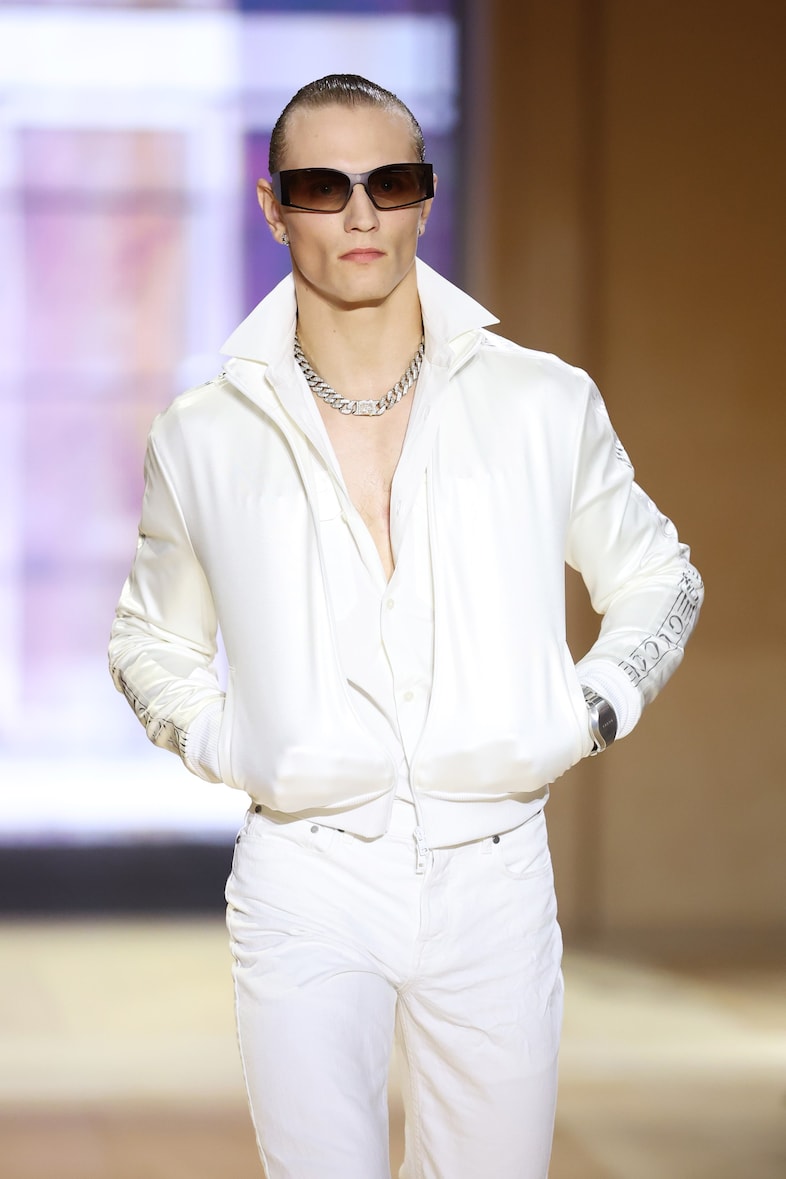
Midway through the menswear sequence, two distinct looks commanded absolute attention: a pristine white silk bomber jacket followed immediately by its tactical twin in slick, supple black leather. Both models sported oversized, shield-like shades, while one accessorized with a heavy, diamond-cut silver chain—an unmistakable nod to the logo-obsessed, early-2000s grifter trying to offload counterfeit leather goods from the trunk of a battered sedan.
As the menswear segment reached its climax, Demna pivoted to contemporary youth culture, showcasing how Gen-Z musicians (such as recent Gucci collaborators fakemink and Nettspend) currently interpret the house’s codes. These looks were slouchy, aggressively undone, and sliding off the body, styled with smeared emo eye makeup and backwards-flipped caps.
From Equestrian Roots to Mob-Wife Glamour: Womenswear Breakdown
When the womenswear chapter commenced, the narrative looped backward to Gucci’s foundational genesis. Founded in Florence in 1921 as an artisanal leather goods and luggage workshop that originally catered to elite equestrians with custom horse harnesses, the house’s history was directly referenced in the opening women’s look: a pristine, jockey-inspired ensemble.
This equestrian purity was swiftly succeeded by the sartorial uniform of an affluent Cheltenham mother. Yet, that upper-crust gentility was almost immediately eclipsed by a cavalcade of older female models embodying the ultimate archetype of the wealthy, unapologetic Italian nonna. Seated nearby, Bianca Jagger observed with evident pride, leaning on her cane as generations of female power marched past.
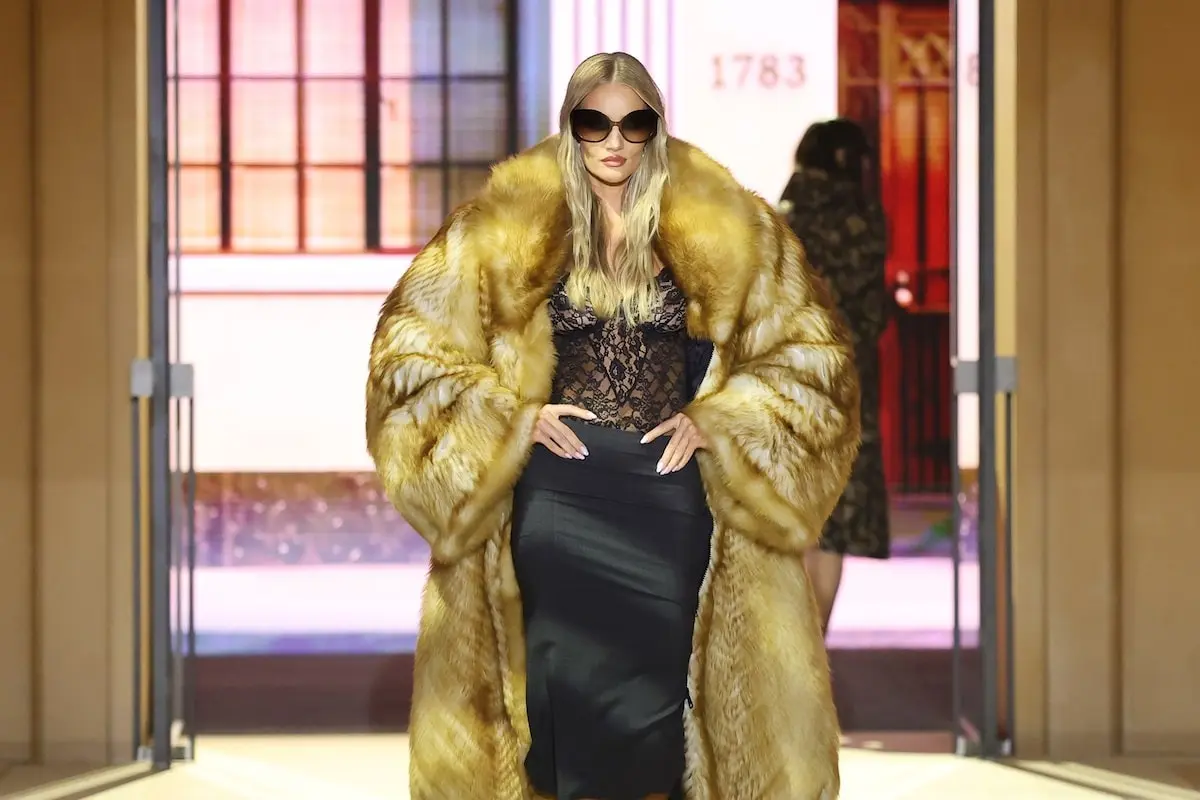
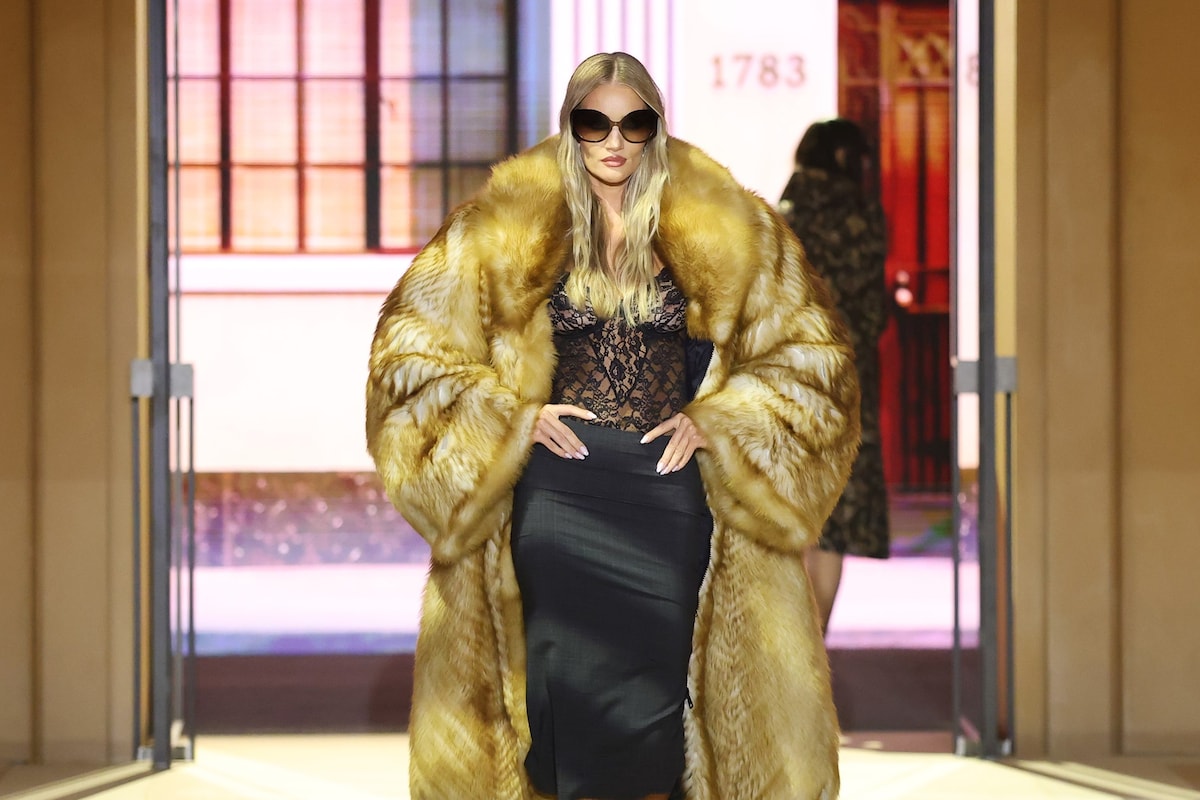
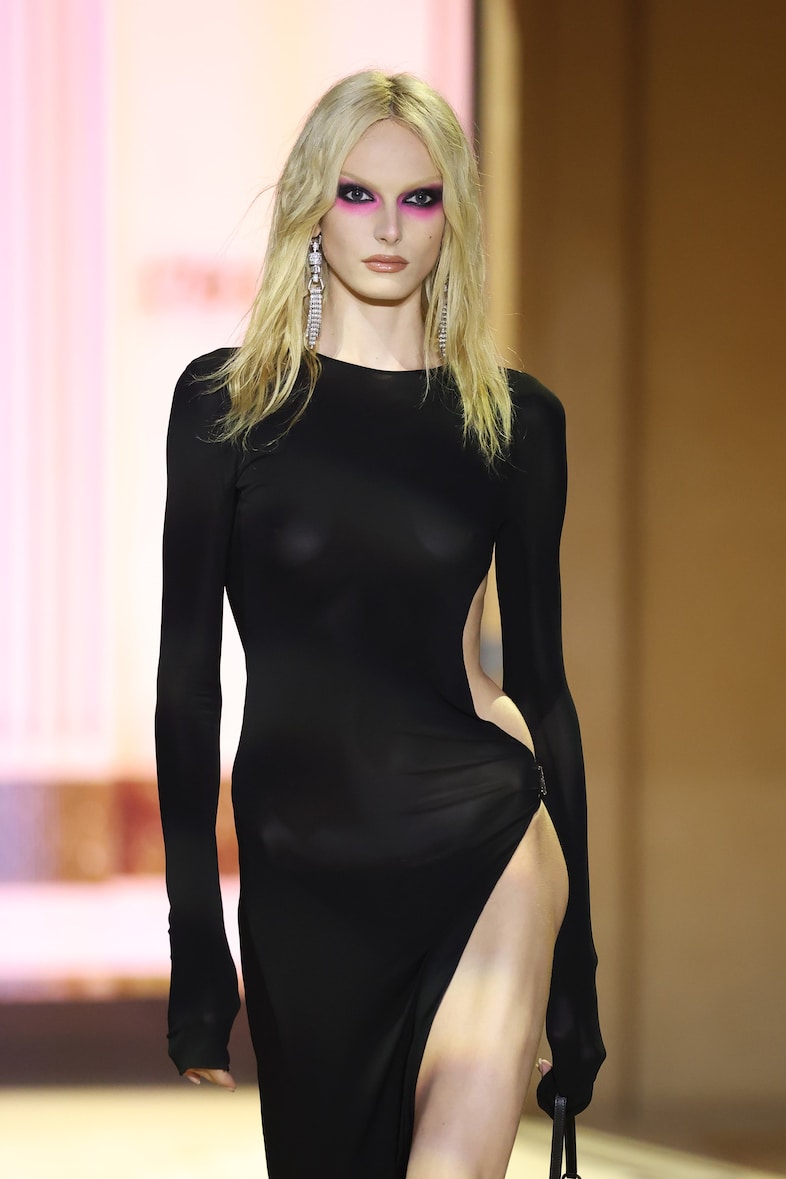
The grand finale was an explosive celebration of after-hours hedonism. Alex Consani commanded the runway in a gossamer-thin black dress that served as a modern, deconstructed homage to Tom Ford’s iconic white cut-out gowns from Autumn/Winter 1996. Meanwhile, supermodels Rosie Huntington-Whiteley, Anok Yai, and Candice Swanepoel closed out the show dripping in Demna’s signature exaggerated, "mob-wife-hits-the-club" aesthetic, encased in shimmering sequins and dramatic outerwear.
Supporting Context & Metrics: The Business of Subversion
To truly understand the brilliance of Demna’s SS27 collection, one must examine the macroeconomic realities facing Kering, Gucci’s parent conglomerate. Following a turbulent period of leadership transitions and shifting consumer demands, Gucci has been under intense pressure to recapture its cultural dominance and arrest declining retail margins.
Industry analysts tracking Milan Fashion Week noted that Demna’s strategy relies heavily on "ironic luxury"—a sociological phenomenon where high-fashion houses lean into their own bootleg culture, mass-market ubiquity, and historical baggage rather than running away from them.
- The Counterfeit Economy: According to recent estimates by the European Union Intellectual Property Office (EUIPO), the global market for counterfeit luxury goods accounts for upwards of $450 billion annually, with leather goods and apparel leading the charge. Gucci remains the second-most counterfeited brand globally, a statistic Demna weaponized on the runway by explicitly designing garments that mimicked the aesthetic of street-corner bootlegs.
- Social Media Impact: Early digital metrics from Launchmetrics indicate that the SS27 show generated an estimated $14.2 million in Media Impact Value (MIV) within the first 12 hours alone, driven largely by front-row heavyweights like Donatella Versace, Cardi B, and viral runway models like Alex Consani.
- Commercial Viability: Unlike the avant-garde conceptualism of his early career, Demna’s work at Gucci strikes a calculated balance between runway spectacle and high-sell-through retail items. The inclusion of wearable, everyday pieces—such as the monochromatic tailoring, silk bombers, and classic leather accessories—ensures that the brand’s commercial pipeline remains robust for both traditional luxury buyers and younger, trend-driven consumers.
Official Statements and Critical Reception
The industry response to Demna’s third outing has been overwhelmingly positive, signaling a maturing of his tenure at Gucci. While his initial debut was met with cautious curiosity, SS27 has been widely hailed as the moment he successfully harmonized his signature dystopian streetwear ethos with Gucci’s rich, maximalist heritage.
"Gucci moves easily between aristocracy and pop culture," Demna stated in his post-show manifesto. "Florence and Hollywood, good taste and bad taste [whatever that means], heritage and mass desire, belonging and rebellion. This collection is an inventory of those contradictions."
Fashion critics across major publications echoed this sentiment, praising the designer’s ability to bridge generational divides. Writing for trade and consumer publications alike, reviewers highlighted the clever integration of historical house codes—from the 1990s Tom Ford sleaze to 1920s equestrianism—with contemporary youth culture references.
"Demna has stopped trying to reinvent the wheel at Gucci and has instead decided to drive every single car in the parking lot at once," noted one prominent fashion critic backstage. "It shouldn’t work on paper, but on the runway, it is an undeniable triumph of curation and tailoring."
Future Outlook: Where Does Gucci Go From Here?
As Milan Fashion Week draws to a close, the implications of Gucci SS27 will reverberate across the global luxury market for months to come. Demna has successfully proven that a heritage brand does not need to sanitize its history, nor does it need to ignore its presence in the underground economy of knock-offs and pop-culture memetic framing. By embracing the full spectrum of its identity—from the aristocratic nonna to the trap rapper, from the elite horse-riding founder to the early-2000s street hustler—Gucci has reclaimed its status as the most culturally conversational brand in fashion.
Looking ahead toward the commercial rollout of the SS27 collection in early 2027, all eyes will be on Kering’s retail performance reports to see if this critical acclaim translates directly into sustained sales growth. If the energy inside the Milanese show space—and the deafening roar of the flashbulbs greeting Donatella Versace and Cardi B—is any indication, Gucci’s bold, chaotic, and utterly fearless reinvention is only just beginning.