Executive Overview
In the rapidly escalating race toward Artificial General Intelligence (AGI), the prevailing industry narrative has long dictated that bigger is better. Multi-hundred-billion-parameter frontier models, backed by hundreds of millions of dollars in compute infrastructure, have dominated the public consciousness. However, a quiet shift in paradigm is emerging from London’s AI corridor.
Inherent, a stealthy artificial intelligence lab founded by alumni of Google DeepMind, recently announced a technical milestone that challenges the brute-force scaling ethos: its newly released AI agent, Faraday, has outperformed top-tier frontier models—including OpenAI’s GPT-5.5 and Anthropic’s Claude Opus 4.8—at independently reproducing published scientific findings without prior hint prompting.
What makes Faraday’s performance remarkable is not merely its success rate, but its computational footprint. Built on top of a modest 27-billion parameter base model (Qwen 3.6), Faraday operates at a fraction of the computational and financial cost of its monumental rivals. Just weeks after coming out of stealth with a $50 million seed capitalization, Inherent is demonstrating that specialized agentic architecture, combined with advanced reinforcement learning, can yield deep reasoning capabilities that surpass monolithic models exponentially larger in scale.
By demonstrating that an AI agent can execute the complex, multi-step scientific workflows typically expected of junior PhD researchers, Inherent is laying the foundation for an ultimate goal: building an autonomous "AI Scientist" capable of discovering entirely original scientific knowledge.
Detailed Chronology: From Stealth to Frontier Breakthrough
+-----------------------------------------------------------------------------------+
| CHRONOLOGY OF INHERENT'S DEVELOPMENT & DISRUPTION                                 |
+-----------------------------------------------------------------------------------+
| 1. FOUNDING PHASE                                                                 |
|    • Four co-founders (including 3 DeepMind alumni) establish Inherent in London. |
|    • Set primary mission: Build an "AI Scientist" capable of novel research.      |
|                                                                                   |
| 2. CAPITAL & EMERGENCE                                                            |
|    • Emerge from stealth securing a $50 Million seed financing round.             |
|    • Establish operating headquarters in London's King's Cross tech hub.          |
|                                                                                   |
| 3. TECHNICAL MILESTONE (FARADAY RELEASE)                                          |
|    • Deploy "Faraday" agent built on a compact 27B-parameter architecture.        |
|    • Benchmark Faraday against OpenAI GPT-5.5 and Anthropic Claude Opus 4.8.      |
|    • Faraday successfully replicates complex published research independently.    |
|                                                                                   |
| 4. SCALE & REGULATORY ADVOCACY                                                    |
|    • Push for labor reforms targeting U.K. "garden leave" policy constraints.     |
|    • Initiate hiring push to double team size (aiming for 20-25 researchers).     |
+-----------------------------------------------------------------------------------+
The DeepMind Pedigree
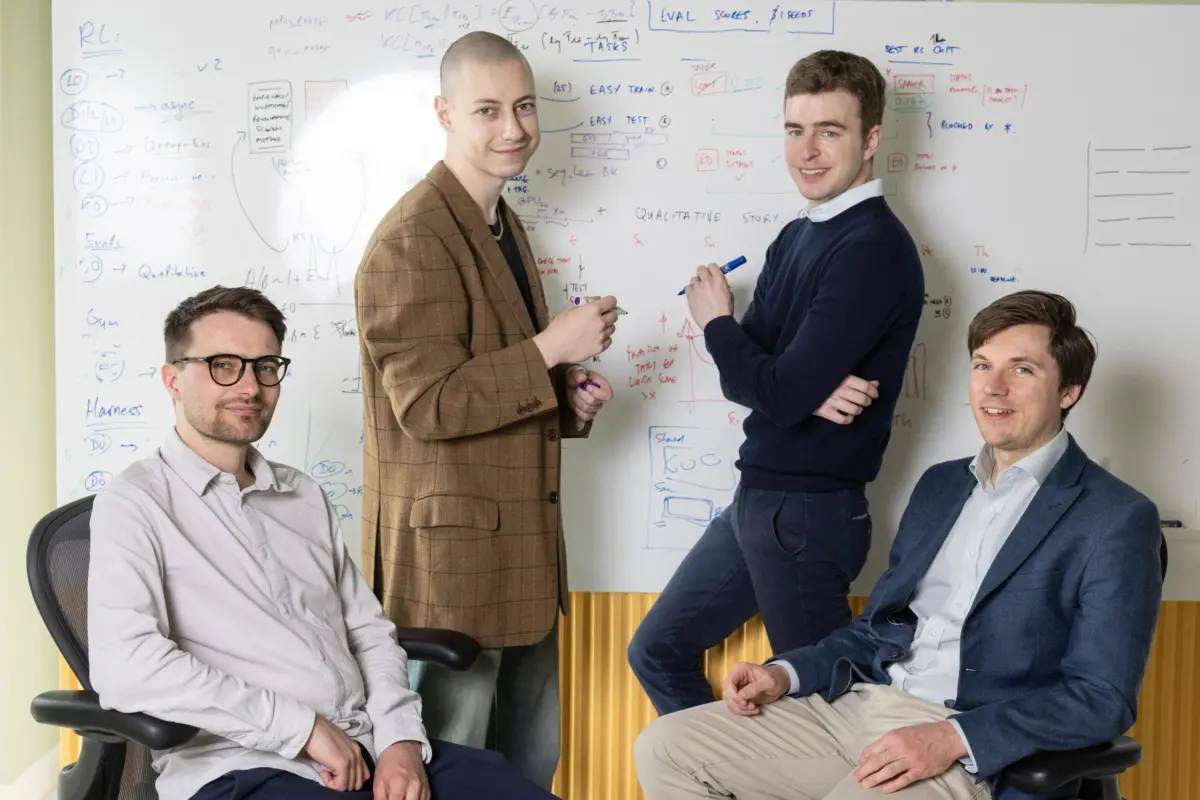
Inherent was founded by a core team of researchers and tech leaders: Louis Kirsch, Kaloyan Aleksiev, Tantum Collins, and Edward Hughes. Drawing on extensive experience within Google DeepMind—the pioneering organization behind AlphaFold and AlphaGo—the team shared a conviction that legacy foundational models, despite their broad conversational dexterity, were fundamentally limited when tasked with rigorous scientific methodology.
While several DeepMind alumni spin-outs raised massive funding rounds on brand prestige alone, Inherent deliberately maintained a low profile during its initial development phase.
The $50 Million Seed Announcement
In mid-2026, Inherent formally emerged from stealth after securing $50 million in seed capital from high-conviction venture funds. Unlike consumer-facing AI startups attempting to build generalist chat interfaces or enterprise productivity plugins, Inherent mapped its capital deployment directly toward compute infrastructure, advanced research, and local talent acquisition in London.
The Unveiling of Faraday
Weeks after its public debut, Inherent published empirical research detailing the capabilities of Faraday, its specialized research agent. Designed specifically to navigate the ambiguities of scientific literature, Faraday was evaluated on its ability to digest published academic papers, extract underlying scientific logic, write code, execute experiments, and verify results autonomously.
When pitted against frontier-class systems, Faraday consistently achieved higher fidelity in reproducing published findings—proving that domain-tuned reasoning and agentic design can outpace sheer parameter size.
Supporting Context & Technical Metrics: Architecture, Efficiency, and ‘Research Taste’
The Economics of Compute: 27B vs. Frontier Scale
In machine learning, parameter count serves as a primary proxy for a model’s size, memory footprint, and training cost. Frontier models such as Anthropic’s Claude Opus 4.8 and OpenAI’s GPT-5.5 rely on massive, distributed compute clusters both during initial pre-training and during real-time inference.
| Metric / Attribute | Inherent’s Faraday | Frontier Model Competitors (e.g., GPT-5.5 / Claude Opus 4.8) |
|---|---|---|
| Base Model Scale | ~27 Billion Parameters (Qwen 3.6 base) | Estimated Hundreds of Billions to Trillions |
| Primary Methodology | Domain-tuned Agentic RL + Targeted Tool Use | Massive Multimodal Scaling & General Fine-Tuning |
| Task Performance | Superior accuracy in paper replication | High baseline accuracy, higher variance in multi-step coding |
| Inference Cost | Low operational footprint / highly efficient | High compute and financial overhead per query |
| Primary Domain Focus | Autonomous Scientific Discovery & World Modeling | General Knowledge, Enterprise Automation, Chat |
By utilizing a lightweight 27-billion parameter base model (Qwen 3.6), Inherent drastically reduces the compute cost per research cycle. This operational efficiency allows Faraday to run thousands of iterative, trial-and-error experiments in parallel—a process that would be cost-prohibitive on massive frontier models.
                  PARADIGM COMPARISON IN AI RESEARCH

   FRONTIER MASSIVE MODELS             INHERENT LIGHTWEIGHT RL AGENT
  +-----------------------+              +-----------------------+
  | Hundreds of Billions  |              |  27B Parameter Base   |
  |    of Parameters      |              |      (Qwen 3.6)       |
  +-----------+-----------+              +-----------+-----------+
              |                                      |
              v                                      v
  +-----------------------+              +-----------------------+
  | Massive Inference &   |              | Reinforcement Learning|
  | Multi-Domain Scale    |              | + Specialized "Taste" |
  +-----------+-----------+              +-----------+-----------+
              |                                      |
              v                                      v
  [ High General Output ]                [ Rapid Iterative Testing ]
  [ High Cost Per Trial ]                [ Efficient Verification ]
Scientific Replication as a Foundational Metric
Replicating published scientific papers is widely considered a benchmark metric for human intellectual competence. In academic settings, doctoral candidates begin their training by attempting to duplicate published findings without looking at the underlying original code or raw execution datasets.
To successfully replicate a research paper, an AI agent must:
- Parse complex, highly dense scientific literature.
- Abstract the core hypotheses and mathematical models.
- Write clean, bug-free implementation code from scratch.
- Troubleshoot unexpected errors, parameter shifts, and edge cases.
- Validate outputs against original claims.
Faraday’s ability to perform these steps independently demonstrates high-level context retention, code generation accuracy, and automated problem-solving.
+---------------------------------------------------------------------------------+
| AUTONOMOUS SCIENTIFIC REPLICATION WORKFLOW (FARADAY)                            |
+---------------------------------------------------------------------------------+
| 1. LITERATURE PARSING: Abstract raw paper logic and identify key claims.        |
| 2. EXPERIMENTAL DESIGN: Formulate implementation steps without solution keys.   |
| 3. TOOL INTEGRATION: Call specialized external tools (e.g., GPT-5.5 Codex).     |
| 4. EXECUTION & ERROR CORRECTION: Run code, identify edge cases, refine setup.   |
| 5. VALIDATION: Verify output results against target academic benchmarks.        |
+---------------------------------------------------------------------------------+
Imbuing Models with "Research Taste" via Reinforcement Learning
A key element of Inherent’s strategy is teaching AI agents "research taste"—an intangible quality human scientists refine over years of practice. Research taste refers to an intuitive sense of which hypotheses are worth exploring, which experiments are likely to yield signal, and how to construct elegant, reproducible frameworks.
To instill this trait, Inherent moved away from traditional Supervised Fine-Tuning (SFT), which teaches models to mimic training text directly. Instead, the team used Reinforcement Learning (RL) based on reward functions tied to real-world experimental outcomes. Rather than dictating step-by-step rules, the RL environment rewards Faraday for finding valid, novel, and efficient paths to a solution, encouraging true reasoning over simple pattern imitation.
Modular Engineering: Utilizing Off-the-Shelf Tools
Inherent avoids building every component of its technical stack from scratch. Instead, Faraday operates as an orchestration agent that delegates specialized sub-tasks to existing external engines. For code execution, Faraday can delegate low-level implementation tasks to dedicated systems like OpenAI’s GPT-5.5 Codex.
This modular philosophy reflects how human scientific labs operate: senior researchers design hypotheses, establish protocols, and direct specialized computational tools to perform specific quantitative tasks.
Official Statements & Leadership Perspectives
Redefining Success in AI Development
Speaking on the technical achievements of Faraday, Edward Hughes, Co-founder and Chief Scientist at Inherent, stressed that beating larger models on benchmarking tables was a byproduct of their methodology rather than the end goal.
"What was most interesting to us about this was not so much the result of beating those frontier agents — which of course we liked — but was actually the way we went about building this."
— Edward Hughes, Co-founder & Chief Scientist
Hughes emphasized that training an AI scientist requires rethinking how agents interact with complex, unmapped problems:
"Many PhD students actually start by doing this [paper replication]… We’re always guided by that north star of building an AI scientist agent and imbuing our agents with taste."
     "We’re always guided by that north star of building an AI scientist
      agent and imbuing our agents with taste."
                                 — Edward Hughes, Chief Scientist
Building Proactive AI Teammates
Inherent’s target user profile is not a passive user seeking simple answers to explicit prompts. Instead, the lab is building agents capable of acting as autonomous research partners.
Describing his ideal vision for an AI collaborator, Hughes outlined a clear contrast to modern conversational assistants:
"Instead of building agents that simply tell users what they want to hear, the goal is modeled on my favorite kind of teammate — the kind who comes back and says: ‘I got curious about this, and I went off and I did these experiments. What do you think of these results?’"
Policy Critiques: U.K. Labor Restrictions and "Garden Leave"
Beyond technical achievements, Hughes has engaged publicly in debates surrounding the European and U.K. technology startup ecosystems. A central point of friction for London’s growing tech hub is the reliance on mandatory "garden leave"—contractual provisions that prevent departing employees from working for a competitor or starting a new venture for several months after resigning.
While common in the U.K. financial and corporate sectors, garden leave creates significant friction in fast-moving fields like AI, where a six-month delay can mean missing an entire development cycle. By contrast, talent in jurisdictions like California benefits from statutory bans on non-compete clauses.
"This is a personal view rather than a company view, but I was affected by the garden leave problem," Hughes noted, calling for modern regulatory reforms to preserve London’s competitive standing against Silicon Valley.
Future Outlook: London’s AI Corridor and the Race for Autonomous Discovery
The Rise of King’s Cross as a Global AI Epicenter
Inherent operates entirely in person from its headquarters in King’s Cross, London. Once known primarily as an industrial transport hub, the district has transformed into a leading global ecosystem for deep-tech research, anchored by Google DeepMind’s corporate presence, the Francis Crick Institute, and the British Library.
Inherent’s team believes that physical proximity and close collaboration are critical during the early phases of AI development, helping to accelerate research cycles and strengthen shared technical culture.
+---------------------------------------------------------------------------------+
| KING'S CROSS DEEP TECH & AI ECOSYSTEM                                           |
+---------------------------------------------------------------------------------+
| [ Google DeepMind HQ ] <---> [ Francis Crick Institute (Biomedical) ]           |
|                                     ^                                           |
|                                     | (Talent & Research Synergies)             |
|                                     v                                           |
| [ Inherent Labs HQ ]   <---> [ British Library Knowledge Core ]                |
+---------------------------------------------------------------------------------+
Talent Acquisition & Strategic Expansion
Currently operating with a lean team of approximately 12 researchers and engineers, Inherent has announced plans to scale its headcount to between 20 and 25 specialists by the end of the year.
This hiring push coincides with a changing landscape within established tech giants. Recent restructuring and shifting priorities at major laboratories have led many senior researchers to evaluate opportunities in agile, specialized environments. Inherent’s focus on fundamental scientific discovery, world modeling, and parameter-efficient systems presents a compelling alternative for researchers looking to escape large-scale corporate overhead.
       INHERENT HEADCOUNT EXPANSION TRAJECTORY

  35 +---------------------------------------------------+
     |                                                   |
  30 |                                                   |
     |                                          [TARGET] |
  25 |------------------------------------------ 20-25 --|
     |                                         /         |
  20 |                                        /          |
     |                                       /           |
  15 |                          [CURRENT]   /            |
     |---------------------------- ~12 ----/             |
  10 |                            /                      |
     |                           /                       |
   5 |                          /                        |
     +---------------------------------------------------+
       Initial Stealth        Seed Launch       Year-End
From Verification to Original Scientific Discovery
While Faraday’s success in paper replication marks a significant milestone, it represents only the first phase of Inherent’s broader technical roadmap. Reproducing known scientific results validates that an agent can parse domain logic, write execution software, and handle edge cases reliably.
The next major frontier for Inherent is shifting Faraday from scientific verification to autonomous scientific generation.
By scaling its reinforcement learning framework and integrating advanced world models, Inherent aims to deploy agents capable of formulating novel scientific hypotheses, designing targeted physical or computational experiments, and synthesizing new insights across domains such as materials science, genomics, and theoretical physics.
Should Inherent succeed, it will prove that the path to true AGI and scientific breakthroughs lies not in simply building bigger models, but in training smaller, targeted systems with the reasoning, autonomy, and research taste necessary to advance human knowledge.