Transitioning artificial intelligence agents from isolated experimental prototypes to robust, enterprise-grade production workflows has long been fraught with infrastructure hurdles. Modern AI agents require more than just a large language model (LLM) backend; they demand persistent state management across multi-step operations that can run uninterrupted for hours or days. They must frequently coordinate with parallel agent nodes, share complex contextual memory, and periodically tap into specialized hardware accelerators—such as Graphics Processing Units (GPUs)—for compute-heavy workloads like code compilation, vulnerability scanning, or graphical user interface (GUI) automation.
Historically, meeting these rigorous infrastructure demands required engineering teams to custom-build, provision, and maintain their own complex environments. Developers had to manually set up Amazon Elastic Compute Cloud (EC2) instances, configure intricate virtual private cloud (VPC) networking, implement session state tracking, design auto-scaling policies, and stitch together disparate monitoring stacks.
To eliminate this heavy operational overhead, Amazon Web Services (AWS) has introduced runtime instances, a powerful complementary compute option within the Amazon Bedrock AgentCore Runtime ecosystem. This new capability provides fully managed, persistent AWS infrastructure purpose-built to support complex, long-running agent workloads. By combining managed EC2 scaling with multi-agent collaboration frameworks, runtime instances allow developers to deploy multiple specialized agents on a single host, share persistent session storage for up to 14 days, and seamlessly leverage GPU acceleration—all without writing custom infrastructure code.
Detailed Chronology
The introduction of Amazon Bedrock AgentCore runtime instances marks a significant evolutionary step in how developers scale generative AI applications. The architectural progression and implementation roadmap unfold across distinct operational phases:

Phase 1: Overcoming Prototype Limitations with MicroVMs
Prior to the launch of runtime instances, Amazon Bedrock AgentCore relied primarily on runtime microVMs. These microVMs provided a fully managed, lightweight environment designed for invocations running up to 8 hours, utilizing managed session storage for state retention. While ideal for lightweight, stateless, or short-duration tasks, microVMs presented scalability bottlenecks for workloads requiring continuous multi-day execution, direct operating system (OS) access, or intensive GPU acceleration.
Phase 2: The Introduction of Runtime Instances
To address these advanced enterprise needs, AWS launched runtime instances as a complementary compute tier. Instead of abstracting away the host entirely into a microVM, runtime instances provision AWS-managed EC2 infrastructure where organizations can deploy multiple distinct agents within a single runtime boundary. Each agent retains its own custom dependencies, libraries, and artifact types while coexisting harmoniously on the same underlying host.
Phase 3: Step-by-Step Implementation and Deployment
Deploying a multi-agent collaborative workflow on Amazon Bedrock AgentCore runtime instances follows a structured, repeatable deployment pipeline:
-
Provisioning a Capacity Provider:
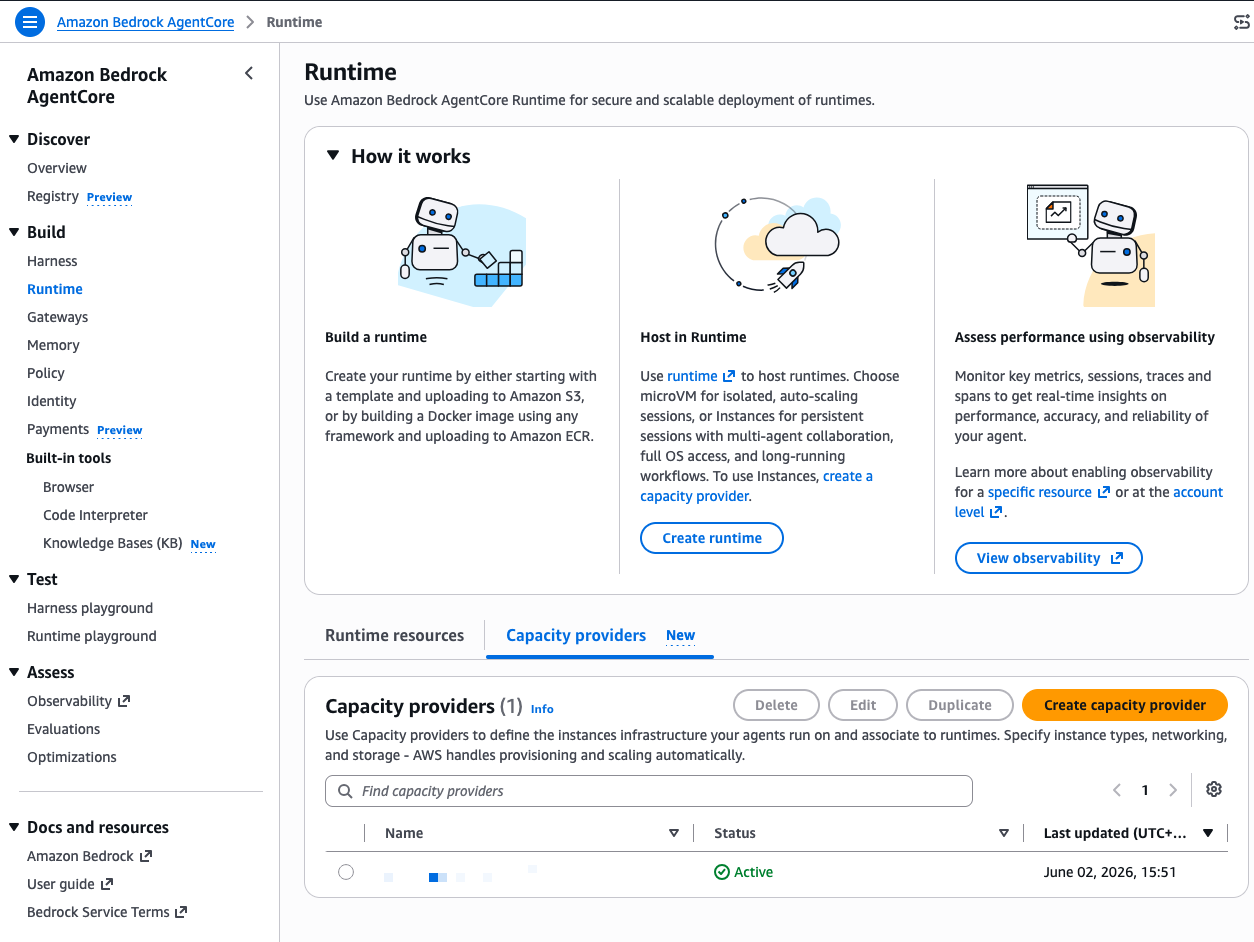
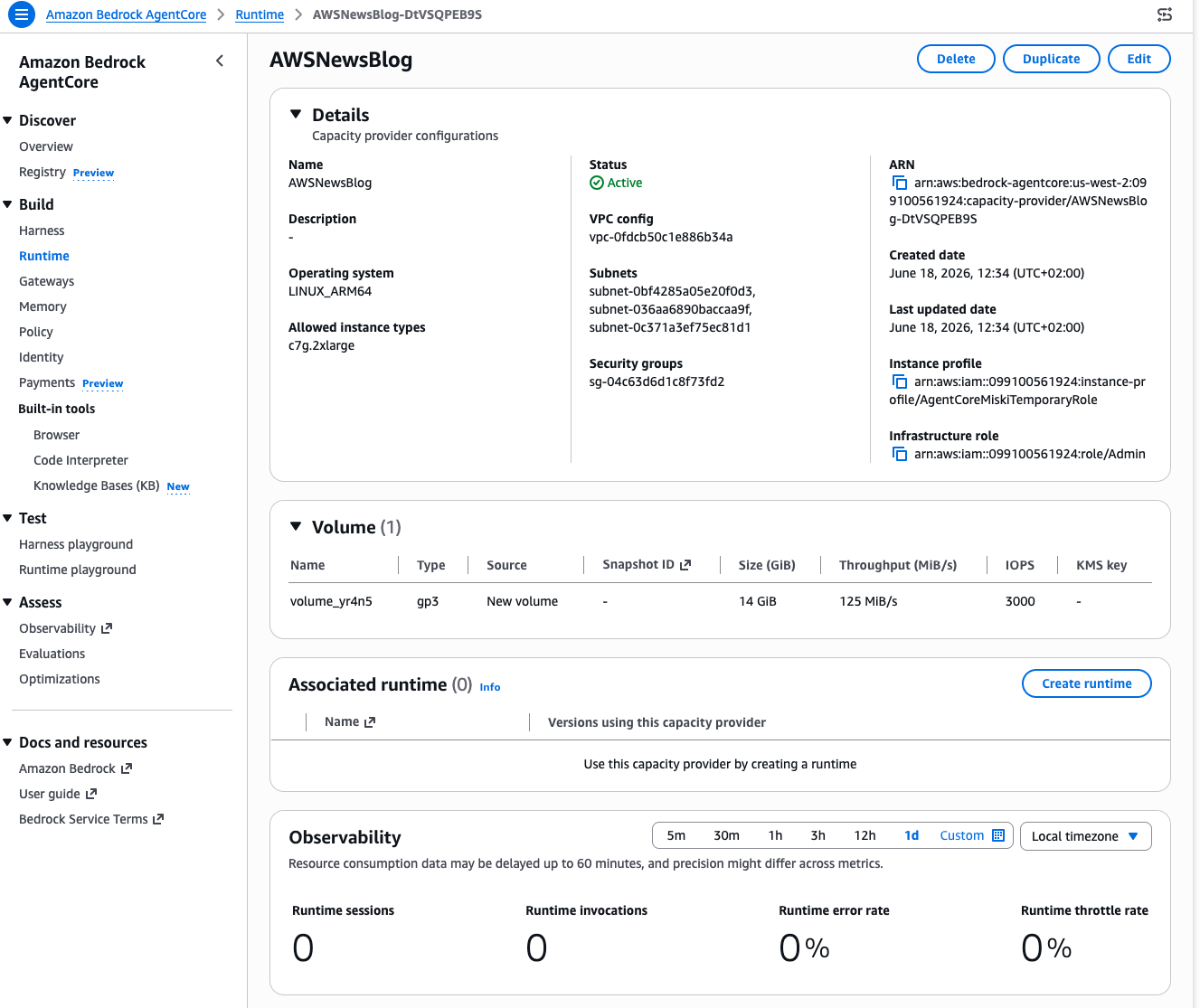
The foundational step involves defining the underlying EC2 compute infrastructure through a capacity provider. Administrators navigate the AgentCore console, select the Linux 64-bit ARM operating system (such as the energy-efficientc7g.2xlargeinstance type providing 8 vCPUs and 16 GiB of memory), and configure the target VPC, subnets, and security groups. AWS automatically provisions an IAM service role to manage the underlying EC2 instances seamlessly.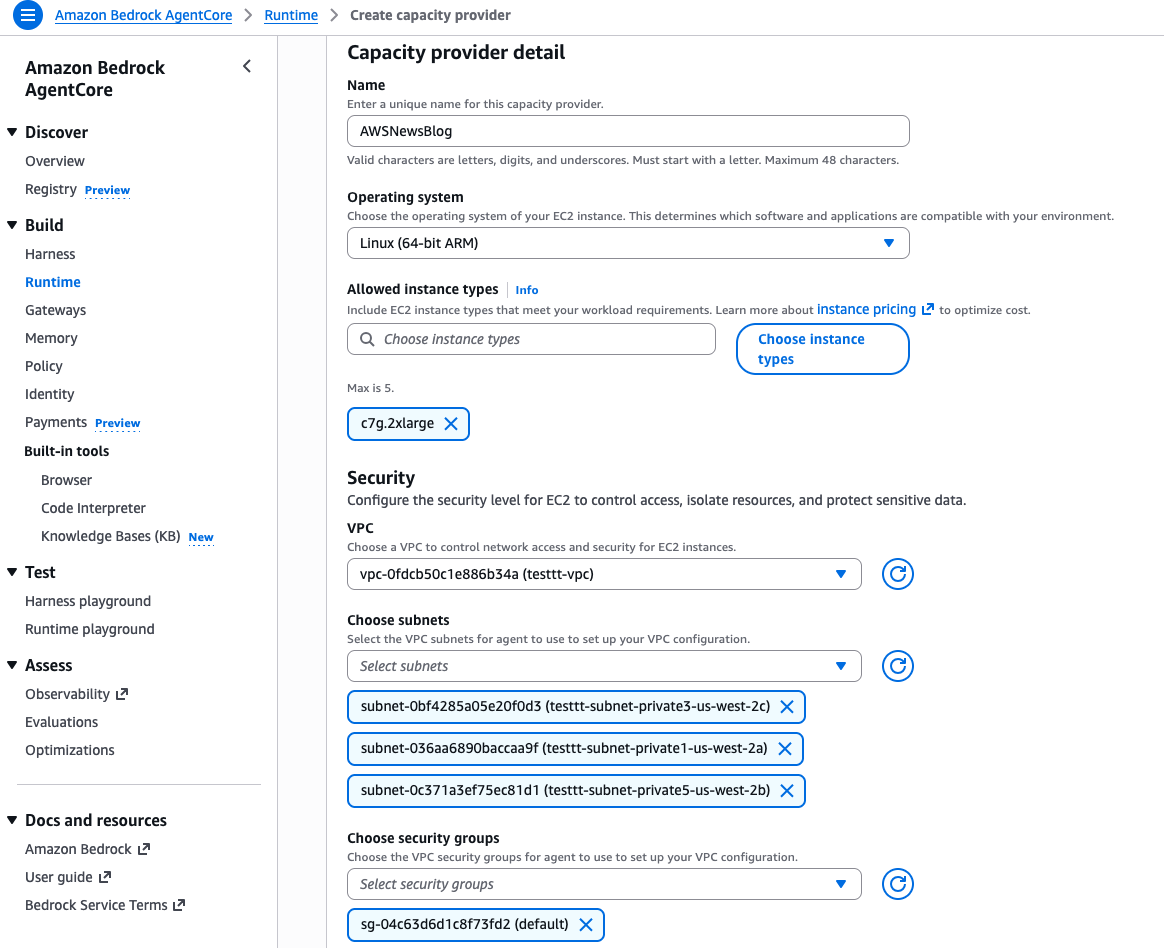
-
Creating the Runtime and Uploading Agent Code:
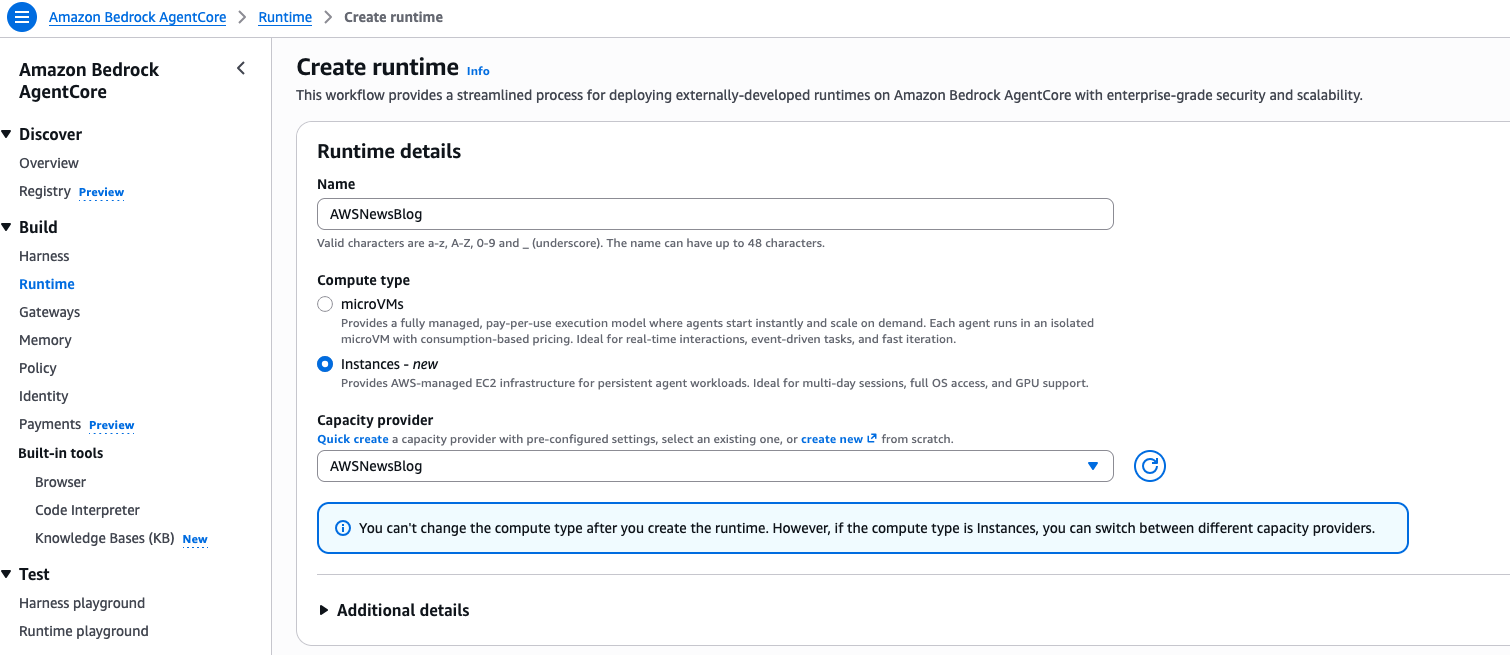
Developers package their agent logic—built using popular frameworks like Strands Agents, CrewAI, LangGraph, or LlamaIndex—alongside an@app.entrypointPython decorator into a standard zip file or container image. This artifact is uploaded to Amazon S3. The developer then creates a runtime entity within the AWS console, links it to the previously established capacity provider, specifies Python 3.13 (or another supported runtime language), and points the system to the agent entry-point file. -
Orchestrating Multi-Agent Collaboration via Shared Sessions:
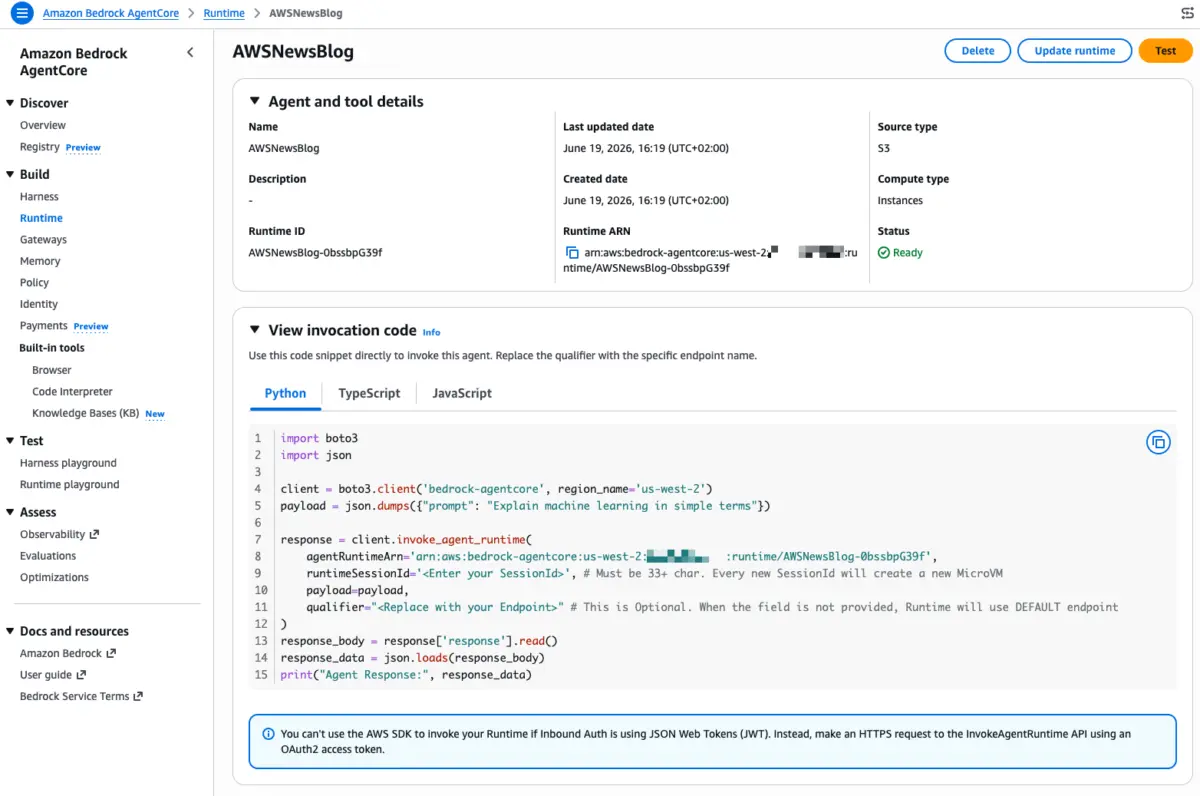
By assigning a sharedSessionIdacross different agent runtimes, separate AI applications can be bound to the same execution context. For instance, a Code Writer Agent can generate Python scripts based on natural language prompts and write them directly to a local session directory (/tmp/agentcore-session/session_id/code.py). Subsequently, a Code Reviewer Agent invoked within the exact same session ID can read the generated file instantly from the shared local file system—eliminating the need for custom API calls, webhooks, or external database transfers.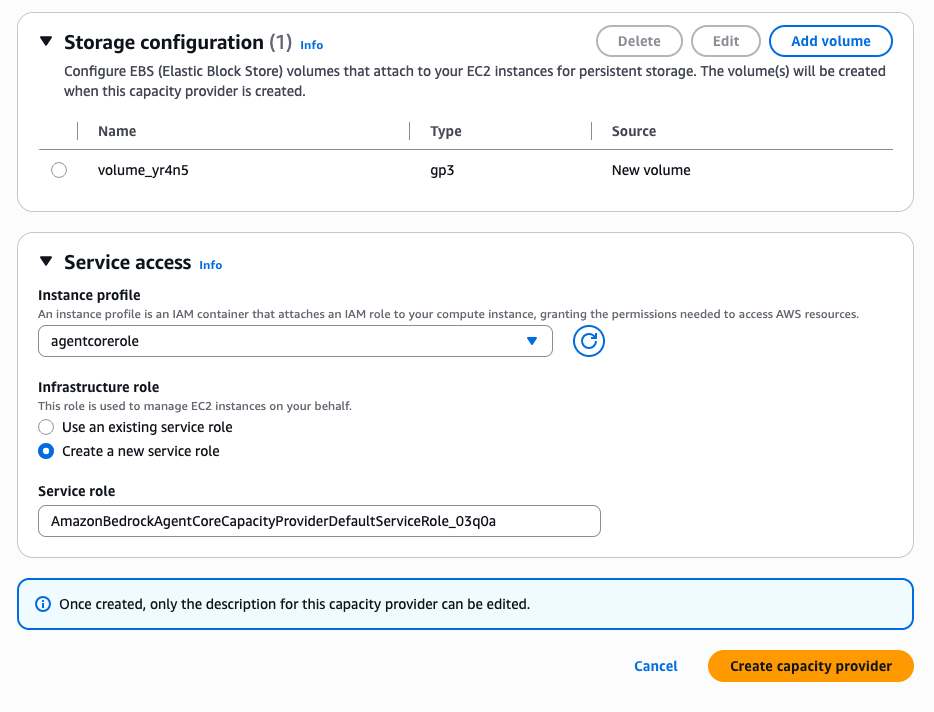
Supporting Context & Metrics
The architectural design of Amazon Bedrock AgentCore runtime instances addresses several core performance, cost, and operational metrics critical to modern software engineering teams:
- Execution Longevity: While standard serverless or microVM invocations often time out after several minutes or hours, runtime instances support persistent sessions lasting up to 14 days. Workflows can be safely hibernated overnight and resumed with all contextual data intact.
- Granular Cost Optimization: Organizations can explicitly trigger session stop and restart routines during idle periods, preventing unnecessary compute charges when agents are waiting for human feedback or secondary triggers.
- Compute Flexibility and GPU Support: Workloads requiring heavy mathematical processing, vector embeddings, or deep learning model fine-tuning can tap into GPU-accelerated EC2 instances directly through the runtime configuration.
- Complementary Hybrid Architecture: Teams are not forced to choose exclusively between microVMs and runtime instances. Instead, they can architect a hybrid model:
- MicroVMs as Orchestrators: A lightweight orchestrator agent running on a fast-scaling runtime microVM handles incoming API requests, routes tasks, and aggregates final results.
- Runtime Instances as Specialized Workers: Heavy-duty worker agents deployed on dedicated runtime instances handle resource-intensive backend operations such as code compilation, automated security scanning, or GUI testing.
Official Statements
Engineering leaders and AWS architects emphasize that the introduction of runtime instances bridges a critical gap between experimental AI prototypes and production-grade enterprise software.
"When moving AI agents from prototype to production, infrastructure challenges multiply exponentially," notes the core engineering team behind Amazon Bedrock AgentCore. "Agents need to persist state across multi-step workflows spanning hours or days, coordinate fluidly with peer agents, share memory context, and securely access specialized hardware like GPUs. Runtime instances provide the persistent, managed infrastructure required to tackle these complex requirements without forcing developers to reinvent the wheel of server management."
Furthermore, early adopters highlight the frictionless nature of bringing custom agent frameworks. Because developers are not locked into a proprietary orchestration framework, they retain the freedom to write code using standard Python decorators (@app.entrypoint) and deploy applications packaged within lightweight zip archives or standard container images. This design philosophy ensures that existing codebases built on LangGraph, CrewAI, or LlamaIndex can be migrated to AWS-managed EC2 capacity with minimal refactoring.
Future Outlook
As generative AI matures from simple chat-based interfaces to autonomous, goal-driven multi-agent systems, the demand for sophisticated runtime infrastructure will only intensify. The launch of Amazon Bedrock AgentCore runtime instances signals a shift toward managed, long-lived, stateful environments where autonomous agents can collaborate continuously, execute background code, and maintain long-term memory across enterprise systems.
Looking ahead, we can expect deeper integrations between runtime instances, Amazon Elastic Block Store (EBS) for expanded persistent data volumes, and AgentCore Memory for advanced cross-session recall. As enterprises increasingly rely on autonomous software engineering squads, automated auditing bots, and self-healing cloud architectures, fully managed infrastructure layers like Amazon Bedrock AgentCore will serve as the indispensable bedrock upon which the next generation of intelligent enterprise applications is built.